The good priest of Terminaison says that this tale of Hyacinthe’s is all a dream. But then Madame points triumphantly to the little sandalwood cabinet in the corner of her room. It has stood there many years now, and the dust has gathered in the fine lines of the little birds’ feathers and softened the petals of the lilies carved at the corners. The wood has taken on a golden gleam, like the memory of a sunset.
“And what of that, my friend?” says Madame, pointing to the cabinet. And the old priest bows his head.
“It may be so. God is very good,” he says gently. But he is never quite sure what to believe.
On that winter day long ago, Hyacinthe was quite sure of only one thing: the workshop was very cold. There was no fire, and only one small lamp when the early dark came on. The tools were so cold they seemed to scorch his fingers, and his feet were so cold he danced clumsily in the wood shavings to warm them.
He was a big, clumsy boy of fourteen, dark-faced and dull-eyed, and no one cared for him. He was clumsy because it is hard to be graceful when you are growing fast and never have enough to eat. He was dull-eyed because no one ever looked at him kindly. And he was uncared for simply because no one had ever noticed the beauty of his soul. But his heavy young hands could carve birds and flowers to perfection.
That evening he was just wondering whether he might put away the tools and creep home to the cold loft where he slept, when he heard his master’s voice shouting outside.
“Quick, quick, open the door! It is I, your master.”
“Yes, master,” said Hyacinthe, and he shambled over and opened it.
“Slowpoke!” cried Pierre L’Oreillard, cuffing him on the head as he passed. Hyacinthe rubbed his head and said nothing. He was used to blows. He wondered why his master had come to the workshop at this hour, instead of drinking at the tavern as usual.
Pierre carried a small, heavy bundle under his arm, wrapped in sacking, then in burlap, then in fine soft cloths. He laid it on a pile of shavings and unwound it carefully — and a faint sweetness filled the dark shed, hanging in the thin winter light.
“It is a piece of wood,” said Hyacinthe, slow with surprise. He knew such wood had never been seen in Terminaison.
Pierre rubbed it respectfully with his knobbly fingers. “It is sandalwood,” he explained, pride making him almost pleasant. “A precious wood that grows in warm countries. Smell it — it is sweeter than cedar. It is to be made into a cabinet for the old Madame up at the big house.”
“Yes, master,” said Hyacinthe.
“Your great hands will shape and smooth the wood,” said Pierre, puffing out his chest, “and I will make it beautiful.”
“Yes, master,” Hyacinthe answered humbly. “And when must it be ready for Madame?”
“Madame will want it next week — for that is Christmas. It is to be finished for the holy festival. Do you hear me?” And he cuffed Hyacinthe’s ears again.
Hyacinthe knew perfectly well that the making of the cabinet would fall to him, as most of the work always did. When Pierre was gone, he touched the strange, sweet wood, and at last laid his cheek against it while its fragrance caught at his breath. “How beautiful it is!” said Hyacinthe — and for a moment his eyes glowed and he was happy. Then the light faded, and with bent head he shuffled back to his bench through a foam of white shavings.
“Madame will want the cabinet for Christmas,” he repeated to himself, and set to work harder than ever, though the shed was so cold his breath hung in the air like a little silver cloud.
Each day after that, Pierre gave plenty of orders and no help at all. “That is to be finished for Madame at the festival,” he would say, cuffing Hyacinthe’s head, “and with something pretty about the corners. Do you hear?”
“Yes, sir,” Hyacinthe would answer in his slow way. “I will try. But if I hurry, I shall spoil it.”
Pierre’s little eyes flickered. “See that it is done, and done properly. My constitution is delicate these days, and my legs are weak, so I cannot handle the tools. I must leave the work to you.”
“Yes, sir,” said Hyacinthe wearily.
It is hard to do all the work and be beaten for it besides. And fourteen is not very old. Hyacinthe labored on with his slow and exquisite skill. But on Christmas Eve he was still at work, and the cabinet was not finished.
“The master will beat me,” he thought, trembling a little, for Pierre’s beatings were cruel. “But if I hurry, I shall spoil the wood — and it is too beautiful to spoil.”
He trembled again when Pierre came in. He stood up and touched his cap.
“Is the cabinet finished, boy?”
“No, sir. Not finished yet.”
“Then work on it all night, and show it to me finished in the morning — or you’ll be sorry for your idleness,” said Pierre, with a wicked glint in his eye. And he shut Hyacinthe in the shed with a smoky lamp, his tools, and the sandalwood cabinet.
It was nothing unusual; he had often been left to finish work overnight while Pierre went off drinking. But this was Christmas Eve, and he was so very tired. Even the scent of the sandalwood could not make him feel warm. The whole world seemed a black and lonely place.
“In all the world, I have no friend,” said Hyacinthe, staring into the lamp flame. “In all the world, there is no one who cares whether I live or die. No place, no heart, no love for me anywhere.” He bowed his head over the bench. “O kind God,” he whispered, “is there a place — a love — for me somewhere?”
And then came the tears, and great sobs that shook him, so that he scarcely heard the gentle rattle of the latch.
He stumbled to the door and opened it on the still woods and the frosty stars. A boy stood outside in the snow.
“I see you are working late, friend,” he said. “May I come in?”
Hyacinthe brushed his ragged sleeve across his eyes and nodded. Those little villages along the great river see strange travellers now and then, and Hyacinthe supposed this was one. Blinking into the stranger’s eyes, he lost, for a flash, that first impression of youth, and felt instead something of incredible age, or sadness. But the wanderer’s eyes were only quiet — very quiet, like the little pools in the woods where the wild deer come to drink. As he stepped inside, smiling and shaking snow from his cap, he seemed no more than sixteen.
“It is bitter cold out there,” he said. “A great oak at the edge of the fields has split in the frost and startled all the little squirrels from their sleep. Next year it will make an even better home for them. And look what I found nearby.” He opened his fingers to show a small sparrow lying still in his palm.
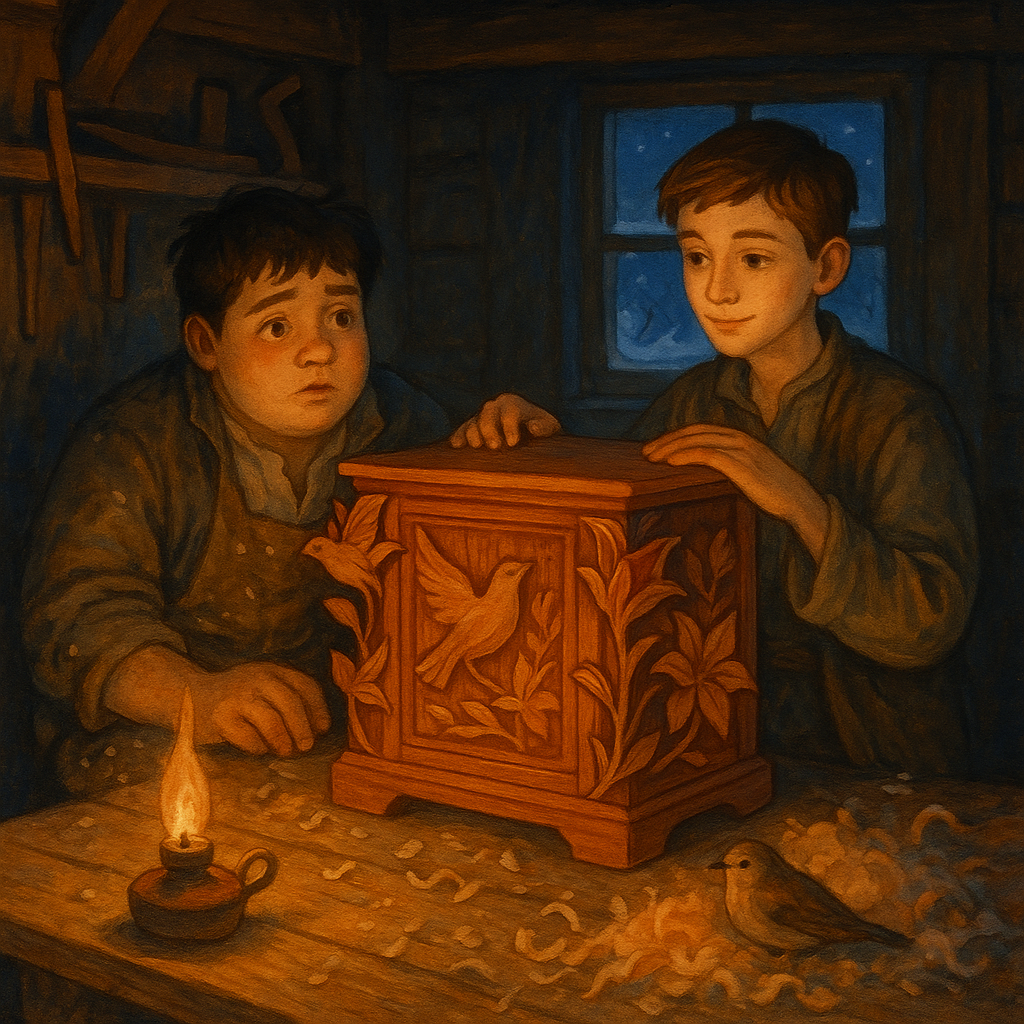
“Poor little thing!” said Hyacinthe, touching it with a gentle finger. “Is it dead?”
“No,” said the boy. “It is not dead. We’ll set it here among the shavings, near the lamp, and by morning it will be well.”
He smiled again, and the shambling boy felt, dimly, as though the sandalwood smelled sweeter and the lamp burned brighter. But the stranger’s eyes were only quiet, quiet.
“Have you come far?” asked Hyacinthe. “It’s a bad season for travelling, and the wolves are out.”
“A long way,” said the other. “A long, long way. I heard a child crying—”
“There is no child here,” said Hyacinthe. “The master says children cost too much to keep. But if you’ve come far, you need food and a fire, and I have neither. At the tavern you’ll find both.”
The stranger looked at him with those quiet eyes, and Hyacinthe felt his face was somehow familiar. “I will stay here,” he said. “You are working late, and you are unhappy.”
“Well, as to that,” said Hyacinthe, ashamed of his tears, “most of us are sad one time or another, God knows. Stay and welcome, if you like — and you may share my bed, though it’s only balsam boughs and an old blanket up in the loft. But I must work at this cabinet. The drawers must be fitted, the handles put on, and the corners carved, all by morning — or my wages will be paid with a stick.”
“You have a hard master,” said the other, “if he would pay you with blows on Christmas.”
“Hard enough,” said Hyacinthe. “But once he gave me a dinner of sausages and white wine — and once, in summer, melons. If I can keep my eyes open, I’ll finish by morning. Stay a while, friend, and tell me of your travels, so the time passes quicker.”
And while Hyacinthe worked, the stranger told him — of sunshine and warm dust, of the shadow of vine leaves on white walls, of rosy doves on rooftops, of the flowers that come in spring: crimson and blue anemones, white cyclamen in the shade of the rocks, the olive and the myrtle and the almond — until Hyacinthe’s hands slowed and his sleepy eyes blinked in wonder.
“See what you’ve done,” he said at last. “You’ve told me such lovely things that I’ve hardly worked this past hour. Now the cabinet will never be finished, and I shall be beaten.”
“Let me help you,” the stranger smiled. “I too was raised a carpenter.”
At first Hyacinthe would not, afraid to trust the sweet wood to another’s hands. But at last he let the stranger fit one of the drawers — and it was done so deftly that Hyacinthe pounded his fists on the bench in admiration. “You have a wonderful knack!” he cried. “It looked as if you only held the drawer a moment, and — hey! — it leapt into place.”
“Let me fit the other drawers while you rest,” said the stranger. So Hyacinthe curled up among the shavings, and the other boy set to work.
Hyacinthe was very tired. He lay still and thought of all the boy had told him — the hillside flowers, the laughing leaves, the golden sun on warm roads — until he felt warm himself. And all the while the boy with the quiet eyes worked on: smoothing, fitting, polishing.
“You do better work than I do,” Hyacinthe said once, and the stranger answered, “I was taught with love.” And again Hyacinthe said, “It’s getting toward morning. In a little while I’ll get up and help you.”
“Lie still and rest,” said the other. And Hyacinthe lay still. His thoughts began to slide into dreams, and he woke with a start, for there seemed to be music in the shed — though whether it came from the stranger’s lips, or from the tools as he used them, or from the very stars, Hyacinthe could not tell.
“The stars are paler now,” he thought. “Soon it will be morning, and the corners aren’t carved yet. I must get up and help him — only the music and the sweetness seem to wrap me close, so I cannot move.”
Then behind the forest a pale glow of dawn rose, and in Terminaison the church bells began to ring. “Day is almost here,” thought Hyacinthe, “and with it the master and his stick. I must get up, for even now the corners aren’t carved.”
But the stranger looked at him, smiling as though he loved him, and laid one brown finger lightly on the four bare corners of the cabinet. And Hyacinthe saw the squares of reddish wood ripple and heave and break, like little clouds when the wind moves through the sky. Out of them came the little birds, and after them the lilies — for a moment living — and then, even as Hyacinthe watched, they settled back gently into the sweet reddish-brown wood. Then the stranger smiled once more, laid all the tools neatly in order, opened the door, and went out into the woods.
Hyacinthe crept slowly to the door. The winter sun, half risen, filled all the frosty air with splendid gold. Far down the road a figure seemed to move within the glory — but the brightness was so great that Hyacinthe was dazzled. His breath caught as the light poured over the shabby shed, the old shavings, and the cabinet with its little birds and lilies carved at the corners.
His heart was too pure to be afraid. “Blessed be the Lord,” he whispered, clasping his slow hands, “for He has visited His people. But — who will ever believe it?”
Then the Christmas sun rose gloriously, and the little sparrow woke among the shavings and shook out its wings to the light.