I.
It was five minutes after nine on the morning of December 23rd when a small boy, with an expression hovering somewhere between pathetic and smug, entered the Second Academic classroom of Marquette College in Milwaukee and handed his teacher a note.
9:04 A.M.
Gerald O’Rourke, late. Please admit.
A. Mosher, S.J.
Mr. Lawton read this communication with a frown — he was impatient of late-comers, as all earnest teachers are. The frown disappeared, however, as a grin at once cheerful and apologetic spread across Gerald’s upturned face.
“Don’t mind it this time, sir. I was up late last night practising the Christmas Mass, and Mamma couldn’t get me up this morning. I’ve got to stay after class for Father Mosher anyway.”
Gerald’s face clouded briefly at the thought of his after-school appointment with the prefect of discipline, then lit up again as he caught his teacher’s carefully assumed expression of delight at this news.
With a cheerfulness that expressed itself even in his walk — one might almost say a levity — he went to his seat beside Maurice Desmond, and gave that young classmate a stealthy but sharp dig in the ribs.
“Are you kept in?” whispered Maurice, ducking his head below his desk lid in pretended search for a pencil.
“Sure!”
Maurice grinned and was about to duck again when he noticed Mr. Lawton taking an exaggerated interest in his movements. He grew very solemn and attentive.
Having in short order regained his teacher’s confidence, Maurice slowly and surreptitiously composed the following note:
Dear Gerald: I’ll bet you one pair of rosary beads that you’ll be late for the four-o’clock Christmas Mass. — Maurice Desmond
After great expenditure of time and patience, Gerald answered:
Dear Maurice: I take your bet, and raise you one more pair of beads that I call at your house and wake you up at 3:15 Christmas morning. — Gerald O’Rourke, Esq.
Half an hour elapsed before Maurice managed this reply:
Gerald O’Rourke, Esq.: You’re out of your senses, you old sleepy-head; but I’ll take you anyhow. You’ll say those two pairs of beads Christmas Day, and don’t you forget it. — The Honourable Maurice Desmond, LL.D.
At this stage of the correspondence, Mr. Lawton interrupted.
“Gerald and Maurice — bring me those papers.”
And thus ended the correspondence.
II.
There may be heavier sleepers in this world than Gerald O’Rourke, but if so, they are unknown to the present writer. Not that sleepiness came upon him at early nightfall — oh, no. He was skilled at wheedling his mother, when nine o’clock came, into letting him stay up just a little longer. Mamma was quite indulgent to her eloquent little darling, and it was not uncommon for Gerald to cajole his way to half-past ten. On the following day, of course, Mrs. O’Rourke had a giant’s task to bring the youngster out of the land of Nod — sometimes a matter of fifteen or twenty minutes.
When, therefore, Mrs. O’Rourke on Christmas Eve heard from the lips of her sanguine son the account of his wager with Maurice, she smiled.
“You foolish boy — why didn’t you content yourself with the first bet? I’m quite sure we can get you to church by four o’clock, but if I want you out by half-past three to call at Maurice’s, I shall have to get up at midnight myself.”
“You don’t have to, Mamma,” cried the child. “Don’t you think I can get up by myself?”
“Decidedly not.”
“Well, I’ll fool every one of you! Don’t you remember the class picnic last June, when we all had to be at the college at seven o’clock sharp? And wasn’t I up at six? And didn’t I wake you, and Papa, and Uncle Edward, who got up so cross he threatened to throw his shoes at me?”
“Picnics are a different thing, my dear. You were too excited about spending a day by Lake Michigan to sleep soundly, and it was warm weather besides. But think of getting up at three in the dark and the cold to go out into the freezing air. Singing at Mass is not precisely a picnic.”
“But Mamma, I’m to sing the solo part of the Adeste Fideles at the Offertory! If I were late, our choir-director would have every right to be disgusted — he’s taken such pains with me. And besides — I’ve got a plan.”
“What plan?” asked his father.
“I’m going to set my alarm clock for three o’clock sharp, and—”
At this, his father, mother, uncle, and two sisters broke into laughter. The idea that any alarm clock could produce the slightest effect on Gerald, once he was asleep, struck them as exquisitely ridiculous. Uncle Edward put it into words.
“If you were to stack your room from floor to ceiling with alarm clocks, and if the biggest alarm clock in the world were your pillow, and if all of them were — I don’t say to ring, but to explode at three o’clock tomorrow morning — I am willing to bet everything I own that you’d snooze right along until your mother got at you.”
“Huh!” snarled Gerald, directing his wrath at his sisters, who were loudest in their merriment. “I will be up. And I can dress six times over while you two are still combing your hair.”
Then, changing tone entirely, he addressed the grown-up members of the family.
“You needn’t think I’m trusting to the alarm clock alone. That’s only part of the plan. My teacher told me this — he saw the notes, mind you, and could hardly keep from laughing when he read them. He said: ‘Set your alarm clock for three, and ask the souls in purgatory to see to it that you hear it go off. Promise them something in return, and they’ll take care of you.’ And I’ve done it — so I’ll be up on time tomorrow as sure as—”
“As sure as what?” asked Uncle Edward.
Gerald had been on the point of saying as sure as shooting, but there was in the family what he considered a prejudice against boyish slang, and he paused, unable to finish the sentence with appropriate dignity.
“But what did you promise them?” Uncle Edward pressed.
“Say, Mamma, may I have a piece of bread and butter? I’m almost starving,” cried Gerald, hurrying from the room.
Like many a good, pious boy, he was — while perfectly frank in general — somewhat private about his devotions, and in his cheerful little heart were enshrined many a quiet practice of piety about which even his mother knew nothing.
Before he went to bed that night, however, he did tell her one thing: if he won the wager, he intended to give a dollar out of his Christmas money to the poor, for the benefit of the suffering souls.
Mrs. O’Rourke kissed him.
“And Mamma — what are we having for dinner tomorrow?”
This was his last question.
But not his last thought. Gerald made it a point on the eve of a Communion day to think of nothing, once he was settled in bed, but the Blessed Sacrament — and he actually succeeded, though it must be said he seldom lay awake more than four or five minutes.
On this Christmas Eve, he had just settled his mind into that peaceful frame when there came a knock at his door, followed by the entrance of his father.
“Why, Papa! Did I forget to say goodnight?”
“No, Gerald. I have just one thing to say to you.” His father sat on the edge of the bed and lowered his voice. “I like your plan very much — asking the holy souls to do you a favor. Well, I’m in some trouble myself, and perhaps they might help me too. Tomorrow, at Communion, will you pray for me? And try to get the holy souls interested in my case.” He paused. “I’m going to leave ten dollars in your coat pocket to add to your one dollar. It’s all I can afford at present — perhaps more than I can afford. Don’t mention it to anyone; your mother is the only one who knows my trouble.”
“Oh, Papa — is that why her eyes were red this evening?”
“She cried at first, Gerald. But she is brave, and so will you be, I hope, if I lose my position.”
Gerald sat bolt upright. “Is Mr. Bush going to get another business manager?”
“I fear so. He told me today that great pressure is being put upon him to replace me with another man. He has no complaint against me — I think he’d rather not do it — but he’s being pushed hard, and he’s afraid of going against a powerful group of men he’s tied himself to. As it stands, it is now nearly certain that I shall lose my place at the end of the year.” He stood, and smiled. “So pray hard, my boy. Good-night.”
And with a smile and a kiss, Mr. O’Rourke left the room.
Gerald lay awake a full fifteen minutes after this, and you may be sure he did not lie idle. Prayer that comes from the heart and idleness live far apart.
III.
“You are out of sorts, Henry,” Mrs. Bush remarked to her husband that same evening.
“So I am, Margaret. I don’t feel well in body, and I’m troubled by a business matter. I’m afraid I shall have to replace my business manager.”
“What — discharge Mr. O’Rourke? You used to say he was the finest and most far-sighted business man you’d ever met, and worth far more than his salary.”
“I say so yet. By rights he should earn more, not less. But I’m worried day and night, by word and letter, to put in another man. A John Landen, who apparently has the great advantage of belonging to the same fraternity as several of my largest investors — at a rather higher rank than I hold.”
“It was a sad day for you, Henry, when you joined that club.”
“No, it wasn’t — it brought me business.”
“Yes; but it took you away from everything else.”
For answer, Mr. Bush gave a growl and took up the evening paper.
“Tomorrow is Christmas, dear. Won’t you come to Mass with me? The children are praying so earnestly — they’re quite sure they’ll be heard this year. It’s nearly fifteen years since you were in a church. Please, Henry. Just promise.”
There were tears in Mrs. Bush’s eyes as she spoke. Mr. Bush was moved. He was growing grey, and his health was not what it had been. For a moment he considered the request — and a sharp pain shot through his head.
“I’m too worried just now, Margaret. Some other Christmas. I’ll go yet.”
“But, Henry — how can anyone promise themselves another Christmas?”
“Margaret, Margaret!” He rose impatiently from his chair, pressed his hands against his temples. “For God’s sake, don’t worry me. I am wretched.”
The poor woman had unwittingly struck a nerve. All that day the thought of mortality had pursued him, and Mr. Bush had built his heaven, as it were, entirely on this earth.
He was a millionaire many times over. When young, he had been a practising Catholic. But business, and the pull of gaining, and then the temptation to join a society that brought connections — all of it had gradually drawn him away, until he was content with the minimum, and then with nothing at all. Now his old parish priest was someone he had not seen in over fourteen years.
At supper, his little daughter Laura said: “Papa, won’t you please take me to Mass tomorrow?”
All the children looked earnestly at their father.
“I can’t, my little one. I’m not well.”
He saw the signs of bitter disappointment on their young faces, and looked away.
“There must have been something wrong with our novena,” muttered Harry, a classmate of Gerald’s.
His eldest sister Mary motioned him to be quiet.
“At least, Papa,” Harry went on, undaunted, “you ought to come for the singing. Gerald O’Rourke’s the boy. He’s got a voice like an angel — only angels don’t play tricks. You just ought to hear him; you’d be glad you came. Gerald’s one of the nicest boys in Milwaukee. Say, Papa, I’m going to bring him home with me tomorrow — you haven’t seen him this past year, and he’s nicer than ever.”
“Whatever else you do,” roared Mr. Bush, bringing his fist down on the table, “don’t bring that boy near this house. I don’t want to see him.”
He hurried from the room. He was very ill and very wretched.
The children were long asleep when Mr. Bush entered the girls’ room — Laura and Edith and Mary — to put a coin in each of their stockings, pinned to the mantelpiece. On that same mantelpiece, among the bric-à-brac, stood a small statue of the Sacred Heart.
One coin fell to the floor. He picked it up, and — needing something to hold the stocking in place — reached for the statue. An open letter lay beneath it.
Mr. Bush adjusted his glasses and read:
Dear Babe of Bethlehem:
A merry Christmas to you! It will surely be merry to you, if people come to love you who do not love you now. It will be very merry to us, if Papa comes to Mass with us. Oh, he is such a good Papa; we are sure you would like him, if you knew him better. Now please get Papa to come to Mass. We have made the Nine First Fridays, all for Papa, and we’re going to give all the money that Papa drops in our stockings to a priest to put flowers on the altar. When we get up on Christmas, dear Babe of Bethlehem, we expect that this letter will not be here. That is to be the sign that Papa will go to Mass on Christmas Day.
With much love, dear Babe of Bethlehem, we are,
Your dear little ones,
Mary (I’m ten and I wrote this letter by myself).
Edith (she’s eight).
Laura (she’s six).
After some moments of irresolution, Mr. Bush put the letter in his pocket and turned to leave the room, his eyes swimming. He stopped on the threshold, passed his hands through his hair, groaned — and with an expression of extreme misery returned to place the letter back beneath the statue where he had found it.
He departed. He did not sleep a single moment that night.
IV.
Whir-r-r-r-r-r-r!
Gerald leaped from his bed and into his clothes before the clock had quite finished its noisy Christmas greeting. In an incredibly short time he had completed his toilet and was out in the cold, biting air of the city.
It was very dark and gloomy, and he felt tempted to turn back. But he shook off the feeling at once, and directed his thoughts to what his father had told him the night before.
“I do hope my toes ache and my hands chap and my ears hurt,” he muttered cheerfully, “and I offer it all up for the holy souls — and if any of them get to heaven on account of a cold little boy, I hope they’ll remember to pay it back to his papa.”
Saying which, the merry-faced small ascetic removed his gloves and his ear-muffs, skipping along with unmistakable levity, and wished earnestly that it were colder.
After several blocks, he stopped at a corner and peered through the darkness at the shadowy outline of a large house.
“Does Maurice live on Eighteenth or Seventeenth Street? I can’t remember. Yes — that’s the house, I’m sure.”
He tramped across the lawn, tripped up the stone steps, put his finger to the electric bell, and held it there quite tranquilly while it tinkled without stopping.
It had been tinkling for something over sixty seconds when Gerald heard heavy footsteps on the staircase within. Something in their fall — some quality of deliberate, thunderous anger — gave him reason to believe they were the footsteps of a very furious man, and he took his finger off the button.
When the door was thrown open with a bang, Gerald gasped in horror.
There, glaring at him fiercely, fully dressed, spectacles on nose, fire in his eye, stood Mr. Bush.
“You little rascal,” roared the victim of insomnia and an uneasy conscience, peering at the dim shape of a small boy in his doorway, “what do you mean by this infernal noise at this time of night? Answer me at once — what do you want?”
Gerald gasped. He shivered. He was within an inch of sinking down upon the threshold in his agony.
Then, in desperation, he blurted:
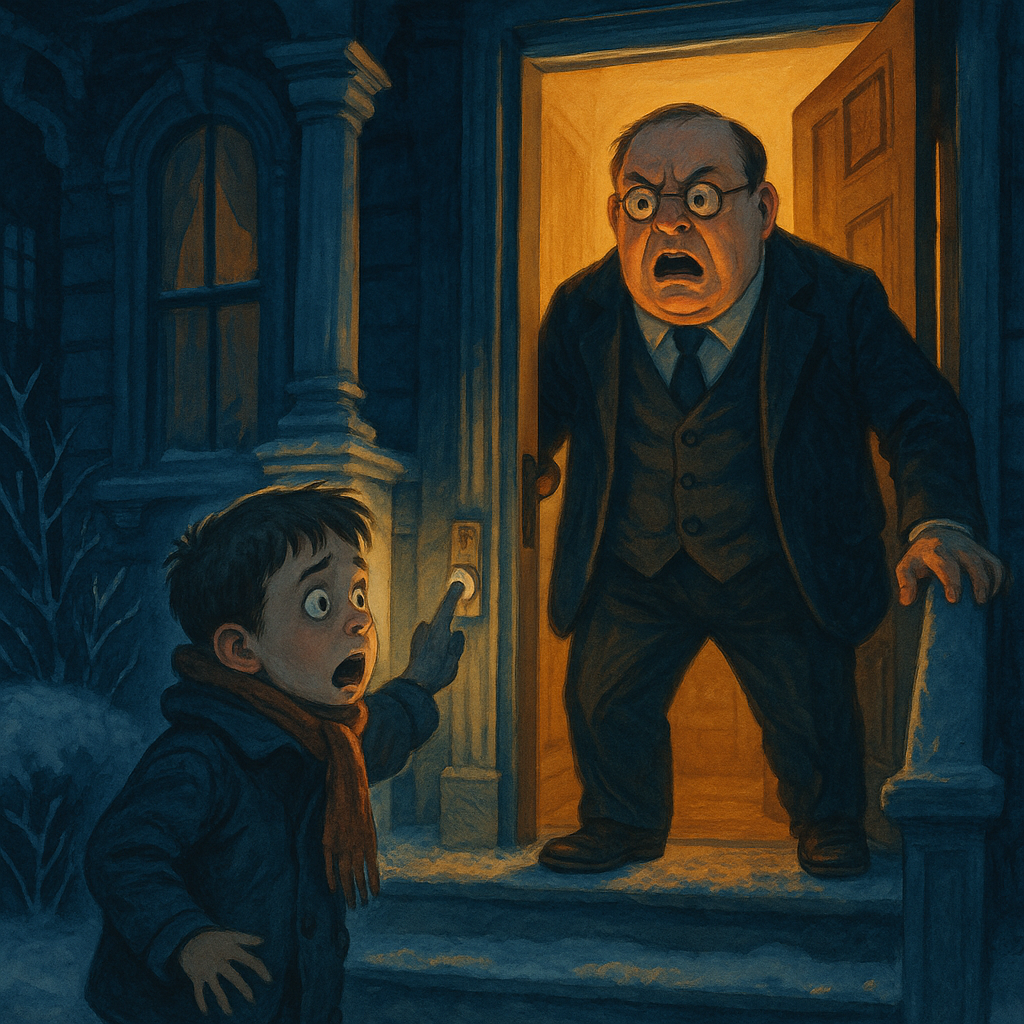
“Mister! Wh-wh-wh-what did you get in your stocking?”
And he dashed down the steps and flew into the darkness at a speed that would have brought instant injury to anyone who was not a small boy — realizing, as he ran, that Mr. Bush had recognized him by his voice, and feeling absolutely certain that his father’s slim hopes were now completely shattered.
For some moments, Mr. Bush stood stock-still in his doorway.
Then he clapped his hands together slowly, took his overcoat from the rack, and went out into the darkness himself.
V.
The Offertory of the early Christmas Mass arrived. The organ played a few soft bars of the Adeste Fideles, and Gerald, standing in the choir beside his friend Maurice — whom he had actually managed to wake before half-past three — raised his voice and filled the church with that sweetest of Christmas hymns.
His voice, clear and firm, rang out with liquid sweetness. But as he reached the words Venite Adoremus, it trembled, quivered, faltered, and softened so unexpectedly that gentleness and love and awe seemed to have found perfect expression in his notes — and on the final word Dominum it dissolved in a musical sigh of reverence.
Many an eye filled. Many a heart was lifted in unwonted tenderness.
But no one in that church had the least idea what had brought out this prodigal wealth of feeling.
The truth of it was this: as Gerald came to the verse beginning Venite Adoremus, his eye wandered among the congregation — and there, almost directly before him, sat Mr. Bush. The millionaire’s spectacled eyes were fixed full upon the soloist.
Gerald was seized at once with nervous dread. He could scarcely go on. He struggled bravely — and thus it came about that his nervousness produced an effect of such rare beauty that Mr. Bush took out his handkerchief and rubbed his eyes for a full five minutes.
Mr. Bush had left his house on impulse. He had entered the church on impulse — or, if you like, on grace. And now, how beautiful it all seemed: the singing, the lights, the solemn ceremonial. There at the altar, as the celebrant, stood Father H., Mr. Bush’s old parish priest, whom he had not seen in fourteen years. How venerable he looked. And after Communion, when the kindly-faced old man turned to say a few words to his congregation — words of peace, of love, of goodwill — Mr. Bush took out his handkerchief again.
When Gerald had finished his thanksgiving and came tripping down the front steps of the church with Maurice, he spotted Mr. Bush advancing toward him.
He took two flying leaps and ran down the street at full speed.
“What’s the matter with Gerald O’Rourke?” asked Mr. Bush, not a little astonished.
“He — oh, I beg your pardon, sir,” said Maurice, “he’s not quite himself, sir. He never acted that way before. I honestly think he’s a little out of his mind. Merry Christmas, sir.”
“Thank you — same to you. Now, would you do me a favor?”
“Certainly, sir.”
“Go to Father H. in the sacristy. Tell him there’s a man in his confessional waiting to see him. An old friend he hasn’t seen in over fourteen years, who wants to make his confession and receive Communion this morning.”
“All right, sir.”
“Hold on — one more thing. Do you know where I live?”
“Of course. You’re on Eighteenth Street, and I’m on Seventeenth, and our houses look almost like twins — which is exactly why Gerald O’Rourke went to yours by mistake this morning and nearly scared himself to death. He told me all about it on the way to Mass.”
“Very good; now I begin to understand. Go to my house, please, and give my wife this message: tell her I’ve been to Mass, and am now going to make my confession and receive Communion. Tell her also to go to the girls’ room, take away the letter she’ll find under the statue on the mantelpiece, read it — and then lock it in my desk, without letting the little ones know anything about it.”
“Yes, sir.”
“Repeat it.”
A minute later, Maurice was racing along the street as though bound on a matter of life and death.
VI.
“O-o-o-o-oh!” screamed Edith, dancing barefoot on the carpet.
“What? What?” cried Mary.
“It’s gone — the letter! The Infant Jesus has read it!”
Mrs. Bush entered then, her face beaming, tears of happiness in her eyes. She kissed the little ones. When they told her how the letter had been taken away by the Babe of Bethlehem, she kissed them again — and left the room to conceal her emotion.
Mr. Bush arrived presently, and it was hard to believe that this cheerful, radiant man had spent the whole night without a moment’s sleep. He was romping with the children and listening for what seemed like the hundredth time to the story of the letter, when the doorbell rang.
“Papa,” called Harry, “Gerald O’Rourke’s here and says he wants to see you.”
“Bring him in at once.”
Gerald entered, pale and nervous. He had come to apologize — to face, as best he could, the consequences of his accidental three-o’clock visit.
But before he could open his mouth, Mr. Bush sprang forward and caught him by both arms.
“It’s all right, Gerald. You don’t need to explain. It was exactly the right doorbell. Now tell me the whole story — and I’ll promise you a bit of good news in return.”
“Well, you see, sir, I’m an awful heavy sleeper,” began Gerald, greatly astonished and relieved, “and still I made a bet that I’d wake Maurice Desmond up for the four-o’clock Mass. I asked the holy souls to wake me — and maybe they didn’t pull me right out of bed! And then, sir, when I came to your house by mistake and found myself facing you, I was dead certain it was all up with my father.” He stopped. “Of course, you can’t expect the holy souls to do everything. It’s easy enough to rout a small boy out of bed — but it’s harder to keep a man in a good position when everyone’s against him, and — oh my! I’ve said too much.”
“What have you given away, sir?”
“I promised Papa to say nothing to anyone about his trouble, and I’ve gone and blabbed it the first chance I got.”
“Gerald O’Rourke,” said Mr. Bush, “you are a smart boy, but you don’t know it all. It was the holy souls that sent you ringing at my bell.”
“And the Babe of Bethlehem,” added Edith.
“If you hadn’t rung that bell,” Mr. Bush went on, “I should not have gone to church. And if I had not gone to church, your father would have lost his position. But now — go and tell him this: he shall stay in his place as long as I live.” He drew his wife close and spoke quietly in her ear: “From the first of January, he shall receive the salary he deserves.” Aloud again: “And Gerald — I owe the holy souls something too. Tell your father that if he can manage it, I should very much like to go round with him this afternoon and add considerably to that ten dollars of his.”
Gerald was down the steps and running before the last word was out of Mr. Bush’s mouth.
And so Gerald was happy, and his father was happy, and his family was happy. And Mr. Bush and his family were happy. And many a poor man was happy too. And — best of all — I do not doubt that many a suffering soul winged its way to heaven that day, all on account of a harmless little wager from which every one came out a winner.