I.
High in the steeple the bells were conversing. Two of the younger ones were vexed and spoke angrily. “Is it not time we were asleep? It is almost midnight, and twice already we have been shaken, twice forced to cry out through the gloom as though it were broad day and we were singing the call for Sunday Mass. There are people moving about in the church — are we going to be tormented again? Might they not leave us in peace?”
At this the oldest bell said indignantly, in a voice that, though cracked, had lost none of its solemnity, “Hush, little ones! Are you not ashamed to speak so foolishly? When you went to Rome to be blessed, did you not take an oath, did you not swear to fulfil your duty? Do you not know that in a few minutes it will be Christmas, and that you will celebrate the birth of the One whose resurrection you have already celebrated?”
“But it is so cold!” whimpered a young bell.
“And do you not think that He was cold, when He came into the world, naked and weak? Would He not have suffered on the heights of Bethlehem had not the ass and the ox warmed Him with their breath? Instead of grumbling and complaining, let your voices be sweet and tender in memory of the canticles with which His mother lulled Him to sleep. Come — hold yourselves in readiness. I can see them lighting the tapers; they have built a little manger before the Virgin’s altar; the banner is unfurled; the beadle is bustling about — the poor man has a terrible cold, how he sneezes! Monsieur le Curé has put on his embroidered robe. I hear the sound of wooden shoes on the road; the peasants are coming to pray. The clock is about to strike — now — Christmas! Christmas! Ring out with all your heart and all your might! Let no man say he has not been summoned to midnight Mass.”
II.
It had been snowing for three days. The sky was black, the ground white; the north wind howled through the trees; the ponds were frozen; and the little birds were hungry. Women wrapped in long brown woollen mantles, and men in heavy cloaks, slowly made their way into the church. They knelt and murmured the responses as the priest said, “And the Lord said unto me, ‘Thou art my Son, whom this day I have begotten.'” Incense drifted in blue ribbons through the air, and blossoms of hellebore — the roses of Christmas — lay before the tabernacle in the glow of the tapers.
Behind one of the pillars, near the door, knelt a child. His feet were bare; he had slipped off his wooden shoes so they wouldn’t clatter on the stone floor. His cap lay on the ground before him and, with clasped hands, he prayed: “For the soul of my father who is dead, for the life of my mother, and for me — for your little Jacques, who loves you, O my God, I implore you!”
He knelt through the whole Mass, lost in devotion, and rose only when he heard the words: Ite missa est.
The people crowded together in the porch. Every man lit his lantern and pulled up the collar of his cloak; the women drew their mantles close. Brrr! How cold it was! A little boy called out to Jacques, “Are you coming with us?”
“No,” he said. “I haven’t time.” And he set off at a run. He could hear the village people singing far away as they walked home — the old carol of France, drifting back to him through the dark:
He is born, the Heavenly Child!
Ring out, hautbois! Ring out, bagpipes!
He is born, the Heavenly Child —
Let all voices sing his advent!
III.
Jacques reached the thatched cottage at the far end of the hamlet, nestled in a rocky hollow at the foot of the hill. He opened the door carefully and tiptoed into a room where there was neither light nor fire.
“Is that you, little one?”
“Yes, mother.”
“I prayed while you were praying. You must be half asleep — go to bed, child. I don’t need anything. If I’m thirsty, the water-jug is here where I can reach it.”
In a corner of the room, near Marguerite’s bed, Jacques turned over a pile of ferns and dry grasses, stretched himself upon it, drew a ragged blanket over him, and fell asleep.
Marguerite, however, did not sleep. She lay thinking, and her thoughts wrung tears from her eyes. She was calling up the happy days when her husband was alive and life had seemed so full of hope. She lay very still so as not to wake the boy, her head thrown back on the bolster, the tears trickling off her hollow cheeks, her hand pressed to her hot chest.
Marguerite’s husband had been the pride of the village — a hard worker and an upright man. When his name was called up for the army, he went into the wagon train, for he was a good driver who was kind to his horses and never made his own bed before preparing their straw. He spoke with pleasure of his time “in the army of the war,” and would say with a laugh, “I carted heaps of glory in the Crimea and Italy.” His return to the village had been a celebration. He had known Marguerite as a child; he found her a woman and married her. They were poor — Marguerite’s trousseau consisted of a single cap she bought to look presentable at the church ceremony — but they owned the cottage, a battered little hut, and were happy in it because they worked hard and loved each other. The village people said, “Marguerite is no fool. She knew what she was about when she married Grand-Pierre. The sun doesn’t find him in bed. He’s strong, saving too, and no drunkard.”
Grand-Pierre was indeed a good workman — spry, dependable, a man of much action and few words. He had gone back to his old trade, driving teams through the mountains for a man who quarried granite. He handled four stout, broad-chested horses, and was expert at working the screw-jack, balancing the heaviest blocks, and guiding the loaded wagons down the steep mountain roads into the plain. When he came home at the end of the day, he found soup and a jug of cider on the table and Marguerite waiting for him. Everything smiled upon them in the poor little home, where soon there was a willow cradle.
But happiness is short-lived. There is an Arab proverb that says: As soon as a man paints his house pink, fate hastens to daub it black. For eleven years Pierre and Marguerite lived happily together and made their plans without fear of the future. Then misfortune came and made its home with them.
One raw, foggy winter’s day Grand-Pierre went out to the mountain. He loaded his wagon, and having left the dangerous high passes behind, sat down on the shaft to rest, leaning against a great block of granite. He was tired; lulled by the swaying of the cart and the monotonous jingle of the harness bells, he closed his eyes. After a little, the left wheel struck a heavy branch lying across the road. The shock was violent. Pierre was pitched from his seat, and before he could move, the heavy wheels rolled over him.
The horses walked on, not knowing that their driver — their oldest friend — lay behind them in the road. They reached the quarry and stopped at the door.
“Where is Grand-Pierre?”
Men were sent out at once. As the light failed, they took torches and went up the mountain, calling into the dark — but no voice answered. At last they came upon him, lying on his back in the middle of the road with his arms outstretched. The wheels had torn through his cloak, and the edge of the rent was crushed into his chest.
All the villagers followed the body to the church and the churchyard, and held out their hands to Marguerite, who stood white and motionless, like a wax figure, murmuring mechanically under her breath: “O God, have pity. Have pity.” Jacques was ten years old. He could not yet understand the size of his mother’s sorrow, and only cried because she did.
After that, misfortune had followed misfortune — poverty, illness, misery. And so through this Christmas night Marguerite lay stifling her sobs as she recalled the past.
IV.
Jacques rose at dawn, shook the dry grasses from his hair, and went to his mother. Her eyes were half closed, her lips very white, and there were burning red spots on her cheeks. When she saw the boy she made a small movement with her head.
“Did you sleep, mother? Do you feel well?”
“Yes. But I’m very cold. Make a little fire, will you?”
Jacques searched every corner of the hut, looked in the old cupboard, went through the cellar that had once held their stores, and came back.
“There’s no wood left. No roots either.”
“Never mind, then. It’s not so very cold, after all.”
Jacques picked up a stone, hammered at the nail that secured the strap of his wooden shoe, slipped his foot in, pulled his cap down over his ears, and said firmly:
“I’m going to the mountain to get some dead wood.”
“Why, you forget that today is Christmas, child!”
“I know. But Monsieur le Curé will forgive me.”
“No, no — it’s been forbidden.”
“I’ll make sure the rural guard doesn’t catch me. Please let me go — I’ll be back soon.”
“Well, go then.”
Jacques put his pruning-knife in his pocket, threw a rope over his shoulder, and opened the door. A gust of wind thick with snow drove him back and swirled through the room.
“What a storm!”
“Holy angels!” cried Marguerite. “It’s a white deluge! Listen, little one — you’re not warm enough. Open the old chest where your father’s things are, and take his cloak — the cloak he had on when they brought him home. Wrap it around you, and don’t take cold. One sick person in the house is enough.”
Jacques took the cloak, which had a sprig of blessed boxwood laid across it. It was one of those great black-and-white cloaks of thick wool and goat-hair, with a small velvet collar and brass clasps. There was a gaping tear across it, and here and there a dark stain. It was very long for Jacques, so Marguerite pinned the hem up under the collar. When he was halfway out the door she called after him:
“Jacques — if you pass the Trèves, don’t forget to say a prayer.”
V.
Jacques set off at a brisk pace. There was not a soul to be seen anywhere. The fields were grey and desolate. The snow seemed to shoot horizontally, so hard was it driven by the north wind. On the high, frost-white limb of a poplar a raven was croaking. Jacques stopped every now and then to knock the snow from the soles of his shoes where it had packed and frozen hard. He was not cold, but the cloak was very heavy.
He had gone a long way and had reached the lower slopes of the mountain — the edge of the forest — when he stopped dead at a turn in the road. There before him stood the rural guard: Father Monhache, imposing in his cocked hat, with his sword at his hip and the word LAW glittering on his belt.
Father Monhache, who had been a soldier before he became a rural guard, was greatly dreaded in the district. He was the terror of village boys, for whenever he caught any of them stealing apples or shaking the plum trees, he swore at them and marched them by the ear to the Mayor for a scolding. Jacques went cold when he found himself face to face with this merciless officer of the law.
“Where are you going, Jacques, in this devil of a storm?”
Jacques tried to think of a story to explain his errand; and before he had settled on the best one, he heard himself say simply:
“I’m going to the mountain, Father Monhache, to get some dead wood. We have none at home, and my mother is ill.”
The old guard muttered something under his breath and said, in a voice that was by no means harsh:
“Ah — so you’re going to the mountain for dead wood. Well. If I meet you in the village this evening with your bundle, I’ll close one eye and wink the other — do you understand? And if you ever tell anyone I said that, I’ll pull your ears.” He walked off with a shrug. He had not gone ten paces when he turned and called back: “There’s more dead wood in the copse of the Prévoté than anywhere else.”
VI.
He’s not such a bad man, after all, thought Jacques.
He was climbing the mountain now, and it was a hard struggle for his small legs. Every now and then he heard what seemed like a moan in the distance — only a branch cracking under the weight of snow. He searched the white branches and could see no blackbirds, no jays. Not a mouse stirred on the slope. A few brave sparrows — small black shapes against the white ground — hopped about in search of food.
Keeping time with his steps, Jacques sang under his breath:
He is born, the Heavenly Child —
He pushed forward, leaning into the wind, sinking into hollows where the snow was deep. He knew the copse of the Prévoté was not far now, and took courage, though he stubbed his toes on concealed ruts and stumbled into holes.
Father Monhache had been right. There was no lack of dead wood in the copse of the Prévoté. Over the shivering heather and the crouching brier, fallen branches lay in their hollows. Jacques set to work — and how he worked! He had taken off the cloak so he could move freely. His legs sank deep in the snow. His hands and arms were soaked and numb, while his face was hot and wet with effort. He would stop every minute or two to look at his growing pile of wood and think of the bright fire it would make back in the hut.
When he had all he could carry, he tied it into a bundle, threw the cloak back over his shoulders, and started down the shortest way to the village. His legs were trembling. He had to stop now and then to lean against a tree.
VII.
After a while he came to a crossroads. This was the Trèves. In Roman times it had been called the Trivium, where three roads met, and on this spot there had once stood an altar to Mercury, the patron of roads and travellers. Christianity had torn down the old altar and raised a granite crucifix in its place. On the pedestal, worn by lichens, you can still make out the date: A.D. 1314. During the Hundred Years’ War the statue was shattered and the crossroads strewn with its fragments. Then, when the foreign invaders were driven out and Joan, the good maid of Lorraine, had returned France to her rightful king, the statue was raised again, and from that day it had been an object of special reverence throughout the country. Every peasant bowed before it, and even the village doctor — who enjoyed laughing at priests — would not pass the Trèves without raising his hat.
With his hands nailed to the cross and his brow wreathed in thorns, the Christ hung there as though calling all the world to take shelter in his outstretched arms. The figure seemed vast. In the folds of the cloth at his waist, wrens had built nests that had never been disturbed. His face was turned to the east, and his deep, suffering gaze was fixed on the sky, as though still searching for the star that had guided the Magi and led the shepherds to the stable in Bethlehem.
VIII.
Jacques did not forget his mother’s instruction. He set down his bundle, took off his cap, and there on his knees began to pray, the wind moaning a dreary accompaniment. He said the prayers he had learned in Catechism class, and then others too — words that rose of their own accord from his heart. As he prayed he looked up at the Christ, lashed by the storm. Its parted lips and upturned eyes gave it an expression of infinite pain. Two small icicles, like frozen tears, hung from its eyelids, and the gaunt body stretched upon the cross in a last convulsion of suffering. Jacques felt that suffering enter him, and was moved to console the One he had come to pray to.
When his prayers were done, he took up his bundle and started on his way. But before he had left the crossroads behind, he turned and looked back. The Christ’s eyes seemed to follow him. The face looked less dark; the features seemed to have eased into an expression of boundless gentleness. A gust of wind shook the snow from the outstretched arms. One might have thought the statue had shivered.
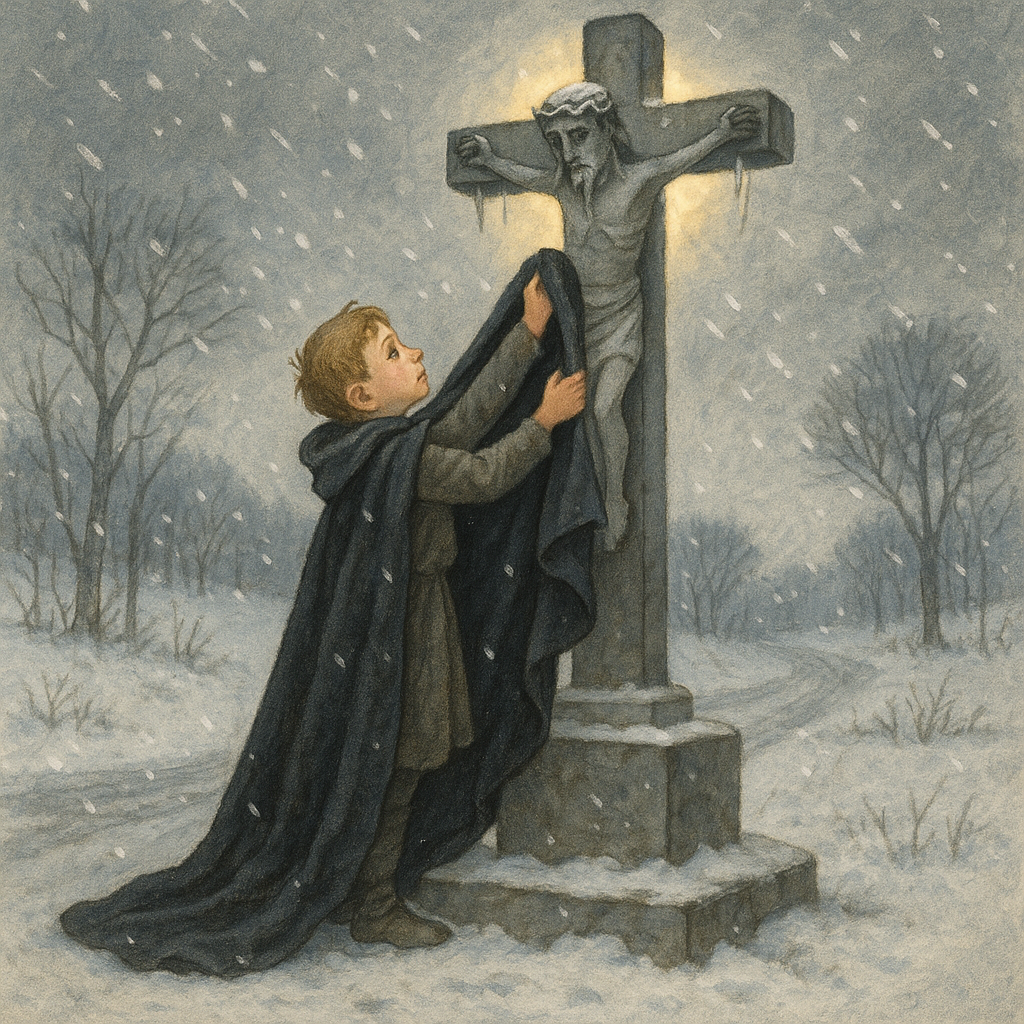
Jacques stopped. “Oh, my poor God,” he said, “how cold you are!” And he went back and stood before the crucifix. Then, on a sudden impulse, he took off the cloak. He climbed up onto the pedestal, set his foot on the stone drapery at the figure’s waist, reached up around the shoulders, and pulled the cloak around the statue.
When he had climbed back down, he said: “Now, at least, you won’t be so cold.”
And the two small icicles that had hung from the eyelids of the stone Christ melted and ran slowly down the granite cheeks — like tears of gratitude.
Jacques set off at a run. The cruel north wind cut through his thin cotton shirt. The bundle of sticks beat against his shoulders and bruised them. At last he reached the foot of a slope and stopped, breathless, beside a ravine sheltered from the wind by a wall of pines. How tired he was. He descended into the ravine and sat down to rest — only for a minute, he thought, just one more minute and he would be up and on his way to his mother. How tired he was. His head felt heavy and very hot. He lay down and rested his head against the bundle of sticks.
I must not go to sleep, he said. Oh no, I will not go to sleep.
And as he said it, his eyelids dropped, and he sank into a great, still darkness.
IX.
When Jacques woke, he was greatly surprised. The ravine, the snow, the forest, the mountain, the grey sky, the freezing wind — all had disappeared. He looked for his bundle of sticks but could find it nowhere. He had never seen or even heard of this country; he could not measure its distances or take in its splendours. The air was warm and fragrant, and from it rose soft harmonies that made his heart tremble with delight.
He stood up. The ground beneath his feet was soft and gave gently to his step, so that walking felt like rest. A warm light hung about him. Instead of the old torn cloak, he wore a mantle scattered with stars — seamless, like the robe for which dice were cast on Calvary. His hands — his poor small hands, swollen with chilblains, chapped and cracked by the cold — were now white and soft as a swan’s wing. Jacques was astonished, but no fear disturbed him. He was calm, and filled with a strange confidence. It was as though a great burden had been lifted from his shoulders; he was light as air, and shining with a happiness he had no name for.
“Where am I?” he asked; and a voice more beautiful than the wind through branches answered:
“In my Father’s House, which is the home of the Just.”
Then through a veil of blue light a great granite crucifix rose before him. It was the crucifix of the Trèves. Grand-Pierre’s cloak, with the old tear across it, hung from the shoulders of the Christ. The coarse wool had become as light and clear as cloud, and through it the light radiated like a sun. The thorns on his brow glittered like rubies, and a beauty beyond human words lit his face. From the depths of space, voices sang. Jacques fell to his knees.
The Christ said:
“Rise, little one. You were moved by the suffering of your God — you gave up your cloak to shield him from the cold. And so he gives you his cloak in exchange for yours; for of all the virtues, the highest and rarest is charity, which surpasses both wisdom and knowledge. Hereafter you will be the guest of your God.”
Jacques took a few steps toward the radiant figure and held out his arms.
“What do you want?” said the Christ.
The child said: “I want my mother.”
“The angels who carried Mary into Egypt will bring her to you.”
There was a great rush of wings, and a smile spread across the face of the granite Christ.
Jacques was praying, but his prayer was unlike anything he had ever said before. It was a song of joy that rose to his lips in words so beautiful that he felt a deep happiness simply in hearing himself speak them.
Far away, on the edge of the horizon, pure and clear as crystal, he saw Marguerite, carried toward him on waves of white. She was no longer pale or worn or sad. She was radiant, lit from within by the light that is the beauty of the soul — the only beauty that does not fade. The angels set her at the foot of the crucifix, and she prostrated herself and gave thanks. When she raised her head there were two souls beside her, and they met in one kiss, in one wordless cry of gratitude.
The granite Christ wept.
X.
High in the steeple the bells are conversing. The two younger ones are sullen.
“The people in this village are mad. Why can they never be quiet? Were yesterday’s duties not exhausting enough — midnight Mass, Matins, the Dawn Mass, the third Mass, High Mass, Vespers, the Angelus, to say nothing of the extra chimes? There was no end to it! And now today we must begin all over again. They pull us, they shake us — first the toll for the dead, then the funeral service, then the burial. It is really too much! Why will they never leave us in peace? Our clappers are weary and our sides are bruised. What can be the matter with these people? Here they come to the church again in their good clothes. Father Monhache wears his most forbidding scowl; his beard bristles; every now and then he wipes something from his eyes with the back of his hand. His hat has a defiant tilt. Far down the road I can see two coffins — one large and one small. They are lifting them onto the cart. But what is that to us, and why are we expected to ring?”
The old bell, full of wisdom and long experience, reproved them:
“Be still, and do not shame me with your ignorance. You have no idea of the dignity of what you do. You have been blessed; you are church bells. To men you say, ‘Keep watch over your immortal souls!’ And to God, ‘O Father, have pity on human weakness!’ Instead of being proud of your calling and paying attention to what you see, you chatter like handbells and reason like sleighbells. Your brightness and your clear voices are no reason for pride — age will tarnish you, and years of ringing will crack your voices. When time has passed; when you have proclaimed festivals and weddings and births and christenings and funerals; when you have raised the alarm for fires and rung the warning bell at the news of an enemy — then you will no longer complain of your fate. You will begin to understand the things of this world, and to guess at the secrets of the other. You will come to understand how tears on earth can become smiles in heaven.
“So ring — gently, gently, without sadness or fear. Let your voices sound like the cooing of doves. A torn cloak in this world may be a mantle of eternal blessing in the next.”