I.
“Two truffled turkeys, did you say, Garrigou?”
“Yes, my reverend — two great, glorious turkeys stuffed with truffles. I ought to know, considering I helped stuff them myself. I thought their skins would crack while they were roasting, they were stretched so tight—”
“Merciful Saints! And I’m so fond of truffles too! Hurry, Garrigou, hand me my surplice. And what else did you see in the kitchen besides the turkeys?”
“Oh, all sorts of good things. Ever since midday we’ve been plucking pheasants, hoopoes, hazel-hens, and heath-cocks. From the pond they brought eels, goldfish, trout, and—”
“About how big were the trout, Garrigou?”
“Oh, about so big, my reverend — simply enormous—”
“Holy Fathers! I can just picture them. Did you put the wine in the vases?”
“Yes, my reverend, I filled them — but mercy! that’s nothing like the wine you’ll have later, after midnight Mass. You ought to see the dining-hall at the castle: all the decanters glittering with many-colored wines, and the silver, the plate, the chased centrepieces, the flowers, the candelabra. I don’t suppose there has ever been such a Christmas supper! The Lord Marquis has invited all the lords of the neighboring estates. There will be over forty at the table, not counting the bailiff and the notary. Ah, my reverend, you are very lucky to be invited! The smell of the truffles haunts me still, just from having sniffed at those turkeys — meuh!“
“Come, come, my child, let us beware of the sin of greediness — particularly on the night of the Nativity. Hurry now and light the tapers, and ring the first call for Mass. It will soon be midnight, and we can’t afford to lose time.”
This conversation took place one Christmas night in the year of Our Lord sixteen hundred and something, between the reverend Dom Balaguère, formerly prior of the Barnabites and present chaplain to the Sires of Trinquelague, and his little clerk — or rather, what he believed to be his little clerk Garrigou. For you must know that the Devil, on that particular night, had assumed the round face and uncertain features of the young sacristan, the better to lead the reverend father into temptation and make him commit the great sin of greediness.
So while the would-be Garrigou (hem! hem!) rang out the chimes with all his might from the seigneurial chapel, the reverend father was slipping on his chasuble in the little vestry; and as his imagination had been somewhat inflamed by Garrigou’s gastronomic account, he repeated to himself, mechanically, as he dressed:
“Two roast turkeys, goldfish, trout about so big!”
Outside, the night wind blew and scattered the music of the bells. Gradually lights began to pierce the darkness along the roads of Mount Ventoux, on whose summit the old towers of Trinquelague reared their mighty heads. The neighboring farmers and their families were making their way up to the castle for midnight Mass, climbing the mountain in little groups of five or six, singing gaily — the father ahead with the lantern, the women following, wrapped in great dark cloaks under which the children snuggled to keep warm. In spite of the cold and the late hour, all these good people walked along merrily, cheered by the thought that a great supper was waiting for them, as usual, in the castle kitchens after Mass. Every now and then on the rough slope, some fine lord’s coach would appear — preceded by torch-bearers, its windows glimmering in the moonlight — or a mule would trot past shaking its bells. And by the light of their lanterns wrapped in mist, the farmers recognized their bailiff and hailed him as he passed.
“Good-night, good-night, Master Arnoton!”
“Good-night, good-night, my children!”
It was a clear night; the stars seemed brightened by the cold; the wind was sharp; and a fine sleet powdered the cloaks without wetting them, just to preserve the tradition that requires Christmas to be white.
On the crest of the mountain the castle loomed like a goal, its huge mass of towers and gables dark against the sky, the chapel steeple rising into the blue-black heavens, while a thousand tiny lights flickered at every window — looking, against the deep black of the building, like the small sparks that glimmer in a pile of burnt paper.
After crossing the drawbridge and the postern, one had to pass through the first courtyard — crowded with coaches, footmen, and sedan-chairs, bright with the blaze of torches and the glare from the kitchens. One could hear the clicking of the spits, the rattling of pots, the tinkling of crystal and silver being laid out for the banquet; and above it all floated a warm vapor smelling of roasted meats and the pungent herbs of complicated sauces — which made the farmers, the chaplain, the bailiff, and indeed everyone say the same thing:
“What a good supper we shall have after Mass!”
II.
Ding, ling, ling! Ding, ling, ling!
Midnight Mass has begun. In the castle chapel — a miniature cathedral, with arching vaults and oaken wainscoting to the ceiling — all the tapestries hang and all the tapers burn. What a crowd, and what sumptuous costumes! In one of the carved stalls surrounding the choir sits the Sire of Trinquelague, clad in salmon-colored silk, with all his noble guests around him. Opposite, on velvet kneeling-stools, the old dowager Marchioness kneels in flame-colored brocade, and the young Lady of Trinquelague wears on her pretty head a great tower of lace, puffed and quilled in the latest fashion from the court of France. Farther down the aisle, all in black with vast pointed wigs and cleanly shaven chins, sit Thomas Arnoton the bailiff and the notary Master Ambroy — two sober spots amid the high colors of silk and brocaded damask. Then come the fat major-domos, the pages, outriders, stewards, and Dame Barbe with her great bunch of keys jangling from a ring of fine silver at her side. On the benches behind is the lower household — butlers, maids, the farmers and their families. And last of all, far back by the doors, which they discreetly open and close, come the cooks, slipping away between two sauces to catch a little breath of the Mass — bringing with them into the bedecked, candlelit church the warm, odoriferous suggestion of the Christmas supper.
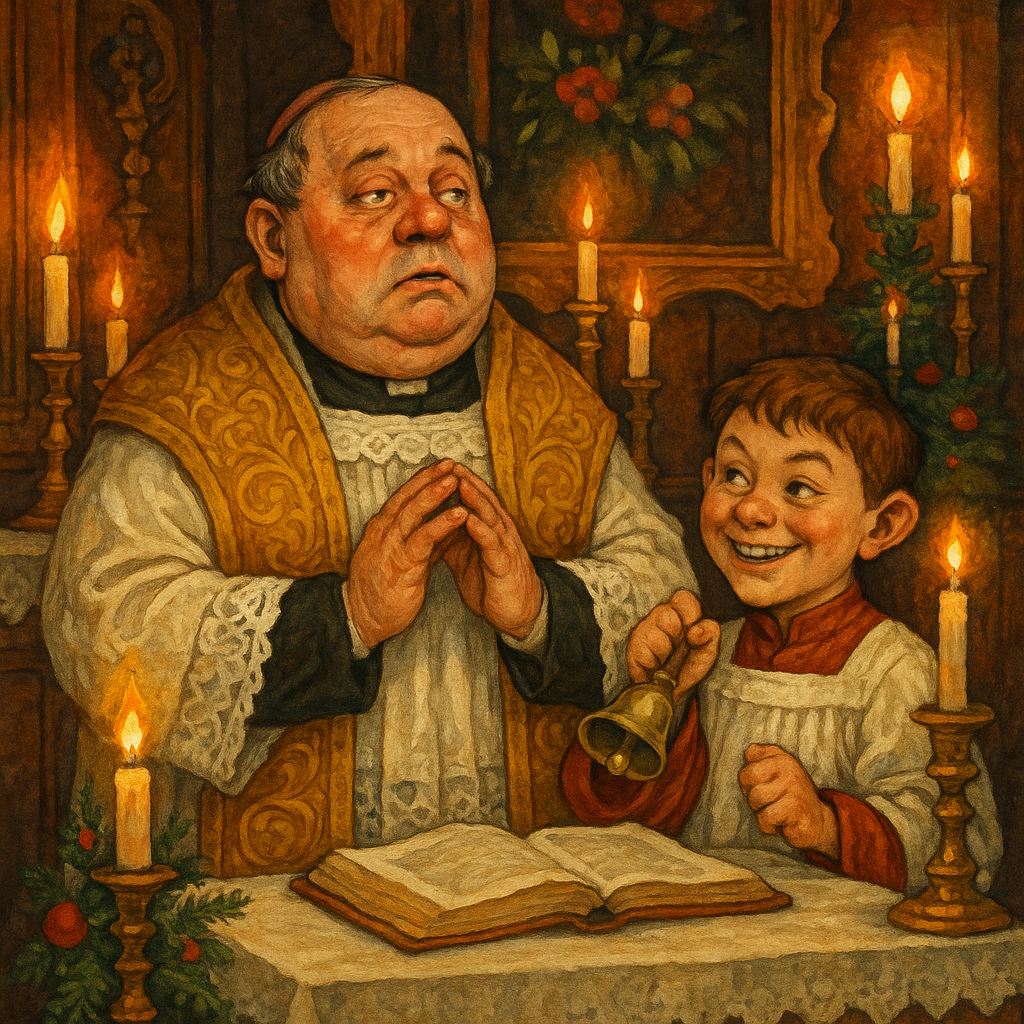
Could it be the sight of those crisp white cook’s-caps that diverts the reverend father’s attention? Or is it not rather Garrigou’s bell — that fiendish little bell that tinkles away at the foot of the altar with such infernal haste, and seems to be saying:
“Come, come, let us hurry! The sooner we despatch the service, the sooner we go to supper.”
The fact is that at every peal of that little devil of a bell, the chaplain forgets his Mass and lets his mind drift to the Christmas supper. He conjures visions of busy kitchens, ovens glowing like furnaces, warm vapor rising from under tin lids — and through those vapors, two superb turkeys, stuffed, crammed, marbled with truffles. Then he sees long files of little pages carrying vast covered dishes, and with them he enters the dining-hall in his imagination. What ecstasy! Here stands the immense table, laden and dazzling — peacocks dressed in their feathers, pheasants spreading bronzed wings, ruby-colored decanters, pyramids of luscious fruit amid greenery, and those wonderful fish that Garrigou spoke of (Garrigou, forsooth!) reclining on a bed of fennel, their pearly scales glistening as though just lifted from the pond, a bunch of pungent herbs in their wide-open mouths. The vision is so vivid that Dom Balaguère actually fancies the glorious dishes are being served before him on the very embroideries of the altar-cloth — and instead of saying Dominus vobiscum, he catches himself saying the Benedicite.
Apart from these slight lapses, the worthy man rattled off the service conscientiously, without skipping a line or omitting a genuflection, and all went well through the end of the first Mass. For you must know that on Christmas the officiating priest is obliged to say three Masses in succession.
“So much for one!” thought the chaplain, with a sigh of relief — and without losing a second, he motioned to his clerk, or to the one he believed to be his clerk.
Ding, ling, ling! Ding, ling, ling!
The second Mass has begun — and with it Dom Balaguère’s sin.
“Come, let us hurry!” cries Garrigou’s bell in its shrill, devilish little voice; and at that sound the unfortunate priest pounces on the missal and devours its pages with all the avidity of his over-excited appetite. He kneels and rises frantically, barely sketches the sign of the cross and the genuflections, shortens every gesture to get through sooner. He scarcely extends his arms at the Gospel or strikes his breast at the Confiteor. Between him and his little clerk it’s hard to say who mumbles faster. The words, half uttered between their teeth — for it would take too long to open their lips fully — die out into unintelligible murmurs:
Oremus — ps — ps — ps —
Meâ culpa — pâ — pâ —
Like hurried vintagers trampling grapes in the vat, they both splashed about in the Latin of the service, spattering it in every direction.
“Dom — scum!” says Balaguère.
“Stutuo!” responds Garrigou — while the infernal little bell jingles in their ears like the sleigh-bells put on racehorses to urge them faster. You may well imagine that at such a rate a Low Mass is soon rattled off.
“So much for the second,” says the panting chaplain, scarlet-faced and in a full perspiration — and without pausing for breath, he goes tumbling down the altar steps and —
Ding, ling, ling! Ding, ling, ling!
The third Mass is under way. Only minutes stand between them and the supper. But alas! as the moment approaches, Dom Balaguère’s fever of impatience and greed only grows worse. His visions sharpen; the fish, the roasted turkeys are right before him — he touches them — great Heavens! — he breathes the perfume of the wines and the savory steam of the dishes; and the frantic little bell calls:
“Hurry, hurry! Faster, faster!”
But how can he go faster? His lips barely move; he has given up enunciating altogether — unless he chooses to cheat the Lord and swindle Him out of a Mass. And that is exactly what the wretched man is doing. Yielding first to one temptation, then another, he skips one verse, then two; then, the Epistle being very long, he omits half of it; skims the Gospel, passes the Creed unnoticed, skips the Pater, salutes the preface from a distance — and thus, with a skip and a jump, plunges headlong into eternal damnation, followed by that infamous Garrigou (Vade retro, Satanas!), who seconds him with marvellous sympathy, hoisting his chasuble, turning pages two at a time, jostling the lectern, upsetting the vases — while the little bell rings on, ever faster, ever louder.
It would be impossible to describe the bewildered expression of the congregation. Compelled to follow, mimicking the priest, through a Mass of which they can make neither head nor tail, some stand while others kneel, some sit while others stand; all the phases of this strange service are jumbled together in the greatest confusion. The Christmas star on its celestial road, journeying toward the little manger, grows pale at the very thought.
“The abbé reads too fast — it is impossible to follow him,” whispers the old dowager Marchioness, whose towering head-dress quivers wildly. Master Arnoton, his great steel spectacles on his nose, loses his place every minute and fingers his prayer-book in agitation. Yet at heart all these good people — their minds no less fixed on the Christmas supper — are not terribly disturbed by a Mass said at breakneck speed; and when Dom Balaguère, turning to face them radiantly, cries in a thundering voice, “Ite missa est,” the response “Deo gracias” rings back so unanimous, so joyous, and so spirited that any stranger might have taken it for the first toast of the supper.
III.
Five minutes later, the assembled lords — and the chaplain among them — had taken their seats in the great hall. The castle, brilliantly lit, rang with songs and laughter; and the venerable Dom Balaguère drove his fork resolutely into a capon’s wing, drowning the remorse of his sin in the savory juice of meats and the soothing draughts of old wine. He ate and drank so heartily, the dear good man, that he died of a seizure that very night — without even having time to repent. By morning he arrived in heaven, where the thrills of the evening’s ecstasies still seemed to linger in the air. I leave you to imagine how he was received.
“Get thee gone, thou wretched Christian!” said Saint Peter. “Thy sin is great enough to wipe out the virtues of a lifetime! So — thou wouldst swindle Us out of a Mass? Very well, then: three hundred Masses shalt thou say, and thou shalt not enter Paradise until three hundred Christmas Masses have been celebrated in thine own chapel, in the presence of all those who sinned with thee and through thee.”
And this is the true legend of Dom Balaguère, as it is told in the land of the olive tree.
The castle of Trinquelague has long since ceased to exist; but the chapel still stands erect on the crest of Mount Ventoux, in a clump of evergreen oaks. The wind sways its unhinged door; grass grows over the threshold; there are nests in the corners of the altar and on the sills of the high ogive windows, whose jewelled panes disappeared long ago. Yet it is said that every year at Christmas, supernatural lights hover among the ruins — and on their way to midnight Mass and the Christmas supper, the peasants see this ghost of a chapel lit by invisible tapers, burning in the open air, even in the wind and under the snow.
You may laugh if you will, but a wine-dresser of the district named Garrigue — a descendant of Garrigou, no doubt — has often told me that on one particular Christmas night, being somewhat in liquor, he had lost his way on the mountain near Trinquelague, and this is what he saw.
Until eleven o’clock: nothing. Everything was silent and dark. Then suddenly at midnight the chimes rang out from the old steeple — strange, uncanny chimes, that seemed to be ringing from a thousand miles away. Soon lights began to tremble along the road, and vague shadows moved about. Under the portal of the chapel there were footsteps and muffled voices:
“Good-night, Master Arnoton!”
“Good-night, good-night, my children!”
When they had all gone inside, my wine-dresser — who was a courageous fellow — crept up to the door. And there he beheld a most marvellous spectacle.
All these good shadows sat around the choir in the ruined nave, just as though the benches were still there. There were fine ladies in brocades and lace head-dresses, lords gaily adorned, peasants in flowered coats like those our grandfathers wore — all of them dusty, faded, weary. Every now and then some night-bird, an habitual lodger in the chapel, awakened by all the lights, would flutter about the tapers, whose flames rose erect and vague as though burning behind a gauze curtain. Garrigue was particularly amused by a gentleman with great steel spectacles who kept shaking his huge black wig, upon which one of these birds had become entangled, clawing and beating its wings.
In the centre of the choir, a little old man of childlike frame knelt and frantically shook a tiny bell that had long since lost its voice — while a priest in old-gold vestments moved to and fro before the altar, repeating prayers of which not a syllable could be heard.
Who could it have been but Dom Balaguère, saying his third Low Mass?