Once upon a time two kings ruled neighbouring countries in India. They were rivals in wealth and power, and since one was a Hindu rajah and the other a Muslim king, they were not good friends at all. To avoid constant quarrels, they had signed and stamped an agreement that if any of their subjects, from the least to the greatest, crossed the boundary between the two kingdoms, he could be seized and punished.
One morning the king and his chief wazir, or prime minister, were about to begin their morning’s work on the affairs of the kingdom. The king picked up a pen and was trimming it with a sharp knife when the knife slipped and cut off the tip of his finger.
“Oh, wazir!” cried the king. “I’ve cut off the tip of my finger!”
“That’s good news!” said the wazir.
“Insolent man!” said the king. “You take pleasure in other people’s misfortunes, and mine too? Guards, take him away and put him in the court prison until I have time to punish him as he deserves!”
At once the guards seized the unlucky wazir and dragged him out of the king’s presence toward the narrow door through which wrongdoers were led to prison. As the door opened to receive him, the wazir muttered something into his long white beard that the soldiers couldn’t hear.
“What did the rascal say?” shouted the king.
“He says he thanks Your Majesty,” one of the guards replied. The king stared at the closing door in anger and amazement.
“He must be mad,” he said. “He’s grateful for other people’s misfortunes and his own. Something has turned his head!”
But the king was very fond of his old wazir. The court physician came and bound up the injured finger with cooling ointment and eased the pain. But he couldn’t ease the soreness in the king’s heart, and neither could the ministers and courtiers, who found His Majesty very cross all day.
Early the next morning the king ordered his horse and announced that he would go hunting. In a flash the stables and halls were bustling, and by the time he was ready a score of ministers and huntsmen were ready to mount and go with him. To their astonishment, the king wouldn’t have any of them. He glared at them so fiercely that they were glad to leave him alone. So he wandered off over field and through forest, so moody and lost in thought that many a fat deer and gaudy pheasant escaped him, and so careless of where he was going that he strayed over the border into the rajah’s land without realising it. He found out only when men stepped out of a thicket on all sides and there was nothing to do but surrender. The poor king was seized, bound and taken to the rajah’s prison. All the while he thought of his wazir, who must be suffering the same fate, and wished that, like the wazir, he could feel there was something to be thankful for.
That night the rajah held a special council to decide what to do with the rival who had walked into his hands. All the priests were sent for, learned men who understood which days were lucky and which unlucky. While the rajah’s other councillors offered different advice until he was nearly crazy with anger and indecision, the chief priest sat in a corner working out sums and signs while a group of younger priests watched him admiringly. At last he rose and approached the throne.
“Well?” said the rajah anxiously. “What do you advise?”
“A very unlucky day!” cried the chief priest. “A very unlucky day! The goddess Devi is full of wrath and commands that tomorrow you cut off this king’s head and offer it to her in sacrifice.”
“Well, let it be done,” said the rajah. “I leave it to you to carry out the sentence.” And he bowed to the priests and left the room.
Before dawn, great preparations were under way for a grand festival in honour of Devi. Hundreds of banners waved, hundreds of drummers drummed, hundreds of singers sang, and hundreds of priests, well washed and anointed, performed their sacred rites. The rajah sat nervous and uneasy among hundreds of courtiers and servants, wishing it were all over. At last the time came for the sacrifice, and the poor king was led out, bound, to have his head cut off.
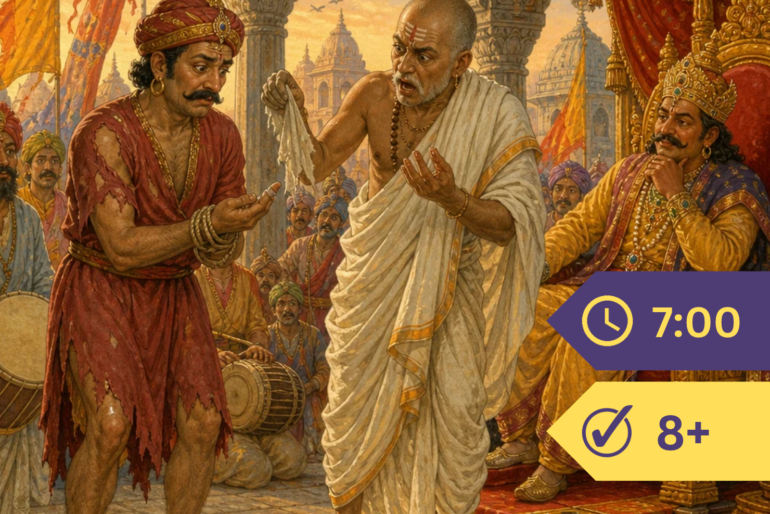
The chief priest came smiling, carrying a big sword. Suddenly he noticed that the king’s finger was wrapped in a bit of rag. He dropped the sword at once and, his eyes bulging with excitement, pounced on the rag and tore it off. There he saw that the tip of the finger was missing. He grew red and furious and led the king up to where the rajah sat, wondering what was wrong.
“Look, O rajah!” he said. “This sacrifice is useless. The tip of his finger is gone! A sacrifice is no sacrifice unless it is complete.” And he began to weep with rage and shame.
But instead of wailing too, the rajah gave a sigh of relief. “Well, that settles it. If it had been anyone else I wouldn’t have minded, but somehow, a king and all, it doesn’t seem right to sacrifice a king.” And he jumped up, cut the king’s cords with his jewelled dagger, and marched him out of the temple and back to the palace.
After bathing and feeding his guest, the rajah loaded him with gifts and rode with him, with a large escort, as far as the border between their kingdoms. There, amid salutes and great rejoicing, they tore up the old agreement and drew up a new one, in which each king promised welcome and safe passage to the other’s people, from the least to the greatest, who crossed the border on any errand. They embraced, and each went his way.
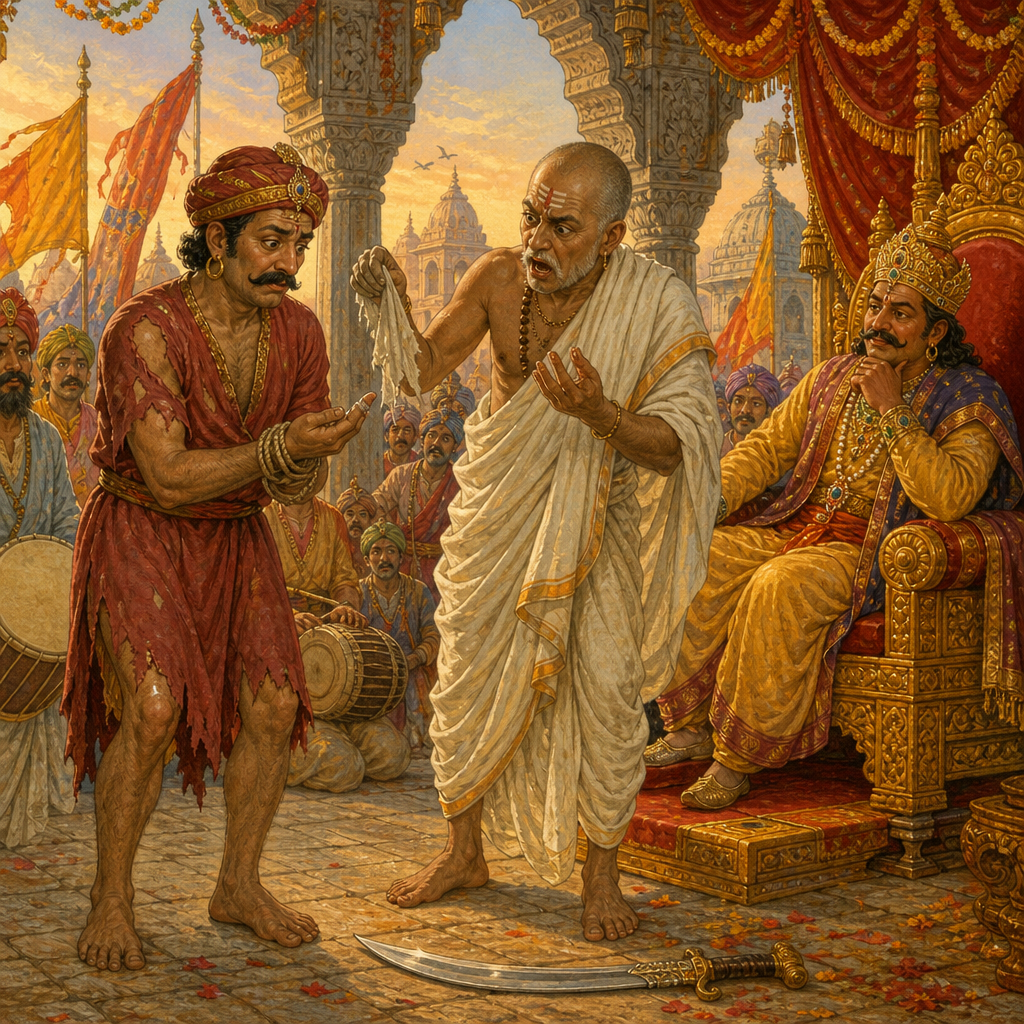
When the king got home that evening, he sent for his imprisoned wazir.
“Well, wazir,” he said when the old man had been brought in, “what do you think has happened to me?”
“How can a man in prison know what’s happening outside it?” said the wazir.
So the king told him all his adventures. When he had finished, he added:
“To show my thanks for my escape, I’ll pardon you freely, if you’ll tell me why you gave thanks when I cut off the tip of my finger.”
“Sire,” said the old wazir, “isn’t it true that it was very lucky for you that you did cut off the tip of your finger? Otherwise you would certainly have lost your head. And to lose a scrap of finger is surely the lesser of two evils.”
“Very true,” said the king, touching his head, as if to make sure it was still there. “But why did you give thanks when I put you in prison?”
“I gave thanks,” said the wazir, “because it is good always to give thanks. And had I known that being in prison would stop the goddess Devi from claiming me instead of Your Majesty as a perfect offering, I would have given even greater thanks.”