Fortunately, we were with our wives.
It is in general an excellent custom, as I will explain if opportunity is given.
First, you are thus sure of good company.
For four mortal hours we had ground along, stopping and waiting and starting again, through the drifts between Westfield and Springfield. We had shrieked out our woes in the voices of fire-engines. Brave men had dug. Patient men had sat inside and waited for the results of the digging. At last, in triumph, at eleven and three-quarters — as they say in Cinderella — we entered the Springfield station.
It was Christmas Eve.
Leaving the train to its own devices, Blatchford and his wife (her name was Sarah), and I with mine (her name was Phebe), walked quickly with our little bags out of the station and waded along the white street — not to the Massasoit, no, but to the old Eagle and Star, which was still standing and was a favourite with us youngsters. Good waffles, maple syrup without limit, such other fixings as we preferred, and some liberty. The amount of liberty in an absolutely first-class hotel is but small. A drowsy boy woke and turned up the gas. Blatchford entered our names on the register and cried at once, “By George — Wolfgang is here, and Dick! What luck!” — for Dick and Wolfgang also travel with their wives. The boy explained that they had come up the river on the New Haven train, were only nine hours behind time, had arrived at ten, and had just finished supper and gone to bed.
We ordered rare beefsteak, waffles, dip-toast, omelettes with kidneys, and omelettes without. We toasted our feet at the open fire in the parlour. We ate the supper when it was ready. And we also went to bed, rejoicing that we had brought home with us by travelling with our wives, and that we could keep our merry Christmas here. If only Wolfgang and Dick and their wives would join us, all would be well. (Wolfgang’s wife was named Bertha, and Dick’s was named Hosanna — a name I have never met with elsewhere.)
Sleep followed, and I am a graceless creature that I do not write a sonnet here on the unbroken slumber that followed. Breakfast, by arrangement among the four of us, at nine. At half past nine, in came Bertha, Dick, Hosanna, and Wolfgang, to name them in alphabetical order. Four chairs had been turned down for them. Four chops, four omelettes, and four small oval dishes of fried potatoes had been ordered, and now appeared. Immense shouting, immense kissing among those who had that privilege, general marvelling, and great congratulating that our wives were there. Solid resolution that we would advance no further. Here, and here only, in Springfield itself, would we celebrate our Christmas.
It may be noted in parenthesis that we had already learned no train had entered the town since eleven and a quarter, and it was known by telegraph that none was within thirty-four miles and a half of the spot at the moment the vow was made.
We waded and ploughed our way through the snow to church. I think Mr. Rumfry — if that is the name of the gentleman who preached an admirable Christmas sermon in a beautiful church there — will remember the platoon of four men and four women who made perhaps a fifth of his congregation in that storm, which had shut off most churchgoing. Home again; a jolly fire in the parlour, dry stockings, dry slippers. Turkeys, and all things fitting for dinner. And then a general assembly, not in a caravanserai, not in a coffee-room, but in the regular guests’ parlour of a New England second-class hotel, where, as luck had it, there were no strangers but ourselves that day, and all the regular boarders had gone either to their own rooms or to other homes.
For people who have their wives with them, it is not difficult to provide entertainment on such an occasion.
“Bertha,” said Wolfgang, “could you not entertain us with one of your native dances?”
“Ho! Slave,” said Dick to Hosanna, “play upon the virginals.” And Hosanna played a lively Arab air on the tavern piano, while the fair Bertha danced with unusual spirit. Was it truly in memory of the Christmas of her own dear home in Circassia?
All that, from “Bertha” to “Circassia,” is not so. We did not do this at all. That was a slip of the pen. What we did was this: John Blatchford pulled the bell-cord until it broke — they always break in novels, and sometimes in taverns too. This one broke. The sleepy boy appeared, and John said, “Lad, is there a fiddler in the house?” The boy said there was, and went to find him. In a minute he returned with his violin — a shining face, white teeth, broad grins, and in his shirtsleeves. And as the light grew grey and crept into the darkness, and as the darkness gathered more thick and more, he played for us and he played for us, tune after tune; and we danced — first with precision, then in sport, then in wild holiday frenzy. We began with waltzes — so great is the convenience of travelling with your wives; where should we have been had we been four men alone? Probably playing whist or euchre. Instead we began with waltzes, which passed into polkas, which subsided into round dances, and then in very exhaustion fell back into a grave quadrille. I danced with Hosanna; Wolfgang and Sarah were our vis-à-vis. We went through the same set that Noah and his three sons danced in the ark with their four wives, and which has been danced ever since, in every moment, on one or another spot of the dry earth, going round it with the sun like the drumbeat of England — right and left, first two forward, right hand across, pastorale — the whole series, done with as much spirit as if it had been on the slopes of Ararat, the ground still too muddy for croquet. Then Blatchford called for the Virginia Reel and we raced through that. After the fiddler began to tire, Dick cried, “Can you not play Money-Musk?” and in one wild frenzy of delight we danced Money-Musk and Hull’s Victory and Dusty Miller and Youth’s Companion and Irish Jigs on the closet door lifted off for the occasion, till the men lay on the floor shrieking with laughter and the women fell back on the sofas, fairly faint.
All this last, since the sentence after “Circassia,” is also a mistake. There was no fiddler, and we did not dance at all. This was a slip of my memory.
What we really did was this:
John Blatchford said, “Let us all tell stories.” It was growing dark and he had put more logs on the fire.
Bertha said —
“Heap on more wood, the wind is chill;
But let it whistle as it will,
We’ll keep our merry Christmas still.”
She said that because it was in a very stupid book she happened to remember.
Then Wolfgang told
The Penny-a-Liner’s Story
(Wolfgang is a reporter, or was then, on the staff of the Star*.)*
When I was on the Tribune — (he was never on the Tribune an hour, unless he counts selling the Tribune at Fort Plains as being on the Tribune). But I tell the story as he told it.
When I was on the Tribune, I was dispatched to report Mr. Webster’s great reply to Hayne. This was in the days of stage-coaches. We had to ride from Baltimore to Washington early in the morning to arrive in time. I found my boots were gone from my room when the stage-man called me, and I reported that speech in worsted slippers my wife had given me the week before.
As we came into Bladensburg it grew light, and I recognised my boots on the feet of my fellow-passenger — there was but one other man in the stage. I turned to claim them, but stopped in a moment, for it was Webster himself. How serene his face looked as he slept there. He woke soon, passed the time of day, offered me part of a sandwich — for we were old friends; I had been counsel against him in the Ogden case. Said Webster to me: “Steele, I am bothered about this speech. I have a paragraph in it which I cannot word to my satisfaction.” And he repeated it. “How would this do?” said he. “‘Let us hope that the sense of unrestricted freedom may be so intertwined with the desire to preserve a connection of the several parts of the body politic, that some arrangement, more or less lasting, may prove in a measure satisfactory.’ How would that do?”
I said I liked the idea but the expression seemed involved.
“And it is involved,” said Webster, “but I can’t improve it.”
“How would this do?” said I.
“‘Liberty and Union, now and forever, one and inseparable!’“
“Capital!” he said. “Capital! Write that down for me.” At that moment we arrived at the Capitol steps. I wrote the words down for him, and from my notes he read them when that place in the speech came along.
All of us applauded the story.
The Schoolmistress’s Story
(Phebe then told her tale.)
You remind me of the impression that very speech made on me, as I heard Henry Chapin deliver it at an exhibition at Leicester Academy. I resolved then that I would free the slaves, or perish in the attempt. But how? I — a woman, disfranchised by law? Ha! I saw the way.
I went to Arkansas. I opened a Normal College, or Academy for Teachers. We had balls every other night, to make it popular. Immense numbers came. Half the teachers of the Southern States were trained there. I had admirable instructors in Oil Painting and Music — the most essential studies. The arithmetic I taught myself. I taught it well. I achieved fame. I achieved wealth, invested in Arkansas Five per Cents.
Only one secret device I persevered in. To all — old and young, innocent girls and sturdy men — I so taught the multiplication table that one fatal error was hidden in its array of facts. The nine-line is the difficult one. I buried the error there. “Nine times six,” I taught them, “is fifty-six.” The rhyme made it easy. The gilded falsehood passed from lip to lip, from State to State — one little speck in a chain of golden truth.
I retired from teaching. Slowly I watched the growth of the rebellion. At last the aloe blossom shot up after its hundred years of waiting. The Southern heart was fired. I brooded over my revenge. I repaired to Richmond. I opened a first-class boarding house, where all the Cabinet, and most of the Senate, came for their meals, and I had eight permanent guests. Soon their brows clouded. The first flush of victory passed away. Night after night they sat over their calculations, which all came wrong. I smiled — and was a villain! None of their sums would prove. None of their estimates matched the performance. Never a muster-roll that tallied as it should! And I — the despised boarding-mistress — I alone knew why. Often and often, when Memminger said to me, with an oath, “Why this discordancy in our totals?” have my lips burned to tell the secret. But no! I kept it. And when, at last, I saw a regiment march into Richmond singing “John Brown,” I cried, for the first time in twenty years, “Nine times six is fifty-four!” and gloated in my sweet revenge.
The Inspector of Gas-Meters’ Story
(Dick spoke next.)
Mine is a tale of the ingratitude of republics.
It is well-nigh thirty years since I was walking beside the Owego and Ithaca Railroad — a crooked road, not then adapted to high speed. Of a sudden I saw that a long cross-timber on a trestle, high above a swamp, had sprung up from its ties. I looked for a spike to secure it. I found a stone to hammer the spike. But at that moment a train approached, downhill. I screamed. They heard — but the engine had no power to stop the heavy train.
With the presence of mind of a poet and the courage of a hero, I flung my own weight onto the fatal timber. I would hold it down or perish. The engine came. The elasticity of the pine timber whirled me into the air! But I held on. The tender crossed. Again I was flung in wild gyrations. But I held on. “It is no bed of roses,” I said, “but what act of Parliament was there that I should be happy?” Three passenger cars and ten freight cars — as was then the vicious custom of that road — passed me. But I held on, repeating texts of Scripture to give me courage. As the last car passed, I was whirled into the air by the rebound of the rafter. “Heavens!” I said, “if my orbit is a hyperbola, I shall never return to earth.” Hastily I estimated its ordinates and calculated the curve. What bliss — it was a parabola! After a flight of one hundred and seventeen cubits, I landed, head first, in a soft mud-hole.
In that train was the young U.S. Grant, on his way to West Point for his examination. But for me, the armies of the Republic would have had no leader.
I pressed my claim when I asked to be appointed to England. Although no one else wished to go, I alone was forgotten. Such is gratitude with republics.
The Wheeler and Wilson Operative’s Story
(Sarah Blatchford’s tale.)
My father had left the anchorage of Sorrento for a short voyage, if voyage it might be called. Life was young, and this world seemed heaven. The yacht bowled on under close-reefed staysails, and all was happy. Suddenly corsairs seized us: all were slain in my defence, but I — this fatal gift of beauty bade them spare my life.
Why linger on my tale! In the seraglio of the Shah of Persia I found my home. How to escape his notice? Fortunately, I remembered that in my bag I carried one box of indelible ink. Instantly I applied it to one cheek. Soon as it dried, I applied the second compound, and sat in the sun for an hour. My head ached with the sunlight, but what of that? I was a fright, and I knew all would be well.
I was consigned, once my deficiencies were known, to the sewing-room. How I sighed for my machine! Alas, it was not there — but I constructed an imitation from a cannon-wheel, a coffee-mill, and two nutcrackers. With this I made the underlinen for the palace and the seraglio.
I also vowed revenge. Nor did I doubt for one instant how, for in my youth I had read Lucretia Borgia’s memoirs, and I had a certain method for slowly destroying a tyrant at a distance. I was placed in charge of the Shah’s own linen. Every week I set back the buttons on his shirt collars by the width of one thread, or by arts known to me I shrank the binding by a like proportion. Tighter and tighter with each week did the vice close around his larynx. Week by week, at the great religious festivals, I could see his face grow blacker. At length the hated tyrant died. The physicians called it apoplexy. I did not disabuse them. His guards sacked the palace. I took the diamonds, fled with them to Trebizond, and sailed from there in a small boat to South Boston. No more — such memories oppress me.
The Conductor’s Story
(I told my tale in turn.)
I was poor. Let this be my excuse, or rather my apology.
I entered a Third Avenue car at Thirty-sixth Street and saw the conductor sleeping. Temptation found me, and I took from him his badge — number 213. I see the hated figures now. When he woke he did not know he had lost it. The car started and he walked to the rear. With the badge on my coat, I collected eight fares, stepped forward, and sprang into the street.
Poverty is my only apology for the crime.
I concealed myself in a cellar where men were playing cards. Fear is my only excuse. Lest they should suspect me, I joined their game, and my forty cents were soon three dollars and seventy. With these ill-gotten gains, I visited the gold exchange, then open evenings. My superior intelligence enabled me to place my modest means well, and at midnight I had a competence. Let me be a warning to all young men. Since that night I have never gambled more.
I threw the hated badge into the river. I bought a house on Murray Hill and led an upright and honourable life. But since that night of terror the sound of horse-cars oppresses me. Always since, to go uptown or down, I order my own carriage, with George to drive me — and never have I entered the clean and airy conveyance provided for the public. I cannot; conscience is too much for me. You see in me a monument of crime.
I said no more. A moment’s pause, a few natural tears, and a single sigh hushed the assembly.
The Wife of Biddeford’s Story
(Bertha, with her siren voice, told:)
At the time you speak of, I was the private governess of two lovely boys — Julius and Pompey, Pompey the elder of the two. The dear boy! I see him now, and see hanging to his neck his blue-eyed brother, who had given Pompey his black eye the day before. Pompey was generous to a fault; Julius, parsimonious beyond virtue. I therefore instructed them in two separate rooms. To Pompey, I read the story of “Waste not, want not.” To Julius, I spoke of the boundless love of Mother Nature, and her profuse gifts to her children. Leaving him with grapes and oranges, I stepped back to Pompey and taught him how to untie parcels so as to save the string. Leaving him winding the string neatly, I went back to Julius and gave him ginger-cakes.
The dear boys grew from year to year. They outgrew their knickerbockers and had trousers. They outgrew their jackets and became men, and I felt that I had not lived in vain. I had conquered nature.
Pompey, the little spendthrift, was the honoured cashier of a savings bank — until he ran away with the capital. Julius, the miser, became chief croupier at the New Crockford’s. One of those boys is now in Botany Bay, and the other is in Sierra Leone.
“I thought you were going to say a hotter place,” said John Blatchford, and he told his story.
The Stoker’s Story
We were crossing the Atlantic in a Cunarder. I was second stoker on the starboard watch. In that horrible gale we had spoken of before dinner, the coal was exhausted, and I, as the best-dressed man, was sent up to the captain to ask what we should do. I found him himself at the wheel. He almost cursed me and bade me say nothing of coal at a moment when he must keep her head to the wind with full power, or we were lost. He bade me reach into his pocket, take out the key of the after freight-room, open it, and use the contents for fuel.
I returned hastily to the engine-room and we did as instructed. The room contained nothing but old account books, which made a hot and effective fire.
On the third day the captain came down himself into the engine-room — where I had never seen him before — called me aside, and told me that by mistake he had given me the wrong key, asking whether I had used it. I pointed to the empty room: not a leaf remained. He turned pale with fright. As I watched his emotion he confided the truth. The books were the accounts and evidences of the British national debt — of what is familiarly called the Consolidated Fund, the Consols. They had been secretly sent to New York for the examination of James Fiske, who had been asked to advance a few millions on this security to the English Exchequer. And now all evidence of indebtedness was gone.
The captain was about to leap into the sea. But I dissuaded him. I told him to say nothing — I would keep his secret, no other man knew it, and the Government would never speak of it. He reconsidered. We came safe to port and did — nothing.
Only on the first quarter-day that followed, I obtained leave of absence and visited the Bank of England to see what happened. At the door was this notice: Applicants for dividends will file a written application with name and amount at Desk A, and proceed in turn to the Paying Teller’s Office. I saw their ingenuity at once. They were making out new books, certain that none would apply but those long accustomed to. So skilfully do men of government study human nature.
I stepped lightly to one of the public desks. I took one of the blanks. I filled it out — “John Blatchford, £1,747 6s. 8d.” — and handed it in at the open window. I took my place in the queue. After an agreeable hour, a pile of Bank of England notes was given to me; and since that day I have quarterly drawn that amount from the maternal government of that country. As I left the teller’s room I observed the captain in the queue. He was seventh from the window, and I have never seen him more.
We then asked Hosanna for her story.
The New England Historical Genealogist’s Story
“My story,” said she, “will take us far back into the past. It will be necessary for me to dwell on some incidents in the first settlement of this country — and I propose that we first prepare and enjoy the Christmas tree. After this, if your courage holds, you shall hear an over-true tale.”
Pretty creature — how little she knew what was before us.
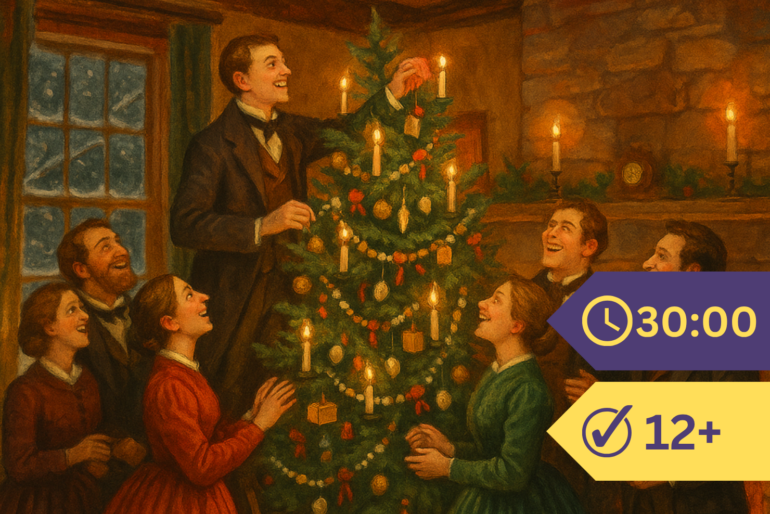
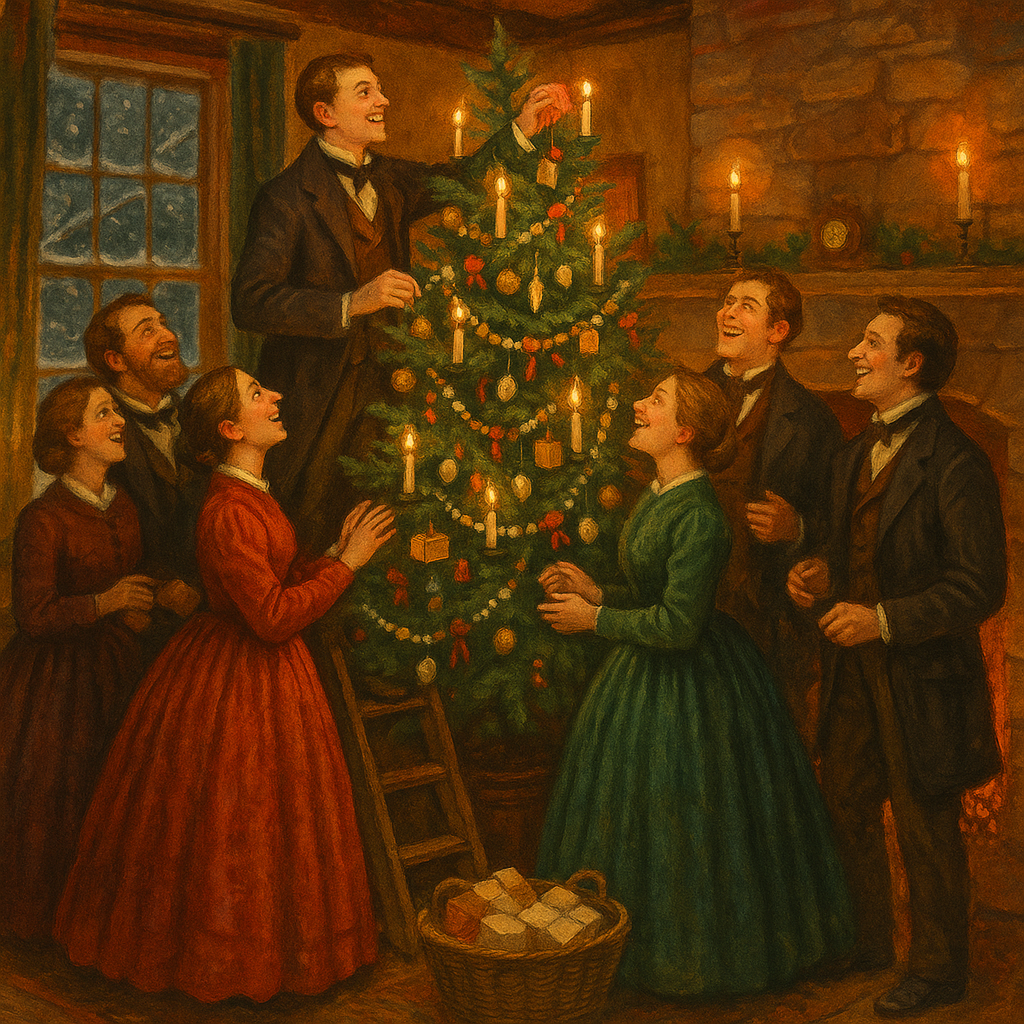
As we had sat listening to the stories, we had been preparing for the tree. Shopping being out of the question, we were content to make up our presents from our own stores, while the women arranged nuts, blown eggshells, and strings of popped corn from the Eagle and Star’s kitchen. The popping of corn in two poppers had gone on through the whole of the story-telling.
All being nearly ready, I called the drowsy boy again and, showing him a large piece of firewood, asked him to bring me a hatchet. To my great joy he brought the establishment’s axe, and I bade him farewell — how little did he imagine what was before him! As soon as he had gone I slipped quietly down the stairs and stepped out into the deep snow in front of the hotel, looked up into the lovely night. The storm had ceased and I could see far back into the heavens. In the still evening my strokes might have been heard far and wide as I cut down one of the two pretty Norway spruces that shaded the front walk of the house next door. I dragged it over the snow. Blatchford and Steele lowered sheets from the large parlour window, which I attached to the trunk. With infinite difficulty they hauled it in. I joined them in the parlour, and soon we had as stately a tree growing there as was in any home of joy that night in the river counties.
With swift fingers our wives adorned it. I should have said above that we travelled with our wives, and that I recommend that custom to others. It was impossible, under the circumstances, to maintain much secrecy; but it had been agreed that all who wished might turn their backs to the circle while preparing their presents, without offence to the others. As each present was wrapped, in paper of different colours, it was marked with the names of giver and receiver and placed in a large clothes-basket. At last all was done. I had wrapped up my knife, my pencil-case, and my letter-case for Steele, Blatchford, and Dick. To my wife I gave my gold watch-key, which fortunately fitted her watch; to Hosanna, a seal ring I wore; to Bertha, my gold chain; and to Sarah Blatchford, the watch which generally hung from it.
For a few moments we retired to our rooms while Hosanna arranged the forty-nine presents on the tree. Then she clapped her hands and we rushed in. What a wondrous sight! What a shout of childlike laughter — for in that happy moment were we not all children again?
Dick, who is the tallest, mounted the step-ladder and called us by name to receive our presents. I had a watch-key from Hosanna, a knife from Steele, a letter-case from Phebe, and a pretty pencil-case from Bertha. Dick had given me his watch-chain, which he knew I fancied; Sarah Blatchford, a little toy of a Geneva watch she wore; her husband, a handsome seal ring, a present to him from the Czar, I believe; and Phebe — that is, my wife, for we were travelling with our wives — had a pencil-case from Steele, a little letter-case from Dick, a watch-key from me, and a French repeater from Blatchford; Sarah Blatchford gave her the knife she carried, with some bright verses saying it was not to cut love; Bertha, a watch-chain; and Hosanna, a ring of turquoise and amethysts. The other presents were similar articles, and were received, as they were given, with much tender feeling.
But at this moment, as Dick was on the top of the step-ladder handing down a red apple from the tree, a slight catastrophe occurred.
The first thing I was conscious of was the angry hiss of steam. In a moment I perceived that the steam-boiler, from which the tavern was warmed, had exploded. The floor beneath us rose and we were driven with it through the ceiling and the rooms above, through an opening in the roof into the still night. Around us in the air were flying all the other contents and occupants of the Star and Eagle.
Still, my flight was in a parabola; and in a period not longer than it has taken to describe it, I was thrown senseless, at last, into a deep snowbank near the United States Arsenal.
Tender hands lifted me and brought me round. Tender teams carried me to the City Hospital. Tender eyes watched over me. Tender science cared for me. It proved necessary, before I recovered, to amputate both legs at the hips. My right arm was wholly removed from the socket by a delicate and curious operation. We saved the stump of my left arm, which was amputated just below the shoulder. I am still in the hospital, recruiting my strength. The doctor does not like to have me occupy my mind at all; but he says there is no harm in my compiling my memoirs or writing magazine stories.
My faithful nurse has laid me on my front on a pillow, put a camel’s-hair pencil between my teeth, and, feeling almost personally acquainted with the artist to whom I address these pages, I have written out for you the story of my last Christmas.
I am sorry to say that the others have never been found.