Omne bene
Sine poena
Tempus est ludendi.
Venit hora
Absque mora
Libros deponendi.
— Old Holiday School-Song
In the preceding paper I made some general observations on the Christmas festivities of England, and I am tempted now to illustrate them with anecdotes of a Christmas passed in the country. I would invite my reader to lay aside the austerity of wisdom and put on the genuine holiday spirit — that spirit which is tolerant of folly and anxious only for amusement.
In the course of a December tour through Yorkshire, I rode a long stretch in one of the public coaches on the day before Christmas. The coach was crowded inside and out with passengers who, by their talk, seemed bound almost to a man for the mansions of relations or friends, to eat Christmas dinner. It was loaded with hampers of game, baskets and boxes of delicacies; hares hung dangling their long ears about the coachman’s box, presents from distant friends for the impending feast. I had three fine rosy-cheeked schoolboys for fellow-passengers inside, full of the vigorous health and high spirits I have always noticed in the children of this country. They were returning home for the holidays in tremendous good humor, promising themselves a world of enjoyment. It was delightful to hear the grand plans of the little rogues — the impossible feats they meant to perform during their six weeks’ freedom from books, birch-rod, and schoolmaster. They were full of anticipations: the reunion with family and household, down to the very cat and dog, the joy they would give their little sisters with the presents crammed into their pockets. But the meeting they seemed to await with the greatest impatience was with Bantam — a pony, I gathered, possessed of more virtues than any steed since the days of Bucephalus. How he could trot! How he could run! And such leaps as he would take — there was not a hedge in the whole country he couldn’t clear.
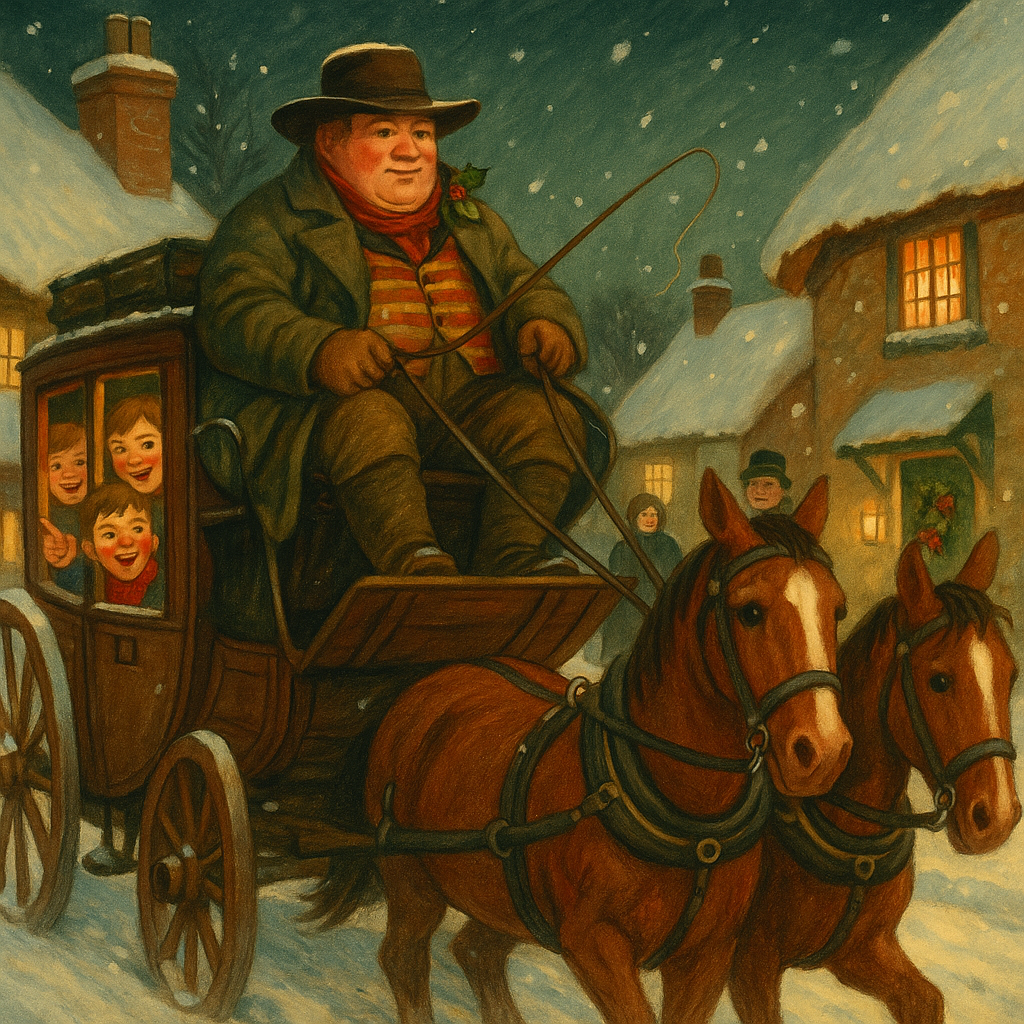
They were under the particular protection of the coachman, whom they peppered with questions at every opportunity and pronounced the best fellow in the world. I noticed the air of extraordinary bustle and importance that distinguished him — his hat tilted slightly to one side, a large bunch of Christmas greens tucked into his buttonhole. He is always a figure of great consequence and business, but especially so at this season, when the great exchange of presents multiplies his commissions enormously. And here, perhaps, it may not be unwelcome to my untravelled readers to have a sketch of this very numerous and important class, who have a dress, a manner, a language, and an air entirely their own — so characteristic, indeed, that an English stage-coachman can never be mistaken for anything else.
He has commonly a broad, full face, curiously mottled with red, as if hard feeding had forced the blood into every vessel of the skin. He is swelled to jolly proportions by frequent draughts of ale, his bulk further increased by a multiplicity of coats, in which he is buried like a cauliflower, the outermost reaching to his heels. He wears a broad-brimmed, low-crowned hat; a great roll of colored handkerchief about his neck, knotted and tucked at the bosom with knowing precision; and in summer a large bouquet of flowers in his buttonhole, the gift, most probably, of some admiring country girl. His waistcoat is of some bright striped color; his breeches extend well below the knees to meet a pair of jockey boots that reach halfway up his legs.
All this costume is maintained with great precision. He takes pride in having his clothes of excellent materials, and for all his seeming roughness there is a neatness and propriety about him that is almost inherent in an Englishman. He is a man of great consequence along the road, much consulted by village housewives who regard him as a person of perfect trust; and he seems to be on excellent terms with every bright-eyed country lass he passes. The moment he arrives where horses are to be changed, he throws down the reins with a certain grand air and abandons the team to the stable-hands — his duty being merely to drive from stage to stage. Off the box, his hands go into the pockets of his greatcoat and he rolls about the inn-yard with an air of absolute lordliness. He is generally surrounded by an admiring throng of stable-hands, boot-blacks, and those nameless hangers-on that infest inns and taverns — all running small errands for the privilege of living on the scraps from the kitchen and the spillage from the tap-room. These worthies look up to him as an oracle, treasure his phrases, echo his opinions on horses and all matters of the road, and above all endeavor to imitate his walk and carriage. Every ragamuffin with a coat on his back thrusts his hands in his pockets, rolls in his gait, talks slang, and fancies himself an embryo coachman.
Perhaps it was the agreeable serenity in my own mind that made me fancy I saw cheerfulness in every countenance throughout the journey. A stage-coach carries animation with it always, and sets the world in motion as it whirls along. The horn sounded at the entrance of each village produces a general bustle: some hasten out to meet friends; some with bundles and hat-boxes scramble for places, hardly able to take leave of the group that accompanies them to the door. Meanwhile the coachman has a world of small commissions to execute. Sometimes he delivers a hare or pheasant; sometimes tosses a small parcel or a newspaper to the door of a public house; and sometimes, with a knowing look and words of sly significance, hands to some half-blushing, half-laughing housemaid an oddly-shaped love-letter from some rustic admirer. As the coach rattles through the village everyone runs to the window, and on every side you catch glimpses of fresh country faces and laughing girls. At the corners stand clusters of village idlers and wise men who have taken their stations there for the important purpose of watching the world go by — though the most sagacious group is always at the blacksmith’s, for whom the passing coach is an event rich in speculation. The smith, with a horse’s hoof in his lap, pauses as the vehicle whirls past; the men around the anvil let their hammers rest and allow the iron to cool; and the sooty figure in the paper cap, laboring at the bellows, leans on the handle a moment and lets the wheezing machine draw one long breath, while he peers through the murky smoke and the sulphurous gleam of the forge.
Perhaps the approaching holiday gave more animation than usual to the countryside, for it seemed to me as if everyone was in good looks and good spirits. Game, poultry, and other luxuries of the table moved briskly through the villages; the grocers’, butchers’, and fruiterers’ shops were thronged. Housewives were stirring briskly about setting their houses in order, and the glossy branches of holly with their bright-red berries had begun to appear at the windows. The scene brought to mind an old writer’s account of Christmas preparation: “Now capons and hens, besides turkeys, geese, and ducks, with beef and mutton, must all die, for in twelve days a multitude of people will not be fed with a little. Now plums and spice, sugar and honey, square it among pies and broth. Now or never must music be in tune, for the youth must dance and sing to get them a heat, while the aged sit by the fire. The country maid leaves half her market, and must be sent again if she forgets a pack of cards on Christmas Eve. Great is the contention of holly and ivy whether master or dame wears the breeches. Dice and cards benefit the butler; and if the cook do not lack wit, he will sweetly lick his fingers.”
I was roused from this pleasant reverie by a shout from my little travelling companions. They had been peering out of the coach windows for the last several miles, recognizing every tree and cottage as they drew near home, and now there was a general burst of joy. “There’s John! And there’s old Carlo! And there’s Bantam!” cried the happy little rogues, clapping their hands.
At the end of a lane stood an old, sober-looking servant in livery waiting for them, accompanied by a stiff old pointer and by the redoubtable Bantam — a small, shaggy pony with a long rusty tail, who stood dozing quietly by the roadside, little dreaming of the lively times that awaited him.
It was a pleasure to watch the little fellows leap about the steady old footman and hug the pointer, who wriggled his whole body for joy. But Bantam was the great object of attention — all three boys wanted to mount at once, and it was only with some difficulty that John arranged that they should ride in turns, the eldest first.
Off they set — one on the pony, with the dog bounding and barking ahead, the other two holding John’s hands and both talking at once, peppering him with questions about home and school anecdotes. I watched them go with a feeling in which pleasure and melancholy were so mixed I could not tell which prevailed; for they reminded me of those days when, like them, I had known neither care nor sorrow, and a holiday was the summit of earthly happiness. We stopped a little while afterwards to water the horses, and when we moved on again, a turn in the road brought a neat country house into view. I could just make out the figures of a lady and two young girls on the porch, and I saw my little comrades — with Bantam, Carlo, and old John — trooping up the carriage road. I leaned out of the coach window hoping to see the reunion, but a grove of trees shut it from my sight.
In the evening we reached a village where I had decided to spend the night. As we drove into the great gateway of the inn, I saw through a window the light of a roaring kitchen fire. I entered, and admired — for what felt like the hundredth time — that picture of comfort, neatness, and wholehearted enjoyment: the kitchen of an English inn. It was a spacious room hung round with copper and tin vessels polished to a shine, decorated here and there with Christmas greens. Hams, tongues, and sides of bacon hung from the ceiling; a smoke-jack — the mechanical spit-turner — clanked steadily by the fireplace, and a clock ticked in the corner. A well-scrubbed wooden table ran along one side of the kitchen, spread with a cold round of beef and other hearty food, over which two foaming tankards of ale seemed to stand guard. Travellers of the plainer sort were settling in to attack this good repast, while others sat smoking and talking over their ale on two high-backed oak settles by the fire. Neat housemaids hurried back and forth under the direction of a brisk landlady, though they still found moments to exchange a quick word and share a laughing remark with the group by the fire. The whole scene perfectly realized what the old poet “Poor Robin” called the proper comforts of midwinter:
Now trees their leafy hats do bare
To reverence Winter’s silver hair;
A handsome hostess, merry host,
A pot of ale now and a toast,
Tobacco and a good coal fire,
Are things this season doth require.
I had not been long at the inn when a post-chaise drew up to the door. A young gentleman stepped out, and by the lamplight I caught a glimpse of a face I thought I recognized. I stepped forward for a better look, and our eyes met. I was not mistaken — it was Frank Bracebridge, a lively, good-humored young fellow I had once travelled with on the Continent. We greeted each other with great warmth, for an old travelling companion always brings back a flood of pleasant scenes, odd adventures, and excellent jokes. There was no time to go over all of them in a brief meeting at an inn; and finding that I had no fixed schedule and was simply making a tour of observation, he insisted I give him a day or two at his father’s country house, where he was going to spend the holidays, a few miles off. “It is better than eating a solitary Christmas dinner at an inn,” he said, “and I can promise you a hearty welcome in something of the old-fashioned style.” His argument was sound — and I confess the preparations for universal festivity I had been watching all day had left me rather impatient of my own loneliness. I accepted at once. The chaise came round to the door, and in a few minutes I was on my way to the family home of the Bracebridges.