There was a man and his wife who had a daughter of marriageable age. A suitor presented himself, was approved, and was asked in to celebrate the betrothal. The wife sent the daughter down to the cellar to draw wine.
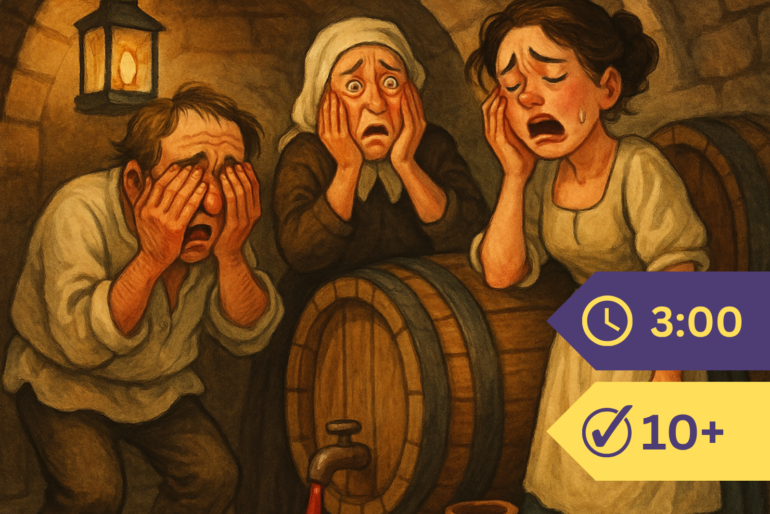
The daughter stood at the barrel and began to cry.
She had been thinking: if she married, she would have a son, and the son might become a priest, and from priest to bishop was not so very far, and a bishop might rise to cardinal, and from cardinal, well — who knew? — perhaps even Pope.
And a Pope, she wept, had to die eventually, and that would be very sad.
She was still crying, with the wine running freely over the full jar, when her mother came down to find out what was taking so long. The mother heard the reason, imagined the same sequence of events, and began to cry too.
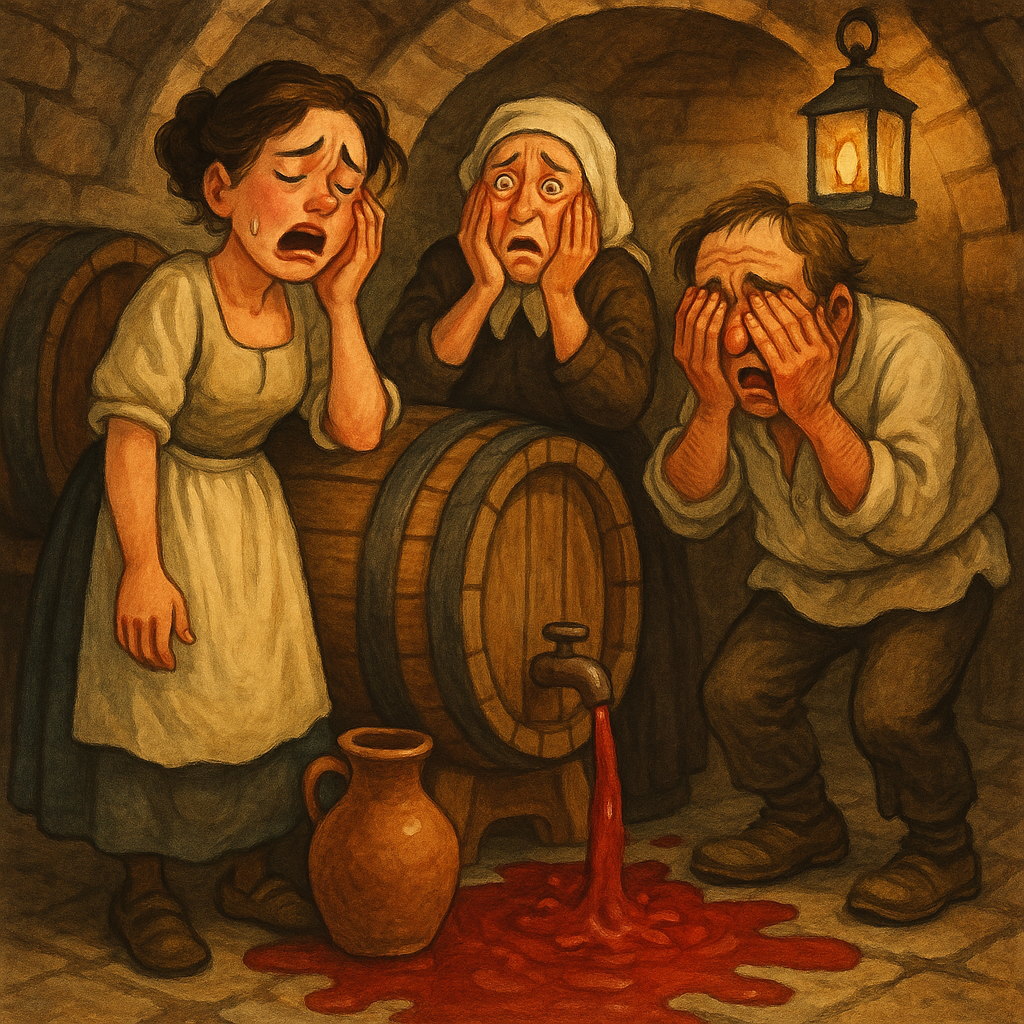
The father came to find them both. The father also began to cry.
When the suitor finally came down to see what on earth was happening, he found all three of them weeping in a puddle of wine, overcome with grief at the distant future death of a Pope who had not yet been born.
He dried his eyes eventually, and they were married. But one day he came home from market with a large quantity of meat, saying he had invited a friend to dinner. The wife, dismayed, began to cry again. He told her impatiently to “put it behind her.”
She went home, put the meat on chairs, and sat on it. Her parents came to help. They sat on it too. When the husband arrived with his guest and knocked, no one answered. He peered through the keyhole, fetched a locksmith, and found his wife, his mother-in-law, and his father-in-law all sitting rigidly on raw meat. They explained they were doing as he said.
“I am leaving,” he said, “and I will not come back until I have found three people more foolish than my family. Which I grant you may take some time.”
On his travels, he came first to a city where a bride had just returned from her wedding and was stuck in the doorway, because her tall ceremonial headdress was too high to fit under the lintel. A crowd stood about, deeply perplexed. The man showed her how to bow her head, and she passed in easily. He was paid a hundred scudi.
Further along, he came to a farm where a woman was trying to fill a pail by dipping a knotted rope into a well, squeezing the water out drop by drop, and wondering why the pail was taking so long. He untied the rope, lowered the pail, and filled it in ten seconds. Another hundred scudi.
That evening he arrived at a widow’s cottage, and in the course of the night convinced her — through some sleight of hand with extra eggs appearing in the pan — that he had recently come from the afterlife. The widow, overjoyed, sent him off in the morning loaded with food, a donkey, and a hundred scudi in cash, all for her beloved late husband.
“That’s three,” he said. “I must go home.”
He did, and never complained about his family again.