You have all heard of the shepherds who went to Bethlehem. But I don’t believe any of you has heard of the shepherd who didn’t go. The Bible says nothing about him — but his story has come to me, and now I’ll tell it to you.
The city of Bethlehem stood on a hill. Below the town, with its steep, narrow streets and white walls, lay grey olive orchards. Below the orchards were gardens bright with flowers. Below the gardens spread green meadows, and beyond them stretched the wild pasture-lands, reaching out to the plains where only patches of grass grew among the bushes and great rocks. There were caves among those rocks where wolves skulked and robbers sometimes hid, so the shepherds who guarded their flocks out there never dared leave them alone.
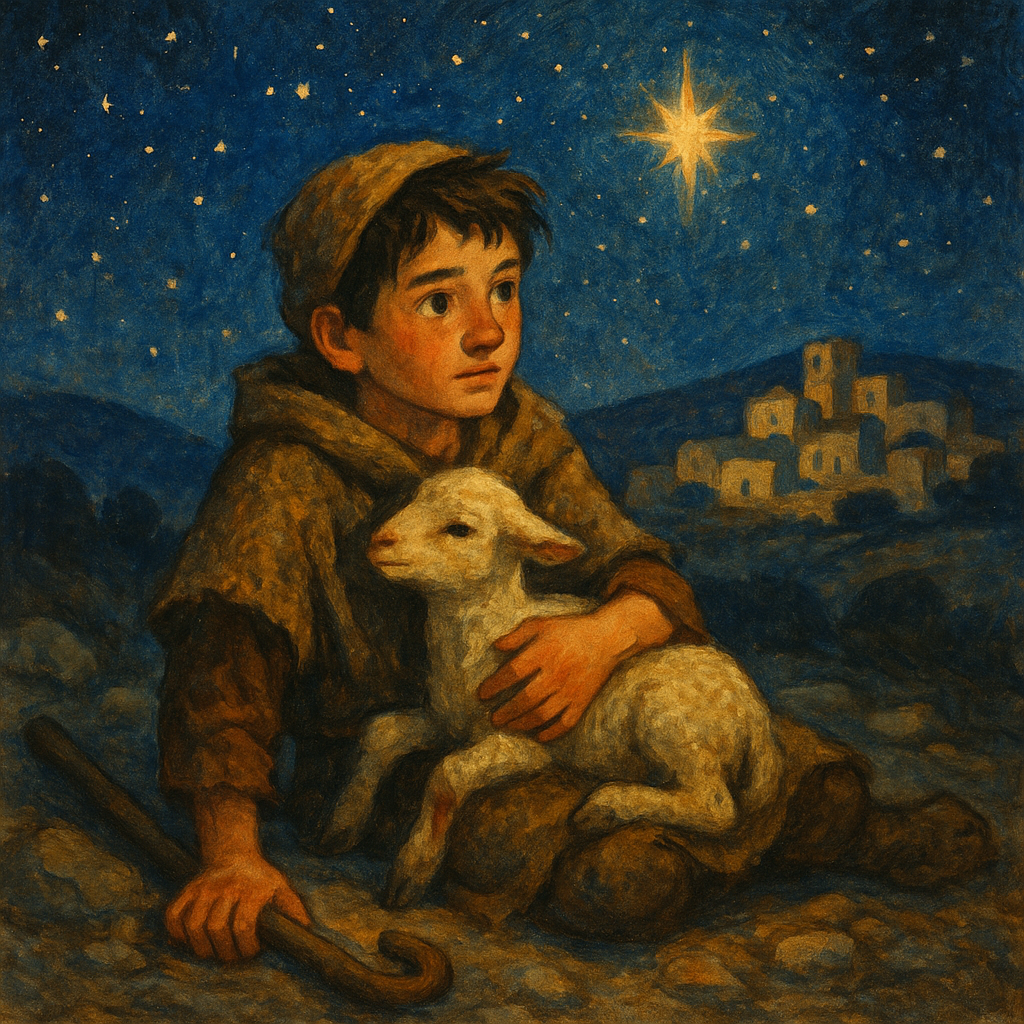
One clear, beautiful night, many centuries ago, four shepherds were watching their flocks on those pastures. Their names were Samuel, Ezra, Joel, and Dahvid. Samuel, Ezra, and Joel were strong men, no longer young, with shaggy brows and brown beards — Ezra’s short, Joel’s long, and Samuel’s streaked with grey. They owned the flocks they tended. But Dahvid was only a boy, with ruddy cheeks, bright eyes, and strong, quick limbs. He tended the flock of old Abraham — a rich man, too old to work, who hired Dahvid, whose family was very poor, to care for his sheep.
The flocks lay quiet on the plain far below the city, and the four shepherds lay near them, wrapped in their cloaks.
“Samuel,” said Dahvid, rising on his elbow.
“What is it, Dahvid?” the older man answered in his deep voice.
“Aren’t you glad we tend our sheep here in Bethlehem, and not in some faraway place?”
“Why, Dahvid?” asked Samuel sleepily.
“Because it’s in Bethlehem that the King we’ve waited for so long is to be born. I was reading it in the prophets just today.”
“Are you only just now hearing of that?” asked Ezra sourly.
“No,” said the boy hotly. “My mother has told me of it as long as I can remember, and I’ve read it over and over. Samuel — do you think we shall ever see the promised King?”
“I do not know, my boy,” the old man answered sadly. “We have waited so long, and there seems little hope for our people now. But he will come one day. He will come. Why do you ask?”
“I can’t say. It’s often in my mind — and something makes me think of it tonight. Samuel, I would walk to the end of the earth to see the Christ Child.”
“Well, you needn’t start now,” grumbled Ezra, and Joel added roughly, “Go to sleep, boy. The hour is late.”
It was much later before Dahvid slept, for his head was full of dreams and the wonderful things his mother had told him. But at last he drifted off with the rest.
Suddenly it seemed to each of them that something passed over them and brushed lightly against their cheeks. The older men raised themselves on their elbows, but Dahvid sprang to his feet. At first they saw only a great light, so bright it nearly blinded them. Then they made out a shining figure in the sky, and heard a voice: “Do not be afraid; for behold, I bring you good news of great joy for all people. For unto you is born this day, in the city of David, a Saviour, who is Christ the Lord. And this shall be the sign: you will find a baby wrapped in cloths and lying in a manger.”
And then the whole sky filled with light, and the air rang with heavenly voices singing, “Glory to God in the highest, and on earth peace, good will toward all.”
The shepherds listened, half joyful, half afraid, until the light faded and the voices floated away — “good will… good will…” — and all was still again. For a moment the men only stared at one another in awe.
Then Ezra spoke, his voice dry with fear. “What was it?”
Dahvid stood speechless. Samuel answered reverently, “Angels. Brothers, a wonderful thing has happened to us — it has been long, long ages since angels last spoke to men.” He wrapped his cloak about him and seized his staff. “Come — Ezra, Joel, Dahvid — let us go.”
“Go — where?” asked Ezra and Joel.
“Why, to Bethlehem, to see the Child! Did the angel not give us the sign? Let us find the baby lying in a manger.”
“There are many mangers in Bethlehem,” Ezra objected.
“I don’t know how we’ll find him,” said Joel, “and I fear it’s a hopeless search. But I’ll go if you say so.” And he reached for his staff.
So they set off — Samuel, Ezra, and Joel. But Dahvid stood still.
“Come, Dahvid, hurry!” called Samuel.
The boy did not move. “I can’t go,” he said.
“Can’t go!” cried Samuel. And Ezra added, “Who was it, just a while ago, who said he’d walk to the end of the earth to see the King?”
“And so I would!” cried Dahvid. “But the sheep — we can’t leave the sheep alone.”
“The sheep will be safe enough,” said Samuel. “The dogs will hold them together. There are no wolves tonight. Come.”
But the boy stood firm. “There’s my master. He’ll be furious if I leave his flock.”
“Old Abraham will never know,” said Joel.
“Abraham is a hard master,” said Dahvid. “Many a time I’ve felt his heavy staff on my back. But that isn’t what keeps me. I gave him my word that — come day, come night, come life, come death — I would not fail to guard his flock. Go on without me. I must keep my word. Go.”
So they went on, eager for their wondrous quest — Ezra and Joel muttering at the boy’s stubbornness, but Samuel full of quiet admiration. Dahvid watched them climb the hill. That dream of finding the Christ Child — how could he give it up? Once he even started after them: “I will go!” But something held him back, and he threw himself on the ground and fought back tears of bitter disappointment. After a while he grew calmer, taking a small comfort in knowing how helpless his flock would be without him.
Suddenly the low growl of his dog brought him to his feet. He saw nothing, heard nothing, and told the dog to hush. But in a moment, with a sharp bark of alarm, the dog was up and away. Dahvid leapt up, certain now that danger was near. There was panic in the flock — and toward the wilderness he saw lean grey shapes slipping swiftly among the sheep. Wolves!
Springing onto a rock and whirling his cloak above his head, he gave the familiar call that drew the sheep in around him — his own flock nearest, and behind them the flocks of Samuel, Ezra, and Joel. The wolves scattered. Quickly Dahvid counted his sheep, for an Eastern shepherd knows every one by name.
One by one he named them, and one by one, with rising relief, he found them — until his heart sank. One was missing: Ke-barbara, the pet of the flock, named “striped” for the dark markings in her fleece. Waving his staff over the huddled sheep and calling his soothing cry — “Hoo-o-o, ta-a-a! Hoo-o-o, ta-a-a!” — he raced off after the wolves. At the top of the steep bank at the pasture’s edge he stopped and called, “Ke-barbara! Ke-barbara!” and from the rocks below came an anguished bleat.
It was a steep, slippery way down, but Dahvid plunged after her without a thought for himself. Loose stones slid beneath him and he lost his footing, but he picked himself up unhurt at the bottom — and there, right beside him, two wolves were snarling over the wounded lamb. One slunk away at the sight of the boy. But the other, having tasted blood, sprang at him, missing his throat but sinking its teeth into his leg. As it gathered itself to spring again, Dahvid swung his staff with all his might and struck it so hard across the head that it yelped and fled limping into the dark.
His leg was bleeding and it hurt badly, but he turned at once, with gentle words, to the trembling lamb.
“Ke-barbara — they’ve hurt you, little one. But they didn’t kill you. I reached you just in time. You can’t walk, can you? And I don’t think I can carry you far. But I can help. There — put your head on my arm.” He gasped with pain. “No — the other one.”
And so, talking to her as though to a child, the wounded boy and the wounded lamb made their slow way back up the steep hillside and over the rough rocks. It was not truly far — half an hour before, the sturdy shepherd boy would have bounded up it easily. But now his hurt leg was slow, his arm was weak, and the little lamb felt very heavy. It was a weary climb, with many stops. When at last they reached the flock, still huddled and trembling, Dahvid had just enough strength to give one reassuring “Hoo-o-o, ta-a-a” — and then he sank down, exhausted.
How long he lay there he never knew. But the dawn was growing bright when three figures came down from the direction of the town. It was not the shepherds — it was old Abraham and two of his servants. When the old man saw his flock but no shepherd, he flew into a rage.
“Dahvid!” he shouted. “Dahvid!” There was no answer. “The young rascal! He’s abandoned the sheep. So much for his fine promises — ‘come life, come death!’ Let me find him and I’ll give him something to remember far longer than his vows!”
But as he came nearer the flock, he found the boy lying on the ground. “Ah — asleep, is he? With the sun this high! Get up!” he shouted, lifting his staff to strike. But as he raised it, he caught sight of the white face, the bleeding arm, and the wounded lamb beside him. Old Abraham let his arm fall, and a tenderness came into his face that was strange to him.
“Ah, Dahvid, my boy,” he said softly. “You didn’t forget your promise, did you? And I nearly struck you. Forgive me, lad.” Then he turned to his servants. “Take him to the inn and have them care for him. I myself will keep the flock today.”
The servants bowed. “The inn is full, my lord.”
“Take him to the inn, I say,” Abraham commanded again.
“But it is full, my lord,” the older servant repeated, trembling.
Then the other servant spoke up. “There may be room in the stable, my lord.”
“Then take him there, and see that he has the very best of care. Go, at once.”
So the servants carried Dahvid away, still unconscious, and made him comfortable on a bed of straw in the stable of the inn.
It was some hours before he came to himself. When at last he opened his eyes and began to catch the sounds around him, the first thing he heard was a faint, small cry.
“What is that?” he asked eagerly of Samuel, who sat watching beside him.
“That,” said the old shepherd, in a voice full of joy and wonder, “is the Child the angels told us about — the Child we went to see. We found Him here, in this very stable, lying in a manger.”
“And am I not to see Him?”
“Yes, you are,” said Samuel. And a grave-faced man brought the Child and laid Him gently in Dahvid’s arms — the Child for whose coming the people had longed for a thousand years.
Slowly the colour returned to Dahvid’s cheeks, and strength came back to his limbs, and in time he went back to the plain. There old Abraham embraced him.
“Forgive me, my son. I have been a hard master. You have been faithful beyond words — and for your reward, I make you master over all my flocks, and half of them shall be your own.”
So Dahvid grew to be a man of many flocks. And all his days, among all the shepherds, he was known as the one who had held the Christ Child in his arms. And there was none thought so brave, so gentle, or so wise as the Shepherd Who Didn’t Go.