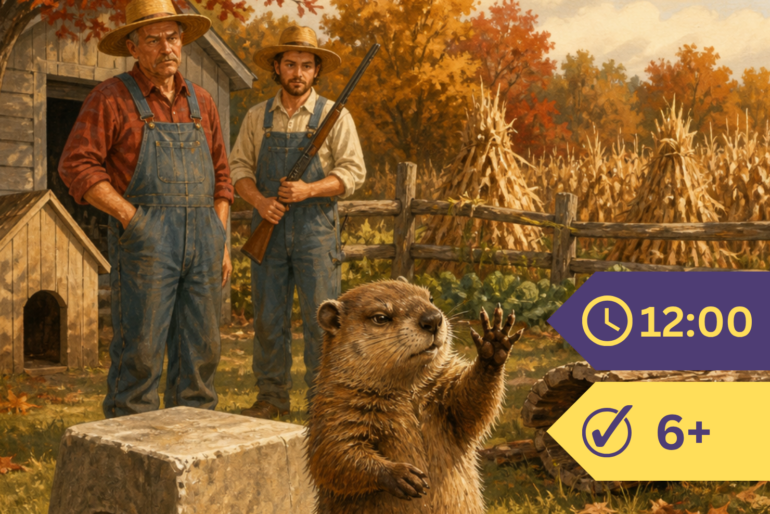
Among the wild animals I have not known was a family of woodchucks who lived in a hollow log at the edge of a farm in New York State. Not that they cared whether it was New York State or some other state. I mention it only so that anyone who doubts this story can go and check. It was New York State.
Here was the first thing that set this family apart from all the others in the neighbourhood: they lived in a hollow log. Their relatives and friends all lived in the ground. Nobody knows how the family got started on a rotten log. There were plenty of warm discussions about the merits of a house in a log versus a house in the ground, and many fine ground houses, in the best locations and with all the modern improvements, were offered to them. They stuck to the log.
The log did have one advantage: it had two doors. It was part of an old fence that ran between the garden and the cornfield. In summer, when the garden was full of good things, you walked down the hallway to the left-hand door and there you were, right in the garden. In fall, when the garden had dried up but the corn was stacked in shocks or stored in the crib, you walked down the hallway to the right-hand door and there you were, in the cornfield. And really, who would live in a house with one door when he could just as easily have two?
The family was father, mother, and four children. The youngest, and the favourite, was named Monax. His mother had heard that the scientific name for a woodchuck was Arctomys monax, and, being of a scientific turn of mind, she was very taken with it. But no woodchuck in her neighbourhood had two names, so she kept the second one and called her son Monax.
Monax had never been out in the world. He had been as far as the two doors and looked out, but that was all. He had been well taught at home, though. He knew about men, and how they sometimes shot at woodchucks. He knew about dogs, and about the corn-crib, and he had long known everything there was to know about garden vegetables and corn. He was a promising boy, and even his father and mother said so. He had just one weak point: he could not learn which was his right paw and which was his left.
That fall, Monax’s father was laid up with rheumatism. He was a terrible old fellow for groaning and carrying on when he was sick, and Mrs. Woodchuck had to stand by him every minute. The house had to be fixed up for winter, and the other children were busy with that. Then Saturday came, and someone had to go to market. Who was there to go but Monax?
Mrs. Woodchuck gave him his instructions. She always gave everybody their instructions. Mr. Woodchuck, like many of us, was a very important man, as long as he was away from home.
“You go out at the right-hand door,” said Mrs. Woodchuck. “Mind me now, the right-hand door. Go through the cornfield until you come to the big rock in the middle of it. Then turn right again.”
She stopped, and a look of doubt crossed her face. “Do you really know,” she said solemnly, “your right paw from your left?”
“Yes,” said Monax.
“Hold up your right one.”
Monax’s mind was in a whirl. He tried to picture himself standing with his back to the cornfield door, the way he’d stood at his last lesson on the subject. If he could only see that clearly, he could remember which paw he’d held up. But he was far too excited to think. So he held up a paw, with not the slightest idea which one it was.
“Certainly,” said his mother. “Certainly. Your father said it wasn’t safe to let you go because you didn’t know your right from your left. But he underrates you. He underrates all the children.” She said it almost crossly. Then she seemed relieved, and went on.
“Through the cornfield to the big rock, then right until you reach the edge of the field. You’ll see a couple of men out there, but don’t be afraid. They’re only scarecrows. Even if one of them has a gun, it’s only a wooden one. Go right ahead. At the edge of the field, by the maple tree, turn right again. Always to the right. Then you’ll see the barn. Go in and look around. Keep away from the horses, and don’t mind the smell. If there’s a basket of corn on the barn floor, help yourself and come home. If not, you’ll have to go a little farther. Just to the right of the barn, a few yards along, always to the right, is the corn-crib. That’s where your father and I get most of our supplies. Climb up into the old wagon box on the scaffolding and jump from that into the crib. Getting out is much easier, and after that all you have to do is come home. No need to hurry. I won’t worry about you, because there are no dogs over there. The dog lives way on the other side of the fence, beyond the garage. And I know the scarecrows won’t hurt you.”
So Monax set off down the hallway, thinking hard about his instructions. If Mrs. Woodchuck hadn’t gone back to tie another piece of red flannel around Mr. Woodchuck’s sore knee, she might have noticed how slowly Monax walked, like someone deep in thought. But she noticed nothing, and so she said nothing.
Monax was deep in thought. He was trying to work out which was his right paw and which was his left. If he could only be sure of one, he could guess the other. And he had to know before he reached the first door. Why were a person’s two paws so much alike? How could anyone tell them apart? He stopped and held up one, then the other. They looked exactly the same. He knocked one against the wall, then the other. They felt exactly the same. He couldn’t stand there long. If his mother caught him at it, she’d guess what was wrong, and his little journey into the world would be over before it began.
Then he reached the first door, and a sudden inspiration came to him. He never knew how, but he felt perfectly sure which was his right paw. It seemed quite simple, really. It was this one. So he turned out into the garden.
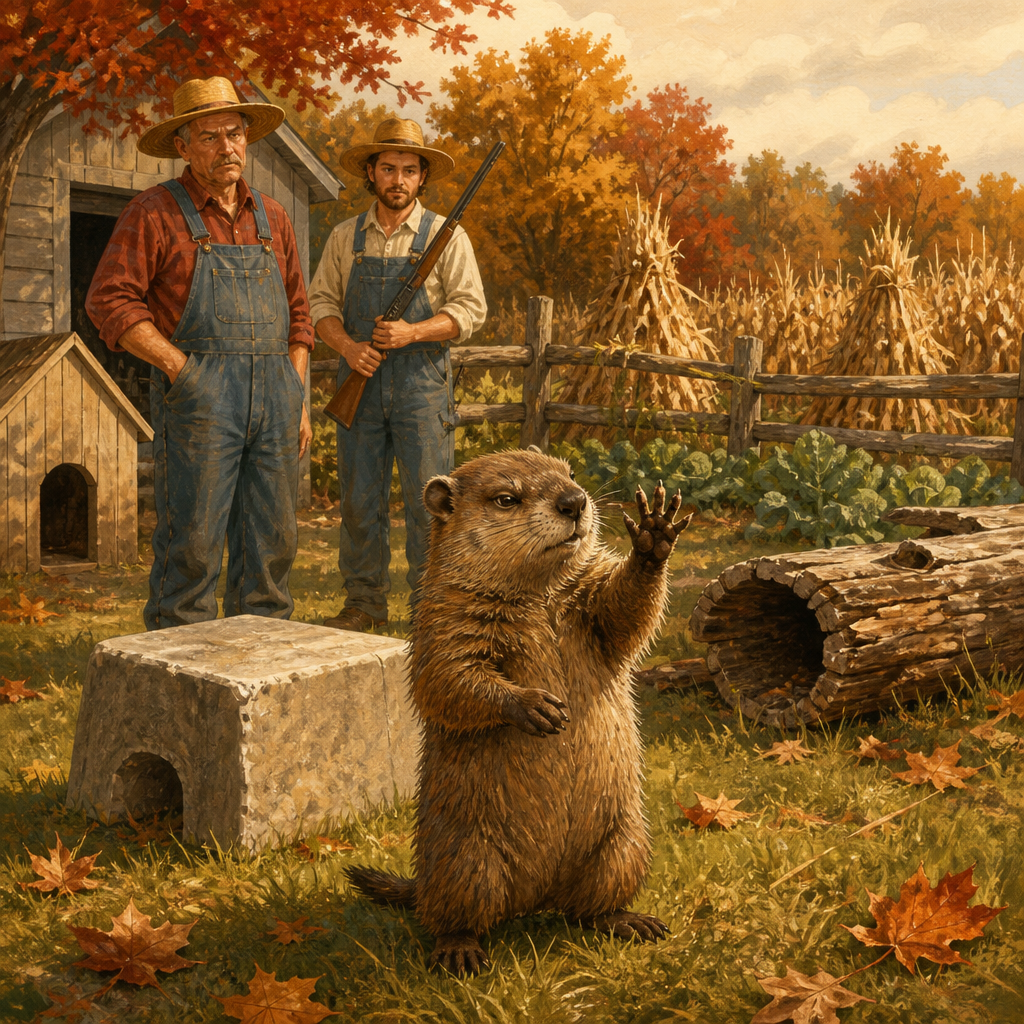
He didn’t see any corn shocks, but he wasn’t surprised. His mother had said they might have been hauled away by now. He looked ahead. Yes, there was the big stone. It did look rather like a cement horse-block. “But then,” he told himself, “they make stone these days so you can hardly tell it from cement.” He looked for the two scarecrows. If they were there, he’d know he was right. And there they were, awfully good imitations of men. One of them was even walking about a little.
As he passed, he noticed that neither of them had a gun. But he heard one say to the other, “Ever eat ’em?”
“The young ones are pretty good,” said the other. “The old ones are too tough.”
Monax was interested, but not at all frightened. In a copy of Scientific American his mother had brought home a few weeks earlier, he had read about the talking pictures Mr. Edison had invented. He hadn’t read about talking scarecrows, but he had no doubt there were such things. “You never can tell what these men will invent next,” he said, and strolled on.
At the big stone he turned, this way, he told himself. “It’s surprising how sure I am about my right paw now.”
He came to the edge of the field, and there, just as his mother had said, was the barn. It looked a good deal more like a garage. But styles change. Anyway, there it was on the right, exactly as she’d described. “If you’re sure of your direction, everything else takes care of itself,” he said. “The location is right.”
He went in. There was a smell, something like gasoline. He looked for the horses. None. He looked for the basket of corn. All he found was a pile of rags on top of a big red tank, and where the horses should have been stood an automobile. “They must have turned it from a barn into a garage since Mother was here,” he said. “If you want to keep up with the times these days, you can’t stay at home. You’ve got to get out where things are happening.”
There was no corn here, and he’d been given no instructions to bring home gasoline. (His mother used ammonia.) So he took his time looking around and then wandered out. A few yards to the right, just as his mother had said, was the corn-crib. He had never seen one before, and this one looked small. It looked rather like a dog-house, in fact. But the location was right again. Always to the right, his mother had said.
The old wagon box wasn’t there, but at the back of the crib a board was propped up against the tree. That was probably the end of the scaffold that used to hold the wagon box. Of course they wouldn’t leave a wagon box sitting out all fall. They were probably using it to haul corn at that very moment, to that very crib.
Meanwhile, at home, Mrs. Woodchuck was growing worried, for Monax had been gone longer than she’d expected. Mr. Woodchuck’s knee was very bad, and when he had rheumatism he was even gloomier than usual.
“I tell you,” he said, “that boy will never get home. He doesn’t know his right paw from his left.”
“I tell you he does,” said Mrs. Woodchuck. “I tested him just before he left.”
“I wouldn’t be surprised,” said Mr. Woodchuck, sticking to his point, “if he went out the left-hand door, into the garden, and ended up at the garage instead of the barn. One thing’s sure: if he tries to get corn out of that dog kennel, he’ll find out his mistake.”
Mr. Woodchuck’s lack of sympathy always annoyed his wife.
“Keep quiet,” she said. “You’ll give me nervous prostration again, saying such things.”
By then Monax had climbed up the board. He paused to look around. Then, thinking he really mustn’t be quite so leisurely, he hopped quickly through the little window just under the roof.
And then things happened so fast that Monax could hardly keep track.
For what Monax had really done was exactly what his father said he’d do. He had turned left every single time where he should have turned right. He’d gone through the garden instead of the cornfield, past a cement horse-block instead of the big stone, mistaken the garage for the barn, and now, worst luck of all, he had jumped into a dog kennel instead of a corn-crib.
The old dog had been chasing the sheep and cows all morning and was fast asleep on the kennel floor. Even so, he didn’t intend to lie there and be jumped on by a woodchuck, not in his own kennel. And Monax, perhaps not so surprised as he might have been, fell clear to the bottom instead of landing on a pile of corn, and felt his feet touch something furry that moved. It didn’t have time to move much.
Monax felt that a crisis had arrived in his career, and it was time to act. He didn’t look for the kennel door. He’d had enough of trying new routes. He simply bounced off the dog’s back like a rubber ball off a pavement. Up he went, breaking the woodchuck record for the high jump, out the window, onto the board and down to the ground, quick as a flash.
The dog was right behind him, but Monax was six feet ahead. Past the barn he went, and as an automobile came backing out, it dawned on him that this had never been a barn at all. He dodged under the machine. The dog had to go around it, and that was three more feet gained. He shot past the big stone at full speed, and it looked more than ever like a cement horse-block. Past the two scarecrows he went, and he could see they had moved quite a bit since he’d passed them on the way out. One of them was holding a gun now. Bang! Monax felt the shot whistle past his tail, which made him go about forty miles an hour.
He had very little time to think, but it did occur to him that those were not scarecrows at all, but men. And what he’d overheard them say half an hour earlier, about “the young ones being pretty good,” might possibly have had something to do with him.
On he sped, through the garden. It was perfectly plain now that it had never been the cornfield. He flew through the garden door and into the log house, and into his father’s room, fluttering, trembling, and more dead than alive.
“Did you turn to the right?” asked his mother.
“I did,” said Monax. “On the way back.”