In a beautiful corner of Andalusia
Lies a smiling valley.
God bless it!
For in that valley
Have I friends, loves,
Brothers, parents.
(El Látigo)
I.
A good many years ago — for I was then only seven — my father came to me in the twilight of a winter’s day, when the three Ave Marias had been rung from the church bells, and said solemnly: “You need not go to bed with the chickens tonight, Pedro; you are a big boy now, and you ought to have supper with your parents and your older brothers. This is Christmas Eve.”
I shall never forget the delight with which I heard these words. I was not going to bed until late! I cast a glance of commiseration and contempt upon my younger brothers, and instantly began composing in my head a description, to be delivered at school after Twelfth Night, of this my first adventure, my first lark, the first dissipation of my life.
II.
It was already las Ánimas, as they say in our village — that certain hour of the evening when the ringing of bells reminds the faithful to pray for the souls in purgatory.
Our village! Ninety leagues from Madrid, a thousand leagues from the world, nestling in a fold of the Sierra Nevada. I can almost fancy I see you still — brothers, father, and mother!
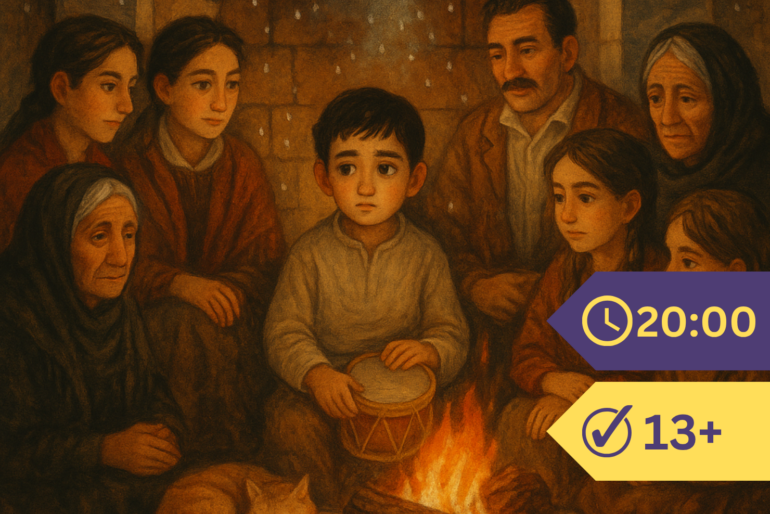
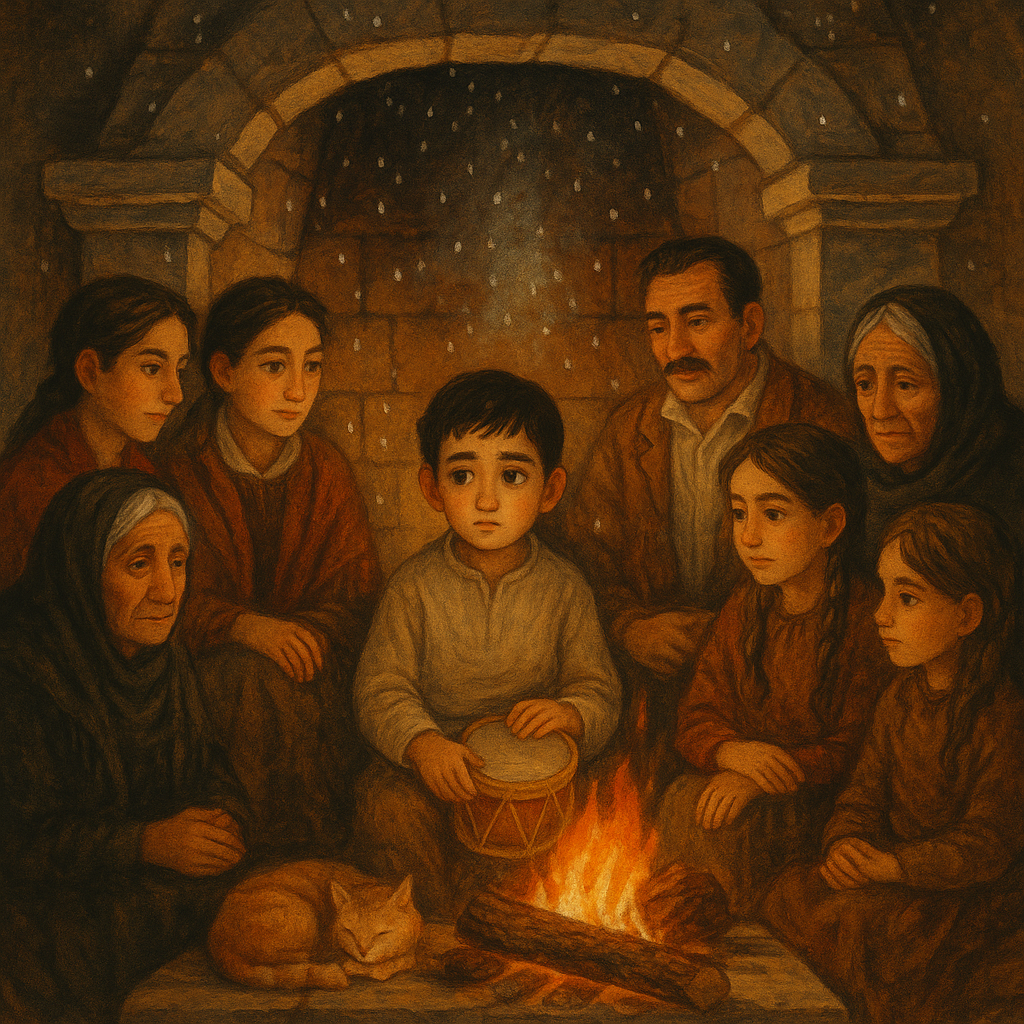
A huge oak log whistled and crackled in the fireplace. We all sat together under the vault of the chimney. My two grandmothers, who spent that night with us and presided over the household ceremonies, occupied the corner seats; my father and mother sat next to them; the rest of the place was filled by the children and servants, for on such an occasion we all belonged to the home, and it seemed right that one fire should warm us all. The cats slept in the centre of the circle, their tails turned to the flames. An occasional snowflake came fluttering down the chimney — that elfin road — and the wind moaned in the distance and spoke to us of the absent, the poor, the wayfarers. My father and my eldest sister played on the harp, and I accompanied them, to their distress, on a drum I had contrived that very evening out of a broken water jug.
Do you know the song of the Aguinaldos, sung in the villages east of Mulhacén? That was the music of our concert. The maidservants took it upon themselves to sing, and they rang out couplets to this effect:
“Tonight is Christmas Eve;
Tomorrow is Christmas Day.
Maria, fetch the jug of wine;
Let’s be merry while we may.”
And all was happiness and merrymaking. Rusks, butter-cakes, honey-and-nut pastries, sweetmeats made by the nuns, rosoli, and cherry brandy were freely passed around. There was much talk of going to midnight Mass, to the Nativity play at dawn, to see the manger the boys had built in the tower, and of making sherbet out of the snow that carpeted the courtyard.
Suddenly, in the midst of all this merrymaking, I was struck by the deep meaning of these words, sung by my paternal grandmother:
“Christmas comes,
Christmas goes;
But soon we all shall be of those
Who come back — never!”
In spite of my tender age, this couplet chilled my heart. All the melancholy horizons of life seemed to unfold before me in a flash. It was a burst of intuition unnatural at my age; a miraculous foresight, the herald of the ineffable sadness of poetry; it was my first inspiration. I saw and understood at a glance, with marvellous clarity, the inevitable fate of the three generations gathered around me. It struck me that my grandparents, my parents, and my brothers were like a marching army whose vanguard was stepping into the grave while the rearguard had not yet left the cradle. These three generations represented a century; and all past centuries had been the same; and ours would disappear as they had done, and so would all the centuries yet unborn.
“Christmas comes,
Christmas goes.”
Such is the implacable monotony of time — the pendulum swinging in space, the indifferent repetition of events, against the brevity of our passage through this world.
“But soon we all shall be of those
Who come back — never!”
A horrible thought. A cruel sentence whose meaning arrived like a summons — death beckoning from the shadows of the future. Before my imagination, a thousand Christmas Eves filed past; a thousand hearths were extinguished; a thousand families that had supped together ceased to exist — other children, other joys, other songs, all lost forever. My grandparents’ love for each other, their old-fashioned clothes, their vanished youth, the memories crowding in on them even now. My parents’ childhood, the first Christmas in our home, all the happiness that had come before me. And then I could foresee a thousand more Christmas Eves recurring, each one robbing us of life and hope — future joys in which we would not all take part together, my brothers scattered over the earth, my parents naturally dying before us. The live coals turning to ash. My own vanished youth, my old age, my grave, my posthumous memory, then complete oblivion — my grandchildren living on my blood, laughing and taking their pleasure while the worms profaned the skull in which these very thoughts were now forming.
The tears came flooding. I was asked why I was crying, and as I did not know — or at least could not have explained even to myself — my father concluded I was sleepy, and I was sent to bed. This was yet another reason to weep. My first philosophical tears and my last childish ones were mingled together that night. The hours of insomnia I spent listening to the joyous sounds of a celebration from which I had been excluded for being too much of a child — as my parents believed then, or too much of a man, as I now realise — were perhaps the bitterest of my life.
I must have fallen asleep at last, for I cannot remember whether the midnight Mass, the Nativity play, and the sherbet from the courtyard snow ever came to anything.
III.
Where is my childhood?
I feel as though I have just been telling a dream.
The world is wide, after all. My paternal grandmother — the one who sang the couplet — has been dead a long time. Meanwhile, my brothers have married and have children. My father’s harp, unstrung and broken, has been thrown among the cast-off furniture. It has been many a Christmas Eve since I had supper at home. My village has vanished from the ocean of my life like an island left behind by a ship.
I am no longer that Pedro the child — that tangle of ignorance, curiosity, and wonder trembling on the threshold of life. I am, for better or worse, a man: an inhabitant of Madrid, comfortably settled, proud of my bachelor’s independence, a novelist, a volunteer in the great orphanage of the capital, with whiskers, debts, and loves.
When I compare myself now — my freedom, my broad life, my early experience, standing revealed and tuned like a grand piano on concert night; when I compare all my boldness, my ambitions, my contempts with the little boy who played the drum fifteen years ago on Christmas Eve in a remote corner of Andalusia — I smile, I even laugh out loud. And all the while my lonely heart sheds quiet tears of infinite melancholy, which it carefully hides from view. Holy tears! May they somehow find their way home to the house where my father is growing old.
IV.
Well, what shall it be? For as the boys sing in the streets —
“Christmas Eve! Christmas Eve!
This is surely no night for sleep!”
Where shall I spend the evening? Fortunately I can choose.
This is the 24th of December, 1855. We are in Madrid. We know the waiters at all the cafés by name. We are hand in glove with the most celebrated poets of the day. We frequent theatres and see the plays from the wings. The great actors shake our hand backstage. We have penetrated editors’ rooms and been initiated in the alchemy that produces newspapers. We have credit at the hotels, access to a gallery in Congress; there are gatherings that appreciate us, and tailors that endure us.
We are happy! Our youthful ambition is satisfied. We can enjoy this night. We have conquered the world. Madrid is ours. And you, provincial young men — who at nightfall on an autumn day, sad and lonely, feel the pull of your longing for the capital; who believe yourselves to be poets, musicians, painters, orators; who despise your village and will not speak to your parents; who weep with ambition and dream wild dreams — burst with envy, all of you, as we are now bursting with pleasure.
V.
Two hours have passed. It is nine o’clock.
My friends, more fortunate than I, will bury their loneliness in the clamour of a party. “The night calls for wine,” they said to me a little while ago; but I would not go with them. I crossed that red sea of youth dry-footed some time ago.
“The night calls for tears,” I told them.
The acquaintances from my usual gatherings are at the theatre — the people of Madrid celebrating the birth of Christ by listening to actors declaim. A few homes where I am almost a stranger have offered me the charity of their warmth in the form of dinner invitations, for the old-fashioned Christmas Eve supper has gone out of style. But I would not accept. That is not what I want. What I long for is the Paschal feast, the Christmas Eve supper, my home, my relatives, my traditions, my memories, the old joys of my soul, the faith that was taught me when I was a child.
VI.
Ah, Madrid is an inn.
On a night like this we see what Madrid truly is: a floating population, mixed and exotic, which can only be compared to a free port, a jail, or a madhouse. Travellers on their way toward some imagined future — toward the fantastic kingdom of ambition — stop here, as do those returning from misery and ruin.
Beauty comes here to marry, or to sell herself. The landowner comes to squander his wealth. Writers come for glory. The politician comes to become a minister. The mediocre man comes for a government post. The scientist, the inventor, the comedian, the giant, the dwarf, the man with a peculiarity of soul or body, the charlatan, the reformer, the composer of melodies and the forger of banknotes — all spend some period of their lives in this great inn. Those who find fame, those who find a buyer, those who grow rich at their own expense, become in time the innkeepers, the landlords, the masters of Madrid, and forget the land where they were born.
But we, the wayfarers, the lodgers — we understand tonight that Madrid means exile. That Madrid is a bivouac, a prison, a purgatory. For the first time in the year, we feel that neither the café, nor the theatre, nor the hotel is our house. More than that — we understand that our house is not our home.
VII.
The home — that sacred dwelling of the patriarch, the Roman citizen, the feudal lord, even the Arab; the holy shelter of the household gods, temple of hospitality, altar of the family — has all but disappeared from our great modern cities. The home survives in the provinces alone.
There, our house is our own. In Madrid it belongs to the landlord. In the provinces, the same house shelters us for twenty, thirty, forty years. In Madrid one moves every year. Our home has its own character, never changing — ever kindly, ever familiar. It grows old with us; it holds the impression of our lives; it keeps our footprints.
In Madrid, the apartment is redecorated every few years; the furniture is sold off — the furniture our hands had made sacred by touching. At home, the whole place is ours: the grassy courtyard, the garden full of chickens, the high bright terraces, the deep well (the children’s terror), the old tower, the broad vine-covered summer house. Here in Madrid we occupy a flat subdivided into cramped rooms with no view of the sky, no sun, no air.
There we have that neighbourly warmth — something between friendship and kinship — that binds all the families of one street together. Here the man who bangs about above our heads is a stranger to us; the man who dies on the other side of our bedroom wall, whose last struggle disturbs our sleep, is unknown.
Our provincial home is a cluster of memories, of attachments to places: here the room in which we were born; there the room where our brother died. Here the empty hall where we played as children; there the small study where we wrote our first verses. In the crook of a column, under an old ceiling beam, swallows have built their nest, and every year the faithful pair fly back from Africa to hatch a new brood. In Madrid, none of this exists.
And the hearth — that consecrated stone, cold in summer, cold in our absence, but warm and welcoming on those winter evenings when all the children come together around the old people, when the schools have their holidays and the married daughters bring their little ones home, and the absent ones, the prodigal sons, come back to the heart of the family — where, tell me, where is this hearth in the houses of the capital? Can we call a French mantelpiece, made of marble and iron, a hearth? Something you can buy at a shop, at wholesale or retail, or even rent? The French mantelpiece is the symbol of home in a great city, people of Madrid — a hearth subject to changes of fashion, sold when it grows old, moved from room to room and street to street, pawned in an emergency.
VIII.
I wandered through a street. From high above, from some upper floor, my grandmother’s couplet drifted down to me through the noise of glasses and dishes and the bright laughter of girls:
“Christmas comes,
Christmas goes;
But soon we all shall be of those
Who come back — never!”
“Here,” I thought, “is a home, a hearth, with almond soup and sea bream — which I could buy for four dollars.” Just then a woman came up to me, begging. She had two children: one in her arms, wrapped in her frayed shawl; the other clinging to her hand. Both were crying. The mother was crying too.
IX.
I don’t know how I came to be sitting in this café. The clock strikes midnight — the hour when Christ was born. I am alone in a crowd of noise.
I have been going over my life since I left my father’s roof, and for the first time I am horrified by what I see: the painful struggle of the poet in Madrid, the sacrifice of so much warmth and peace to a vain ambition.
I have watched the writers of this century produce column inches on deadline. I have watched the Muse, scissors in hand, cutting clippings. I have seen men who in another age would have written national epics busy patching together editorials to rehabilitate a party and earn fifty dollars a month.
Poor children of God. Poor poets.
Antonio Trueba, to whom I dedicate this piece, once wrote:
“I have found so many thorns on my journey that my heart aches, my soul aches!”
And so much for my present Christmas Eve.
I think back through the years. I am surely missed at home tonight. My mother shivers when the wind moans in the chimney, as though those moans were my dying sighs. And she says to the neighbours: “In such a year, when he was still with us—” or “I wonder where he is now.”
I cannot bear this. I wave you a farewell from my soul, dear ones. I am ambitious; I am ungrateful; I am a bad brother, a bad son. How do I explain it? A force I cannot name drives me forward, whispering: Thou shalt be. The voice that spoke to me in my cradle. And what, I wonder, am I to be?
“Soon we all shall be of those
Who come back — never!”
I do not want to go. I shall not go. I have fought too hard to fail. I will return. I will make something of this life. Is there to be no compensation for the infinite anguish of my soul?
X.
It is very late. That couplet of the dead still rings in my head:
“Christmas comes,
Christmas goes;
But soon we all shall be of those
Who come back — never!”
“Yes, yes; other Christmas Eves will come,” I thought, as a child; and I dreamed of the future and built castles in the air. I saw myself at the centre of a family not yet born — in the second twilight of life, when the flowers of love have turned to fruit. The storm of love and tears that wrecks me now would be past; my head resting in the lap of patience, crowned with the quiet flowers of the last, true affections. I was a husband, a father, the pillar of a home.
A hearth I did not yet know sparkled in the distance, and in its wavering light I saw faces that made me throb with pride — my sons. I wept, and closed my eyes to hold the vision: that reddish glow, the faces of the unborn. The grave was near; my hair was grey. But what of that? Would not half my life remain in these children of love? Would not half my soul remain with their mother?
I tried in vain to recognise this wife who would share the last years of my life. She sat with her back to me. I could not see her face. I searched for her reflection in the faces of my sons, but the light from the hearth was fading.
When it was gone, I still felt her — felt the warmth of her in my soul. I murmured:
“Christmas comes,
Christmas—”
And I was asleep. Perhaps dead.