There was a husband and wife who had been married two or three years and had no children. At last they made a vow to St. James of Compostela: if they should have two children — a boy and a girl, even just those two and no more — they would go on pilgrimage to his shrine all the way to Galicia in thanks.
In time two children were born, twins, a boy and a girl, and the parents were full of joy. They devoted themselves to raising them, and the years passed, and the vow slipped from their minds. When the children were fifteen or sixteen, both husband and wife dreamed the same dream on the same night: St. James himself appeared and said, “You made a vow. Two children were born to you. You have not kept your word, and evil will find you if you do not. But time is still given to you.”
In the morning they told each other their dreams, and both said at once, “This is no ordinary dream.” So they bought pilgrims’ cloaks and set out — husband, wife, and son together. The daughter they left at home in the care of her nurse and the parish priest, thinking the journey too hard for a young girl.
But the priest was a wicked man. When the girl refused what he wanted of her, he sent false letters to her parents, slandering her character. The brother saw the letters and, in his fury, rode home without waiting for his parents’ counsel — and killed his sister with his dagger, and threw her body into a ditch. Then he returned to the shrine of St. James and lived in penance.
But the girl was not yet dead. A prince came by hunting, and the hounds found her in the ditch. When the huntsmen drew her out, still warm, and brought her to the prince, he had her taken to a convent to be healed. And when she had recovered, he loved her, and after a time married her, and when his father died he became king and she became a queen.
Her parents, hearing only that she had been killed and thrown in a ditch, saw no reason to return home. “What is there for us?” they said to each other. So they stayed at the shrine of St. James, and built a hospice there, and welcomed pilgrims for the rest of their lives.
Meanwhile the queen had two children of her own, a boy and a girl, and was happy. Then troubled times came and her husband went to war, and while he was away the viceroy tried to ruin her. When she refused him, he killed her two children before her eyes and said she had done it herself.
She took the bodies of her children and walked out into the wilderness. After wandering for a long time, she came to a mountain, and at the foot of it sat a small man who looked on her with compassion.
“Go up the mountain,” he told her, “and be comforted.”
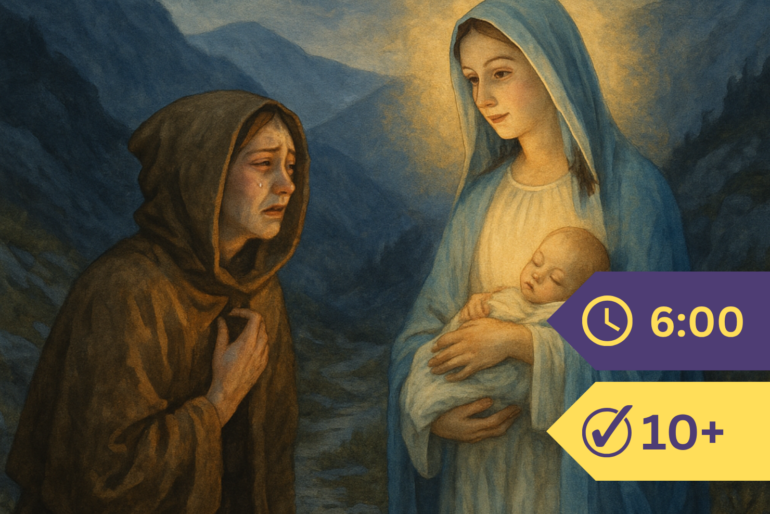
She climbed until she saw a woman of great beauty and calm, with an infant in her arms — and she knew without being told that this was the Madonna.
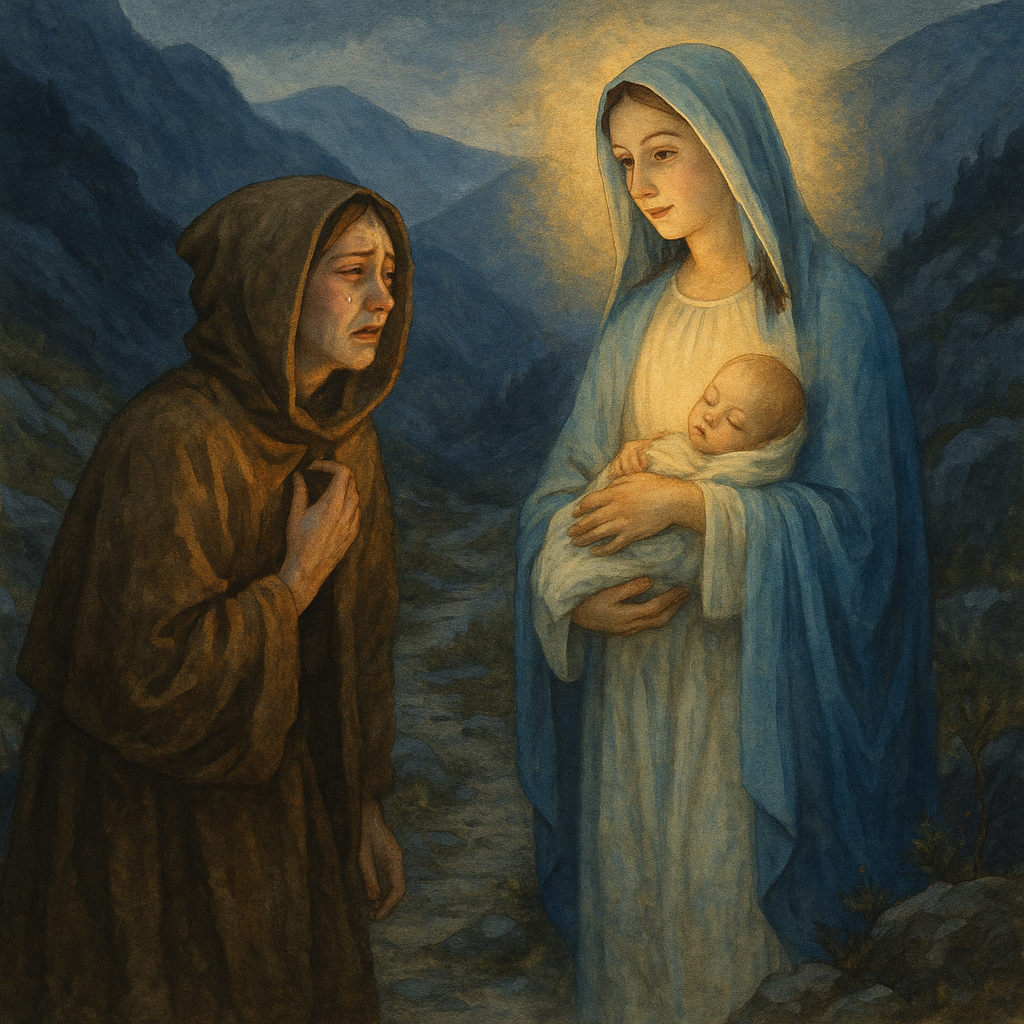
Something in that sight — a woman like herself, also holding a child, yet shining with a peace she did not understand — eased her grief enough that she could speak. She poured out everything: her exile, her dead children, her husband who was far away and would be told lies about her.
“I want to go to the shrine of St. James,” she said, “to pray for my husband’s heart to be turned back to me. But how can I leave these children?”
“Leave them with me,” said the Lady. “They shall be with my child. Go, and be at peace.”
So the queen put on a pilgrim’s cloak and went to Galicia.
When the king returned from the wars, the viceroy poured poison in his ear about the queen. The king’s own mother believed it too. But in the king’s heart he could not believe her guilty, and so he put on a pilgrim’s cloak himself and went to the shrine of St. James to pray that the truth would be brought to light. And the viceroy, seized with remorse, went on the same journey in secret, unknown to anyone.
And so it came about that all of them — the parents who had built the hospice, their son who had done penance for years, the king, and the viceroy — gathered together one evening under the same roof, strangers to each other. When the day’s pilgrimage was done, they all sat in the great hall and told stories of what they had seen and suffered. One among them said nothing.
“And you, friend,” said the king, “why do you tell no story?”
The one who had been silent — dressed as a peasant, impossible to recognize — rose and began to speak. A husband and wife had made a vow, she said, and two children were born to them, and she pointed to the founders of the hospice: “just such people as you might be.” And a parish priest had slandered their daughter, so that her brother came home and stabbed her and threw her in a ditch, and she pointed to the young man: “just such a one as you may have been.” But the daughter was not dead, and a king found her and married her, and she had children, and was happy until the king went to war and the viceroy ruined her, and she pointed across the room: “just such a man, strong and dark, as you may be.” And the king came back and was told evil of his wife, but he was noble and loving and would not believe it in his heart, and went on pilgrimage to pray for her, and she pointed to the king: “just such a one as you.”
One by one, as she spoke, they all stood up. “How does this peasant know the story of my life? Who sent them here to speak it?”
“My old grandfather,” she said, “sitting by the fire.”
“That cannot be,” they said. “You have told each of us our own history. Tell us who you are — we will not rest until we have made right what has been done.”
And then she took off her hood, and they knew her, and everyone gathered around her, and there was great weeping and embracing. The king took her hands and said, “What shall we do with the viceroy, for all that you have suffered?”
“Nothing,” she said. “He has come to the shrine of St. James. God will forgive him. Let him find peace.”
They stayed together several days, and when they left, the queen and king went back by way of the mountain where she had left her children — and found them well and laughing, playing with the Madonna’s own child. The Lady gave them back, blessed them, and went up to heaven. And in that place, the king and queen built a chapel.