It was the Thursday before Christmas, grey and bitterly cold, with a north-east wind making all the houses look small and huddled. Cuthbert had just been to call on his friend Edward, but Edward had gone to sit by the railway, collecting engine numbers. Cuthbert was collecting too, but it was the dates on pennies, and he didn’t feel like sitting about in the cold. He was wondering what to do when his friend Doris turned the corner.
“Come out to tea at my uncle’s,” he said, and she was glad, because she had nothing to do.
“Let’s cut across the fields,” she said, “past old Mother Hubbard’s. It’s jolly cold. I think it’s going to snow.”
“I hope it does,” said Cuthbert.
It was cold enough, with horses standing miserably under bare hedges and the wind crumbling the ploughed ridges into powdered chocolate. They passed the house they called Mother Hubbard’s: a gloomy place standing by itself, with all its blinds and curtains drawn. Behind it were ruined stables with a tin roof that flapped up and down, and a big yellow dog on a long chain ran out and barked at them.
It was called Mother Hubbard’s because it belonged to a Miss Hubbard, who lived there alone and had let nobody through the door since her father died fifty years ago. He had been a proud old general with a bad temper. Some said he had driven her mad, others that she was only odd and hated everybody except her dog. Occasionally you could see her peering round a blind, or feeding the dog in the stables, and once a week she went into town with a big bag to do her shopping. The shopkeepers said she was perfectly polite, and so did the postman. But she kept her own counsel and no one could make her talk. Some said she was poor and had promised her father never to let on. Others said she was quite rich and had suffered some great sorrow. She was nearly eighty now, though her eyes were clear and her cheeks bright, and a few old people remembered her as a girl, galloping over the fields on horseback.
“Silly old thing,” said Doris. “I shouldn’t be surprised if she were a witch.”
Cuthbert said there were no such things. Perhaps she had killed somebody and had a guilty conscience.
They crossed a road and climbed a stile and skirted a field pricked with tiny wheat blades, and slid down a bank into a sheltered, muddy lane. Just then a young man on a horse came clattering towards them, splashed to the eyes, his bowler hat jammed down. “Which way have they gone?” he shouted, and didn’t wait for an answer. More riders followed, men and women, and turned into a grass meadow where it was easier to gallop.
“It’s the hunt!” said Doris. “Let’s run after them.”
They ran down the lane, saw riders jumping a gate across the meadow, and scrambled over it just in time to see the last horseman vanish over a hedge. They heard a horn blow. “They’ve seen the fox!” cried Doris. From a little rise they saw the whole hunt streaming away across the fields.
They were so hot from running that they’d forgotten the wind and the grey clouds over the downs. They ran across a road, over more fields, past a wood, and came to a sluggish stream between pollarded willows. On one of the trees stood a man, who waved to them.
“They’re coming back,” he said. “Keep along the stream and you’ll see some fun.”
It was nearly four, and the light was fading, and Uncle Joe’s was a long way off. But they pushed through the tangled grass to a plank across the stream, and came out by a hazel copse. They heard the horn again, not far off, and the deep calling of hounds. Something cold touched Cuthbert’s cheek.
“It’s snowing.”
A burly man on a big grey mare came crashing through the undergrowth on the other side. He shouted, they jumped aside, and the horse rose to clear the water. The next moment the man was sprawling on the ground in front of them with his scarlet coat round his ears. He swore, but he was laughing as he picked himself up and helped his horse out of the stream, and soon he was back in the saddle and vanishing into the dusk. They waited, but nobody else came. An old cock pheasant clattered out of the copse. The horn blew once more, and all was still. Their breath hung like smoke.
Doris stooped and picked up a coin that had been half trodden into the bank. “He’s dropped a penny. Add the date to your collection.”
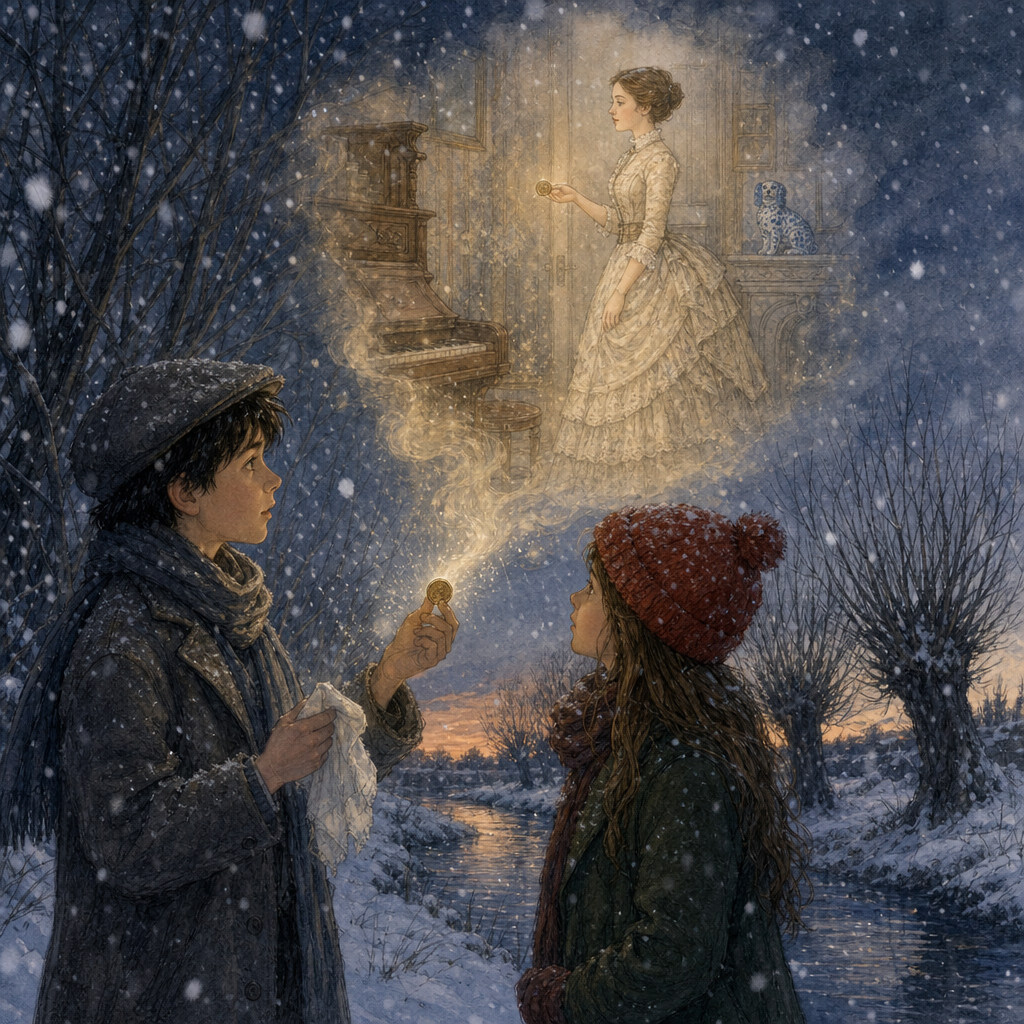
Cuthbert took it. It was an old one and the date was hard to see. The snow began to fall in heavy flakes. He took out his handkerchief and polished the coin. And then something odd happened. As he rubbed, the stream and the hazel copse seemed to fade, and a young woman was standing in a room, holding out a penny.
“A penny for your thoughts,” she said.
She wasn’t speaking to him but to somebody else, and the thoughts that came into Cuthbert’s head weren’t his own but a grown man’s. He knew they were someone else’s because he was still thinking his own thoughts too. The other person’s thoughts were of two kinds: the weak thoughts that he decided to tell the girl, and the strong thoughts that went into the penny.
The thoughts he told the girl were that when he got to South America he was going to study the birds there. He would write a book about them, and perhaps afterwards he’d get a job looking after a museum. But the strong thoughts he didn’t tell her were: I love you and want to marry you. But I mustn’t tell you, because I’m only a carpenter and you’re a lady, ever so far above me.
“What’s the matter?” said Doris.
Cuthbert handed her the penny. “It’s a queer sort of penny. Catch hold of it.”
“I don’t see anything queer.”
He polished it again, harder, until it was warm, and when he gave it back Doris seemed to be standing in a strange room full of old-fashioned furniture and heavy ornaments. The same girl said, “A penny for your thoughts,” and the same thoughts came to Doris as had come to Cuthbert. The day was almost dark now, and snow was glistening on their shoulders.
“I know what’s happened,” she said. “His real thoughts were so strong they went into the penny.”
“And when you rub it, they come out.”
“Did you notice her dress? And how her hair was done? And the blue china dog on the mantelpiece?”
Cuthbert shook his head. “Let’s have another go.” He rubbed as hard as he could, and this time he noticed the room: a high-backed piano, a picture of people hunting on the wall, the blue china dog, and the girl’s dress, in layers like a wedding-cake. Her hair was pulled back into a smooth bundle behind her head.
“It must have been a long time ago,” said Cuthbert. “Do you think he was the man who fell off the horse?”
“He was much too young,” said Doris. “And besides, I’m sure he was never a carpenter.” She shivered. “We should be getting home.”
But Cuthbert lingered, looking at the penny. “Hundreds of people must have had it in their pockets and never known what was inside it.”
“I daresay. But I’m jolly hungry, and we must be miles from anywhere.”
They weren’t even sure where “anywhere” was, but they crossed the plank again and started home, the snow driving past their ears and piling up in front of their feet. Grey-capped hedges loomed out of the darkness, and the snow lay so thick that they couldn’t tell whether the next field was ploughed. Hours seemed to pass. They felt emptier and emptier. They stumbled into ditches, and the snow melted on their necks and trickled down their backs. They thought longingly of Uncle Joe’s, of hot muffins by the fire, of bread and milk at home. Every field seemed longer than the last, and the night closed down like a lid, and their feet felt heavier than ten-pound weights.
“I believe we’re lost,” said Cuthbert, but Doris didn’t seem to hear. They toiled on with sinking hearts, and then, just as they were nearly spent, their knees knocked against a little gate. It was the sort that leads into a garden path. They pushed it open and plunged through the snow beyond, and found themselves in front of a door, with a gleam of light shining through the letter-box.
They knocked for a long time. Nobody came. They shouted through the letter-box. Still nobody. Then, from behind the house, they heard a dog bark.
Doris gripped Cuthbert’s arm. “It’s old Mother Hubbard’s. That’s her dog.”
“Then we’ll never get in,” said Cuthbert. But just as he said it they heard footsteps coming down the hall.
“Who’s there?” said a voice, with a creak in it like a drawer that is seldom opened. Cuthbert told her. After a long pause the door opened a little. A swirl of snow blew in, and the door opened a little more.
“You’d better come inside,” said Miss Hubbard.
They stepped into the hall, her first guests for fifty years. She stood looking at them over a flickering candle. Her eyes were frostier than the wind. The air smelled like a tomb, and they could hear the ticking of several clocks.
“Come into the scullery and shake off the snow.” She led them to the back of the house, left them for twenty minutes, and came back to invite them to tea.
“It’s in the drawing-room. I hope you won’t talk. I’m very strong and I have a big dog.”
They followed her into the drawing-room. And then something even more wonderful happened. Cuthbert stopped short, and so did Doris. Miss Hubbard turned and stared at them.
“What are you gaping at?”
“Why, it’s the penny room!” said Cuthbert.
And so it was. There was the high-backed piano, and the hunting picture, and the heavy old ornaments.
“But where’s the dog?” said Doris. “The blue china dog that stood on the mantelpiece?”
Old Miss Hubbard had turned quite white. “The blue china dog? What do you know about that? It was broken thirty years ago.”
“But it’s the same room,” said Cuthbert. “And there was a girl in it, and she gave a man a penny for his thoughts.”
Miss Hubbard began to tremble. She sat down heavily. “But how do you know? You’re only children, and that was more than fifty years ago.”
Cuthbert felt in his pocket and drew out the penny. “This is the penny the girl gave him. We found it by accident. He didn’t tell her all his thoughts. He only told her some. The rest are in here, and we made them come out.”
He polished it with his handkerchief and gave it to her. They stood watching. She sat quite still for about five minutes. When she looked up, her voice had changed.
“If I tell you a story, will you let me keep it?”
Cuthbert looked at Doris, and Doris nodded.
“Of course. We’d be very pleased.”
So while they had tea she told them that long ago a girl lived in this house and fell in love with a young man, a carpenter by trade. But he was also a naturalist, especially fond of birds, and wanted to discover all sorts of things about them. One day he told the girl that he was going away to work on a railway in South America. He hesitated, as if he wanted to say something else, and she gave him a penny for his thoughts. Then he left the house, and was drowned at sea, and the girl never knew whether he had loved her or not.
“It was very silly of him,” said Miss Hubbard, “not to tell her. But perhaps the girl was sillier still. She was so sad that she wasted her whole life. And now it seems he loved her after all.”
She went to the window and pulled up the blind. The storm had died down; it had stopped snowing. The stars shone in their thousands, brighter than eyes at a Christmas party. Cuthbert and Doris said they must go, and Miss Hubbard took them to the front door.
“You must come and see me again. Come as often as you like. And next time perhaps you’ll bring some of your friends.”
“But she never told us,” said Cuthbert, “who the girl was.”
“Why, you silly,” said Doris. “It was Miss Hubbard herself.”
A short companion poem on the lonely woman in the house, left in the author’s words.
Old Mother Hubbard went to the cupboard
To fetch her poor dog a bone,
But this Mother Hubbard in her heart’s cupboard
Lives in the dark alone.
Sorrow’s grey dust on the chandelier
Never a sun-ray sees,
Never a finger stirs the blind,
Nor the harpsichord’s yellow keys,
Dumb is the clock with the china face,
The carpet moulds on the floor;
Oh, won’t you come down to her house with me
And open Miss Hubbard’s door ?