I.
Though there was wrong on both sides, they would never have separated had it not been for the old man.
He was Ben’s father, and Ben was an only child — a spoiled, selfish, hot-tempered young man who had grown up believing that his father, Anson English, was far richer than he really was, and that he had no need for personal effort or purpose beyond the pursuit of pleasure.
Ben’s mother had died when he was fifteen, and his father had never remarried. It was not allegiance to her memory that kept Anson from a second marriage. He remembered her, to be sure — scarcely a day passed without her name on his lips. But in death as in life he used that name as a byword for everything undesirable. He compared everyone to “‘Liz’beth,” always to her disadvantage. He had a word of praise for every housewife in the neighborhood except his own. Whatever went wrong, indoors or out, “‘Liz’beth” was the direct or indirect cause.
During the first five years of her marriage, Elizabeth had tried desperately to please her husband. She wept herself half-blind over her repeated failures. Then she understood that she had been attempting an impossible task, and grew passively indifferent — an indifference that lasted until death kindly released her.
Elizabeth had been a tidy housekeeper in those early years. “You’d scrub and scour a man out of house and home!” was all the praise her husband gave her for her cleanliness; and to his neighbors he would often say, “Liz’beth’s at it again — sweeping and cleaning, so I cleared out. Never see her without a broom in her hand. I’d a good deal rather have a little more dirt than so much tearing ’round. ‘Liz’beth tires me with her ways.”
Yet when, in the despair that seized Elizabeth toward the end of her life, she allowed the house to look after itself, Anson was no better satisfied. “I’ve come over to find a place to sit down,” he would tell his neighbors. “‘Liz’beth’s let things accumulate till the house is a sight to see. She’s getting dreadful slack. A man likes order when he comes home to rest.”
Even when she died, she displeased him by choosing a busy season for it. “Just like ‘Liz’beth, to die in haying time,” he said. “Everything had to stop — hay spoiling, men idle. Women never seem to have any system about such things, no power of planning to make it convenient for men folk.”
Yet after she was gone, Anson felt how much help she had been to him, how careful her economy, how modest her expenditures. He knew he could never find anyone to replace her in these respects, and as money was the main consideration in his mind, he concluded it would be better economy to remain a widower and hire his work done.
So during the most critical years of Ben’s life, the boy had grown up without a woman’s care or guidance. By eighteen he was as arrogant, conceited, selfish, and hot-tempered as a young man could be. Yet he was a favorite with the young women of the neighborhood, for he had a fine figure and a warm, coaxing manner when he chose to use it.
Anson had begun to think it would suit everyone if Ben married and brought a wife home. A wife could do the housework better than hired help and keep the money in the family. Ben would stop wasting his time and means on half a dozen different women, stay home, and settle into a sensible man of business. Yes, Ben ought to marry — and his father told him so.
Ben smiled. “I’m already thinking of it,” he said. He had expected opposition, and was surprised by his father’s encouragement.
“Good,” continued the old man, as Ben already called him. “I’d like to see you settled before you’re twenty-one. But you want to make a wise choice. There’s Abby Wilson — she’s strong as a man and afraid of nothing. And her father has a fine property. Abby’ll make a vigorous helpmate, and she’ll come into money in time. You’d do well to court Abby, Ben.”
Ben gave a contemptuous laugh. “I’d as soon marry a dressed-up boy,” he said. “She’s more like a man than a woman in her looks and ways. I have other plans, father. I mean to marry Edith Gilman, if she’ll have me — and I think she will.”
A dark frown crossed Anson English’s face. “Edith Gilman? That slight little schoolteacher with her baby face and soft voice will never help you get a living, Ben. What are you thinking of?”
“Love, father, I suppose. I love her, and that’s all there is to it. I’ll marry her if she’ll have me, and you can like it or not, as you please. She’s a good girl, and if she’s treated well, she’ll make a good wife. She’s the only woman who can put a check rein on me when my temper’s up. She’ll make a man of me yet.”
“But she can’t work,” the father insisted. “She looks as pale and slight as ‘Liz’beth did the year she died.”
“She’s overworked in the schoolroom. I mean to bring her home and give her a rest. I don’t ask a woman to marry me and be my drudge. My wife will have household help.”
The old man groaned. Ben’s notions were positively ruinous. But it was useless to oppose. Ben would do as he pleased — that was plain — and his father might as well accept it.
He did accept it, and Ben married Edith on his twenty-first birthday, and brought her home.
II.
Edith was a quiet young woman with a soft voice, a pale sweet face, and a slight figure. When she entered the house she came to Anson English and placed her hands timidly on his arms.
“I want you to love me,” she said. “I have had no father or mother since I can remember. I want to call you father, and to make you happy if I can.”
“Well, I’ll tell you how,” the old man retorted. “Dismiss the hired girl and make good bread. That’ll make me happy.” He laughed harshly.
Edith shrank from his rough words, so empty of the warmth she had hoped for. But she let the girl go within a week, and tried to make good bread. It was not a success, and the old man made his dissatisfaction known. Edith left the table in tears.
“Another one who cries — ‘Liz’beth was always weeping over every little thing,” sighed the old man.
In time Edith mastered bread-making and became a skilled cook. But she pleased her father-in-law no better for it. “You’re always fixing up some new sort of nonsense for the table,” he told her. “‘Liz’beth had a taste for this kind of thing, but I cured her of it.”
“Yes, and you killed her too,” cried Edith — the first time since her marriage that she had answered back. “Everyone says you worried her into the grave. But you won’t have such easy success with me. I will live just to defy you, if nothing else, and I’ll show you that I won’t bear everything.”
It was over in a moment and was never repeated. Indeed, Edith was kinder and gentler in the days that followed, as generous natures often are after they have once broken the rules that govern their lives.
Yet the old man spoke of Edith as a shrew after that. “She’s worse than ‘Liz’beth,” he would say, “and ‘Liz’beth had a temper that could singe things.”
Ben spent most of his evenings — and a good part of his days — at the village store. He came home the worse for drink on occasion, and was utterly indifferent to the farm and family. “She’s just like ‘Liz’beth,” the old man told his neighbors. “She doesn’t make home entertaining for her husband. But Ben isn’t steady like me, and he goes wrong. The right kind of woman could keep him at home.”
When a child came, things seemed to mend for a time. As long as the infant lay pink and helpless in her mother’s arms, she was a bond between them all. Once she grew into an active little girl with her own will, she became another point of contention.
The old man did not think Edith capable of managing the child. Ben was harsh and impatient; he could not bear to hear the baby cry. So he stayed away more, and was an object of fear to the child and of grief to her mother when he did return.
They drifted further apart, and the old man steadily widened the breach between them. They had been married six years, and little Eva was four, when Ben struck Edith one day and told her to take her child and get out.
She was gone within the hour. No one knew where.
“She’ll come back, more’s the pity,” the old man said. “‘Liz’beth tried to leave me once, but she thought better of it.”
But Edith did not come back. Months later they heard she was teaching school in a distant part of the state, supporting herself and her daughter.
Ben sued for divorce on the grounds of desertion. Edith never appeared against him, and the divorce was granted.
III.
One year after Edith left, Ben married Abby Wilson. She had grown into a bold, handsome woman, dashing in dress and manner. Her father had died recently, leaving her a fine property. She had always wanted Ben, and she let nothing slow the wedding.
The old man was well pleased. After all this time, Ben was finally married to the woman he had chosen for him years ago. Surely now Ben would settle down and lift the burden from his aging shoulders — for in truth, the old man was wearing out.
He fell ill with a fever not long after the second marriage, and when he rose from his bed he seemed ten years older. His fault-finding grew more fretful, and this new wife of Ben’s had little patience for it. She was nothing like Edith. She bullied him and frightened him into silence when he dared to criticize her extravagances — and she was extravagant, there was no denying it. She cared only for show, neglected the house, and often left the old man to fend for himself while she and Ben drove through the countryside behind the fine horses she had insisted he buy.
Poor old Anson English. He was nearing sixty now and looked older. Ben was his only tie to the world, and had proved to be a broken reed. He would never amount to anything steady or practical. And this new wife encouraged every reckless indulgence instead of curbing it. Somehow Ben had never been the same since Edith went away. Whatever gentleness had been in him seemed to have left with her.
And struggle as he might against the feeling, the old man missed the child.
No — he was not happy in the state of affairs he had so rejoiced over. He grew very old in those next two years. Ben’s wife had subdued him with her loud voice and forceful manner, and he had been too cowardly at heart to resist. He spoke little at home now, but he still visited his neighbors, and he remained fixed in his conviction that Elizabeth had been the source of all misfortune in his life.
“Ben’s early training wasn’t right,” he would confess. “‘Liz’beth, she let him do as he pleased. She never knew how a boy should be raised. He’d have turned out all right if I’d had the managing of him from the start.”
Strangely, he never once spoke a critical word about Abby. Her harshness and neglect were common knowledge in the neighborhood, but the old man who had been so bitter about his first wife and about Edith seemed to hold a curious respect for this woman who had mastered him. Perhaps he remembered how eagerly he had wanted the match, and pride kept him silent. Whatever the reason, he bore her abuse without complaint and sometimes spoke of her with something like admiration. “She’s a brave one, Abby is. Afraid of nothing and nobody. She’d have made a mark in the world if she’d been a man.”
Ben drank more and more. The farm ran down, and debts accumulated — debts that Abby refused to settle with her own money — and the old man watched the savings of a lifetime squandered.
People said the worry was affecting his mind, for he talked to himself constantly as he walked the roads. Then he fell ill again and was delirious for weeks. When the fever finally left him, he was completely blind and entirely helpless.
He needed constant care and could not be left alone for an hour. Ben was seldom home, and Abby resented the burden. Hired help refused to manage the troublesome old man without higher wages than Ben could pay and Abby would allow. Servants left; Ben’s absences grew longer; and Abby finally carried out a plan that had cost even her hard heart a twinge or two.
She applied to the county authorities to have her husband’s father admitted to their care.
“He’s not in his right mind,” she told them. “We can’t manage him. Ben’s never home, and I’m not equal to it alone. He talks and cries half the night. He’d be far better off where he could get proper attention.”
The authorities looked into the matter and found that at least some of what she said was true: the old man would plainly be better cared for by the county than in his son’s home. So he was taken away, and Abby was free at last.
“We’re taking you somewhere you’ll have proper care,” they told him gently. “It’s your daughter-in-law’s wish.”
“Oh, yes — Abby thinks I’ll get my sight back if I’m properly looked after. Well, maybe. I’m getting on in years for doctoring to do much good. But Abby has a powerful mind for planning things. ‘Liz’beth never would have thought of something like this — ‘Liz’beth was too easygoing. Abby ought to have been a man, she had.”
So he rambled on as they carried him to the poorhouse.
It was November, and the holidays were close at hand. Abby meant to enjoy them. She invited all her relations for a season of feasting and merrymaking.
“I feel as if a great weight has been lifted from me now that the old man has gone,” she said. “He’ll be so much better off there, and so much better cared for. They’re very kind in that institution — very clean and pleasant — and he’ll have company so he won’t be lonesome. We never would have sent him there otherwise. It’s really an excellent home for him.”
IV.
It was just a year later when a slight, sweet-faced woman was shown through the wards of that excellent home for the poor and unfortunate. She walked quickly, her eyes moving from room to room and face to face, searching for something she both hoped and dreaded to find.
Presently an attendant pushed open a half-closed door leading into a small, airless room with one high narrow window. “This is the room, I believe,” he said, and the woman stepped inside and stopped.
The air was close and stale. On the far side of the room stood a large crib fitted with a cover that could be lowered and fastened when needed, but which stood open now. On a thin mattress and a soiled pillow lay the wasted form of an old man. He turned his sightless eyes toward the door at the sound of footsteps.
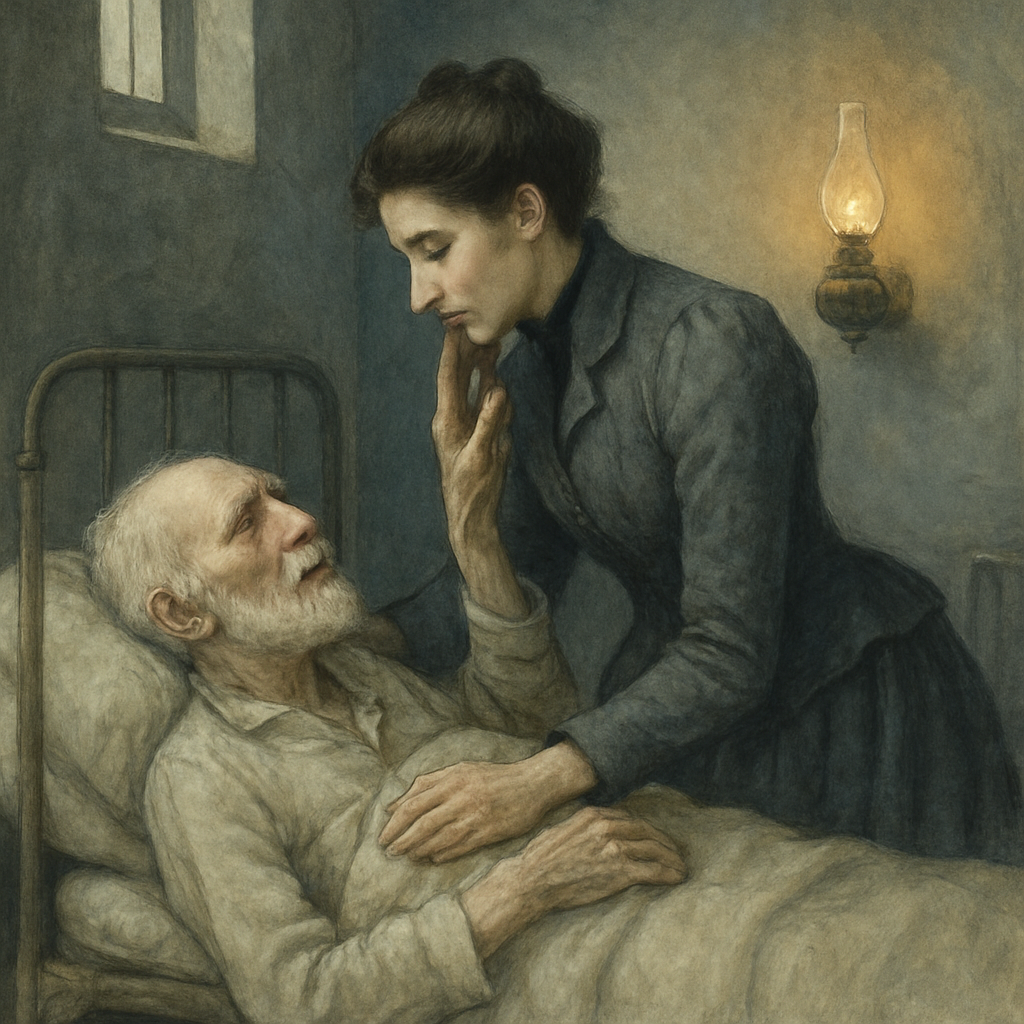
“Who’s there?” he asked faintly. “Has someone come for me?”
“Oh, father, father!” cried the woman, her voice breaking with sobs. “Don’t you know me? I’ve come to take you home. Will you come?”
A glow of happiness passed over the old man’s wasted face like the last light of sun on a winter afternoon. He raised himself on one elbow and leaned forward as if trying to see.
“Why — it’s Abby! Abby, come at last!” he said. “You called me father, didn’t you — and you were crying, so your voice sounded strange. But you must be Abby, come to take me home. I thought you’d come at last. It has seemed such a long, long time. And you’ve never once been to see me — nor Ben either. But you’ve come at last. Let me take your hand, daughter, for I can’t see yet. They don’t seem to have helped me much here. And I’m so hungry, Abby. Do you think you could get the old man something to eat before we start home?”
The woman had grown paler and paler as she listened to the words that poured out of the old man in an eager rush, as if thoughts and feelings long bottled up for want of anyone to hear them were tumbling free all at once.
“He doesn’t know me,” she whispered. “He doesn’t know me. Well — I will not undeceive him. He is happy in this mistake. Let him keep it.” Then, aloud: “You’re hungry, father? Don’t they give you enough to eat here?”
“Oh, I have my share. But my appetite comes and goes, and sometimes when they bring it I can’t eat, and when I want it most I can’t get it. I’m one of many here, and I’ve been so lonely. But I always knew you’d come for me in time. And Ben — how is Ben? Does he want to see his old father? Ah, Ben was a fine little boy. But ‘Liz’beth was never the right sort of mother for a high-spirited lad. And then he shouldn’t have married that sickly young woman who ran off and left him. What a temper she had! It sort of broke Ben down, living with her as long as he did. But he hasn’t forgotten his old father — he wants me home to die with him. Ben has a good heart after all.”
“I must not tell him. I must not,” whispered the woman. Then, with a visible steadying of herself, she said aloud: “Ben is away from home just now, father. He won’t be there to meet us — but you won’t mind that. I’ll make you very comfortable. I want you at home for the holidays.”
And so the old man left the gloom and loneliness of the poorhouse for the comfortable home that Edith had made for herself and her daughter in the years since she had left Ben. Eva was nine now — a bright, thoughtful child, old beyond her years. When Edith had learned of the old man’s fate, she had resolved at once to bring him home. Eva could look after him during the day while Edith was at the school, and in the evenings Edith could fill in whatever her daughter had missed of her lessons — or hire help if the old man proved as difficult as people said. He had been a hard man, and had done much to widen the gulf between her and Ben. But he was Ben’s father, and she could not let him die in the poorhouse. So she brought him home.
“I hear a child’s voice,” he said as Eva came dancing out to meet them. “Who is it, Abby?”
“Why, it’s your own granddaughter Eva!” the child cried, clasping his thin hand between her two warm palms. “Don’t you remember me? Mamma says you used to be fond of me.”
Edith’s heart stood still. Surely now he would understand. Would he be angry?
The old man’s face brightened. “Ah, I see,” he murmured slowly. “Abby and Ben have taken the little one home. It must be that Edith has died. She was always such a slight, fragile creature.” Then he turned toward the woman guiding his steps and asked: “Is Edith dead?”
“Yes,” she answered quietly — and added under her breath, “to you.”
He must never know the truth, she thought. The shock might kill him. Later she drew Eva aside and said: “Dear, your grandfather is very ill and his mind is not clear. He believes my name is Abby. You must not correct him, or argue with anything strange he may say.”
The journey had left the old man very weak, but he talked nearly without stopping. “It was so good of you, Abby, to take the little girl home,” he would say again and again. “I knew you had a kind heart, and Ben too. He was fond of his old father, for all his rough ways. It was very lonely at that place — that institution where you sent me. Some people said it was the poorhouse, but I knew better. Ben and you would never do that. I suppose it was a fine enough place, but there were too many patients. Sometimes I was cold and hungry and alone for hours on end. Oh, it’s good to be back with you, Abby. But why doesn’t Ben come?”
“Ben is away, father.”
“Of course — business, I suppose. Ben will turn out all right at last; I’ve always thought so. I hope he’ll be back for Christmas. I’ve been thinking lately about Christmas when Ben was a little boy. We always put something in his stocking that night, even if it was only a little cake. My, how he treasured what he found there Christmas morning! I lay at that institution last Christmas, thinking of it all, and I cried like a child, I was so homesick. It seemed to me that if I could just see Ben’s face again I’d want nothing more. And now — I think if I can just hear his voice once more, that will be enough. Do you think he’ll be home for Christmas, Abby?”
“I hope so, dear father — but I cannot say.” Edith answered softly, her heart aching within her.
She knew perfectly well that Ben would not cross the street to see the father he had abandoned, and that she could never bring herself to send for him to come to her house, even on such an errand of mercy.
What will I do, she thought, how will I explain it when Christmas comes and Ben does not appear?
But the question was answered for her, as such things sometimes are.
On Christmas Eve the old man’s talk grew wandering and incoherent. He spoke of people and times long past, and called his mother’s name over and over. Then he fell asleep.
In the morning he seemed very weak, and his voice had grown faint.
“Such a strange dream I have had, ‘Liz’beth,” he said as Edith smoothed the thin white hair from his forehead. “I dreamed Ben had grown into a man and left me all alone to die. I’m so glad to wake and find it isn’t true. How dark it is — how long the night seems. Tomorrow is Christmas. Did you put something in little Ben’s stocking, ‘Liz’beth? I’ve forgotten.”
“Yes,” answered Edith, in a voice she could barely keep steady.
“It’s getting colder, ‘Liz’beth. You’d better look in on Ben. See if he’s covered up warm in his crib. You’re so careless sometimes — the boy will take a chill yet. And he’s all I’ve got. He’ll be a fine man, a fine man, if he’s given the right start. Is he covered up? It’s bitter, bitter cold.”
“He is well covered,” Edith answered.
The old man seemed to doze. Then he stirred.
“It’s dawn,” he said. “I can see the light breaking. Little Ben will be creeping out for his stocking soon. I should have had the fire going already, to warm his little feet. Strange that you couldn’t have waked me, ‘Liz’beth. You never did seem to have much foresight.”
Then the old man sank back against Edith’s arm, and was still.