I.
The poor little one had stopped moaning. She turned her head slightly and stared with wide eyes at the faces around her bed. Her breath came fainter, fainter — and then stopped altogether. She was dead. The guardian angel uttered a deep sigh, unfolded his wings, and flew away.
The mother could not believe in so much sorrow. But Celinina’s exquisite face was already growing pale and waxy, her limbs were cold, and her small body had become rigid and still, like a doll’s. The mother was led away to the bedroom, while the father, the nearest relatives, a few friends, and the servants performed their last gentle duties.
They dressed her in a beautiful gown of white lawn, light as a cloud, covered with frills and laces that looked like sea-foam. They put on her shoes — white too, their soles showing that they had taken only a few steps in the world. They braided her lovely dark-chestnut hair and arranged it gracefully around her head, weaving in blue ribbons. They tried to find fresh flowers, but the season was too far along and there were none to be had; so they made her a wreath of artificial blossoms, choosing only the most beautiful, the ones that might have been mistaken for flowers just cut from the garden.
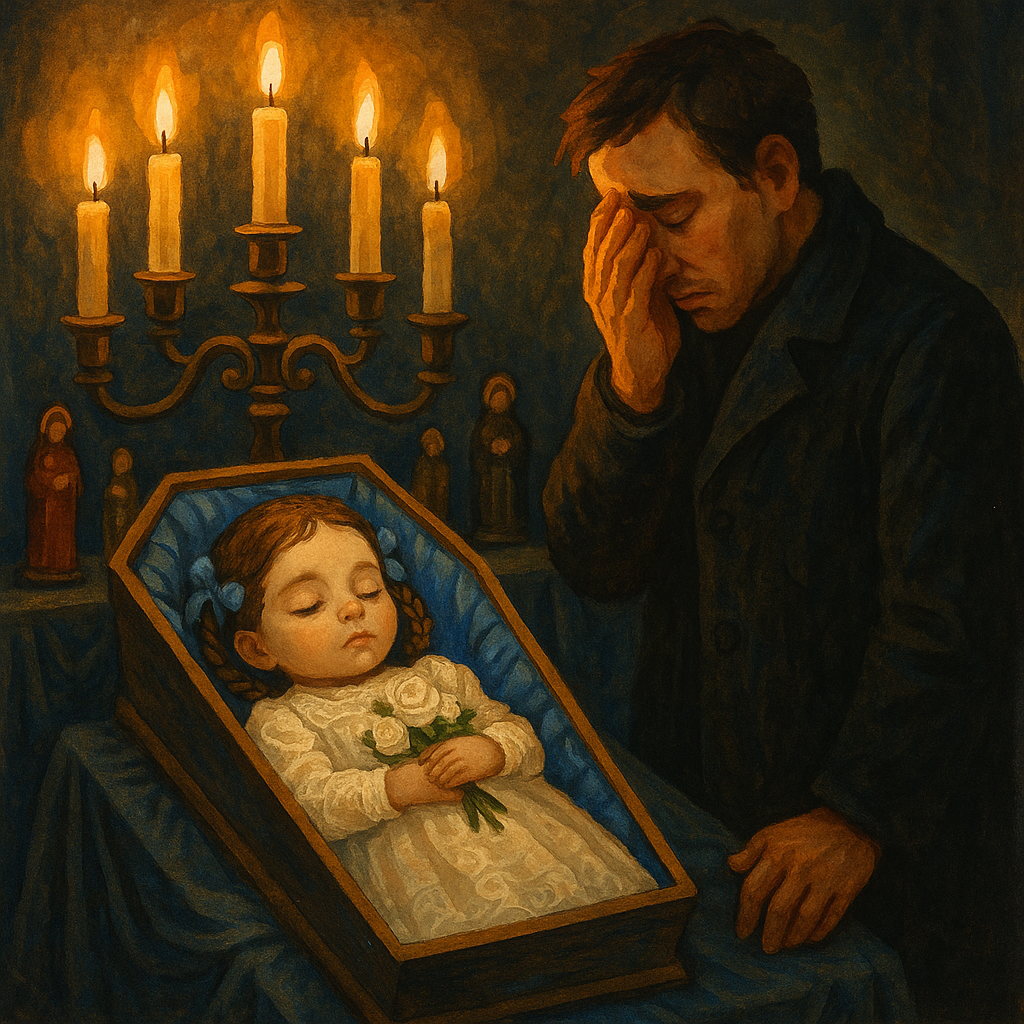
Then a solemn-faced man arrived with a box — just a little larger than a violin case — lined with blue silk and trimmed with white satin and silver braid. They laid Celinina inside, placing a soft pillow beneath her head so she might seem at rest. They crossed her little hands, tied them gently with a ribbon, and slipped a bunch of white roses between them — roses so perfectly made that they seemed children of Spring itself.
The women draped the table in gorgeous cloth, adorned it like an altar, and set the coffin upon it. They arranged white curtains around her like a church canopy, caught back on either side. They brought in saints and images from the other rooms and arranged them in careful symmetrical groups, forming a kind of reverent court around the little departed angel. They lit the great candelabrum from the parlor — several dozen candles — whose mournful glow fell over Celinina. Then they kissed her cold cheek again and again, and their pious task was done.
II.
From the far end of the house, from the depths of the bedroom, came the sounds of a man and a woman — the heartbroken laments of parents who could not be consoled by the usual words friends offer on these occasions, those gentle phrases about angels in heaven administered like medicine. They believed, on the contrary, that this world is the proper and natural home for angels. They could not accept the theory that a child’s death is somehow less terrible than an adult’s. Their grief was sharpened by that particular pity which a dying infant always inspires — a pity unlike any other pain in the world.
A thousand memories struck at their hearts like daggers. The mother’s ears rang with Celinina’s lispings — that enchanting baby-talk that gets everything delightfully wrong, that turns ordinary words into tender little caricatures. Her little pink tongue had said wat for hat and called a bean a ween. The vocabulary of a three-year-old is the real literary treasure of a family.
No matter where the mother turned, her eyes fell on the toys with which Celinina had spent the last days of her life. Since these were the days before Christmas, the floor was strewn with little clay turkeys on wire legs, a Saint Joseph who had lost both hands, a manger with the Christ-child lying inside like a tiny pink ball, and a Wise Man from the Orient mounted on a proud but headless camel. What these poor little figures had endured in the past few days — dragged here and there, posed this way and that — was known only to God, the mother, and the small spirit that had taken its flight.
All this broken statuary was imbued with Celinina’s soul. It was clothed in a peculiar sad light — the light from her, as it were. The mother trembled as she gazed at them. How those broken pieces of clay seemed to weep! They were so full of sorrow that the sight of them was scarcely less bitter than the memory of the dying child herself, who had looked up at her parents with pleading eyes, begging them to take the pain away from her burning head. Nothing — nothing at all — had moved the mother more than the turkey with the wire legs, which had lost its crest and bill from so many changes of posture.
III.
The mother’s grief was intense, but the father’s was still more profound. She was pierced through with sorrow; his pain was sharpened by remorse.
Here is how it came about.
It may seem very childish to some people. But bear in mind that nothing is more open to childishness than a deep, pure sorrow — one free from worldly interests or the bitterness of wounded pride.
From the very beginning of her illness, Celinina’s mind had been filled with dreams of Christmas — the celebration supremely delightful to children. We all know how they long for it: the feverish excitement of presents and Bethlehem mangers, the prospect of turkey, sponge-cake, candied almonds, and almond paste. Some little ones sincerely believe that, if only allowed, they could easily stow away in their stomachs every display on the Plaza Mayor and the surrounding streets.
In her intervals of relief, Celinina gave her whole soul to the engrossing subject. Her cousins, who came to sit with her, were older and full of expert knowledge about celebrations, presents, and nativity scenes; and the poor child’s longing for toys and sweets grew more and more excited as she listened to them. In her fever-delirium, her prattle was of nothing but drums and tambourines and Christmas carols. The darkness of her mind was peopled with turkeys gobbling, chickens peeping, mountains of almond paste reaching to the sky, Bethlehem mangers blazing with light and containing fifty thousand million figures at the very least, great bouquets of sweets, trees laden with toys beyond imagining, and thousands of other inexpressible wonders.
IV.
Celinina was an only child; and when she fell ill, her father’s anxiety knew no limit. His work called him away during the day, but he ran home every chance he got to check on the little invalid. The illness moved in treacherous waves, giving and withdrawing hope.
The good man had his premonitions. The image of Celinina lying crushed with fever in her little bed never left his mind for a moment. He was watchful for everything that might cheer her — so each evening he brought her a Christmas present, something different each time, carefully avoiding sweets. One night he brought a flock of little clay turkeys so lifelike one almost expected them to gobble. The next, he pulled half the Holy Family from his pockets; then a little Saint Joseph; then the manger and the portico of the stable. One evening it was a magnificent drove of sheep led by proud shepherds; another time, washerwomen at their work and a sausage-maker at his stall, and two of the Magi — one dark-skinned and one with a white beard and a golden crown. What didn’t he bring? He even brought a small old woman indecorously spanking a boy for not knowing his lesson.
From everything her cousins had told her, Celinina knew her nativity scene was incomplete — it was missing two very important figures: the Mule and the Ox. She had no particular idea what the Mule and the Ox signified; but in her passionate desire for a perfect scene, she asked her father again and again for the two animals, which seemed to be about the only things the toy shops still had left. He promised to bring them, and made a firm resolution not to come home without them. But on the 23rd he had an accumulation of things to do: the lottery drawing took place that day; he was notified of winning a lawsuit; and two old friends managed to occupy his morning entirely. He came home without the Mule or the Ox.
Celinina was deeply disappointed. The good man was about to make it right immediately — but just then the doctor arrived. Celinina had grown considerably worse during the day, and the doctor’s words were not encouraging. In the shadow of that news, nobody thought any more about mules or oxen.
On the 24th, the father resolved not to leave the house. For a brief moment, Celinina seemed so much better that her parents were wild with hope, and the father said joyfully, “I’m going right out to get those things.”
But before he could even put on his coat, Celinina fell back into a fierce fever — like a bird, wounded in flight through the clear air, that drops swiftly to the ground. She tossed and trembled, suffocating in the hot grip of her disease, which shook her violently as if trying to drive the life from her. Yet on the broken waves of her delirium, like the single thing rescued from a shipwreck, there floated one persistent thought: the longed-for Mule and the sighed-for Ox.
The father ran out of the house like a madman — then stopped himself. This is no time to think of figures for a nativity scene. He ran from door to door, climbing stairs and ringing bells, until he had gathered seven or eight doctors, whom he brought home with him. Celinina must be saved at any cost.
V.
But apparently it was not God’s will that seven or eight physicians should interfere with the orders He had given. Celinina grew worse and worse, struggling with indescribable anguish — like a bruised butterfly quivering on the ground with broken wings. Her parents bent over her with desperate intensity, as though they might hold her in the world by sheer force of will, as though they might arrest the swift dissolution and breathe their own life into the little one who was breathing hers away.
From the street came the thumping of drums and the jingling of tambourines. Celinina opened her eyes. With an appealing look and a few grave words that already seemed to belong to another world, she asked her father for the things he had failed to bring.
In their distress, the parents thought to deceive her. Hoping to cast one last ray of happiness into this darkest of moments, they pressed the clay turkeys into her hands and said, “Look, my darling — here are the little Mule and the little Ox.”
But Celinina, even at the point of death, was clear-headed enough to know that turkeys can never be anything but turkeys. She pushed them gently away.
From that moment she lay still, her large eyes fixed on her parents, one small hand pressed to her head to show them where the terrible pain was. That faint rhythmical sound that is the last vibration of life grew quieter and quieter, until it was hushed altogether — like the machinery of a clock that has wound down — and the dear little girl became only an exquisite scrap of matter: cold, still, and as white and clear as the wax that burns on the altars.
Now you understand the father’s remorse. To bring his Celinina back, he would have scoured the face of the earth and gathered every ox and mule upon it. The thought of not having satisfied that one innocent wish was the sharpest and coldest blade in his heart. He appealed to his reason — but what good was reason? He was as much a child as the little one asleep in the coffin, and he gave more importance to a toy at that moment than to anything else in heaven or on earth.
VI.
The sounds of grief at last died away in the house, as if sorrow, piercing its way into the very depths of the soul — its natural dwelling-place — had closed the windows of the senses after it, so as to be alone.
It was Christmas Eve. While stillness settled over the house so recently visited by death, from every other house and from the streets of the city came the joyous roar of instruments and the clamorous voices of children and adults celebrating the coming of Christmas. The noise from the flat above could be heard even in the parlor where the dead child lay, disturbing the pious women keeping vigil in their grief and prayer.
Upstairs, many small children — and rather more large ones, happy mothers and fathers, excited aunts and uncles — were celebrating Christmas before the most magnificent Bethlehem manger ever dreamed of and the most splendid tree ever hung with toys and sweets, bearing a thousand little lighted candles on its branches. The parlor ceiling shook with the commotion. The poor little body trembled in its blue coffin. All the lights in the room wavered, as though they too had caught the festive spirit.
Two of the women keeping watch grew too tired to continue and retired to bed. Only one remained — but her head grew very heavy, no doubt because she had lost so much sleep in the preceding nights. After a little while, her chin sank to her breast, and she drifted entirely from consciousness.
The lights continued to waver, though there was no draught in the room. One might have thought invisible wings were fluttering about the altar. The lace on Celinina’s gown rose and fell; the petals of her artificial flowers stirred, as if touched by a playful breeze — or by tender hands.
Then Celinina opened her eyes.
They filled the room with bright, curious glances, cast up and down and all around. She unclasped her hands at once, the ribbon that bound them offering no resistance; she closed her little fists and rubbed both eyes, just as children do when they wake. Then, with a quick, easy movement and without any effort at all, she sat up — and looking toward the ceiling, she began to laugh. It was a peculiar, silent laugh, visible only to the eyes. The one sound in the room was a rapid beating of wings, as though all the doves on earth were flying in and out through the walls and ceiling, brushing their feathers against everything. Then Celinina rose to her feet, stretched out her arms, and two small white wings sprouted from her shoulders. They flapped and beat for a few seconds — and she rose into the air, and was gone.
Everything in the parlor remained as it had been. The lights glowed on the altar. The saints and images stood in their places, unsealing neither lips nor eyes. The good woman slept on undisturbed. Nothing had changed, except that the little blue coffin was empty.
VII.
What a celebration upstairs tonight at the home of the Señores! The house shakes with drums. Children cannot be made to understand that they might enjoy themselves considerably more without the merciless instrument. And to make quite certain that no ears in the building are left intact for tomorrow, they have added the zambomba — a Spanish friction drum whose low, resonant growl is the very voice of Christmas — and the tambourine, whose rattling and clashing completes the symphony. This discordant, rhythmless, glorious hubbub, this sound more ancient than music itself, is nonetheless inspiring and cheerful on this particular night, and bears something of a distant resemblance to a celestial choir.
The Bethlehem manger may not be a work of art to adult eyes, but to the children the figures are so beautiful, their expressions so mysterious, their costumes so proper, that the children can hardly believe them to be made by human hands and are inclined to attribute the whole thing to a particular order of angels who earn their living by working in clay. The entrance of the stable, carved from cork in the likeness of a ruined Roman arch, is a dream of beauty. The little river made of mirror-glass, with green patches for aquatic growth and mossy banks, seems genuinely to ripple along the table. The bridge over which the shepherds are crossing is a masterpiece: never before was pasteboard known to look so much like stone — a striking contrast to the bridges of modern engineers, who build stone bridges that look like pasteboard.
The mountain in the centre might be a piece of the Pyrenees. Its little cottages, a trifle smaller than the figures, and its tiny trees with real foliage are more convincing than Nature.
But the most beloved figures are those on the plain: the washerwomen at their stream; the turkey-minders driving their flocks; an officer of the civil guard hauling two young scoundrels off to jail; gentlemen in carriages brushing past the camel of the Magi; and Perico the blind man playing his guitar for a little crowd through which the shepherds have elbowed their way. A tramcar runs from one end of the landscape to the other — just as it does in the Salamanca quarter — and since it has real wheels and real tracks, it is kept going back and forth, much to the bewilderment of the darker Magi, who cannot make out what sort of machine it can possibly be.
The arch opens onto a little square with a glass aquarium at the centre. A newsboy sells papers nearby; two Majos dance prettily. But the most-loved figures of all — the ones every eye seeks out — are the fritter-seller and the old woman selling chestnuts at the corner, and the children nearly double over laughing at the small ragamuffin who holds a lottery ticket out to the old woman with one hand while quietly pilfering her chestnuts with the other.
In short: there is no Bethlehem manger in all Madrid to compare with this one.
VIII.
And the tree?
The tree is built from oak and cedar boughs. The devoted friend of the family who constructed it declares that a more finished piece of work never left his hands, and one cannot argue with him. The presents that dangle from its branches cannot be counted; according to the arithmetic of one small boy present, they are more numerous than grains of sand on the shore. There are sweets nestled in shells of frilled paper, little mandarin oranges that are the wee babies of the regular oranges, chestnuts draped in mantillas of silver foil, tiny boxes of bonbons in miniature portions, figures of every variety on foot and on horseback — in short, everything that the confectioner has improved upon and the toy-seller has perfected has been placed here by hands as generous as they are clever.
The tree blazes with so many little candles that, according to the testimony of a four-year-old guest, there are more lights than stars in heaven. The delight of the children is not comparable to any ordinary human feeling. It is the ineffable joy of the celestial choirs in the presence of the Supreme Good and Supreme Beauty. They stand half-perplexed, souls entirely in their eyes, anticipating everything they are about to eat, floating like angels in an atmosphere of sweetness and cinnamon and pure, unashamed childhood bliss.
IX.
And then they are startled by a sound that doesn’t come from them.
They all look up at the ceiling. Seeing nothing, they look at one another and begin to laugh. A great rushing sound fills the room — the rustle of wings brushing the walls and striking the ceiling. If they had been blind, they might have thought all the doves from all the dovecotes in the world had gotten into the parlor. But they saw nothing — no wings whatsoever.
What they did see was quite extraordinary enough.
All the figures of the Bethlehem manger began to move. They were being rearranged — quietly at first. The tramcar ascended to the very pinnacle of the mountain. The Magi walked straight into the river on all fours. The turkeys passed under the arch and entered the stable without a by-your-leave, while Saint Joseph stepped outside in bewilderment, trying to understand the commotion. Then figures began to tumble off the table entirely. The rearranging that had begun so gently became a perfect hurly-burly, as though a hundred thousand small busy hands were determined to turn everything upside down. It was a miniature universal catastrophe. The mountain was levelled. The river changed its course, scattered the broken mirror from its bed, and flooded the plain. The roofs of the little cottages sank into the sand. The Roman arch shook. Many of the little lights went out, and the sun and stars of the miniature landscape were obscured together.
In the general stupor, some of the smaller children laughed wildly while others cried. A superstitious old lady said — “Don’t you know who is doing this? It is the children who have died and gone to heaven, and whom Grandpapa God lets come down on Christmas Eve to play with the Bethlehem mangers.”
After a little while it was over. The rushing sound of beating wings faded and was gone.
People began to assess the damage, picking up figures and returning them to their places. When they counted and identified them all, they found that some were missing. They searched everywhere, and searched again.
Two figures were gone: the Mule and the Ox.
X.
Just before dawn, the disturbers were on their way back to heaven — merry as crickets, frisking and skipping among the clouds. There were millions and millions of them, all beautiful, pure, and bright, with short white wings beating faster than any bird on earth. This white swarm was greater than anything the eye can take in; it spread across the moon and the stars, and the firmament seemed filled with tiny fleecy clouds.
“Hurry, hurry, dears!” called a voice among them. “Before you know it, it will be day, and Grandpapa God will scold us for being late. To be honest, the Bethlehem mangers this year were not worth much. When I think of the ones in former times—”
Celinina was among the merry throng, but as this was her first experience at such altitudes she felt a little giddy.
“Come over here,” one of them called to her. “Give me your hand and you’ll fly straighter — but wait. What is that? What have you got?”
“‘Em’s my sings,” said Celinina, pressing two small clay figures to her chest.
“My dear, you must throw those away. It’s very clear you are just from the earth. Let me explain. Although we have all the toys we want in heaven — eternal, ever-beautiful toys — Grandpapa God lets us come down on Christmas Eve just to stir up the Bethlehem mangers a little. And we do have a glorious time in heaven tonight too; if you ask me, they send us away partly because of how noisy we are. But Grandpapa God lets us into the houses only on one condition: that we take nothing. And here you have stolen!”
These weighty reasons did not seem to have the effect they should have on Celinina. She pressed the animals more tightly to her chest and only repeated:
“My sings — ’em’s my sings.”
“Listen, little goose,” her companion continued, “if you don’t do as I say you’ll get us all into trouble. Fly back and leave them where you found them — they belong to the earth, and to the earth they should stay. Be sensible: you can go and be back in less than a minute. I’ll wait for you on this cloud.”
At last Celinina was convinced. She turned and flew back down to the earth to return what she had taken.
XI.
This is how it came to pass that the next morning, Celinina’s body — that which had been her visible self — was found holding two small clay animals instead of the bunch of artificial flowers.
No one could explain it. Not the women who had kept watch. Not the father. Not the mother. And the beautiful little girl, for whom so many tears were shed, went down into the earth with the Mule and the Ox clasped in her cold little hands.