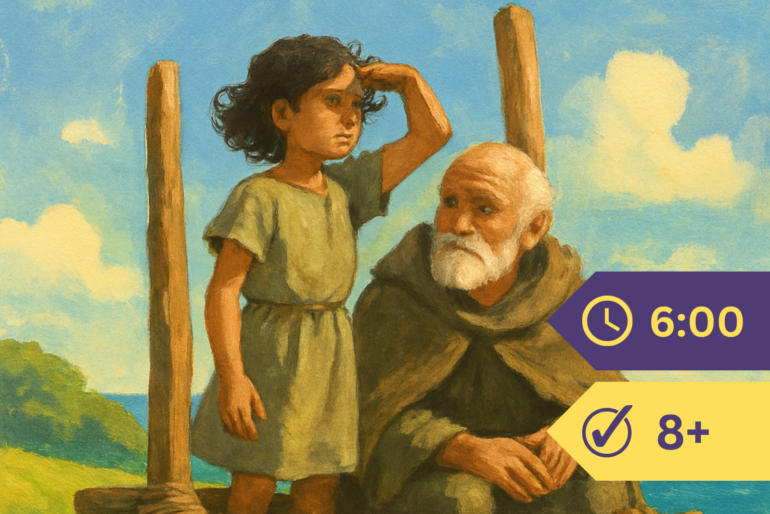
Long, long ago, before Dénia was called Dénia, there was only a green hill beside the sea, a scatter of huts on the sand, and a tower made of two tall fir trunks lashed together with wide planks. The tower stood on the highest point of the hill, where nothing blocked the view, and on top of it, from sunrise to sunset, sat an old man named Olpis.
Olpis was the watcher of the day. That was his whole job: to watch.
Melitta thought it was the most wonderful job in the world.
Everyone else in the little village worked with their hands. Her father mended nets. Her mother packed fish into jars with salt from the shining salt flats. Her uncles rowed the six boats that waited on the beach, ready to leap to sea. But Olpis worked with his eyes, and everyone — even the strongest rower — did exactly what Olpis said.
Because Olpis could see the tuna coming.
Every spring, the great silver fish came swimming up along the coast, thousands and thousands of them, travelling together like an army on the march. No one could say exactly when they would pass the hill. Someone had to watch for them. And when Olpis saw them, he would fill his chest with air and shout down to the beach, so loud the gulls scattered:
“TUNA! FROM THE SOUTH! A BIG SCHOOL! SPREAD THE NETS TOWARD THE SHORE!”
Then the whole village would run, and the six boats would fly out one behind the other, each dropping its part of the great net into the water until the fish were circled round, and there would be food and trade for everyone.
One morning, Melitta climbed the hill and stood at the bottom of the tower.
“Olpis,” she called up, “teach me to watch.”
The old man looked down at her for a long moment. “Watching is not seeing,” he said. “Anyone can see. Come up, then. We will find out if you can watch.”
So Melitta became the watcher’s apprentice, and she learned the secret wisdom of the tower.
She learned that tuna swimming deep turn a patch of sea dark purple-blue, a color with its own name, a color like no cloud shadow ever makes. She learned that when they swim near the surface, their back fins stir the water into a fine trembling ripple, as if the sea itself were shivering with excitement. She learned to tell wind on the water from fish under the water, to count a school by how wide and how long the dark patch stretched, and to read which way it was moving before her eyes were even sure it was there.
“Small school, middle school, big school, enormous school,” Olpis said. “That is all the boats need to know. That — and never, ever shout before you are certain.”
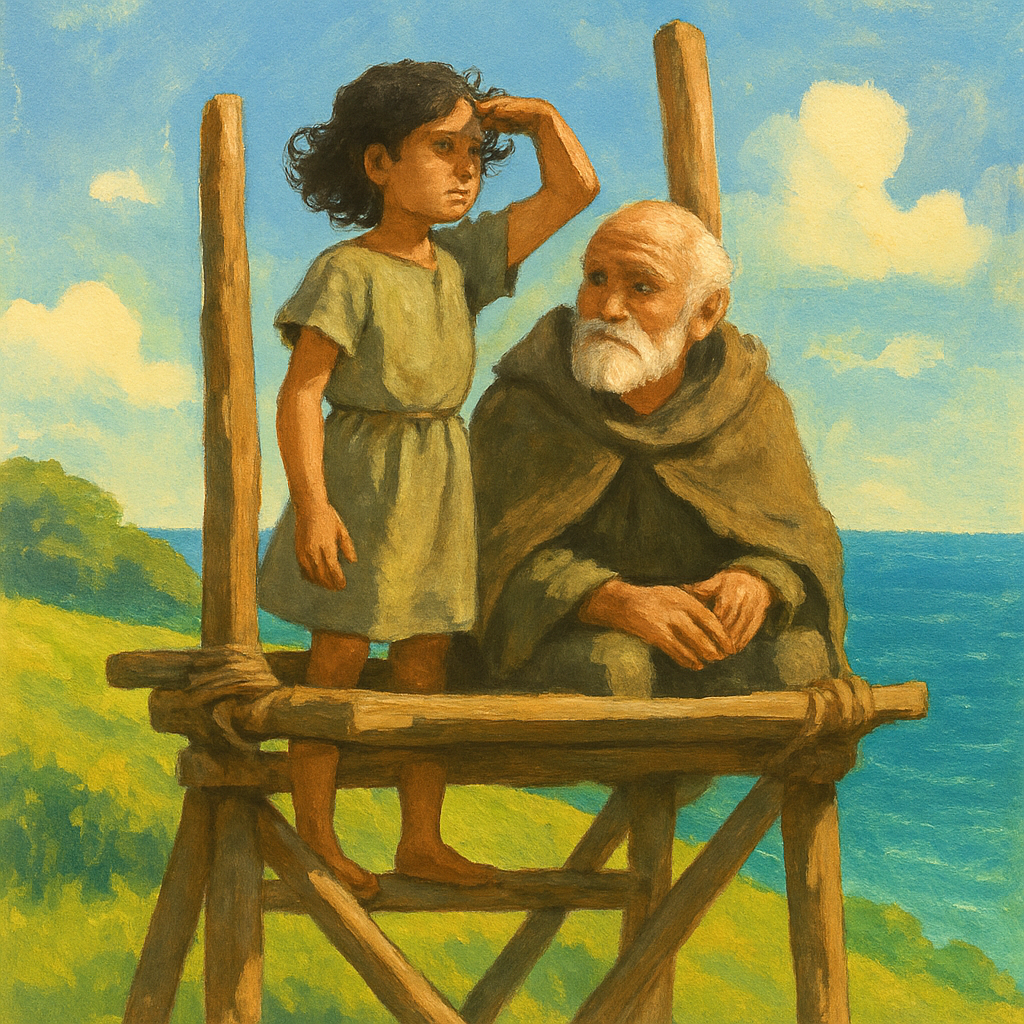
For days and days, Melitta watched nothing at all. The sea stayed empty and blue and beautiful, and her eyes ached, and still she watched.
Then one afternoon, when Olpis had climbed down to drink water in the shade, Melitta saw it. A dark patch! Far out, moving! Her heart jumped like a fish on a deck. This was her moment. She filled her chest with air, just as she had heard Olpis do, and she shouted with all her might:
“TUNA! TUNA FROM THE SOUTH! ENORMOUS SCHOOL!”
Oh, how the village ran! Nets on shoulders, oars rattling, six boats hissing off the sand and flying over the waves, her uncles rowing until their arms shone. They rowed out. They circled. They spread the great net wide.
They caught one very surprised octopus and a great deal of seaweed.
For the dark patch was not tuna at all. It was only the shadow of one small cloud, drifting slowly across the water, exactly the way Olpis had warned her a cloud shadow drifts.
Melitta wanted the tower to swallow her up. The rowers came back wet and empty-handed, and though nobody scolded her — not even her uncles — that was almost worse. She sat at the top of the tower with her knees pulled up to her chin.
Olpis climbed up and sat beside her. For a while he said nothing at all.
“When I was your age,” he said at last, “I once called out a school so enormous the whole village put to sea. It was a dead camel, floating all the way from who knows where. They talked about it for thirty years.” He looked out over the water. “Every true watcher has one wrong shout inside them, Melitta. The lucky ones let it out early. Now it is gone, and you will never shout it again. Now you know, here” — he tapped his chest — “the difference between hoping you see tuna and knowing you see tuna.”
Melitta kept climbing the tower. She watched all summer and all the next spring, and she never shouted again — not once — but she saw more and more: every ripple, every shade of blue, every trick the light played.
And then came the morning the sea shivered.
Far in the south, a patch of water turned that deep purple-blue that no cloud can make, and above it the surface trembled with the flick of a thousand fins. Melitta looked at Olpis. His eyes had grown old and misty over the winter, and he peered and peered and could not be sure.
“You tell me, little watcher,” he said quietly. “Is it hoping, or is it knowing?”
Melitta watched one breath longer. The patch moved steadily, keeping close to the coast, wide as ten boats, long as forty.
“It is knowing,” she said.
And she stood up, and filled her chest with air, and her shout rolled down the hill like thunder:
“TUNA! FROM THE SOUTH! ENORMOUS SCHOOL! NETS TOWARD THE SHORE!”
The boats flew. The net circled. And that evening the beach blazed with cooking fires, and the salting house was full, and the rowers lifted Melitta onto their shoulders, and Olpis smiled the way the sea smiles on a calm spring morning.
From that day on, Melitta was the watcher of the day, and after her came her daughter, and her daughter’s daughter, for as long as the tuna swam past the hill. Travellers who sailed by saw the tower on the headland and gave the place a name in Greek: Hemeroskopeion — the Daytime Watchtower.
The tower of fir trunks is long gone. A castle stands on the hill now, and around it a town full of people. But the town is still there because, long ago, somebody sat above the sea, patient as stone, and truly watched.
And its name today is Dénia.