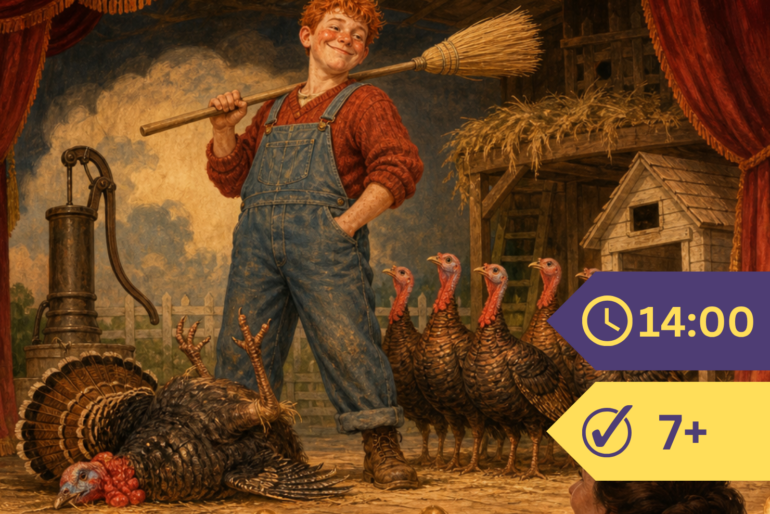
“I guess you can get the ell roof shingled any time now,” cried Homer Tidd, bouncing in at the kitchen door. A blast of icy wind followed him.
“Gracious! Shut that door, Homer, and then tell me your news.” His mother shivered and pulled her little brown shawl tighter. Homer planted himself behind the stove with his mittened hands around the warm pipe, his freckled face glowing.
“I’ve made a great deal, Mother.”
“What?”
“Did you see the man who just drove out of the yard?”
“No.”
“That was Mr. Richards, of Finch & Richards, the big market over in the city.”
“Has he bought your Thanksgiving turkeys?”
“Not for Thanksgiving. He’s rented the whole flock! Three dollars a day for a week, and then he’ll buy them all for Christmas.”
“Land sakes! Three dollars a day!” Mrs. Tidd nearly dropped the pan of apples she was carrying, and some went rolling over the floor. “Eighteen dollars for just showing off some turkeys? Some folks must have money to throw away.”
“I’ll tell you all about it.” Homer took a chair and propped his feet on the oven door. “Mr. Richards is putting on a big Thanksgiving food show, and he wants live turkeys. He’s been driving all over the country looking. The postmaster sent him here and told him about Dan’l Webster’s tricks.”
“Tricks don’t make Dan’l any better eating,” said his mother.
“Maybe not. But don’t you see?” Homer laughed, a little embarrassed. “I’m going to put Dan’l and Gettysburg through their tricks right in the store window.”
“You aren’t!” She looked at her clever son in wonder.
“I am!”
“I don’t know what to think, boy,” she said slowly. “It’s not exactly a gentlemanly thing to do, is it?”
“I reckon I’m no gentleman, Mother,” Homer said, with his jolly laugh.
“Tell me all of it.”
“I was feeding the turkeys when Mr. Richards drove in. He’d heard I had trick turkeys and wanted to see them. Lucky for me, I hadn’t fed them yet. They were so hungry, they never did their tricks better.”
“What did he say?”
“He said it was the most amazing thing he’d ever seen. He’d never have believed a turkey had enough sense to learn a trick.”
“Did you tell him how you’d worked with them since they were chicks?”
“I did. He offered me three dollars to give a show three times a day. He’s got a window half as big as this kitchen. He’ll wire it in, and the turkeys stay there at his expense. And before Christmas he’ll pay me twenty-two cents a pound for them. He’s even giving me a railroad pass, and he’ll send for the turkeys and bring them back, so it won’t cost me a cent.”
“Well, I vow, Homer, that’s good pay.”
Homer got up and strolled around the kitchen, picking up the apples that had rolled into every corner.
A week before Thanksgiving, the corner in front of Finch & Richards’ great market looked the way it did on circus day, except that nobody was looking up Main Street. Every eye was fixed on one window of the big store.
One window held a glowing mountain of fruit and vegetables, arranged by someone with a keen eye for color: monstrous pumpkins, purple cabbages, rosy apples, snowy celery, corn as yellow as sunshine, eggplants gleaming like amethysts, and cranberries tucked into every crack. People said “Ah!” at the sight, and then moved on to the next window. There, six plump turkeys, supremely innocent of any feast day, flapped their wings and gobbled rudely whenever a small boy pressed his nose to the glass.
Three times a day the crowd grew twenty deep. It laughed and shouted and elbowed good-naturedly, for the Thanksgiving spirit was in the air. Fathers hoisted children onto their shoulders, and small hands clapped while small legs kicked with joy.
The hero of the hour was a freckled, red-haired boy who came leaping through a wire door with an old broom over his shoulder. Every turkey waited for him eagerly, because each old trick, learned back in chickhood, earned a good meal. When he whistled, or his voice rang out in a shrill command, Dan’l Webster, Gettysburg, Amanda Ann, Mehitable, Nancy, or Farragut stepped to the center of the stage and did some irresistibly funny turn with a turkey’s perfect solemnity. None of them had stage fright. They acted as if they were back in the farmyard, with only Mrs. Tidd leaning over the fence to praise them and toss a handful of golden corn.
With every performance the crowd grew thicker, the applause louder, and the Thanksgiving trade at Finch & Richards’ bigger than it had been in years. Each night Homer rode the last train home, tired but happy, with three more crisp dollars in his small, shabby wallet.
Two days before Thanksgiving, Homer was up at dawn in his blue overalls and faded sweater, hurrying through his chores. He still had a man’s work to finish before the ten o’clock train, and he had promised to help his mother in the house, too. His grandfather, an uncle, an aunt, and three small cousins were coming to eat Thanksgiving dinner at the old farmhouse.
He whistled cheerfully as he spread fresh straw, but the whistle trailed off into a trill. The turkey pen felt lonely. Only old Mother Salvia was there. Homer tossed her a handful of corn.
“Poor old lady, are you lonesome? Never mind. When spring comes you’ll have a whole raft of chicks scratching at your heels. We’ll teach them a trick or two, won’t we, Salvia?”
Salvia clucked over her corn.
“Homer! Homer, come quick!”
Down the frozen path came Mrs. Tidd with her shawl wrapped tight around her head, waving a yellow envelope.
“A telegram! I can’t read it. I’ve mislaid my glasses.”
Homer was beside her in a flash, tearing open the thin envelope. “It’s from Finch & Richards, Mother. It says, ‘Take the first train to town without fail.'”
“What on earth do they want?” Her face was anxious.
“Maybe the store burned down,” gasped Homer. He brushed a rough hand across his eyes. “Poor Dan’l Webster and Gettysburg! I never knew a person could care so much about turkeys.”
“Maybe it’s nothing bad, Homer,” she said, laying a hand on his shoulder. “Maybe they want an extra-early show.”
“Maybe. But I’ve got to hurry to catch the 7:30.”
“I’m coming with you.”
“You don’t need to. It’s probably nothing serious.”
“I’m coming,” said Mrs. Tidd firmly. “Do you think I could sit here doing nothing but waiting and wondering?”
They caught a streetcar at the city depot, and five minutes later they stood in front of the big market.
“Mother,” Homer whispered, “my turkeys! They’re not there! Something’s happened. Look at the crowd.”
They pushed through a mob peering in at the windows and the locked doors. The row of plump turkeys no longer hung under the sign. The magnificent mountain of fruit and vegetables had been torn down.
Mr. Richards came to meet them himself.
“Well, young man,” he cried, “I’ve had enough of your pesky bird show! A hundred dollars’ worth of food is gone, and we’re turning customers away, two days before Thanksgiving, of all times!”
“Good land,” whispered Mrs. Tidd. The store was strewn from end to end with wasted food, and sticky rivers trickled across the floor. A small army of clerks was sweeping and mopping.
“Where are my turkeys?” asked Homer.
“Safe in their crate in the back room, all but that gobbler you call Dan’l Webster,” snarled Mr. Richards. “He’s up on a top shelf tearing cereal boxes to shreds, and he’s pecked every clerk who’s tried to touch him. For mercy’s sake, go get him down!” His face had turned as red as Dan’l’s own comb.
Homer and his mother dashed across the store. High above them, Dan’l Webster strutted along the shelf with slow, stately steps. Now and then he peered down at the wreckage below and remarked on it with a lordly, satisfied gobble.
“Dan’l Webster,” Homer coaxed, “good old Dan’l, come and see me.”
He crept up a stepladder, reaching for one black leg. Dan’l hopped away with a triumphant gobble and raced gleefully along the shelf. A row of salad-dressing bottles stood in his path. One energetic kick sent them tumbling to the shelf below, where their yellow contents oozed toward the mouth of a tea box.
“I’ll have that bird dealt with!” thundered Mr. Richards. “Henry, go get a pistol!”
“Wait, sir,” pleaded Mrs. Tidd. “Homer will get him.”
But Dan’l would be neither coaxed nor commanded. He wandered up and down the shelf, gobbling right into the faces of the excited crowd.
“Homer,” whispered Mrs. Tidd, clutching his arm, “why don’t you pretend to shoot Dan’l? Maybe he’ll lie down, and you can grab him.”
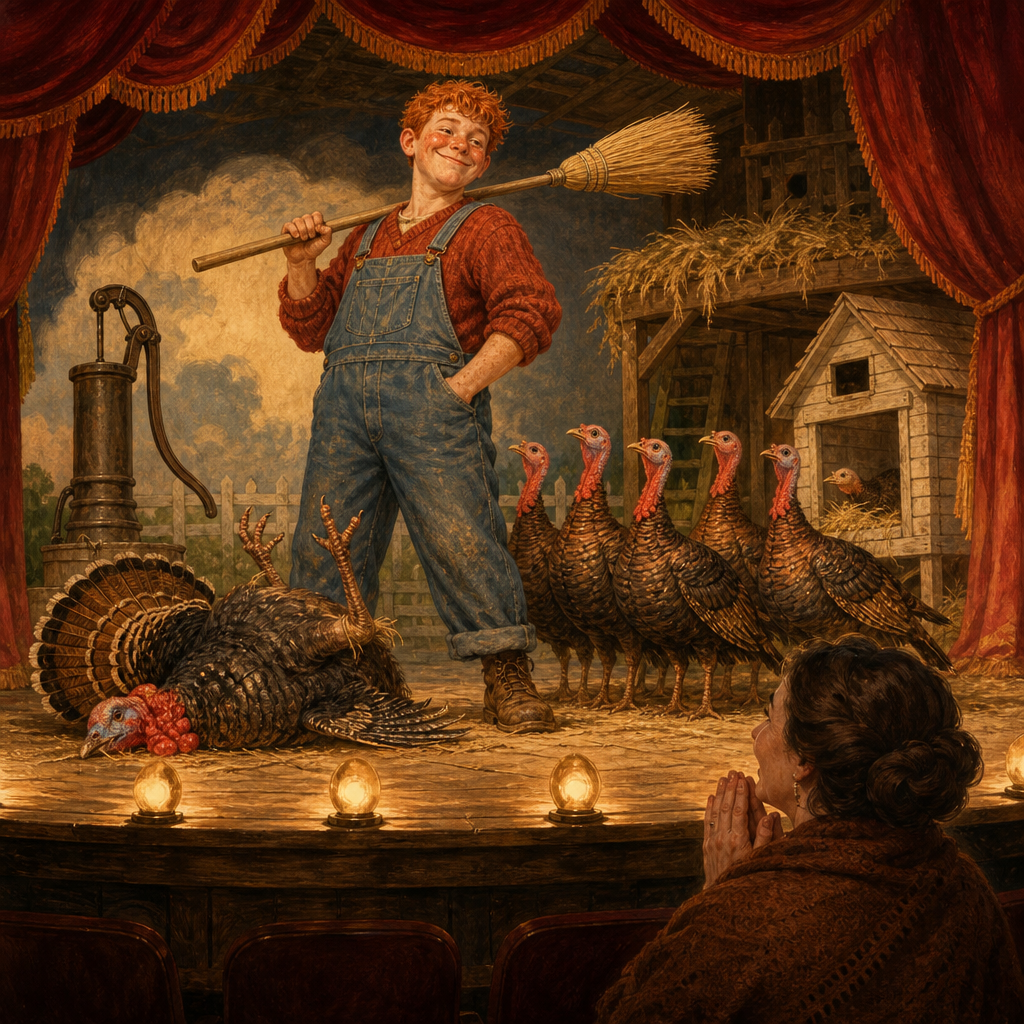
Homer called for a broom. He tossed it across his shoulder like a rifle and crept forward, sliding a ladder before him, to the spot where the turkey stood watching with sharp eyes. He set one foot on the lowest rung and burst into a spirited whistle. It was “Marching Through Georgia.” The bird stared at him.
“Bang!” cried Homer, pointing the broom straight at the rebel turkey.
Dan’l Webster dropped stiff. A second later, Homer had a firm hold of the scaly legs. Dan’l came back to life at once, but by then his rebellious head was tucked under his master’s jacket, and the world had gone dark and quiet.
“There!” cried Homer, and closed the lid of the crate. He wiped the sweat from his forehead. “I guess you won’t get out again.”
He followed Mr. Richards to the front of the store to look at the damage.
“Who would have thought turkeys could rip up strong wire like that?” cried the furious storekeeper, pointing at the shattered door.
“I guess Dan’l started it,” said Homer gravely. “He’s awful strong.”
“I’m sorry I ever laid eyes on him! And I’ll hate to face Finch. He’s coming in on the 4:20. He’s old-fashioned, and he never had any use for the turkey show.”
“When did you find out what had happened?” Homer asked timidly.
“Five this morning. Two of the men came in early and telephoned me. I never saw such a mess in my life. Your turkeys sampled everything in the store, from split peas to molasses. What they didn’t eat they knocked over or tore open. I doubt they’ll need feeding for a week. They’re stuffed with oatmeal, beans, crackers, peanuts, pickles, toothpicks, prunes, soap, red herring, and cabbage. Whatever their crops would hold.”
“I’m awfully sorry,” said Homer.
“So am I,” said Mr. Richards. “Now the best thing you can do is take your flock and clear out. I’ve had enough of performing turkeys.”
Homer and his mother waited at the depot for the eleven o’clock train, a crate of well-fed, satisfied turkeys beside them. Somebody tapped Homer’s shoulder.
“You’re the boy who does the stunts with turkeys, aren’t you?” asked a well-dressed man in a silk hat, with a flower in his buttonhole.
“Yes,” said Homer, puzzled.
“I’ve been hunting for you. That was a great rumpus you made at Finch & Richards’. The whole town’s talking about it.”
Homer blushed scarlet. “Yes.”
“Taking your turkeys home?”
Homer nodded.
“I’ve come to see if we can keep them in town a few days longer.”
Homer shook his head hard. “I don’t want any more turkey shows.”
“Not if the price is big enough to make it worth your while?”
“No!” said Homer sturdily.
“Let’s step into the station and talk it over.”
On Thanksgiving afternoon, the Colonial Theater, the best vaudeville house in the city, was packed with people who had dined well and were ready to laugh at anything. Hundreds of children shrieked with delight at every act. Near the end of the fourth turn, two stagehands, instead of hanging the usual big red number, put up a brand-new card. It read: “Extra Number: Homer Tidd and His Performing Turkeys.”
A shout of joy went up. Every newspaper in town had made a splashy story of the wreck at Finch & Richards’, and no surprise could have been better. Everyone broke into applause except one small woman in the front row, pale, her hands clasping and unclasping. “Homer, boy,” she whispered to herself.
The curtain rose on a farmyard. Straw lay on the floor, an old pump leaned in one corner, hay tumbled from a loft, and a coop with a hen and chicks stood by the fence. A white-faced cow blinked at the glare of the footlights. The orchestra struck up a merry tune, the cow let out an astonished moo, and in walked a sturdy red-haired lad with a freckled face, in faded overalls and a sweater that had once been red. Six splendid turkeys followed at his heels, in a straight line, every eye on their master.
Homer never knew how he managed it. Two minutes earlier he had told the manager, desperately, “I’ll bolt the second I see all those people.” Maybe he drew courage from the worried face of his mother, the only face he could see in the whole house. Maybe it was the turkeys’ magnificent calm. They strode out as if a gorgeously lit stage were an everyday thing. Whatever the reason, Homer threw up his head and led the turkey march round and round past the footlights until the cheering died down. He snapped his fingers, and the turkeys lined up at the back of the stage.
“Gettysburg,” he called, pointing to a stately, plump hen. She stepped to center stage. “How many kernels of corn have I thrown you, Getty?”
The turkey turned to count them, head cocked thoughtfully to one side. Then she scratched her foot on the floor.
One, two, three, four, five.
“Right. Now you may eat them.”
Gettysburg wore her new laurels with excellent grace. She jumped through hoops and glided around the stage on a pair of tiny roller skates. She stepped from stool to chair to table in perfect time with Homer’s whistle and a soft strain from the orchestra, danced a stately jig on the tabletop, and hopped down the far side with a satisfied cluck. Amanda Ann, Mehitable, Nancy, and Farragut did a slow dance of dignified hops and mazy turns, then waited in a decorous line while Homer dashed offstage. He came back with his head held high, in the blue uniform and jaunty cap of a soldier boy, a rifle on his shoulder.
The orchestra put all its vigor, patriotism, and wind into “Marching Through Georgia.”
At Homer’s whistle, the turkey regiment wheeled to his side, ready to keep step, march, and countermarch. Only one feathered soldier fell. At a bang from Homer’s rifle, Dan’l Webster dropped stiff as a board. Here and there a child cried out in horror and whispered to a parent whether the turkey was “truly shooted.” As if to answer, Dan’l leaped to his feet. Homer pulled a Stars and Stripes from his pocket and waved it, and the orchestra swung into “Yankee Doodle.” Some patriotic spirit stirred in Dan’l Webster’s soul. He left his master, puffed himself up to full size, stalked to the footlights, and let out one glorious, soul-stirring gobble.
The curtain fell, but the applause went on and on and on. At last Homer came out again, waving the flag, with Dan’l Webster, Gettysburg, Amanda Ann, Nancy, Mehitable, and Farragut following in triumphal march. His eyes searched past the footlights for one face. This time it was one radiant flush, and her hands were adding their share to the thunder.
“Homer, boy,” she said fondly. This time she said it aloud, though nobody heard. The encore was so loud it nearly shook the plaster from the ceiling.