A very rich man died and left everything to his son — palaces, farms, vineyards. The son took possession of it all and lived grandly, but he never once had a mass said for his father’s soul.
Around the same time, there was a poor man who could barely feed his children. He went into a church to pray for help. He was so poor that he thought, no one in the world can be worse off than I am — and then he saw the alms box where people left coins for masses to be said for souls in Purgatory. Yes, he thought, those are poorer than I am. And he reached into his pocket for his last coin and dropped it in.
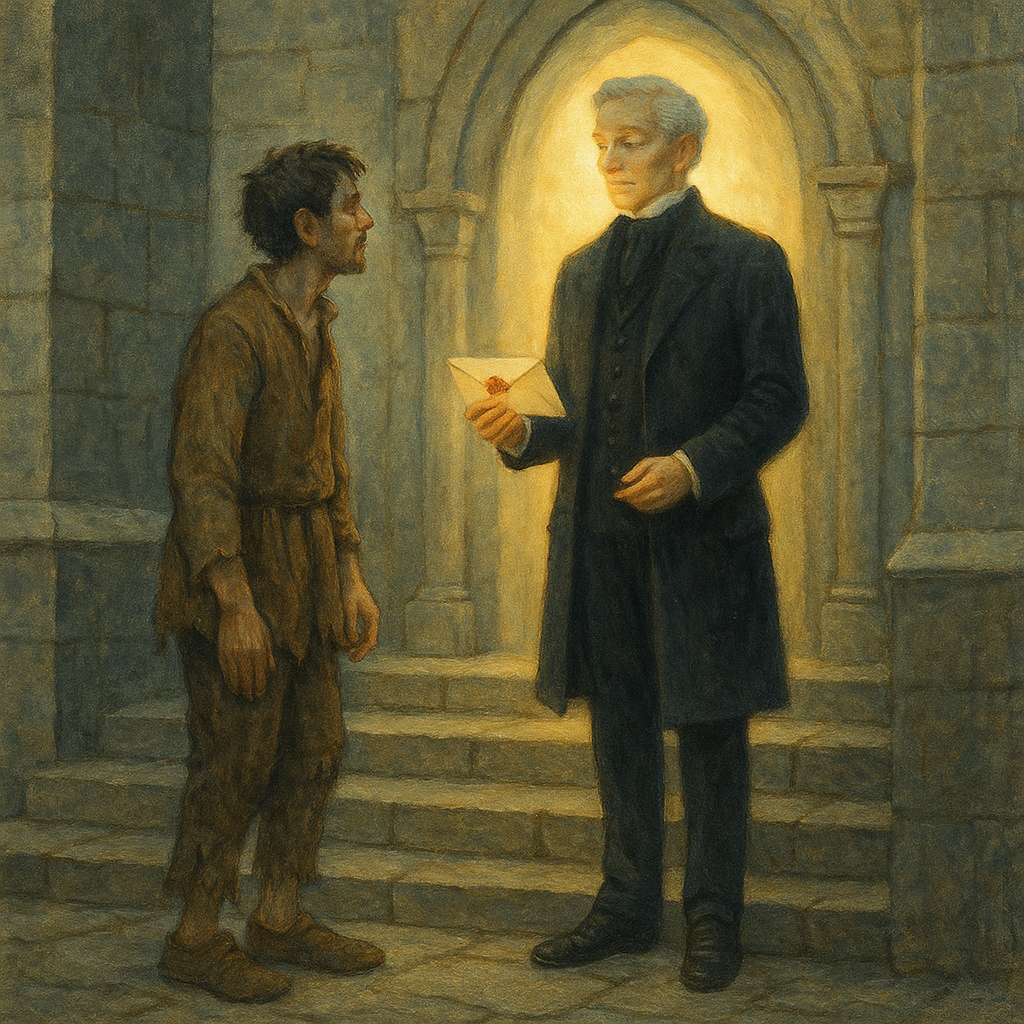
As he came out of the church, a well-dressed gentleman was waiting on the steps.
“You have done me a great good,” said the gentleman, “and you don’t even speak to me.”
“When have I ever done you any good?” said the poor man, bewildered.
“Just now.” The gentleman was no stranger: he was one of the holy souls, in borrowed form, and the poor man’s coin had paid for the mass that helped him. “I want to ask you one more favor. Take this letter to the palace of the Count at such-and-such an address. And give it only into the Count’s own hands — not the porter’s, not the servants’. His hands alone.”
The poor man went.
The porter refused him. The footman refused him. The valet tried to take the letter. The poor man refused them all, calmly and without anger: my orders are to give it to the Count himself. The scuffle brought the Count out to see what the noise was about.
When the Count saw the handwriting on the letter, he went pale. He tore it open and read it quickly. “Who gave you this?”
“A gentleman on the steps of the church. I never saw him before.”
“Would you know him again?”
“Without question.”
The Count led him into the portrait gallery and told him to look along the walls. The poor man stopped in front of one painting. “That is him.”
It was the Count’s father, who had been dead for years — for whose soul not a single mass had ever been said.
“He says in this letter,” the Count told the poor man, his voice changed, “that you, with your poverty, have done for him what I never did with all my wealth. He instructs me to bring you and your whole family to live here, and to share with you everything I have.”
And that is what he did.