Griet woke up because of the silence.
That sounds strange, but it was true. For weeks the Spanish army had been camped around Alkmaar, and every night there was noise somewhere: trumpets, shouting, a cannon shot. The Spaniards did it on purpose, Father said, to wear the town out. But now, in the middle of the night, everything was dead quiet. Griet lay in the dark beside her little brother Jacob and listened. The great clock struck two.
And then, at three o’clock, the world burst open.
Twenty cannons at once. The floor trembled, plaster dust drifted down from the attic beams, and Jacob sat bolt upright with wide eyes. Outside, the storm bell began to ring — not the ordinary alarm, but the heavy, urgent toll that meant only one thing: they are coming. This time for real.
“Up,” said Mother. Her voice was calm, but her hands were not. “Jacob, you go to Grandma. Griet, you come with me.”
Griet was ten. Old enough, Mother had decided, since the day the Spaniards came. Sixteen thousand soldiers lay around the town, and inside the walls everyone was needed — everyone. The men and the soldiers stood on the ramparts. The women hauled kettles and buckets. And the children? They did whatever needed doing.
The streets were crowded, but nobody ran about wildly. Everyone knew where to go, as if they had practised it a thousand times. Klaas the baker from next door carried a pitchfork. The blacksmith had brought his biggest hammer. People called out encouragement to each other, and two friends who shook hands looked at one another without saying a word. Griet only understood that look later.
She knew her own task by heart: stones. By the Friese Gate lay mountains of rubble from the shattered wall, and that rubble had to go up — up onto the rampart. For hours she lugged basket after basket with the other children, while cannonballs howled overhead. On that one day, she heard afterwards, the Spaniards fired more than two thousand cannonballs at the town.
By midday, nobody went home to eat. They cooked on the rampart itself — porridge and bread between the sandbags — because nobody wanted to leave their post. Griet sat beside her mother with her back against the earthen wall and felt the ground thump at every hit, like a heartbeat.
And then, between three and four o’clock, through all the thunder of the guns, came the blast of a Spanish trumpet.
“Here they come!” rang out along the wall.
Griet was not allowed to look, but she could hear it: thousands of boots, drums, shouting in Spanish. The soldiers were coming across the filled-in moat, straight for the breach — the gap the cannons had battered in the wall. Up on the rampart stood Captain Dirk Duyvel, an old sea dog with a voice like a foghorn. “Stand firm, men!” he bellowed. “Not one step back!”
“Not one step back!” roared the whole wall.
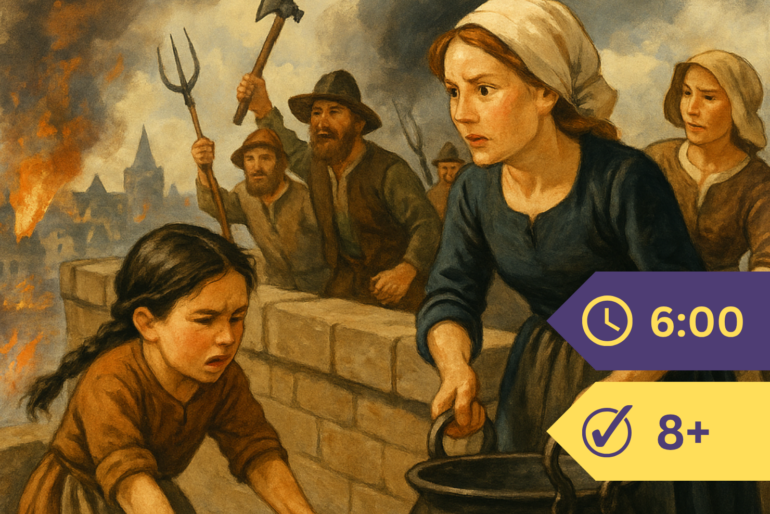
What happened next, Griet would never forget. Everyone did something. The men struck at the climbing soldiers with axes and pitchforks. The women lifted great kettles between them and poured boiling limewater over the edge as if they were sluicing down the street. The boys hurled stones; the girls passed along burning hoops coated with pitch, which were flung around the helmets of the Spaniards. Griet hauled and threw and passed things along until her arms shook, and beside her, her mother did exactly the same.
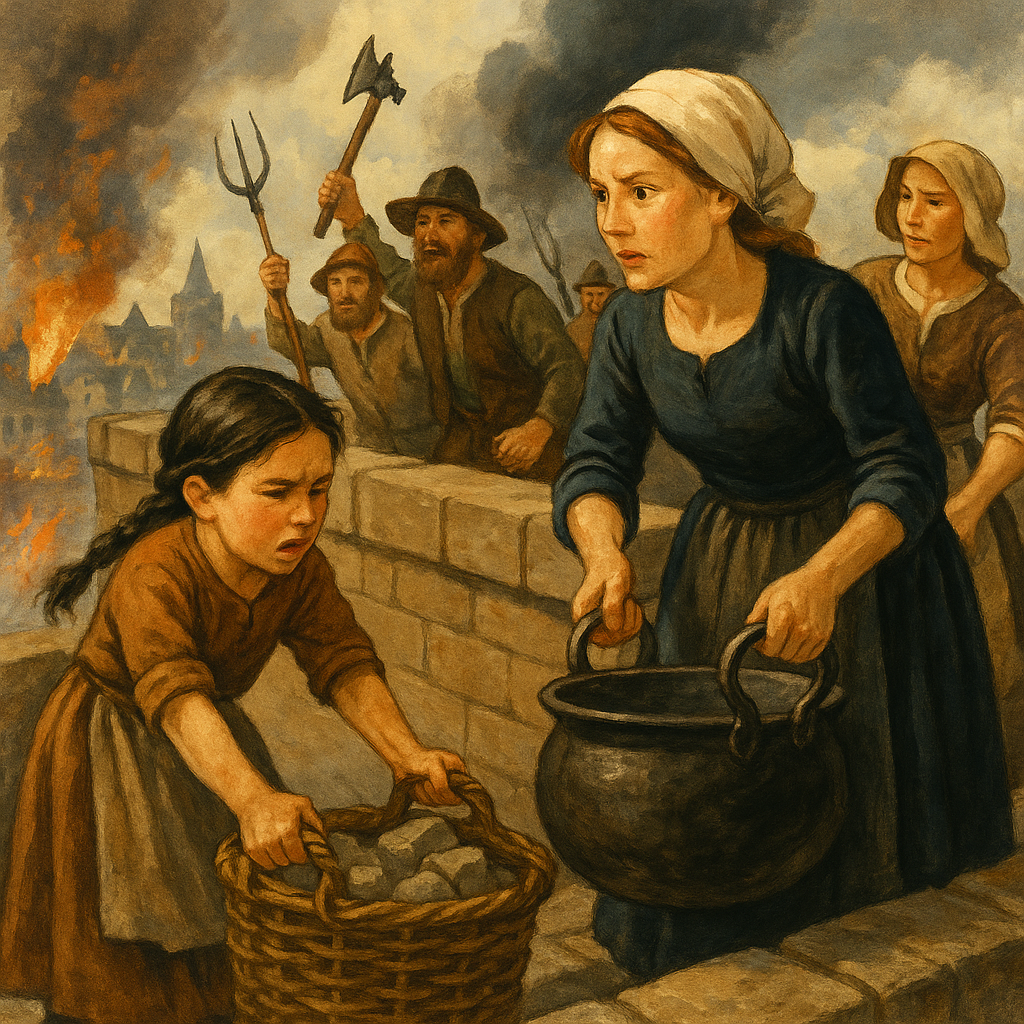
Whoever was wounded was carried off by the girls to the houses near the wall, where old women stood ready with bandages. Whoever was too old to carry, prayed. Even praying, Grandma always said, is doing your part.
Three times the Spaniards came that day.
The first time, they were driven back by the heat and the stones and the furious townspeople, and they ran down off the wall as if the ground beneath them were on fire.
The second time, they attacked in four places at once. At the Heiloo Gate they pushed a floating bridge of barrels into the water — but days earlier, the people of Alkmaar had secretly shot the barrels full of holes. No sooner did four soldiers in heavy armour step onto it than the whole bridge sank, gurgling. Up on the wall there was cheering, and even laughter.
But the third time, it nearly went wrong.
The best Spanish soldiers stormed over the rubble so fast that they were at the top before anyone knew it. Three standard-bearers planted their flags on the wall of Alkmaar. “Victory!” they screamed. “The town is ours!”
For one heartbeat, everything went quiet. Griet felt her heart in her throat.
Then an ordinary townsman stepped forward — Kitman was his name; little else is known about him — and with one tremendous sweep of his broadsword he knocked the first standard-bearer down and stamped the flag into the mud. Someone else tore the second flag from its pole. And the third? A townsman speared a burning bundle of straw onto his pitchfork, pushed forward with it, and set the last banner alight. It vanished in a cloud of smoke and sparks.
“VICTORY!” the whole wall screamed now — but this time in Dutch.
That was the moment the Spaniards gave up. By sunset, the last soldier had been driven from the wall. The town had held. Three assaults in a single day, and Alkmaar had held.
That evening they all sat together on the rampart, exhausted and filthy and happy. The men said: “Without the women, we would never have managed.” And the women said: “The men fought like lions; without them we would have been lost.” And both were right.
A soldier who had seen it from above said the enemy could not believe who had beaten them: not an army with helmets and armour, but bakers and blacksmiths, mothers and daughters, boys and girls. A town made not of walls, but of people.
“Were we brave?” Griet asked her mother that evening.
Mother thought about it. “We were together,” she said at last. “That is the same thing, only stronger.”
Three weeks later, on the 8th of October, the enemy broke off the siege and Alkmaar was free. But when the people of Alkmaar told the story of where the victory began, they did not only speak of the eighth of October. They spoke of the eighteenth of September — of the day all of Alkmaar fought, down to the smallest child.