Long ago, in one of England’s old shires, there stood a famous inn called The Saracen’s Head. On its creaking sign-board was painted a fierce Moorish warrior with gleaming white teeth and frowning brows. But one day the sign came down, and in its place swung a freshly painted holly branch, with the words The Christmas Inn beneath it.
To tell why is to give a page from the obscure chronicles of ordinary people — men, women, and children — living more than five centuries ago. The story comes like a silver flute-note between the blare of trumpets and the clash of swords, tucked briefly between entries of household expenses and records of deaths in battle. It is well worth remembering at Christmas.
It was Christmas Eve in 1465. Snow had fallen thick and fast, covering the charred gable-ends of ruined houses — for England had not been merry in those years. Class had fought against class, east against west, friend against kinsman. The white rose of York and the red rose of Lancaster were still at war for the English throne. But for the sacred Christmas season, a truce of thirty days had been proclaimed, and for thirty days no blow would be struck.
The Saracen’s Head looked grim in the drifting snow, but inside, Thomas Curdy — mine host — stood at the doorway peering up and down the highroad, his broad red face cheerful as the Yule logs blazing behind him. It was so wild a storm he was nearly ready to shut and bar the door for the night, yet he hated to miss any sign of approaching travellers.
“No traveller abroad to-night,” he said at last, going back to the fire and rubbing his stout hands before the leaping flames.
“Marry, then — no drinking and brawling, no quarrelling in men’s cups till they come to blows, truce or no truce!” answered Dame Curdy contentedly. She was rosy and motherly, and seemed to shed comfort around her as naturally as the fire shed warmth.
A jolly pair they were, and the flames made them ruddier and jollier every moment. The old chronicles have little enough to say about this honest couple, but they are quite as worthy of our attention as any Lancastrian Hightower or Yorkist Barnstaple in the lot.
“Travel, good dame — travel up and down the highroad brings good luck to the Saracen’s Head, and it’s a bad night that stops it!”
“Aye — travel in peace, I’ll grant you. But no bands of fighting men to give the house a hard name, and no reckonings left unpaid. In this storm, I warrant, none will stir abroad who can bide at home.”
But here a loud, shrill blast from a trumpet rang keen and clear across the wild wind.
Mine host was on his feet at once, alert and ready. Dame Curdy wrung her hands in dismay.
“More soldiers! I hear the ring of their armour as they ride through the gate. May the saints keep watch over us — that’s none other than Sir John Keightley’s call! They are all the Earl’s men.”
The good landlady loved peace and hated war, and she dreaded the turbulent scenes that old kitchen had too often witnessed. But she dared not offend the formidable Earl of Hightowers, or any of his men-at-arms. In a moment the inn was full of bustle and confusion — hostlers ran, maids hurried here and there, and Thomas Curdy shouted a welcome through the fierce blasts of wind that drove the whirling snow through the wide-open doors.
Across the threshold — with the wind and snowflakes — entered the late comers: Sir John Keightley, a weather-beaten, rugged, scarred old veteran of many a hard-fought battle, and at least nine or ten stout men with him, roughly dressed and armed with the longbow as common soldiers were in those days. But as they came out of the night and the storm into the circle of firelight, Thomas Curdy saw that this was no ordinary band of fighting men. There were women — three of them — and one who carried herself so haughtily that mine host, accustomed to the ways of great people, shrewdly guessed she was no more than some great lady’s attendant. (He had always noticed that the great lady herself was likely to be quieter and simpler in her ways than her maid.)
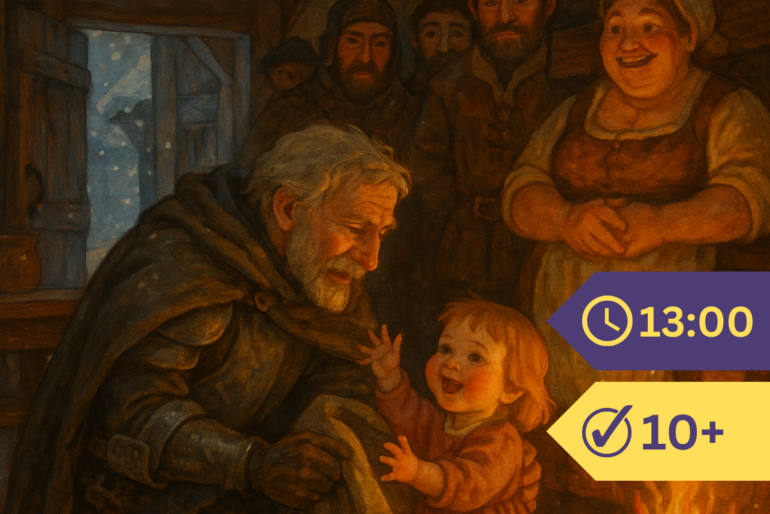
And Sir John Keightley carried in his arms a bundle which he would let no one touch. He strode ahead to the great fire, knelt down, and began tenderly to unfasten wrap after wrap. What a hush of amazement fell first — and then what exclamations of wonder and delight from Dame Curdy and her women — when the last wrapping was thrown off, and out stepped the daintiest little girl anyone had ever seen!
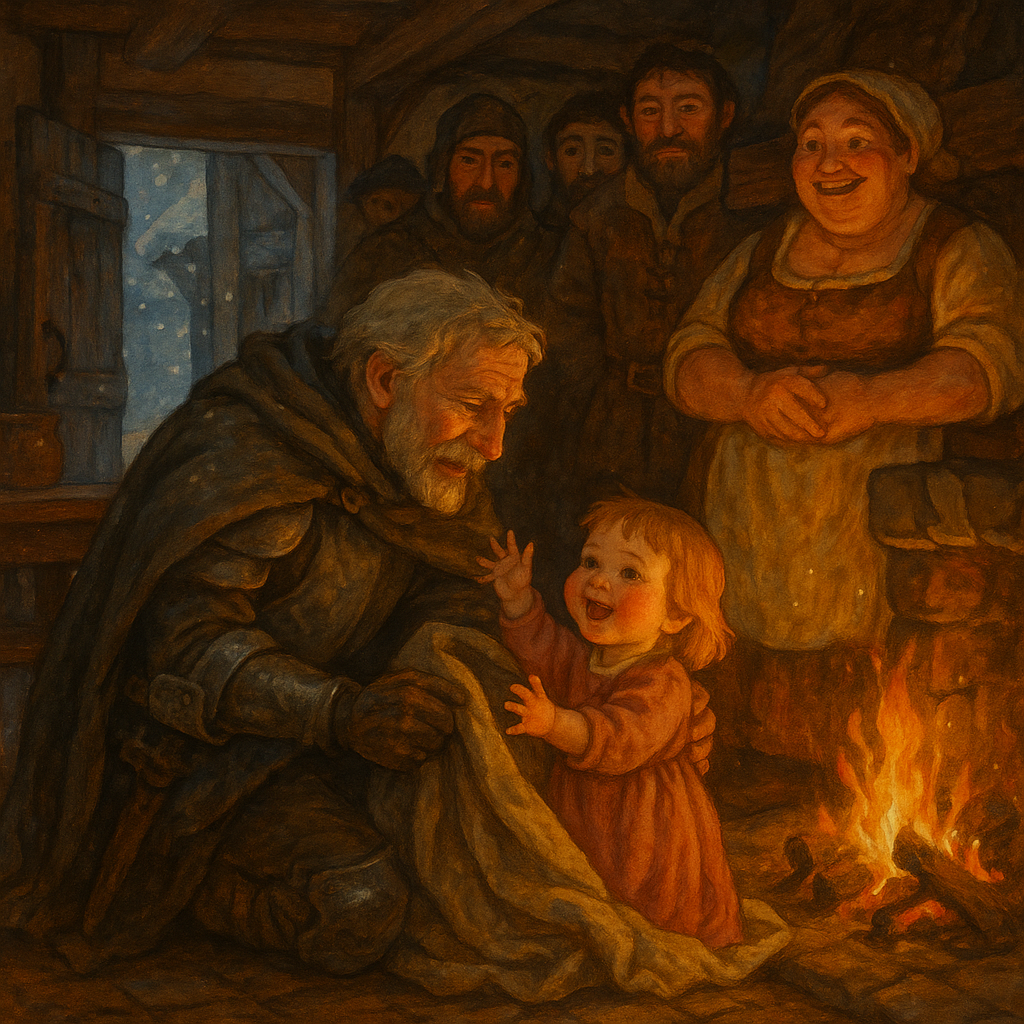
She was two years and six months old. She laughed out merrily — a sound like rippling water or the first spring wind through young leaves — and, looking up at the big grizzled knight, she reached up with tiny hands and began to brush the snowflakes from his beard.
“Who is this dear heart?” cried Dame Curdy.
A clear, flute-like voice answered in the softest of tones: “I’m Lady Margery — Marg’y — Rosamond Vere.”
Her hair was reddish gold, of the finest silken texture, cut square across her brow and hanging over her lace collar behind. Her eyes were a deep blue-black, with a look of wistful tenderness contradicted by the laughing, mischievous mouth and the dimples that lurked in cheek and chin. That tender look must have come from her young mother, who had died not long after her father — only son of the Earl of Hightowers — was cut down in a skirmish with the Yorkists at Stapleton-on-the-Moor. The baby girl had her mother’s eyes and her father’s chin. But the likeness that delighted the portly landlady and made her smile and rub her fat hands was to little Margery’s stately old grandmother, the Countess herself.
“Pretty lamb — how she favours the Countess with that proud turn of her sweet head!”
Dame Curdy was right. This baby, in her little rose-coloured gown, with the gold of her precious head for a crown, ordered her retainers about — Sir John most of all — more royally than the Earl dared to do. But it was a heavenly rule of love, even if a willful one.
After a dainty grace, she ate supper of cream and fine white bread, then ran away laughing — tripping and almost falling — past the men-at-arms to old Sir John Keightley, and climbed onto his knee in triumph. She was quite sure of having her own way there.
Sir John had been sent by the Earl to bring home his little granddaughter, who was too young to grieve over her double loss. He had fallen in love with the little maid from the first sound of her childish voice. She prattled away merrily, her silvery, piping tones sounding curiously sweet among the gruff voices of the rough soldiers. The men were watching with keen appetites as the landlady stirred savoury dishes over the fire, glancing every now and then at the pretty child on the knight’s knee.
“Hark! Hark!” cried Margery suddenly, making an imperious gesture for silence with her baby finger. “Marg’y hears the big horn coming!”
She laughed with delight and doubled up her rosy fists and began to blow in pretty mimicry, her eyes shining like stars. Then, quickly changing, she clapped her tiny palms together, crying, “Kling-klang, kling-klang!”
They all heard it then — what the finer ear of the child had caught first — a trumpet-call coming nearer and nearer, and the clang of arms.
“Who do you think that may be, landlord?” asked Sir John anxiously, glancing at the golden head against his breast.
“I fear it is Sir Joseph Barnstaples’s men,” answered mine host, with an apologetic look — for the Barnstaples were Yorkists, and long at enmity with the Hightowers. Dame Curdy sighed and wrung her hands again.
Fearing a possible attack despite the solemn proclamation of the truce, Sir John had his men take up their weapons while the great door was unbarred.
Then what a sight! No such wonderful night had the old Saracen’s Head ever known. Here again, with the soldiers, were nurses — two nurses in russet gowns, each carrying a small bundle. And out of these bundles, when unwrapped, appeared two babies — twin girls of eighteen months. Sir Joseph Barnstaples’s second son had married a rich heiress in one of the southern shires, and she had died of a fever. Now, with the grandmother gone as well, the father was sending the little girls home under military escort to Barnstaples Manor.
The women clapped their hands and laughed with “Ohs!” and “Ahs!” and “Dear hearts!” — even the soldiers laughed — but nobody was so pleased as little Lady Margery. She gazed at the demure twin babies with wide-open eyes and crimson lips just parted in a smile, showing a few small white teeth.
Barbara and Janet Barnstaples, as the firelight danced over their smooth, dark round heads, could not be coaxed into smiling. Their four dark, solemn eyes stared gravely at all the noise and all the strange faces, and two small mouths were drawn up for a cry — when all at once they caught sight of Margery leaning toward them, and two faint little dimples showed for a moment, one on each right cheek. At least, Barbara smiled first. Then Janet followed suit.
The snow came down thick and fast that night, but old Sir John — wont to dream of bugles and ambuscades and skirmishes — dreamed instead of a long-forgotten meadow above the weir, where blue speedwell bloomed until the ground was all a delicious blue like angelic robes in the old chapel windows. Waking in the morning, he cast about in his mind as to whether this might not foretell death — for had he not heard all his life that flowers out of season meant trouble out of reason? It would seem very funny, nowadays, for an experienced old soldier to worry about such things, but people in the fifteenth century were not so very wise about them.
That same night, the old nurse was wakened by a light footfall in the room. Peeping from the bedclothes, she saw a small white figure cross the dusky space, dimly lit by the gleams of the dying embers.
She put her hand out for her nursling. The little nest in the bed was warm, but empty. Up she started in alarm — and saw a sight fit for fairyland. Little Margery, hearing one of the twin babies cry in her sleep and finding the nurse not waking, had stolen out of bed and was tucking the baby in and cooing to her like a little wood-dove. The nurse called softly, and the little bare feet pattered across the floor to the bed, to be caught up and cuddled back to sleep.
The next morning, Margery would not eat until the twins had been placed one on each side of her at the table. Then she fed them herself — giving Barbara a bit of wheaten loaf, then Janet a spoonful of cream. And if she ever gave to Janet first, Janet would shake her small brown head and point with her tiny finger to Barbara. The whole party were in high spirits, until Margery noticed with displeasure that far too many people were watching. Even the hostlers and scullions had stolen to the doorways to peer at the strange sight of three babies among all those soldiers, who had by now become quite friendly with each other, and were wonderfully quiet in their innocent presence.
Margery turned her head to Sir John and asked, with an air that delighted the landlady, “Are dose folks all so hungry?”
There was such a shout of applause that the intruders fled abashed, and the little lady gravely returned to her breakfast.
Very soon the two convoys went on their separate roads. Whether the little lady of Hightowers and the twin heiresses of Barnstaples ever met again, and whether they were friends or foes, the chronicle does not say. But the coming of the three babies to the Saracen’s Head on Christmas Eve was not soon forgotten — and in memory of that day of goodwill, the grim old Saracen was hauled down from his creaking sign-post, and in his place swung gaily to and fro a freshly painted holly branch, with the words The Christmas Inn beneath it.