The parish of Wastmoor-cum-Pitsfield lay in one of the bleakest corners of the north of England, where the sky seemed to hang lower than elsewhere and the land offered no hill or tree to soften it. The nearest town was half a day’s journey; the people who worked the collieries and the fields were rough and wary. It seemed, on the face of things, an unlikely place for happiness.
The Reverend Lawrence Ingleby had come to Wastmoor as its curate in circumstances that required some explaining. He was the younger son of Sir Marmaduke Ingleby — a man of considerable property and considerably more pride — and he had done everything wrong by his family’s accounting. He had chosen the church over the army. He had taken his modest gifts to Oxford and fallen in love with the pastoral poets. And then, while recovering his health at a farmhouse in Herefordshire, he had met Caroline Newcombe — Carry, as everyone called her — the farmer’s daughter.
She had been educated above her station and returned to it without complaint. She was cheerful, warm, and possessed of brown eyes that laughed before her lips did. There was a cider harvest, and country dancing, and long evenings by the fire with a book. Lawrence had not stood a chance.
Sir Marmaduke had not been pleased. The marriage, he declared, was a disgrace to the family name. He bound himself by oaths to refuse any assistance. Lawrence and Carry were married quietly and came to Wastmoor.
Their income was fifty pounds a year from the curacy, supplemented by occasional literary work. The house was cold in winter. The congregation was suspicious of its curate’s careful diction. Yet Lawrence found, if not happiness exactly, something very close to it. He had Carry, and in time their son Frederick — whom his father called Da, from some half-formed syllable of the boy’s first year that Lawrence had chosen to interpret as a learned reference. Frederick grew up quick and sharp-eyed, and the three of them made the best of the bleak house and the fifty pounds.
Sir Marmaduke’s wife, Lady Ingleby, had been gentler than her husband. She died without being able to do more than send her son a banknote for ten pounds and a letter — long, tender, pleading — that begged Lawrence to believe she had always loved him, and that his father, in time, might relent. Lawrence read it alone by candlelight and said nothing. Carry, watching him, saw no tears but a look she had never seen before.
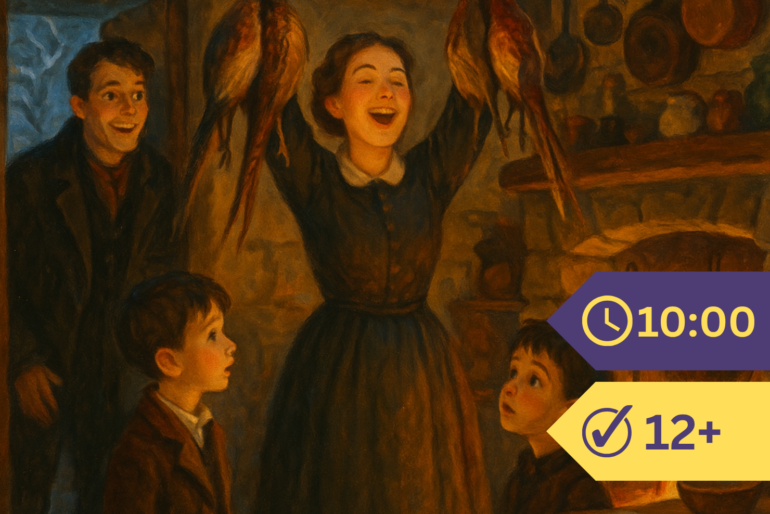
It was three weeks after Lady Ingleby’s death — a Christmas Eve, with heavy snow on the ground — that Lawrence took Frederick with him to the market town. They came back after dark, cold and tired, the road barely passable. But when Lawrence pushed open the door of the little parlour-kitchen, Carry was standing by the fire with a sly, demure expression that he knew meant mischief. She dove behind a pile of faggots and emerged holding aloft, with tremendous ceremony, a brace of pheasants.
The mystery was soon explained. An old college friend of Lawrence’s — Charles Morton, now a successful advocate — had been shooting in the neighbourhood, had come across Lawrence’s name by chance, and had sent the pheasants ahead with a note announcing himself for supper. Lawrence read the note twice before the name finally landed. Morton! Charles Morton! He rubbed his hands with a kind of cautious, incredulous glee.
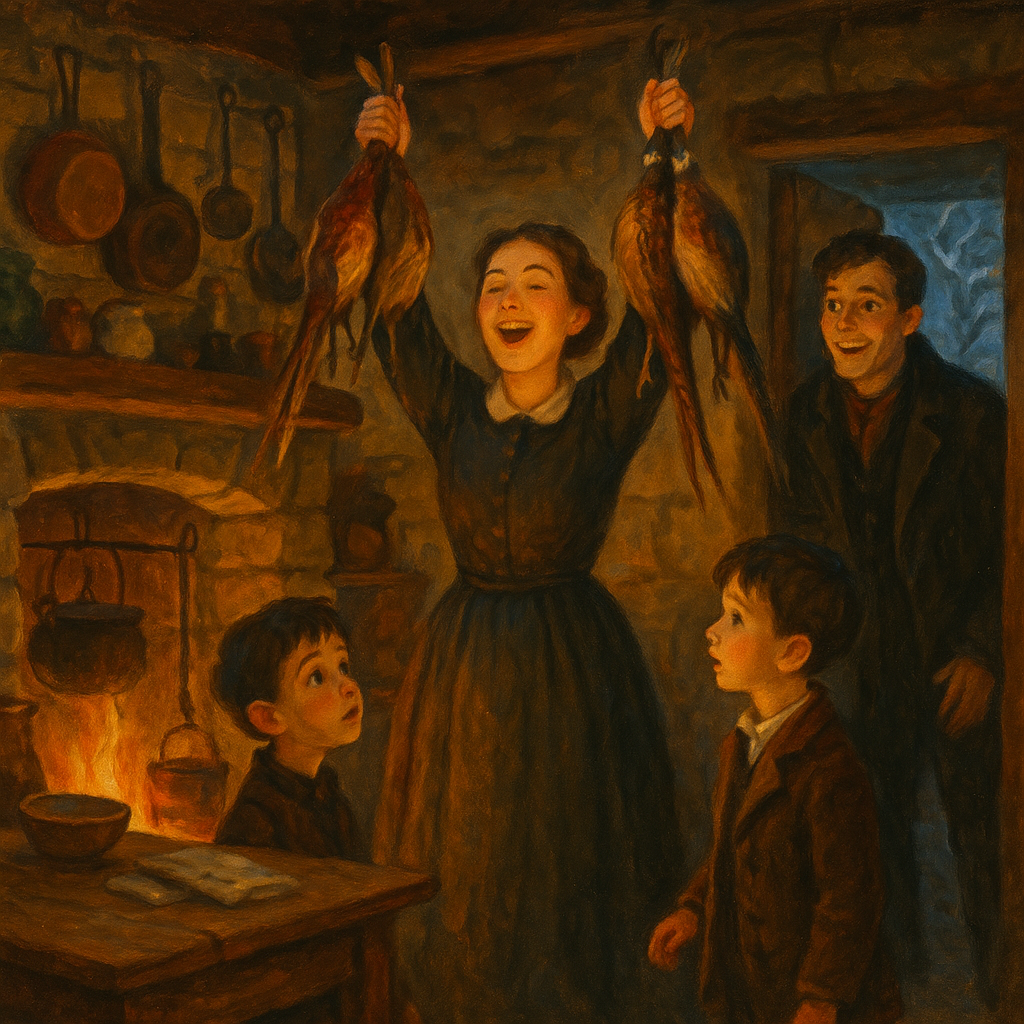
Carry had already got the pheasants on the spit. The fire crackled; the little kitchen filled with the smell of roasting meat and something sweeter from the oven. The warmth and the scent did something unexpected to Lawrence — they took him somewhere he hadn’t been in years. The great kitchen at his father’s house at Christmas. Cured meats hanging from the rafters. The warm smell of cakes. A sense of abundance that had seemed, until now, permanently lost. He drew his chair toward the fire and sat quietly, touched with sadness and yet, slowly, with something that approached peace.
When Morton arrived and clapped him on both shoulders and called him by his old college nickname — Corydon, for the curate who had vanquished Thyrsis — Lawrence laughed, and wept, and laughed again. They sat together long into the night, all four of them: Morton telling stories, Frederick listening with round eyes, Carry keeping everyone’s cup full. The church bells broke in upon them, and they realised it was no longer Christmas Eve.
The years passed. Frederick grew tall and serious and devoted to his books. Morton, on one of his visits to Wastmoor, saw what the boy might become and made an offer: a place in his London chambers, help with a post in legal reporting, and whatever guidance he could give. Frederick went south. He read law in the evenings, was called to the bar, and made his reputation by steady, clear-headed work. More than one solicitor began to trust him with briefs.
It was in this way that he came, one autumn, to be given a junior brief in a case called Sanders v. Ingleby. The Ingleby in question was Sir Marmaduke — his grandfather — who had purchased a large estate and was now facing a claim that the title to it was defective. The baronet had vested nearly all his remaining fortune in the purchase; if the claim succeeded, he would be ruined. A distinguished leading counsel had been retained. Frederick was engaged as junior. The solicitor had no idea who his clerk was.
On the morning of the hearing, the leading counsel was occupied elsewhere. When the judge called the case and found only the junior present, Frederick rose and said simply: “I appear, my Lord, in the absence of my learned friend.”
“Proceed, Mr. Ingleby,” said the judge.
At the sound of the name, a heavy, grey-haired gentleman across the room sat suddenly forward and stared. He watched the young barrister through the entire argument — watched the measured pace of it, the economy, the quiet force — and understood, slowly and with a sensation he could not quite name, that he was watching his grandson defend him. After a long hearing, the judge found for the defendant. Sir Marmaduke kept his estate.
Leaving court, the baronet moved to intercept the young man as he crossed the lobby. He looked at him with wonder and something close to fear. Frederick turned on him a steady glance, nodded slightly, and walked on without a word.
Sir Marmaduke had been finding England uncomfortable. His elder son — Major Ingleby, lately returned from India — received his father with cold courtesy and made no secret of where his sympathies lay. The baronet had not thought of Lawrence in years. Now he could not stop thinking of him. He thought of Carry’s patience and Lawrence’s dignity and the grandchild he had never met, and the great house felt emptier each time he turned the thought over. He had achieved everything he had wanted and found that it cost more than the price.
It was his elder son who finally arranged matters. That December, Major Ingleby took his father north.
Through Frederick’s influence at the bar, the living of Fairthorp had recently been offered to Lawrence — a proper rectory with beech trees before it, good rooms, and a fire that didn’t go out. Lawrence and Carry had moved in quietly, arranged their things, and were sitting by the library fire on Christmas Eve when they heard wheels on the drive. Frederick was already there. He and Carry exchanged a glance. Morton, whose friendship had shaped so much of their story, was with them too.
The door opened. A bent, grey figure appeared in the doorway, leaning on Major Ingleby’s arm. Sir Marmaduke had aged considerably. He paused on the threshold and shaded his eyes against the firelight, and looked at his son.
What was said between them is not ours to report. Some reconciliations are too old and too private for words to do them justice. By the time the church bells rang in Christmas morning, the family was together at the fire — Lawrence and Carry, Frederick, Major Ingleby, and the old baronet in the best chair by the hearth, quiet and warmed through for the first time in longer than he could say.
And who shall say that Lady Ingleby’s spirit was not among the rejoicing presences at that Christmas hearth?