Chapter I
On the borders of Dartmoor, in a retired dwelling set apart from the nearest village by a long sweep of moorland, there lived a man who went by the name of Paul Corolla. Little was clearly known about him beyond the fact that he was a trader in flowers. Some few whispered that he also dealt in poisons, while others loudly proclaimed him a magician—a dabbler in the black art. He was, moreover, a collector of simples; and many were the country people who sought his habitation for remedies of all kinds. He was frequently solicited to furnish charms and spells whose potency was supposed to avail against ills which no human hand could alleviate or arrest—the trial and burden of mortal sorrow.
With such a reputation it may well be imagined that many unaccountable stories went abroad concerning the man and his pursuits. What most puzzled the curious was that, instead of the mystery and seclusion generally supposed to belong to dealers in occult sciences, here all was open and undisguised. The house of Paul Corolla was a habitation of the most perfect simplicity. Looking at its plain brick walls and ordinary windows, its long and slightly-fenced garden, and its spacious hothouse, the most excursive imagination could scarcely entertain the notion of artifice or concealment. The dress of Paul was similarly unassuming—out of keeping, rather, with the habits of a successful merchant, and suited more to the ease of a man who laboured with his hands, as Paul evidently did. He generally wore a long loose coat reaching below his knees, and the exact fashion of his other garments was a matter of doubt. His head was rarely covered at all, and when it was, it was surmounted by a cloth cap resembling in shape an ancient baronial cap. His hair was slightly grizzled, but not grey; his eyes mild, but searching. His only companion was a young mute servant boy who appeared to act as his assistant.
One evening, late in summer, as the twilight of a shortening day deepened and closed, Paul was seated in the little back parlour of his house, alone. On the table before him stood a solitary plant in a common red earthen pot—that species known to botanists as the Fraxinella, or “little ash.” As Paul lightly touched its pink flowers and feathered foliage, apparently occupied in studying the condition of the plant, a hasty knock was heard; and the next moment the servant boy showed a young man in—a young man of somewhat disturbed aspect, who could scarcely have seen more than nineteen summers, with that free, frank, open face which at once prepossesses the beholder in its favour. His eyes wore a look of restless excitement, and his lip quivered with some inward emotion.
As the youth found himself suddenly in the presence of Paul Corolla, the calm and unmoved bearing of the reputed magician appeared to act as a momentary check upon the outward manifestation of the passions stirring within him. He took the offered seat which Paul drew forward. Paul was about to speak, when, glancing behind, he saw the boy’s eyes fixed intently on him. He made a quiet gesture of dismissal, and the boy withdrew.
“Speak,” said Paul. “What is your pleasure?”
“A moment since,” cried the youth, rising restlessly and turning to go, “a moment since I arrested my steps at your threshold, scarcely knowing whom or what I sought. Your presence has awakened me: I have been a fool. Pardon me, and farewell!”
“Yet stay a moment,” returned Paul, eyeing the young man with some interest. “You sought the magician; remain at least with the host. I do not entice you with the promise of a love-philtre or a charm against the plague; but there are more things in nature than you dream of, and perhaps—”
Paul stopped; for the young man had reseated himself, and, placing his two elbows on the table, buried his face in his hands. A long silence followed, during which neither spoke. At length the young man looked up. As he did so he started on seeing that the plant which stood on the table before him, over which his bowed head had almost touched, was illumined by a soft blue light which ran over every leaf and branch. A balsamic odour at the same time filled the room, so strong as to be almost overpowering.
“This is juggling,” cried the youth, drawing back his chair.
Paul Corolla smiled. “You do not like the light?” he said, and he lifted the plant from the table and put candles in its place. “Come, I will humour you. You dislike my Fraxinella; I will exchange it for my sweet gall. These tapers are composed of wax produced from our Devonshire myrtle—nature’s production equally with the other.” The tapers were lighted, and again a delicious odour, most grateful to the sense, filled the chamber of the Flower Magician.
“You are no common man,” said his visitor, gazing boldly and steadfastly at Paul. “You have bidden me stay, and I have tarried. But what are these shows to me—to me, a man racked in heart and brain? Send me forth wiser, stronger, freer than I came, or in Heaven’s name let me go!”
“Hark to the cry of the river,” said Paul, as if he had not heard him. “The Dart is full tonight, and comes roaring down into the valley. You know the saying here in Dartmoor?
River of Dart, river of Dart, Every year thou claimest a heart.
That knell rang in your ear as you took refuge from your own thoughts upon my threshold. Go, fulfil the prophecy of the fool who first uttered it. Or shall I guide your steps rather to Cranmere pool, whence the swollen Dart rushes down lusty and strong as breathing buoyant human life? There, they say, you may mingle your grief with that of the unhappy who fill its drear morasses with their groans.”
“You mock me.”
“Love itself is a tradition,” pursued Paul, his eyes intently bent upon the countenance of his visitor; “so at least you will account it when you have lived to my years: a jest, a juggle, a counterfeit—a worn-out tradition, believed in by our fathers, trusted in by ourselves. This is all that I know of it now; yet, you see, I am calm.”
“You search deeply. Sorcerer or not, you read my heart,” said the youth. “Know, then, the whole. I am reckless, despairing. I loved—I love still, with the hazardous passion of the gamester; of one whose all is staked upon a single die. She whom I so blindly worshipped once vowed that she loved me in return. Now, all at once, without one parting word of peace for memory to starve upon, I am scorned, rejected, banished! From what quarter can comfort come to a wretch like me? Other women have loved and been fickle: but Alice Cranstone has no heart.”
Stirred by the passion under which he spoke, the young man rose suddenly and paced the room to and fro. But Paul spoke not. A strange cloud—a momentary expression of bitter sternness—passed over his usually calm face at the last words. The young man saw it, and supposing himself to be in some way the cause, would have withdrawn abruptly. But Paul, with restored calmness, said, “It is nothing. Do not go. You are not a boy to be chilled by a passing change of mood. And yet,” he added after a pause, “perhaps you are right. I think we are neither of us quite ourselves tonight. But if you do not quite condemn me as a charlatan—visit me here again. I have done you at least no harm for this time. Your next coming may, possibly, be more propitious. Your name is—?”
“Philip Tremenheere.”
Chapter II
An hour after Philip had gone from Corolla’s door, the mute servant boy returned from an errand on the moors. He found his master seated by the window gazing out at the dark valley, and communicated by rapid gestures that he had followed the young man as far as the road—and that Philip had not turned for home, but had taken the path that led down to the gaming houses of the town. Paul received this news in silence, his face settling into the same expression of controlled sternness that had flickered across it earlier.
But again the knocker was assailed. This time it was raised by a woman’s hand.
“What is your business, my good woman?” demanded Paul, somewhat impatiently.
“My young lady is taken badly, sir,” was the woman’s answer. “My mistress is from home, and belike I may be doing wrong, but I heard you were learned in leechcraft, sir; so, may it please you, just step down a weary way though it is, and give her a simple.”
“And who may your mistress be?”
“Miss Alice Cranstone of the Hollies, so please you, sir.”
A contracting of the brows showed Paul Corolla to be ill at ease. “Lead the way, then,” was his somewhat testy reply; and the two went out along the moors.
The summer night was dark and starless, the moon had not yet risen; no sound broke the stillness of the dreary moorland waste as Paul pursued his way onward—no sound, at least, more earthly than that voice to which he had recently alluded as “the cry of the river.” Tonight it rang with more than its wonted solemnity upon his ear; and while the imagination of his more simple companion beguiled the way with legend of pixie and rock-sprite, Paul’s thoughts were with the days of his youth and of his love.
Alice Cranstone, the girl whose sick room he had thus unexpectedly called upon to visit, lay shivering like one in an ague-fit. As her pale, sweet face reposed sideways on the pillow, Paul gazed upon her almost child-like beauty, and marvelled little at the despairing madness of Philip Tremenheere. Aided by his recently-acquired knowledge of their quarrel, he divined at once how much of real bodily sickness was here, and how much of disorder was the mind’s work. He was bodily ill, the poor child; but a glance round the room soon served to open his understanding.
“You have wandered far in search of these flowers,” he said to her, lifting from a table near him a large quantity of the sweet-smelling but sickly Spiraea ulmaria. “You found this meadowsweet sufficiently fragrant, doubtless, or you would scarcely have encumbered yourself with so plentiful a burden.”
“I did not know how far I had wandered,” answered the sick girl, like one speaking in a dream. “I did not know I had gathered so much—I was thinking of something else.”
“You believe in charms?” questioned Paul.
The lip of Alice blanched as she responded, “I do not know. I sometimes think that some charm must have power over me, that I am possessed: why else—oh! why else am I so weak?” and she wrung her hands in sickness of soul.
Paul drew from beneath his vest a few sprigs of his favourite mignonette. “Take this, my child,” said he; “lay it next your heart. It is the reseda of the ancients, potent to calm and appease all suffering, whether of body or of mind.” As he bent over the sick girl to place the flowers in her hand, he whispered hastily in her ear: “Be of good cheer! I will watch over your Philip, and restore him to you if it be possible. I have seen him, and I believe he bears a soul less unworthy than it seems. Take heart—but be silent.”
“And now farewell!” he added, aloud. “But stay—you must give me this meadowsweet to carry away with me; I have a use for it. And keep yonder window open awhile; the air is heavy with its odour.”
A silent look of rapturous thankfulness from Alice, and a stealthy smile on the part of Paul, and the Flower Magician passed out to tread his solitary way back across the lonely moors.
What this short interview with the mere child had cost him—what he had felt, and how he had subdued the emotions that almost mastered him—was known only to himself. The longing of the heart he had felt to fold her to his breast and call her his child; the thirst with which he craved—childless and mateless as he was—to watch over and shield her tender youth from harm: no soul may divine. Few, indeed, could have fully sympathised with him. But Paul Corolla was, as Philip had said, no common man.
Chapter III
Informed with that elastic spirit which seeks and finds good in everything, and inspired now by a new and engrossing object of interest, Paul began to experience an increased relish for life. He seemed to feel at last that he stood not quite alone. Human sympathies, which alone he had lacked, and wanting which even the exhaustless resources of Nature herself were insufficient to satisfy his being, once more stirred within him. All the energies of his mind he determined to devote to the reformation of Philip, who he rightly conjectured had been discarded by Alice on account of habits and companions as those in the midst of which he had been discovered by the acute West Indian. Philip Tremenheere was yet very young, and Paul felt hopeful that gentle means would lead him to relinquish his present companions and their evil influence.
Philip had lost little time in renewing his visit to the Flower Magician. Struck by the originality of Paul’s mind, he sought him again and again; at first merely to satisfy a restless curiosity, but soon enough, perhaps, with some latent hope of deriving counsel and aid from one whose frank and cordial bearing was so much in unison with his own. He grew, however, to like the man Corolla; and it was not long before a firm friendship sprang up between them—a friendship rare between persons of such different ages. Not only did Philip find himself insensibly drawn to adopt the same modes of thinking as his friend, but Paul was soon able to lead him to enter heart and soul into his own tranquil pleasures. Vegetable chemistry became in a short time Philip’s most engrossing pursuit. Night after night, the two might be seen employed together in the small laboratory into which Paul had converted one of the rooms of his house, while Paul busied himself in preparing decoctions of the various medicinal herbs and plants which grew in abundance about the neighbourhood.
Thus passed the remaining months of summer; and autumn drew on, ripe with its burden of fruits. Meanwhile the fame of Paul Corolla had spread itself still further abroad, and people began to come from far and near, to see and judge for themselves what manner of man he was. Many burdened with some soul-disease, true believers in that lore which taught that the simplest wayside flower may be administered for “the comfort of the heart, and the driving away of sorrow,” sought him for his simples. Others openly implored him to drive hence, by any means, the internal enemy of their peace, whose presence maddened and rendered life a hell.
One night, when Philip had left him, and he was about to relinquish his labours until the morning sun, Paul was startled by an apparition as singular as unexpected. A female figure, closely veiled, slipped past him through the open door, and entered at once unannounced into his presence. The manner of her coming struck Paul as that of one whose courage to encounter the reputed necromancer had failed at the last moment. His mysterious visitor remained standing in the shadow of the room, and seemed to gaze past rather than at him.
“I am here to seek your aid, Paul Corolla,” she said. “Not long since you raised from sickness to health one whose love is my solitary good and blessing. Whatever spell you called down on her, it was potent to heal and save, and worked as a miracle, swift and strong. Is the magician of these moors equally skilled to cure those maladies of the soul which waste its mortal frame to a shadow, thus?” And she raised from beneath her mantle two hands—
So wan and transparent of hue, You might have seen the moon shine through.
“Behold these wasted hands,” she continued, “and judge what my malady must be. The sickness under which I suffer is in my brain; upon my heart; I am consumed with the constant pressure of one haunting thought—the constant recurrence of one miserable dream. One face, one form, known and loved in early youth, is ever before me. Nothing can free me from it. As surely as the night comes, as surely comes this dream—this nightmare of the heart. During my one short year of wedded life, the very thought was banished as a forbidden thing; but no sooner was I free than back the haunting shadow came, more constant, more terrible in its unsought presence, because once so forcibly shut out. I strive against it; I battle with its despair: in my waking hours I task myself with books; I labour with my hands; I go abroad into other scenes. All is unavailing. Speak! What can you do for me?”
Breathless and exhausted with the passionate energy with which she spoke, Paul saw that strength failed her. “Take this,” he said, while he poured from a phial an infusion he had just prepared. As he did so, he contrived to change his position so that the light should not fall upon his face. His voice was husky with emotion, and scarcely needed the effort he was evidently making to disguise its tone.
“Fear not to drink,” he said; “the infusion is simple: an ancient remedy, sacred to the memory of its discoverer, Gentius of Illyria. Its virtues are alike prized by the hardy Swiss and the more feeble natives of our West Indian Isles. Have faith, and drink.”
But the cup fell from her hand. “That you have visited those far-off lands, I know,” she cried. “You are said to have spent a life there. Tell me where—in which of those distant islands you have been a dweller?”
“In the Island of Humming-birds, as we call it there,” answered Corolla. “You know something of it?”
“Trinidad!” And she drew closer to Paul, that not a word, not a breath of his should escape her. “It is a vain, vague hope, I know,” she cried eagerly; “yet it was this hope that half lured me hither. Can it be? Is it possible that you should ever have met one who lived and died there?—one who—his name was—” But she could not utter it.
Taking a letter from a drawer, Paul tore off the signature and placed it before her, saying quietly, “That was the man.”
Florence Cranstone—for it was indeed the mother of Alice—did not start or faint. Her eager ear cleaved to his words. She believed him to be a magician now in truth; and, filled with a degree of awe that held her spellbound, she motioned with her hand for him to speak further.
“I knew him well,” he said, “none better. I was his second self: he ever laid bare his inmost heart before me. He had been early disappointed; but he learnt to bear the ill like a man. He had loved and wooed among these very moors. Lovelier to him was the fierce mountain storm, sweeping yonder moorland ridge, than all the glowing sunlit gardens of those Islands of the West; dearer to his ear the sound of the wild plover’s wing than the flutter of bright tropical plumes. But he is at peace: what would you more?”
“Nothing; my soul is satisfied!”
She turned to go; but Paul arrested her step on the threshold.
“Yet a moment stay. To one haunted as you profess to be, such comfort as I have given is little. What if my power extends further? Are you prepared for all that it might reveal to you?”
“Anything—anything of him! But oh! what can bring rest to the one miserable, torturing thought, that he died—died lonely and forsaken, never knowing that I too was betrayed even more drearily than he? He was slandered before I was false!”
“How?—Slandered?” exclaimed Paul, in a tone that made Florence Cranstone start, and sent a knell through her heart like a voice from the far-off grave.
“Even so. They told me he had wedded. That falsehood was proved—too late!”
“Too late?” returned Paul, as he sprang to her side. “Too late? Never, never while there is life and truth, is love too late! Florence, my Florence, my own lost love!” And Florence Cranstone fell like one dead upon the strong heart of Paul Corolla.
Chapter IV
Were this a tale of younger loves it might well close here. But the shadows of a life are like the moorland mists—not to be swept away with one light breath, or curled heavenward at the first call of the sun. So heavily did the past still press upon the memory of Florence, and so difficult did she find it to realise the strange change which had fallen upon her life, that she yielded to an impulse it was impossible to control, and for a time almost entirely withdrew herself into the seclusion of her own home, to ponder upon the present and gradually accustom herself to the contemplation of the possible future.
Paul made the less opposition to it, since he saw clearly that nothing but entire repose of mind was likely to restore that healthful state of being without which life is but a burden to its possessor. And out of themselves, and apart from their own individual cares, they each had sufficient food for thought; for plans for the happiness of Alice and Philip soon engrossed them both, almost to the exclusion of every other object.
Winter had now set in, and was drawing on with swift pace. Rimy frosts sheathed the thorned spikes of the golden moorland gorses; silver snows deepened on the hills. Vegetation became scant about the rock-bound pastures; solitary sheep-tracks, mapping the upland ridges, showed blank and bald along the far white slopes. Cattle sought the shelter of leaf-bare boughs; the stone-chat and the water-ouzel hid themselves away in clefts of the unhewn rock. The year was indeed in its wane, and Christmas, with all its gracious and hallowed associations, was at hand.
And the genius of Change, which showed itself everywhere, took new forms of wonderment in and around the dwelling of the Flower Magician. Numerous workmen—evidently brought thither from a distance—were seen busily employed about his domain; altering, enlarging, glazing, and roofing, dismembering and transforming hothouse and garden, homestead and orchard. No expense appeared to be spared in forwarding the work. Loaded wagons made their appearance day by day; and what added to the mystery of the whole was that these were never unpacked until the early winter sunset screened their contents from view. As if touched by the wand of a genius, the wizard’s domain became in a short time transformed into a scene unsurpassed in the realms of fairy. And as the gracious Christmas-tide drew nearer and nearer, there arose a structure so rare, so delicate in its design, so beautiful in its choice adornments, that little wonder it was if the simple inhabitants of those sequestered hills lifted up their hands in awestruck wonder and bewilderment.
At last dawned the eve of the great winter festival of the year. And did Paul, the lonely liver, the man without kindred and without friends, did he become all at once a mere hollow guest-receiver? Not so: the Christmas feast of Paul Corolla was characteristic of the man. He caused it to be given out far and wide that the Wizard of the Moors would throw wide his doors on that most blessed festival of all the year to the poorer inhabitants of his native wilds. The moorland children were to know what a Christmas feast-day meant for once in their lives.
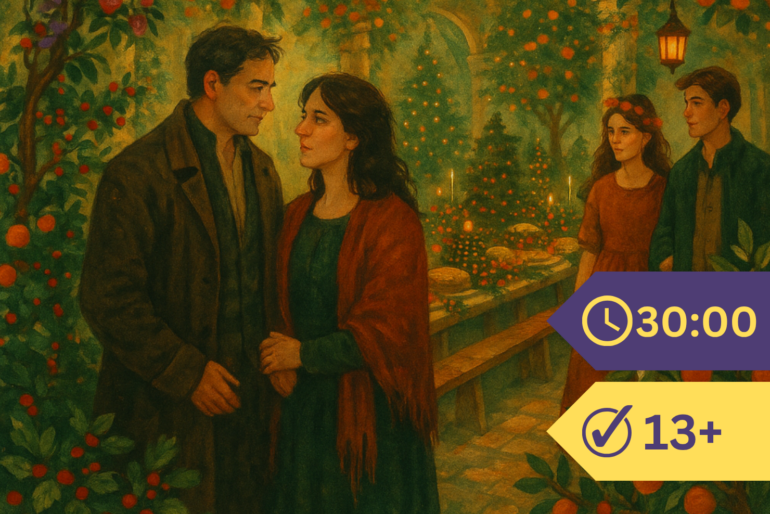
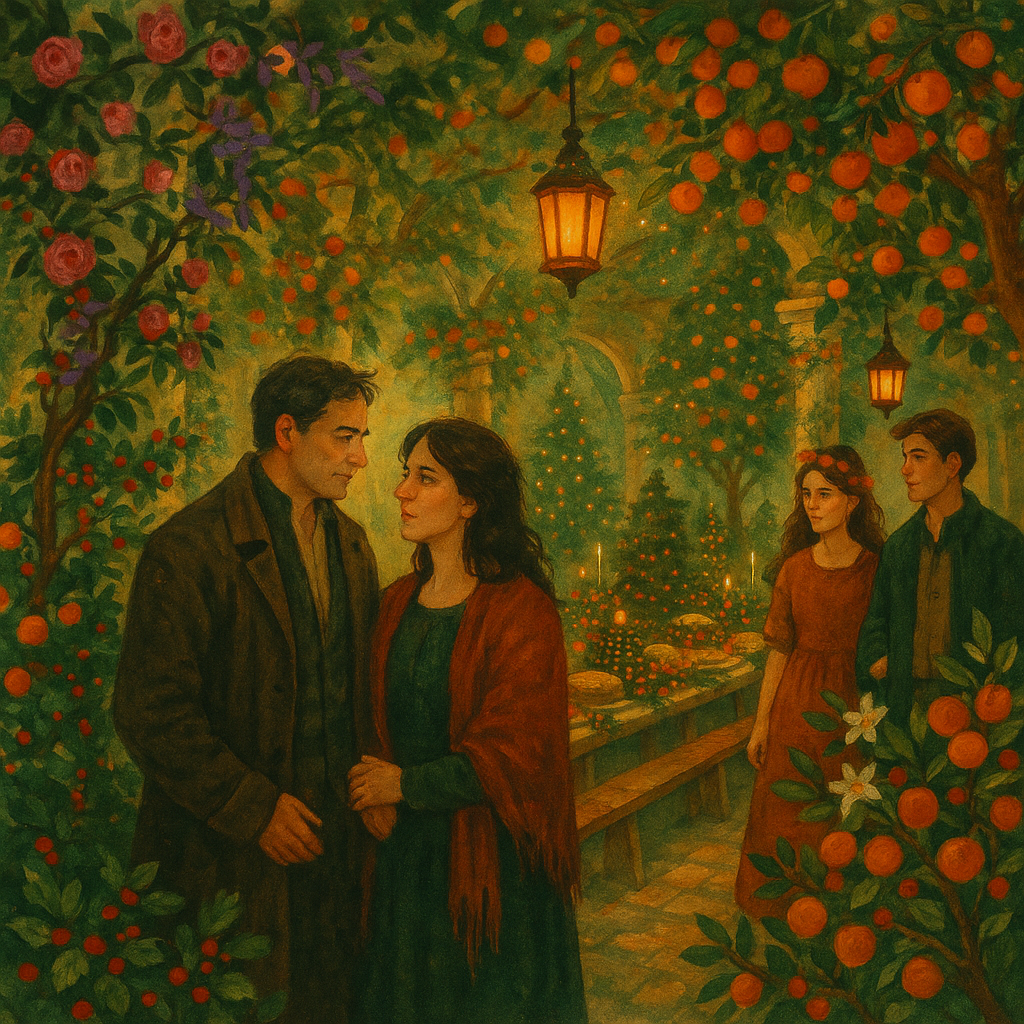
Wide flew the gates. And what a scene of enchantment opened from within upon the delighted sense! Stretching away through far vistas, trellised over with creeping foliage and violet-bearing ivy, rose pillar after pillar, clasped by budded branches of the hundred roses of China. Grouped clusters of evergreens studding the long smooth-rolled floors shone bright with glossy boughs of viburnum, fresh as if newly uprooted from the classic ground of Mount Atlas. The scarlet pyracantha and the ruddy winter-cherry vied with the ripe red berries of the pointed holly. There, too, was seen in wild profusion the far-famed Christmas rose—the fabled lunatic-curing shrub of Anticyra; while the aloe and the palm, with many another plant of wondrous growth that adorns the teeming earth, spread here their various foliage—ministers to the one great season’s joy, till the pulse of the full human heart thrilled with a love of the beautiful, and soul and sense were satisfied.
Down every alley were ranged benches groaning under a weight of the good old Christmas fare. There the sire and the maiden, widowhood in its fading and rosy childhood in its bloom, youth in its jollity and old age in its repose—all shared that Christmas wassail in the wizard’s fairy hall.
There, too, strayed Alice with her Philip, severed now no more. The promised bride of the New Year, she moved through the lengthened aisles, a coronal of orange-blossom encircling her beaming brow.
Not far apart sat Florence, with Paul by her side—her long-treasured, never-forgotten love—the Paul Meredith of her youth—our Paul Corolla! It was not without significance that Paul had placed her near to that same spreading orange-tree, luxuriant in its fruited ripeness and lovely in its yet lingering bloom, from which her daughter’s bridal coronal had been torn. Restored health on her cheek, and renewed joy in her eye, Florence was perhaps the happiest of all that happy multitude.
Full of dearest, tenderest associations was this Old Year’s closing; and if, for her, a shadow of mystery hangs upon the probable issues of the coming year, for an answer to all such wild and dreamy doubtings of the soul—she has only to consult the Flower Magician.