Lo, now is come our joyful’st feast! Let every man be jolly,
Each room with ivy leaves is dressed, and every post with holly.
Now all our neighbours’ chimneys smoke, and Christmas blocks are burning;
Their ovens they with baked meats choke, and all their spits are turning.
Without the door let sorrow lie, and if, for cold, it hap to die,
We’ll bury it in a Christmas pie, and evermore be merry.
— Withers, Juvenilia
I had finished dressing and was loitering with Frank Bracebridge in the library when we heard a distant thwacking sound. He told me it was the signal for dinner. The squire kept up old customs in the kitchen as well as the hall, and the rolling-pin struck on the dresser by the cook was the summons for the servants to carry in the meats.
Just in this nick the cook knocked thrice,
And all the waiters in a trice his summons did obey;
Each serving-man, with dish in hand,
Marched boldly up, like our train-band, presented and away.
Dinner was served in the great hall, where the squire always held his Christmas banquet. A blazing, crackling fire of logs had been piled high to warm the spacious room, and the flames went sparkling and wreathing up the wide chimney. The great portrait of the crusader and his white horse had been lavishly decorated with greenery for the occasion, and holly and ivy were likewise wreathed around the helmet and weapons on the opposite wall, which I understood belonged to the same warrior. I confess I had my doubts about both — the painting and the armour had more the look of recent centuries than the Crusades — but I was told the portrait had been considered a family heirloom since time out of mind, and as for the armour, it had been found in a lumber room and elevated to its place of honour by the squire, who immediately declared it the very armour of the family hero. Since he was absolute authority on such matters under his own roof, the matter had passed without question.
Beneath this chivalric trophy stood a sideboard displaying a collection of silverware that might have rivalled — at least in variety — Belshazzar’s parade of the vessels of the temple: “flagons, cans, cups, beakers, goblets, basins, and ewers,” the gorgeous utensils of good companionship that had accumulated through many generations of jovial housekeepers. Before them stood two great Yule candles, shining like twin stars of the first magnitude; other lights were arranged in branches around the room, and the whole array glittered like a firmament of silver.
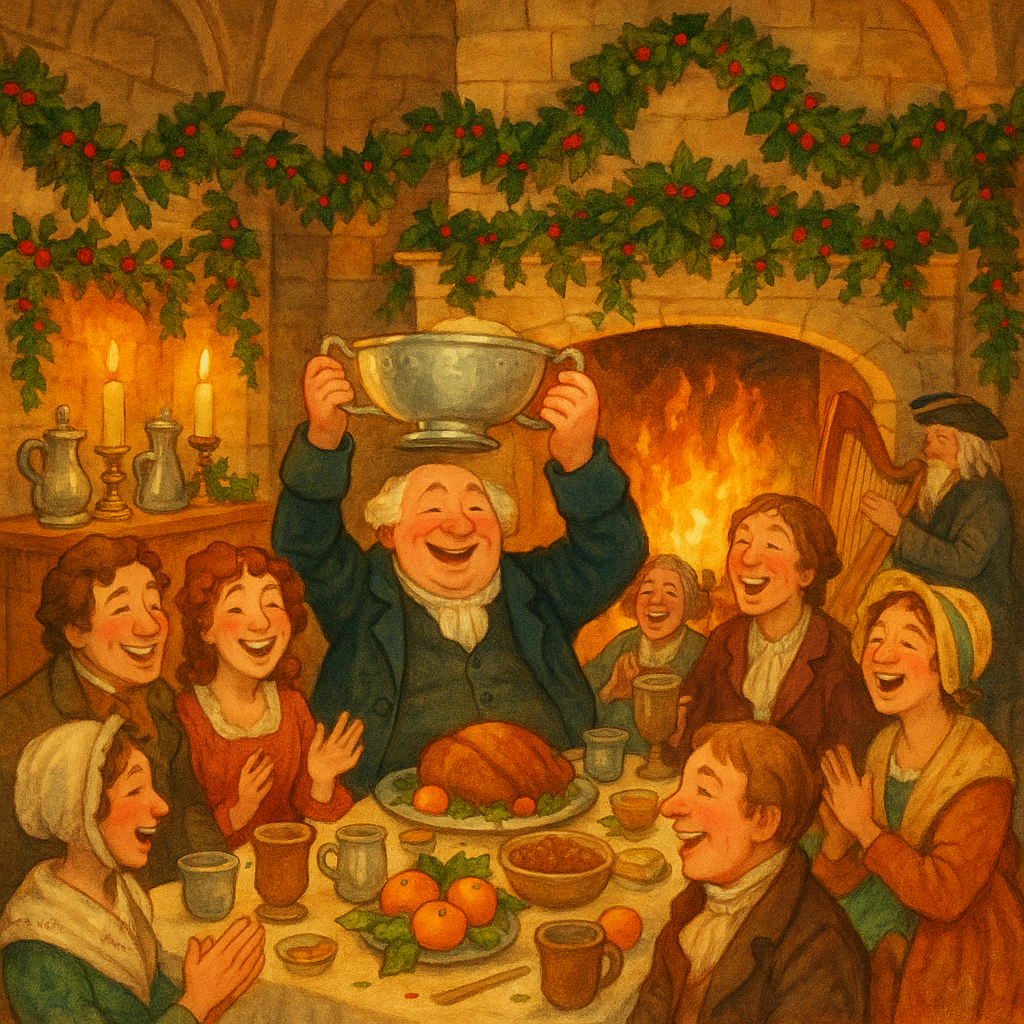
We were ushered into this banqueting scene to the sound of music — the old harper seated on a stool beside the fireplace, twanging his instrument with a great deal more vigour than melody. Never did a Christmas table display a more cheerful and gracious company of faces; those who were not handsome were at least happy, and happiness is a rare improver of a plain countenance. I always find an old English family worth studying as carefully as a gallery of Holbein portraits. There is much history to be read in such faces, many physiognomies of former ages faithfully reproduced. I have traced a family nose through a whole picture gallery, handed down legitimately from generation to generation since the time of the Conquest. Something of the kind could be observed in the company around me — many of their faces had evidently originated in a Gothic age and been merely copied by succeeding generations — and there was one small girl in particular, grave of manner, with a high Roman nose and an expression of prim severity, who was a great favourite of the squire’s. She was, he said, a Bracebridge all over, the very image of an ancestor who had figured at the court of Henry VIII.
The parson said grace — not the short, hurried sort commonly addressed to the Almighty in these informal days, but a long, courtly, beautifully worded one of the ancient school. Then a pause fell, as if something were expected, and suddenly the butler entered the hall with an air of ceremony. He was attended by a servant on each side carrying a large wax light, and he bore a silver dish on which lay an enormous pig’s head decorated with rosemary, a lemon in its mouth, which was placed with great formality at the head of the table. The moment this spectacle appeared, the harper struck up a flourish, at the conclusion of which the young Oxford man — receiving a nod from the squire — gave, with an air of comic gravity, an old carol:
Caput apri defero,
Reddens laudes Domino.
The boar’s head in hand bring I,
With garlands gay and rosemary.
I pray you all sing merrily,
Qui estis in convivio.
I had been prepared for some of these little eccentricities, having been told of our host’s hobby, but I confess the ceremony surrounding so unusual a dish perplexed me — until I gathered from the conversation of the squire and the parson that it was meant to represent the bringing in of the boar’s head, a dish formerly served with great ceremony, minstrelsy, and song at grand tables on Christmas Day.
“I like the old custom,” said the squire, “not merely because it is stately and pleasing in itself, but because it was observed at my college at Oxford. When I hear the old song chanted it brings back the time when I was young and carefree, and the noble old college hall, and my fellow students loitering about in their black gowns — many of whom, poor lads, are now in their graves.”
The parson, whose mind was not haunted by such associations and who was always more interested in the text than the sentiment, objected that the Oxonian’s version of the carol differed from the one sung at Queen’s College. He proceeded, with the dry perseverance of a scholar, to give the correct college version with sundry annotations, addressing himself at first to the company at large — but finding their attention gradually drifting to other conversations and other dishes, he lowered his voice as his audience dwindled, until he concluded his remarks in an undertone to the stout, good-natured old gentleman beside him, who was silently occupied with a large plateful of turkey.
(The boar’s head ceremony is still observed at Queen’s College, Oxford, where the carol runs:
The boar’s head in hand bear I,
Bedecked with bays and rosemary.
And I pray you, my masters, be merry,
Quot estis in convivio.
Caput apri defero, reddens laudes Domino.
The boar’s head, as I understand,
Is the rarest dish in all this land,
Which thus bedecked with a gay garland
Let us servire cantico.
Caput apri defero, etc.
Our steward hath provided this
In honour of the King of Bliss,
Which on this day to be served is
In Reginensi Atrio.
Caput apri defero, etc.)
The table was literally loaded with good cheer, a portrait of country abundance at this season of overflowing larders. A place of honour had been given to what our host called “ancient sirloin” — “the standard of old English hospitality,” he declared, “a joint of goodly presence and full of expectation.” Several dishes were quaintly decorated in what seemed to be traditional fashions, though I did not like to enquire too closely. I could not help noticing, however, a pie magnificently crowned with peacock feathers arranged in a fan, which overshadowed a considerable stretch of the table. This, the squire admitted with some hesitation, was a pheasant pie — a peacock pie being the more authentic — but there had been such losses among the peacocks that season that he could not bring himself to order one killed.
The peacock, as Massinger reminds us in The City Madam, had once been a centrepiece of Christmas feasting in the grand old style:
Men may talk of country Christmasses,
Their thirty-pound buttered eggs, their pies of carps’ tongues;
Their pheasants drenched with ambergris: the carcases
Of three fat wethers bruised for gravy
To make sauce for a single peacock!
It might seem tedious to those of my readers who have no fondness for odd and obsolete things — a fondness to which I confess myself rather given — to hear me catalogue all the squire’s other attempts to follow, however humbly, the quaint customs of antiquity. I was struck, though, by the affection with which his children and relatives entered into the spirit of it all. They clearly knew their parts well, having rehearsed them many times before. I was equally amused by the air of profound gravity with which the butler and the other servants executed their duties, however eccentric those duties might be. They had an old-fashioned look about them, most having been raised in the household and grown into keeping with the antiquated house and its master’s whims, and most probably regarded all his peculiar regulations as the established laws of proper housekeeping.
When the tablecloth was removed, the butler brought in a great silver vessel of rare and curious workmanship and set it before the squire. Its appearance was greeted with a cheer — for this was the Wassail Bowl, so celebrated in Christmas festivity. The squire had prepared it himself, alleging that the mixture was too complex and abstruse for any ordinary servant to manage. It was a potation that might well make the heart of a hard drinker leap within him: composed of the richest and most full-bodied wines, highly spiced and sweetened, with roasted apples bobbing about the surface.
The old gentleman’s face beamed with quiet delight as he stirred this mighty bowl. He raised it to his lips with a hearty wish of a merry Christmas to all present, then sent it brimming around the table for everyone to follow his example, calling it “the ancient fountain of good feeling, where all hearts meet together.”
There was much laughter as the honest emblem of Christmas joviality made its circuit, kissed a little shyly by the ladies. When it reached Master Simon, he lifted it in both hands and, with the air of a born companion, broke into an old wassail song:
The brown bowl,
The merry brown bowl,
As it goes round-about-a,
Fill —
Still —
Let the world say what it will,
And drink your fill all out-a.
The deep canne,
The merry deep canne,
As thou dost freely quaff-a,
Sing —
Fling —
Be as merry as a king,
And sound a lusty laugh-a.
Much of the dinner conversation turned on family matters to which I was a stranger. There was, however, considerable teasing of Master Simon about a gay widow with whom he was said to be carrying on a flirtation. The ladies began it, but it was taken up and sustained throughout the meal by the stout old gentleman beside the parson, with the plodding persistence of a slow hound — one of those long-winded jokers who, though rather slow to start the game, are unrivalled at running it to ground. At every lull in the general conversation he renewed his bantering in much the same terms, winking at me with both eyes whenever he believed he had landed a telling thrust. Master Simon, for his part, seemed to enjoy being teased on the subject, as old bachelors generally do, and he confided to me in an undertone that the lady in question was a prodigiously fine woman who drove her own carriage.
The dinner hour passed in this flow of innocent merriment, and though the old hall had doubtless resounded in its time with many a scene of louder revelry, I doubt whether it had ever witnessed more genuinely happy enjoyment. How easily one warm-hearted person can spread pleasure around him; how truly is a kind heart a fountain of gladness, making everything in its vicinity freshen into smiles. The squire’s joy was perfectly contagious — he was happy himself and determined to make all the world happy — and the small eccentricities of his character only seasoned, in a manner, the sweetness of his goodwill.
When the ladies withdrew, the conversation grew livelier still, and many observations that had been formed during dinner but deemed unsuitable for the ladies’ hearing came out at last. I cannot positively assert there was much wit spoken, yet I have heard contests of brilliant wit produce far less laughter. Wit, after all, is a sharp and pungent ingredient and too acid for many stomachs; honest good humour is the oil and wine of a merry gathering, and there is no better companionship than that where the jokes are modest and the laughter plentiful.
The squire told several long stories of early college adventures, in some of which the parson had played a part — though looking at that little dried-up figure of a man, it required some effort of imagination to cast him as the perpetrator of a madcap escapade. The two old college friends were a study in what different fates make of men. The squire had left the university to live heartily on his family estate in the vigorous enjoyment of sunshine and prosperity, and had flourished into a hearty and florid old age; while the parson had dried and withered away among dusty volumes in the silence and shadow of his study. Yet there still seemed a spark of almost extinguished fire feebly glimmering in the depths of his soul, and when the squire hinted at an old story concerning the parson and a pretty milkmaid they had once encountered on the banks of the Isis, the old gentleman produced such an “alphabet of faces” that — as far as I could read his physiognomy — I believe was the nearest he could come to laughing outright. I have rarely met an old gentleman who took genuine offence at the imputed gallantries of his youth.
I noticed the tide of wine and wassail fast gaining on the dry land of sober judgment. The company grew merrier and louder as their jokes grew duller. Master Simon was as chirping as a grasshopper full of dew; his songs grew warmer in complexion, and he began to grow maudlin on the subject of the widow. He even delivered a long song about the wooing of a widow, which he told me he had found in an excellent old work entitled Cupid’s Solicitor for Love, full of good advice for bachelors:
He that will woo a widow must not dally,
He must make hay while the sun doth shine;
He must not stand with her, shall I, shall I,
But boldly say, Widow, thou must be mine.
This song inspired the stout old gentleman to several attempts at telling a broad story from Joe Miller’s Jests that was apt to the purpose — but he always lost his thread in the middle, everyone at the table remembering the punchline except himself. The parson, meanwhile, was showing the effects of the evening’s good cheer, having gradually settled into a doze with his wig tilted at a suspicious angle. At this juncture we were summoned to the drawing room — at the private instigation, I suspect, of our host, whose joviality was always tempered by a proper concern for decorum.
After the dinner table was cleared, the hall was given over to the younger members of the family who, urged to every kind of noisy mirth by the Oxonian and Master Simon, made the old walls ring. I delight in watching children at play, and particularly during this happy holiday season. Hearing a fresh peal of laughter, I slipped out of the drawing room to investigate, and found them playing blindman’s buff.
Master Simon — leader of their revels, fulfilling in all circumstances the ancient office of Lord of Misrule — stood blindfolded in the middle of the hall. The children swarmed about him like the mischievous fairies around Falstaff, pinching him, pulling at the tails of his coat, tickling him with straws. One fine blue-eyed girl of about thirteen was the ringleader: her flaxen hair in beautiful confusion, her face flushed with excitement, her dress half torn off her shoulders — a complete picture of a romp. From the slyness with which Master Simon avoided the smaller children and steadily cornered this wild young creature, obliging her to shriek and leap over chairs, I suspected the rogue was not quite so blind as he appeared.
When I returned to the drawing room, I found the company seated around the fire listening to the parson, who had settled deep into a high-backed oaken chair — the work of some skilled craftsman of long ago, brought from the library for his particular use. From this venerable seat, with which his shadowy figure and sharp, weathered face so perfectly accorded, he was recounting strange tales of the popular superstitions and legends of the surrounding countryside, gathered in the course of his antiquarian researches. I half suspected the old gentleman was himself somewhat touched with superstition, as men often are who live a reclusive and scholarly life in a remote corner of the country, poring over old books filled with the marvellous and supernatural.
He told several anecdotes about the local peasantry’s feelings toward the effigy of the crusader that lay on the tomb beside the church altar — the only monument of its kind in that part of the country, and regarded with a good deal of unease by the village goodwives. It was said to rise from the tomb and walk the rounds of the churchyard on stormy nights, particularly when it thundered; one old woman whose cottage bordered the churchyard claimed to have seen it through the church windows on moonlit nights, slowly pacing the aisles. The belief was that some wrong had been left unredressed by the deceased, or some treasure hidden, which kept the spirit restless and troubled. Some spoke of gold and jewels buried in the tomb, over which the spectre kept watch, and there was a story of a sexton in the old days who attempted to break into the coffin at night — only to receive a violent blow from the marble hand of the effigy, which stretched him senseless on the pavement. These tales were laughed at by some of the bolder rustics, yet when night fell there were many a stout unbeliever who was shy of venturing alone along the footpath across the churchyard.
From these and other stories the crusader emerged as the great favourite hero of ghost tales throughout the area. His portrait in the hall was thought by the servants to have something supernatural about it — for wherever in the hall you stood, the warrior’s eyes seemed fixed upon you. The old porter’s wife at the lodge — born and raised in the household, and a great authority among the maids — maintained that in her younger days it was commonly said that on Midsummer Eve, when all manner of ghosts, goblins, and fairies are abroad, the crusader would mount his horse, descend from his picture, and ride around the house, down the avenue, and so to the church to visit his tomb; on which occasion the church door would oblige by swinging open of its own accord — not that he needed it, for he rode through closed gates and even stone walls, and had been seen by one of the dairymaid’s to pass between two bars of the great park gate, making himself thin as a sheet of paper.
All these superstitions had been much encouraged by the squire who, though not superstitious himself, was very fond of seeing others so. He listened to every goblin tale with infinite gravity and held the porter’s wife in high esteem on account of her gift for the marvellous. He was himself a great reader of old legends and romances, and often lamented that he could not believe in them — for a superstitious person, he thought, must live in a kind of fairy-land.
While we were all absorbed in the parson’s stories, our ears were suddenly struck by a burst of sound from the hall — something between the clang of rough music and the uproar of many small voices and girlish laughter. The door flew open, and a procession came trooping in that might almost have been mistaken for the breaking up of the court of Faery.
That indefatigable spirit Master Simon, in faithful discharge of his duties as Lord of Misrule, had conceived the idea of a Christmas mummery — a masking — and, having enlisted the Oxonian and the young officer, who were equally ready for anything involving romping and merriment, had carried it into instant effect. The old housekeeper had been consulted; the antique wardrobes and clothespresses had been ransacked and made to yield up relics of finery that had not seen the light for several generations; the younger members of the party had been quietly summoned from parlour and hall; and the whole troop had been decked out in a burlesque imitation of an antique mask.
Master Simon led the procession as “Ancient Christmas,” quaintly dressed in a ruff, a short cloak bearing a strong resemblance to the old housekeeper’s petticoat, and a hat that might have served as a village steeple and must certainly have figured in the days of the Covenanters. From under this his nose curved boldly forth, flushed with a frost-bitten bloom that seemed the very emblem of a December blast. He was accompanied by the blue-eyed girl, turned out as “Dame Mince Pie” in the magnificent finery of a faded brocade gown, long stomacher, peaked hat, and high-heeled shoes. The young officer appeared as Robin Hood in Kendal green with a foraging cap and gold tassel.
The costume, it must be said, showed little evidence of deep research and a good deal of attention to being picturesque — natural enough for a young man in the presence of his mistress. The fair Julia hung on his arm in a pretty rustic dress as Maid Marian. The rest of the party had been transformed in various ways: the girls trussed up in the ancient finery of the Bracebridge ladies of former generations, and the young men bewhiskered with burnt cork, gravely clad in broad skirts, hanging sleeves, and full-bottomed wigs, representing such ancient Christmas worthies as Roast Beef, Plum Pudding, and their festive companions of old maskings. The whole pageant was under the direction of the Oxonian, cast appropriately as Misrule, who was exercising a distinctly mischievous sway with his wand over the smaller participants.
The irruption of this motley crew, entering to the beat of a drum according to the old custom, was the height of the evening’s uproar and merriment. Master Simon covered himself with glory by the stateliness with which, in the character of Ancient Christmas, he walked a minuet with the peerless though giggling Dame Mince Pie. This was followed by a general dance of all the characters, which from its medley of costumes seemed as though the old family portraits had stepped down from their frames to join the sport. Different centuries were crossing hands and dancing together; the Dark Ages were cutting pirouettes and rigadoons; and the days of Queen Bess were jigging merrily down the middle through a line of succeeding generations.
The worthy squire watched these fantastic revels and the resurrection of his old wardrobe with the pure delight of a child. He stood chuckling and rubbing his hands, scarcely hearing a word the parson said — though the latter was discoursing most learnedly on the ancient and stately dance called the Pavon, or Peacock, from which he believed the minuet was descended.
For my part, I was in a continual state of pleasure from the varied scenes of whim and innocent gaiety passing before me. It was exhilarating to see wild-eyed frolic and warm-hearted hospitality breaking out from the chills and gloom of winter, and old age throwing off its apathy and catching once more the freshness of youthful enjoyment. I felt, too, a particular interest in the scene from knowing that these fleeting customs were fading fast into oblivion, and that this was perhaps the only household in England in which the whole of them was still faithfully observed. There was a quaintness mingled with all the revelry that gave it a peculiar charm, suited to the time and place; and as the old manor house almost reeled with mirth and wassail, it seemed to be echoing back the joviality of long-departed years.
But enough of Christmas and its gambols; it is time for me to pause. I seem to hear my graver readers asking: “To what purpose is all this? How is the world made wiser by such talk?” Alas — is there not wisdom enough already in the world for its instruction? And if not, are there not thousands of abler pens labouring for its improvement? It is so much pleasanter to delight than to instruct, to play the companion rather than the preceptor.
What, after all, is the small contribution of wisdom that I could add to the general stock? And how am I to know that my cleverest conclusions might safely guide the opinions of others? But in writing to amuse, if I fail, the only harm is my own disappointment. If, however, I can by some happy chance in these troubled days smooth one wrinkle from the brow of care, or beguile a heavy heart for one moment of sorrow; if I can now and then pierce through the gathering mist of misanthropy, prompt a warmer view of human nature, and leave my reader a little more at peace with his fellow beings and with himself — then surely I shall not have written entirely in vain.