It was a perfect Christmas Day. The sun shone brightly, the air was crisp and cold, and snow and ice lay sparkling everywhere. A light wind the night before had swept the frozen river clean, and by two o’clock in the afternoon the broad bend near Creighton’s mill was alive with skaters. Girls in bright caps and scarves, boys in sweaters and jackets of every colour, here and there a plump grown-up in a plush coat or a tiny child bundled in scarlet — together they made a picture worthy of an artist.
Tom Reynolds wove in and out among the happy crowd with swift, easy strokes, his cap pushed back on his curly head, his brown eyes shining. Every now and then he glanced down with pardonable pride at the brand-new skates twinkling on his feet. “Jolly Ramblers” — real “Jolly Ramblers”! Ever since Ralph Evans had remarked, with a tantalizing toss of his handsome head, that “no serious skater would use anything but Jolly Ramblers,” Tom had longed for a pair with all his heart. And now they were his — and the ice was smooth, and the Christmas sun was shining!
Tom was rounding the big bend for the fiftieth time when he saw, gliding gracefully toward him through the crowd, a tall boy in a fur-trimmed coat, his head held proudly high.
“That’s Ralph Evans,” Tom said to himself. “Just wait till you see these skates, old boy.” With slow, careful strokes he worked his way into a spot right in front of the taller skater, then paused and, in pointed silence, looked down at his gleaming blades.
“Hey there,” said Ralph good-naturedly, grabbing Tom’s arm and swinging around. Taking in the situation with a careless glance, he added, “Get new skates for Christmas?”
“Jolly Ramblers,” Tom said grandly. “The best Jolly Ramblers made!”
Ralph was a good half-head taller, but as Tom made his announcement with his chin up, he felt every bit as tall as the boy in front of him.
If Ralph was impressed, he didn’t show it. “Huh, is that so? Pretty good little skates, the Jolly Ramblers.”
“You said no serious skater would use any other make,” Tom said hotly.
“Oh, but that was nearly a year ago,” said Ralph. “I got new skates for Christmas too — ‘Club House’ skates, brand new on the market this season. Look at the curve on that blade, will you? And a clamp you couldn’t shake loose if you tried. Guaranteed for a whole year, too — anything breaks, you get a new pair free. Three-fifty, they cost, at Harrison’s hardware store. I gave my old Jolly Ramblers to some kid about your size. Good little skate, though!” And with one long, graceful stroke, Ralph glided away.
And it seemed to Tom that all his Christmas joy went skimming off behind Ralph. The sun still shone, the ice still gleamed, the skaters still laughed and sang — but Tom moved on slowly now, with heavy, listless strokes. The Jolly Ramblers still twinkled beneath his feet, but he didn’t look at them anymore. What was the use of Jolly Ramblers when Ralph Evans had Club House skates that cost a dollar more, curved just so, clamped tight, and came guaranteed for a year?
It was only four o’clock when Tom slung his skates over his shoulder and trudged up the bank toward home. He was slouching down the main street, head down, hands deep in his pockets, when he rounded a corner and walked smack into — a full moon.
Now, I know it’s unusual for a full moon to be out walking the streets by daylight. But that’s the only fair way to describe the round, freckled, beaming face that peered at Tom from behind an enormous box, held up by two sturdy arms.
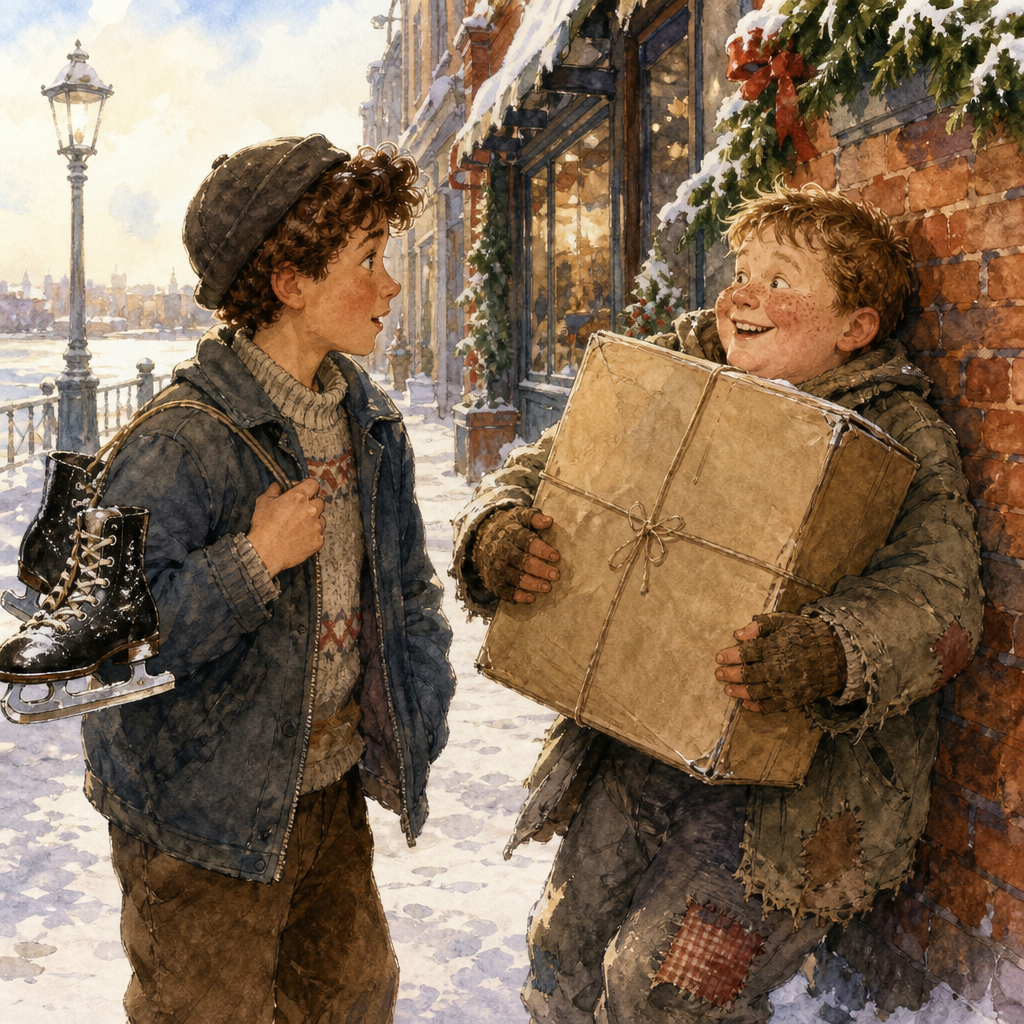
“That was almost a crash,” said the owner of the moon-face cheerfully, setting the box down and leaning against a wall to rest.
“Nobody hurt, I guess,” said Tom.
“Been down at the ice?” the boy asked eagerly. “I could see the skaters from Patton’s store. Oh — you got new skates for Christmas! Aren’t they beauties!” And he beamed at the once-despised Jolly Ramblers with his whole heart in his little blue eyes.
“Pretty good little pair of skates,” Tom said, in Ralph’s own condescending tone.
“Good? I’ll say! And Christmas ice made just on purpose for them!”
In spite of his bad mood, Tom couldn’t help warming to the shabby boy’s happy enthusiasm. He recognised him now — Harvey McGinnis, the son of a poor widow, who worked at Patton’s department store after school. Glancing at the big box with new curiosity, Tom asked, more kindly, “What’ve you been up to on Christmas Day?”
“You really want to know?” said Harvey, his round face glowing brighter than ever. “Well — I’ve been playing Santa Claus down at Patton’s store.
“About a week ago,” he went on, leaning back against the wall and stuffing his hands in his worn pockets, “I was cleaning out the storeroom, and I found three big boxes with broken dolls in them. Beauties, I’m telling you — the Lady Jane in a blue silk dress, the Lady Clarabel in pink, and the Lady Matilda in shimmering white. Nothing really wrong with them, just snapped elastics inside that put their joints out of whack and let their heads roll around. ‘They could be fixed in no time,’ I said to myself, ‘and what a treasure they’d be for the girls!’ Because Mom and I had been racking our brains over how we’d scrape together anything for the girls this Christmas.
“So I went to the boss and asked what he’d charge me for the three ladies just as they were. And he says, ‘Jimmie’ — he’s never once got my name right, always calls me Jimmie — ‘Jimmie,’ he says, ‘you come down Christmas Day and help me take down the decorations and set the store right for regular trade, and I’ll give you those dolls for nothing.’
“So I told the girls that Santa would be running a little late at our house this year — with so many children to visit, that’s no surprise — and I went down first thing this morning, finished my work, and fixed the ladies up good as new. Want to see them?”
“Sure, I’d love to,” said Tom.
With careful, almost reverent hands, Harvey untied the string and opened the big box, revealing three smaller ones stacked inside. He lifted the lid of the first to show a truly handsome doll in a blue silk dress, with big dark eyes that opened and shut and dark, curling “real hair.”
“This is the Lady Jane,” he said, smoothing her frock with gentle fingers. “She’s for Kitty. Kitty’s own hair is pretty and curly, but she can’t stand it because it’s red — she thinks black hair’s the prettiest in the world. Funny, isn’t it, how we all want what we haven’t got?”
Tom didn’t answer that bit of wisdom out loud — but he laid a repentant hand on his Jolly Ramblers, as if he knew he’d wronged them in his heart. “That’s as fine a doll as I ever saw, and no mistake,” he said.
Pleased, Harvey opened the second box to reveal the Lady Matilda, with golden curls and a gown of shimmering white. “The Lady Matilda goes to Josephine,” he said. “Josephine’s hair is black and straight as a string — won’t she laugh to see these yellow curls?”
“She surely will,” said Tom.
The Lady Clarabel was another fair-haired doll, in the brightest pink. “And this beauty’s for the baby,” said Harvey, his eyes glowing. “She won’t care whether the hair’s black or yellow, but won’t that dress make her eyes pop!”
“They’ll believe in Santa for sure when they see these,” said Tom.
“That’s just what I told Mom this morning,” said Harvey. “Kitty’s had her doubts lately — she’s almost nine — but when she sees these fine ladies she’ll be certain Mom and I couldn’t have bought them. If only I had a Santa suit, I’d dress up and hand them out myself.”
Tom’s face lit with a sudden idea. “My brother Bob has a Santa Claus suit he wore in a show last Christmas,” he said. “Say — let me dress up and play Santa for you! The girls would never guess it was me.”
“Wouldn’t they stare, though!” said Harvey, delighted. Then, hesitating, “But do you really want to spend the time — with brand-new skates and ice like this?”
“Of course I do, if you’ll let me,” said Tom. “I’ll skate down the river and meet you wherever you say.”
“Our back yard, then — seven o’clock,” said Harvey.
“I’ll be there!” And with his head up and his skates clinking, Tom hurried off.
It was a flushed, excited boy who burst into the Reynolds’ quiet sitting room a few minutes later, skates still on his shoulder. “Mom — can I have Bob’s Santa Claus suit tonight? I’m going to play Santa for Harvey McGinnis!”
“Play Santa for Harvey McGinnis? What do you mean, child?”
“You know Mrs. McGinnis, that poor woman in the little house by the river — her husband was killed on the railroad last winter. Well, Harvey, her boy, has fixed up these gorgeous dolls for his sisters, and he wants me to come play Santa tonight.” And Tom poured out the whole story.
“He sounds like a wonderful boy,” said Mrs. Reynolds warmly, “and I’ll be glad to have you go.”
“And Mom,” said Tom, hesitating a little, “do you think Grandma would mind if I spent part of that five dollars she gave me — for a pair of skates for Harvey? He doesn’t have any skates at all, and I know he’d love them.”
“That’s generous of you,” said his mother, clearly pleased. “You’d still have two and a half left for your trip to Grandma’s.”
“But I want to get him the Club House skates,” said Tom. “They’re the new kind — three-fifty.”
“But I thought you said the Jolly Ramblers were the best skates made?” Mrs. Reynolds looked a little hurt, glancing from Tom to the skates on his shoulder.
“They are, Mom — they’re the best!” said Tom, blushing with shame that he’d ever looked down on her gift. “But the Club House ones are just right for Harvey. His shoes are old and worn, and these have clamps that won’t shake loose. And if anything breaks in the first year, you get a new pair free — and Harvey wouldn’t have any money for repairs.”
“Well, do as you like,” said his mother, warmed by his eagerness — for such a burst of generosity was something new in her younger son. “But remember, your visit to Grandma will have to wait a while.”
“That’s fine — thanks, Mom!” said Tom. “I’ll run over and ask Mr. Harrison if he’ll open the store just this once for a special occasion. I bet he will!” And away he flew.
That evening at seven, as the moon rose over the eastern hills, a short, round Santa Claus stepped out of the dry reeds by the riverbank and walked on remarkably nimble feet into the McGinnis’s little back yard. As he neared the porch, a dark figure rose to meet him — one hand raised in warning, the other holding out a bulging grain sack, filled to the brim.
“Here’s your pack, Santa,” Harvey whispered gleefully. “They’re all waiting in the front room. I’ll slip in the back way while you go around and knock at the front, and Mom’ll let you in.”
Trembling with excitement, Tom tiptoed around the house, quietly slipping one long, flat package deep into the sack as he went. Thump, thump! How his knock echoed in the frosty air! The door swung wide, and Mrs. McGinnis stood before him.
“Good evening, Santa — come right in,” she said.
Tom had always thought Harvey’s mother rather plain, the few times he’d passed her at the grocery, with her thin hair drawn back and a dark shawl over her head. But now, looking up into her big, kind face, so full of Christmas warmth, he wondered how he could ever have thought her anything but lovely. The room was small and bare but wonderfully cheerful, hung with pine boughs and scraps of red and green paper saved from the store decorations. On a big bed in the corner sat the three little girls: Kitty with her bright curls bobbing, Josephine with her black braids sticking straight out, and the baby with tiny blue eyes that twinkled just like Harvey’s.
The fine speech Tom had rehearsed for two hours vanished clean out of his head in front of that excited little audience. But somehow, in a stammer no one was calm enough to notice, he got out something about “Merry Christmas” and “good children,” and set to opening the magic sack.
“Miss Kitty McGinnis!” he called in deep, gruff tones. Kitty took the box shyly, slid back the lid — and cried out in wonder. “A doll! Oh, the loveliest doll that ever was!” Then, turning to her brother, she whispered as quietly as her excitement allowed, “Oh, Harvey — I’m afraid you paid too much!”
“Go on!” said Harvey, his face more like a full moon than ever. “Don’t you know Santa can do whatever he pleases?”
The other dolls were greeted with the same delight — Josephine stroking the Lady Matilda’s golden curls in wonder, the baby dancing round and round waving the pink-gowned Lady Clarabel over her head.
“Mr. Harvey McGinnis!” boomed Santa. Harvey grinned over at his mother as he drew out a pair of sturdy cloth gloves.
“Mrs. McGinnis!” And the good woman smiled back as she shook out a dainty white apron with an embroidered ruffle.
“I reckon Santa wanted you to wear that on Sunday afternoons,” said Harvey shyly.
“And I’ll be proud to,” said his mother.
Little bags of candy came next, and everyone had settled in to enjoy them — sure the sack must be empty by now — when Santa called out, in a voice that trembled beneath its gruffness, “Another package for Mr. Harvey McGinnis!”
“For me? What — ” said Harvey, taking the heavy, flat bundle. And as the sparkling Club House skates came into view, his face lit with a joy Tom never forgot. Then, in a moment, the glow gave way to worry. “You shouldn’t have done it,” he said. “These must’ve cost a fortune!”
“Aw, go on,” came the reply — in a distinctly boyish voice this time. “Don’t you know Santa can do whatever he pleases?” And with an enormous bow, old Santa was gone.
A few minutes later, a slim boy with a bundle under his arm was skating swiftly down the shining river in the moonlight. As he rounded the bend, a tall figure in a fur-trimmed coat came gliding toward him, and a familiar voice called out in Ralph Evans’s condescending tone, “Well, how are the Jolly Ramblers doing tonight?”
But this time the answer rang out clear and glad and triumphant. “The best in the world,” said Tom. “And isn’t it a glorious night for skating?”