I. Christmas Eve
“They’ve come! They’ve come!”
It was little Herbert, running in from the flat stone that served as the front doorstep, where he had been posted as a self-appointed sentinel, watching for the moment when the carriage would turn the corner at the bottom of the hill.
“They’ve come! They’ve come!” echoed joyfully through the house, and the cry reached into the kitchen extension — the “ell” — where the grown members of the family were going about their tea preparations with a solemnity rather above the ordinary.
“Have they come?” cried Grace, and she slid her skillet to the back of the stove so its white contents wouldn’t burn while she was away. She threw a handkerchief over her shoulders and ran with the others to the front door, to wave something white and be in at the first welcome.
Young and old gathered in that hospitable open space where the side road swept up toward the barn. The bigger boys had scattered halfway down the hill. Even grandmamma had stepped off the stone and walked out toward the road. Everyone was waving something — those without handkerchiefs waved hats or dish towels — and the older boys set up a ragged, enthusiastic cheer.
But the carriage came slowly up the hill with no answering handkerchief, no bonneted head stretched out from the side. As it neared Sam and Andrew, their enthusiasm visibly drooped. George and Herbert fell silent as it passed them. And before it even reached the house — as bad news always does — the word had come up the hill ahead of it: “She has not come, after all.”
It was Huldah Root, Grace’s older sister, who had not come. Their father, John Root, had driven down to the station himself to meet her; Abner, the oldest brother, had gone along. It had been two years since Huldah was last home, and the whole family had been on tiptoe. Hence the elaborate tea; hence the sentinel on the step; hence the general assembly in the yard. And after all of it, she had not come.
It was a wretched disappointment. Their mother had that heavy, silent look which children feel more deeply than any outburst. John Root led the horse into the barn as if nothing that might happen in heaven or on earth could touch him now. The boys were loud in their outrage: “It is too bad!” and “Grandmamma, don’t you think it’s too bad?” and “It is the meanest thing I ever heard of in all my life!” and “Grace, why don’t you say anything?” As for Grace herself, she was beyond saying anything. All the words she had stored up to say to Huldah — all the doubts and hopes and half-formed secrets, known only to God, that were to be poured into Huldah’s ear the moment they were alone — came rising up one by one as if to choke her. She had waited so long for this fortnight of sympathy, and now she had lost it. And poor grandmamma, on whom fell the task of quieting the boys, was at heart as wretched as any of them.
Somehow, supper managed to get itself onto the table; and when John Root and Abner came in from the barn, they all sat down and pretended to eat. What a miserable contrast to the Christmas Eve they had expected.
It is worth noting that the observance of Christmas was still something of a novelty in the New England hill country in those years. The Pilgrim Fathers had celebrated their first Christmas by working all day at the raising of their first house — a fine beginning for a new civilization. And many a New Englander still in middle life at this period could not have told you, if asked, on which day of the year Christmas fell. But New England had been coming into the general life of the world, and with the generous openness of her Congregational tradition, her people and churches had been claiming, one by one, all the noble observances of the wider Christian world. And so it was that the Roots of their hillside farm had decided they would keep Christmas as no Root had done since Josiah Root landed at Salem from the Hercules, with other Kentish settlers, in 1635. Abner and Gershom had cut and trimmed a pretty fir-balsam from the edge of the Hotchkiss clearing; it stood now in the best parlor. Grace, with her firm ally Mary Bickford, had gilded nuts and rubbed lady apples and strung popped corn; the tree had been dressed in secret, the little ones locked firmly out of the room. The choicest turkeys and plumpest geese had been set aside for the feast. And all of this was only the accompaniment, the side decoration, of the great glory of the celebration — which was that Huldah, after two years away, was coming home.
And now she had not come — was not coming.
As they sat down before their splendid, untasted feast, the abundance seemed to mock them. John Root handed his wife the letter their daughter had sent; she read it and passed it to Grace, who read it and passed it to the grandmother. No one read it aloud. To read aloud in such moments is not the New England way.
Boston, Dec. 24, 1848
Dear Father and Mother — It is dreadful to disappoint you all, but I cannot come. I am all packed and ready, and this goes by the same carriage that was to take me to the train. But our dear little Horace has just been brought home, and I am afraid he is dying — though we cannot tell, and I cannot leave him. You know there is no one else who can do what I can. He was out riding his pony. The pony came home alone first, and five minutes later two policemen brought the dear child in a carriage. His poor mother is very calm, but cannot think yet, or do anything. We have sent for his father, who is downtown. I try to hope the boy will come to himself, but he only lies there drawing long, slow breaths on his little bed. The doctors are with him now. I write this little scrawl to say how terribly sorry I am. A merry Christmas to you all. Do not worry about me.
Your own loving Huldah.
P.S. I have little presents for the children, but they are all in my trunk and I cannot get at them now. I’ll make up a bundle on Monday. Good-by. The man is waiting.
The letter passed from hand to hand, its contents trickling slowly into the comprehension of each person according to their age. It was Sam, as usual, who broke the silence:
“It is a perfect shame. She might as well be their property, bought and sold. I should like to tell them that her blood is as good as theirs, and that, with all their airs and money, they have no right to—”
“Sam,” said poor Grace, “you shall not say such things. Huldah has stayed because she chose to stay, and that is the worst of it. She will not think of herself, not for one minute, and so — everything happens.”
And Grace was sobbing beyond speech again, her intervention amounting to nothing. The boys argued among themselves through the evening, and grandmamma and their mother took turns talking them down; but for all that, it was a miserable night. John Root took a lamp in one hand and the Weekly Tribune in the other and sat before the fire pretending to read. He did not once turn the page.
At half-past eight every light was out, and every member of the household lay wide awake in bed.
Now — Huldah Root, you should understand, was in service with the Bartlett family in Boston. When she was only sixteen she had gone there as a seamstress for a fortnight; the fortnight became a month, the month two months. She grew fond of Mrs. Bartlett because Mrs. Bartlett grew fond of her. The children adored her, and she kept an eye to them, and it ended with her engaging to spend the winter — half seamstress, half nurse, half nursery governess, and a little of everything. From that beginning she had lived six years in the household, in confident, confidential service. She could cook better than anyone in the house — better than Mrs. Bartlett herself — though she rarely displayed this gift. On a birthday in August she might make huckleberry cakes by the old homestead recipe for the children. She looked after all their clothes as no one else could; she took the younger ones to be fitted and made sure the older ones went out with no cracked seams and no rough edges at the trouser cuff. It was whispered that young Minnie would rather slip upstairs to the sewing room to have Huldah explain “alligation” or “square root” than wait for Miss Thurber’s lesson in the morning. In fifty such ways it had come about that Huldah — who on the census roll probably counted as a nursemaid — was the confidential friend of every member of the family, from Mr. Bartlett, who wanted to know where the Intelligencer had got to, down to the errand boy who came in to black the shoes.
And so it was that when poor little Horace was brought home with his skull fractured by the pony, Huldah was — and quietly knew that she was — the most essential person in that stunned household.
While her brothers and sisters were putting out their lights in New Durham, heartsick and hurt, Huldah was sitting in that still room where only the rough, broken breathing of Horace disturbed the quiet. She was changing the ice-water cloths every ten minutes; feeling his feet sometimes; wetting his tongue once or twice an hour; putting her finger to his pulse with a native instinct that needed no watch to help it. And all the time, with thought of him, she remembered how grieved and heartbroken they would be at home.
Every half-hour or so a pale face appeared at the door. Huldah would slide across the room and say, softly, “He is really doing nicely — please go lie down,” or “His pulse is surely better; I will come to you the moment it flags,” or “Pray trust me — I won’t let you wait a moment if he needs you,” or “Please rest yourself now. An hour’s sleep will be worth everything to you tomorrow.” And the poor mother would crawl back to her room and pretend to try to sleep, and in half an hour would be at the door again.
One o’clock. Two o’clock. Three o’clock. How companionable the clock becomes when one is sitting up alone through such a vigil. Four o’clock — quite intimate, really. Five o’clock. If I were in dear Durham now, one of the roosters would be calling. Six o’clock. Poor Horace stirred, turned, flung his arm out. “Mother — oh, Huldah! Is it you? How nice that is!” And he was gone again; but he had known her. What a blessed Christmas gift to carry to his poor mother when she slipped in at daybreak: “He knew me. He spoke my name.”
“Why, Huldah,” said the mother, “what an angel of peace you are.”
So opened Huldah’s Christmas morning.
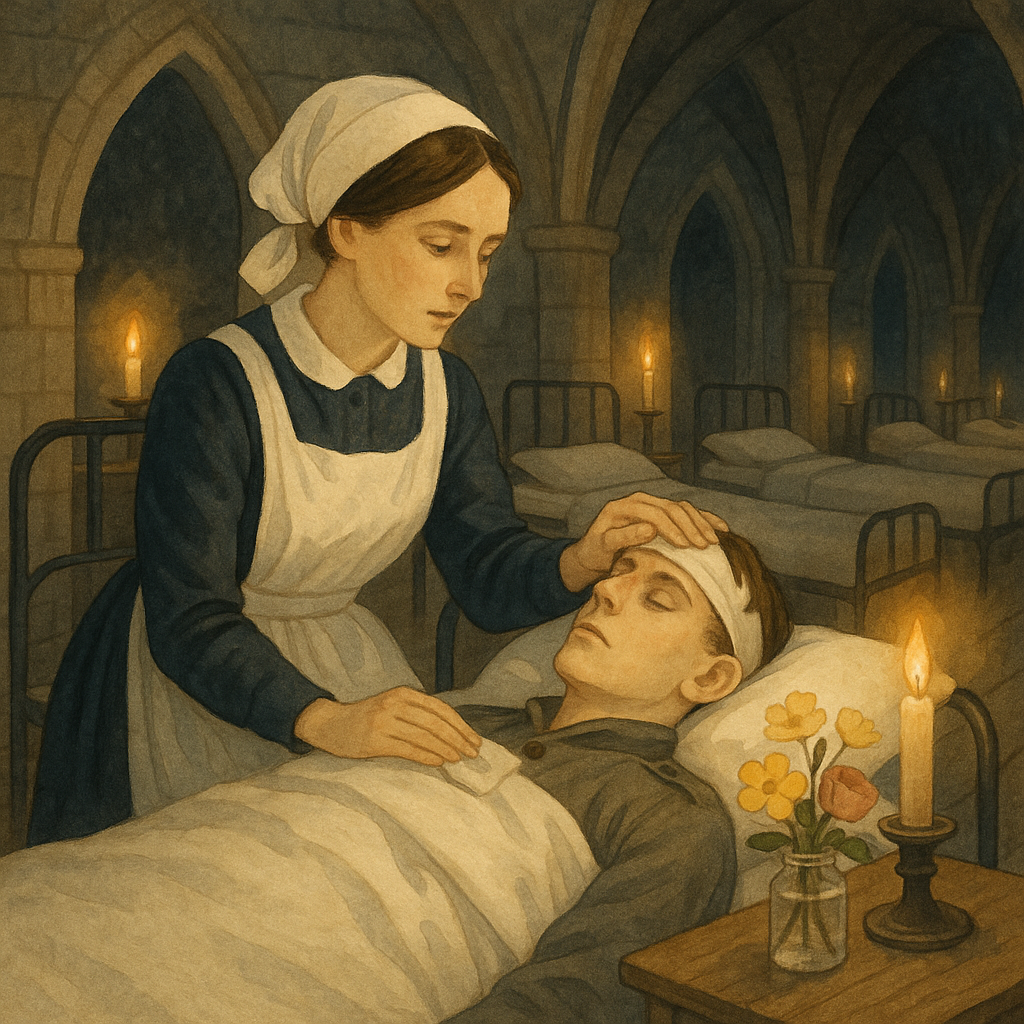
Then followed days of doubt and nights of watching. Every now and again the boy would know his mother, his father, or Huldah. Then would come the heavy stupor that was so different from natural sleep. At last the surgeons determined that a fragment of the bone must be removed. There was the quiet gathering of the most skillful men at the appointed hour; the firm table for the little fellow to lie on; the ether and the sponge — and, of course, everywhere and always, Huldah. She could hold the sponge or fetch and carry; she could answer at once if spoken to; she could wait, when waiting was required, and act, when acting was called for. At last the wretched little sliver of bone that had been pressing on the boy’s brain was lifted safely out. It was in the surgeon’s hand; he smiled and nodded at Huldah as she looked her question, and she knew he was satisfied. And did not the poor child, even in his unconscious sleep, draw his breath more lightly than before? All was well.
“Who is that young woman?” said Dr. Morton to Mr. Bartlett, as he drew on his coat in the doorway. “Could we not tempt her over to the General Hospital?”
“No, I think not. We cannot spare her.”
The boy Horace was as good as new-born that day — a New Year’s gift to his mother. So passed Huldah’s holidays.
II. Christmas Again
Fourteen years make of a boy who has been thrown from his pony a man equal to any prank of any pony — even a boy of ten. Horace Bartlett was now colonel of a cavalry regiment stationed in West Virginia. He was twenty-four years old, held the oldest commission in his district, and had been Post Commander at Talbot Court House all fall; he would be, in all likelihood, for the winter. The boy had a vein of foresight in him, a good deal of system, and — what is worth having alongside system — a knack for order. His staff were young men like himself, all friends, all earnest; his surgeon had taken his degree in Washington that spring, which was encouraging — if he lacked experience, he had at least the latest knowledge. Their very youth made them provident and serious.
Among a hundred other letters written as October opened, Horace wrote this one:
Talbot Court House, VA., Oct. 3, 1863
Dear Huldah — Here we are still, and here we are likely to stay, as I’ve explained to father. We are doing tolerably well. I won’t bore you with my views on what should have been done in the valley of Yellow Creek, though I confess that if my advice had been followed we should probably all be in Richmond for Christmas dinner. It wasn’t, and so here we are.
I’ve been talking with Lawrence Worster, my Surgeon-in-Charge, who is a very good fellow. His sick list is not bad, and he intends to keep it that way — but he tells me he is not satisfied with his ward-masters, and it was his suggestion, not mine (mark that), that I should write to see if one or two of the Sanitary Commission women would not come this far to put things in order. So of course I write to you. Could mother spare you for the winter? It will be rough — but all in a good cause. Perhaps you know some sensible, generous women who might come along — not like you, of course, but still. Worster says we may have three hundred men in hospital before Christmas. Talk with mother and father.
Always yours, Horace Bartlett.
P.S. Worster has enclosed an official letter that will pass you through on government account. If you come, show it to Dr. Hayward first — it will save time.
Of course Huldah went. Grace Starr, her married sister, went with her, and Mrs. Philbrick, and Anna Thwart. That was how they all came to find themselves together in what had been the Methodist Church of Talbot Court House as Christmas of 1863 drew near.
By then they had been there long enough to grow accustomed to December in the open air of Virginia. On Huldah’s little table in front of the old pulpit were three or four buttercups in bloom, gathered in an afternoon walk, along with a few heads of hawkweed. “The beginning of one year,” Huldah said, “with the end of the other.” There was even a stray rose that Dr. Sprigg had found in a farmer’s garden.
Huldah came out from the vestry — where her own cot was — in the gray of the morning, changed the water for the flowers, glanced over last night’s memoranda, and beckoned to the ward-master. What was the movement she had heard in the night? Another alarm from Early?
“No, Miss. Not an alarm. The colonel’s orderly passed by — they stopped here for Dr. Fenno’s case. Orders had come down from General Mitchell, and the men were called out without the bugle, one by one, quiet as you please. Not a horse was to neigh if they could help it. They were gone in twenty minutes.”
“Gone — who is gone?”
“The whole post, Miss, except the day’s guard. There are not fifty men in the village besides ourselves. The orderly thought they’d gone down toward Braxton’s, but he didn’t know.”
Here was news! News so startling that Huldah went straight back and roused the other women, and then all of them together set to that wretched business of waiting. They had never yet waited for a real battle. They had had their beds filled from other posts, and some older gunshot wounds among the patients, but this was their first battle — if it was to be a battle. The covers came off that long line of beds down the west aisle and under the singers’ gallery; sheets and pillowcases were aired and put on; the big kettles were filled with strong soup; the milk-punch and beef-tea were set ready. Everyone who could be called was on hand to help lift patients and distribute food. But there was far too much time and far too little news. Anna Thwart and Dr. Sprigg walked down to the bend of the hill to watch for a messenger. The other women sat at the table, looked at their watches, walked to the door, came back to the table. Huldah noticed they had all put on fresh aprons — just to have something more to do.
Then Anna Thwart: “They’re coming! Someone is coming — a mounted man crossing the flat, heading this way — the doctor sent me back to tell you!”
Five minutes more. Ten minutes more. An eternity more. And then the clatter of hooves and the mounted man was there: “Wagons right behind me. We bagged every man of them at Wyatt’s. Got there before daylight. Colonel White’s men from the Yellow Creek came up at exactly the same moment, and we pitched into them before they knew what was happening — three or four regiments, thirteen hundred men, all their guns.”
“And with no fighting?”
“Oh, there was fighting, right enough. The colonel has a train of wagons coming down with the men who are hurt. Here is his note.”
Dear Doctor — We have had great success. We surprised the whole post. The company across the brook tried hard to get away, and a good many of them — and of Sykes’s men — are hit; but I cannot find that we have lost more than seven. I have nineteen wagons here of wounded men, some hurt badly. Ever yours, H.
More waiting, then — but now they knew what they were waiting for. Thank God, at half-past three in the afternoon, here they came. Twenty-seven poor fellows with everything wrong, from burnt faces to hearts that were barely beating for want of blood.
Horace Bartlett came in with them. “Huldah, come here. This is my old classmate Barthow — sat next to me at morning prayers for four years. He’s a major in their army, as you see. His horse stumbled and pitched him against a stone wall, and he hasn’t spoken since. Don’t tell me he’s dying; but do as well for him, Huldah” — and the handsome young colonel smiled — “do as well for him as you did for me.”
They carried Barthow, senseless as he was, tenderly into the church. He became patient E-27, on an iron bedstead. Not half the soup was wanted, nor the beef-tea, nor the punch. So much the better.
Then came days and nights, week in and out, of army routine and womanly care — that quiet, cheerful, homelike hospital life in the white-washed church, where the pointed arches of the windows and the worn fabric of the pulpit reminded one, not unpleasantly, of what the building had been. Two or three weeks of hope and fear, failure and success, brought them to Christmas Eve.
The surgeon-in-chief gave the Christmas dinner that concerns us here. Huldah and the other ladies had accepted his invitation. Horace Bartlett and his staff were guests, along with some of the other officers, and the doctor had given his personal permission for Major Barthow to walk up to his quarters with the ladies. Barthow and Huldah went ahead, he leaning with many apologies on her arm, delighted with his companion and full of enthusiasm about the mild Virginia winter. Dr. Sprigg and Anna Thwart were some way behind; the two married ladies, needing no escort, walked in the middle.
“What a party this is,” said Barthow. “The doctor ought to call on us for stories, the way Dickens would at a Christmas feast. Let’s see — we should have The Surgeon’s Tale, and The General’s Tale — we can pretend that the man with all the stars has come down from Washington. Then that one-eyed servant of his must tell The Orderly’s Tale. Your handsome friend from Wisconsin can give us The German’s Tale. I shall be invited to tell The Prisoner’s Tale. And you—” He paused.
“And I?” said Huldah, laughing.
“You shall tell The Saint’s Tale.“
Barthow spoke with feeling he made no effort to conceal. But Huldah was not there for sentiment; and without quivering in the least, she laughed as she knew she ought to do and said, “Oh, no — that is far too grand. The story must end with The Superintendent of Special Relief’s Tale. A little unromantic to the ear, but that is what it is.”
“I don’t see,” persisted the major, “if ‘Superintendent of Special Relief’ means ‘Saint’ in Latin, why we shouldn’t say so.”
“Because we are not talking Latin,” said Huldah. “Now listen to me, and before we sit down to dinner I will tell you a story good enough for Dickens, and it is not fifteen minutes old.
“Have you noticed the dark-whiskered fellow under the gallery, by the north window? Yes — that one. He’s French, enlisted in New London, I think. I went to him just now, managed to say étrennes and Noël and a few other French words, and asked if there was anything we could do to make him feel more at home. Oh, no, nothing — madame was too kind, everyone was too kind. But I stayed. And at last: ‘No, madame, nothing. But since you say it — if there were perhaps two drops of red wine, du vin de mon pays — but you could not find that here in Virginia.’ Could I not? A superintendent of special relief has long arms. There was a case of claret — the first thing my eye fell on when I took over the storeroom keys. The doctor was only too glad the man had thought of it. And you should have seen the pleasure that glass of wine — filled to the brim — gave him. The tears ran down his cheeks. Anna found another Frenchman and sent wine to him as well. And my man is now humming a little song about the red wine of Burgundy. Could not Mr. Dickens make a pretty story of that? The Frenchman’s Story.“
Barthow longed to say that the great novelist would not make half so pretty a story as she had. But this time he did not dare.
You are not going to hear the eight tales — Mr. Dickens was not there, and neither was I. But a fine Christmas dinner they had, and they were quiet and very happy. There was something remarkable in how much at ease they all felt with one another, in that plain Virginia kitchen — a Confederate kitchen, at that — where the doctor and his mess had arranged the feast. The memories of other Christmases at home came in not sadly but warmly, and cheered rather than shadowed the evening. There was no responsibility for once, no strain. The officers were glad not to be on duty; the prisoner was glad not to be in bed. It was a small, out-of-the-way post, and they took their holiday with the ease of a detached command.
“Shall we have toasts?” said the doctor, when the nuts and raisins and apples appeared.
“Oh, no — nothing so formal.”
“Oh, yes!” said Grace. “I have heard of toasts all my life and never seen one drunk.”
“One toast, then,” said the doctor. “Colonel Bartlett — will you name it?”
“Only one? That is a hard selection.” He thought while a dozen voices offered suggestions. “I might give The Country, or The Cause, or The President — and everyone would drink. I might give Absent friends or Home, Sweet Home — but then we should cry.” A few more suggestions came, half-serious, half-comic. Then Major Barthow, when the first rush was over, said, “Give Saints and Sinners.“
“I shall give no such thing,” said Horace. “We have had a lovely dinner, and we know it, and the host, who is a good fellow, knows the first thanks are not to him. Those of us who have ever had our heads knocked open, as the Major and I have, we do know. Fill your glasses, gentlemen. I give you — the Special Diet Kitchen.“
He caught them all off guard. A general shout went up, and all the ladies rose and dropped mock curtsies.
“By Jove,” said Barthow to the colonel afterward, “it was the best toast I ever drank in my life. That woman has saved my life. Did she do the same for you?”
She had.
III. Christmas Again
So you expect that when the war was over, Major Barthow — then a Major General — remembered Huldah, came north, and persuaded her to marry him; that she is sitting now on a veranda looking down at the Pamunkey River.
You were never so mistaken in your life. If you want that story, you can buy yourself a dime novel. I would recommend The Rescued Rebel, or perhaps The Noble Nurse.
After the war, Huldah did pay a visit to Colonel and Mrs. Barthow at their place in Pocataligo County — but I was not there and know nothing about it.
Here is a Christmas of hers, about which she wrote a letter — and as it happens, it was a letter to Mrs. Barthow.
Huldah Root to Agnes Barthow
Villers-Bocage, Dec. 27, 1868
…Here I was, then, after this series of hopeless blunders, quite alone at the train station of this little out-of-the-way Norman town. My dear, there has probably not been an American here since time began. And here I was likely to remain, for there was no possibility of the others getting back to me until tomorrow, and no use in trying to overtake them. All I could do was bear it and live through from Thursday to Monday — and the very worst of it was that Friday was Christmas Day.
Well, I found a little carriage with a funny old driver who understood my French no better than I understood his Norman patois, but he understood a franc-piece well enough. I had my guidebook and said “auberge,” and we arrived at the oddest, most old-fashioned establishment that ever stepped out of an old French novel. And here I settled.
The reason I am writing today, dear Mrs. Barthow, you will now understand. It was only ten o’clock when I arrived. Then I went for a walk, with a respectful following of children; then I came back and ate the odd little meal they provided; then I took a nap; then I went out again and made a little sketch in the churchyard. This time one of the children fetched her mother — a cheerful Norman woman in a beautiful local costume — who dropped a curtsy and asked in gentle patois whether the children were troubling madame. I said certainly not, found a sweet for the child, and showed my sketch to the woman. She asked if madame was English.
I said I was not English — and here the story begins — for I said I was American. And do you know, her face lit up as if I had told her I was one of the old northern saints.
“Américaine! Est-il possible? Jeannette, Gertrude, faites vos révérences. Madame est Américaine.”
And sure enough, they all dropped courtesies of preternatural depth. Then came the most eager enthusiasm — how fond they all were of les Américaines, though no American woman had ever come here before! Was madame at the Three Cygnets? Might she and her son and husband call on madame? Might she bring a little étrenne — a Christmas gift? And I know not what besides.
I was very glad the national reputation had reached so far. I wished I were Charles Sumner, to receive the delegation with proper dignity. But I said “Oh, certainly!” — and returned to the Three Cygnets with my admiring following whispering to the street that madame was Américaine.
In the evening they all came. You should have seen the pretty basket they brought — stephanotis blossoms, a wealth of roses, all arranged with charming taste in a quaint country basket that exists nowhere but in this corner of old Normandy. In came the husband, dressed up and a little frightened, but thoroughly good in his face. In came my friend the Norman woman; then two sons and their wives, and three or four children — and my dear Agnes, one of the sons I knew in an instant. He was a man we had at Talbot Court House when your husband was there. I think the Colonel will remember him: a dark-whiskered fellow who used to hum a little song about the red wine of Burgundy.
He did not recognize me — I could see that at once. It was all so different, you know. In the hospital I wore my cap and apron; here — well, it was another thing. My hostess had put me in her largest room, and I received the family’s formal welcome, thanked them in my best Parisian French, and then the conversation stalled. I took my turn.
“You served in America, did you not?” I said to the young man — Louis, his name was.
“Ah, yes, madame! I did not know my mother had told you.”
She hadn’t, of course, and she looked astonished. I continued:
“You seem strong and well.”
“Ah, yes, madame!”
“How long since you returned?”
“As soon as there was peace, madame. We were mustered out in June.”
“And does your arm never trouble you?”
“Oh, never, madame! I did not know my mother had told you.”
New astonishment on the mother’s part.
“You never had another piece of bone come out?”
“Oh, no, madame — but how does madame know? I did not know my mother had told you!”
By this time I could not help myself. “You Normans care more for Christmas than we Americans — is it not so?”
This he would not stand. He said stoutly, “Ah, no, madame! Never!” and launched into an eager defense of American goodness and American religious feeling and the kindness of Americans to all who were kind. But still he had not the slightest idea who I was. And I said:
“Do the Normans ever drink Burgundy?” — and to my old hostess — “Madame, could you bring us a flask of the red wine of Burgundy?” — and then I began to hum his little song. I am sure the Colonel will remember it: “Deux — gouttes — du vin rouge de Bourgogne…”
My dear Mrs. Barthow, he sprang from his chair and fell to his knees and kissed my hands before I could stop him. And when his mother and father and all the rest discovered that I was the particular nurse who had tended dear Louis when he was wounded — that it was I he had told of that very day, for the thousandth time, he said — who had given him that glass of claret and cheered his Christmas — I believe they would have carried me to the church. The women were not satisfied with kissing me, the men with shaking hands with each other; the whole inn had to be called in. I cried my eyes out, and when they let me go to bed at ten o’clock, I was worn out with crying and laughing and talking and listening.
For forty-eight hours after that I was simply a queen. I can hardly put my foot to the ground. Christmas morning, the dear Thibault family came again; then the curé came; then some charming Madame Perrons, and I went to Mass with them; and after Mass, their brother’s carriage appeared, and they would take no refusals, and so with many apologies to my sweet old hostess at the Three Cygnets I was brought up to M. Firmin’s lovely château here and made thoroughly at home until my friends arrive. The Thibaults, it turns out, had come to this very château to beg the flowers for the Christmas basket. It is the most beautiful country house I have seen in France, and the family lives on the most generous, open terms with everyone around them. So here I am, waiting, with my little overnight bag to make me presentable, and here I ate my Christmas dinner.
Tell the Colonel: here is “The Traveller’s Tale” — which is why the letter is so long.
Most truly yours, Huldah Root.
IV. One Christmas More
This last Christmas party is Huldah’s own — or at least as much hers as anyone’s. There are five of them living in the house, six if you count the general, in what I will call by its affectionate name, the Saints’ Rest. It stands three miles out from the old State House in Boston — one of those comfortable older houses with two stories connected by a staircase of such easy, gracious tread that you can go up or down it without quite knowing which direction you’ve traveled.
Into this house, by the inevitable law of attraction, have drifted together: Huldah herself; Ellen Philbrick, who was with her in Virginia and France and has been parted from her only on duty for twenty years; and three other friends whose stories I cannot tell without writing three separate romances.
The quiet, strong, meditative woman now coming into the parlor is Helen Touro. She was left alone with her baby when the Empire State went down, her husband never heard of again. The love of that baby expanded to love of all others, and when I first knew her she was the mother of a household of orphans, always with a heart large enough to say there was room for one more. The older woman writing at the secretary in the corner managed the household of General Schuyler through all the last years of his public life — his wife long ill, then gone, his children needing care — and those who think they know what is owed to that good man’s public service would think differently if they knew how much of it is owed to her. And Miss Peters — she served in another regiment entirely; she spent twenty-five years at the head of the finest school I know of, which in that time turned five hundred girls into the capable, generous women at the center of five hundred families.
All five of these women have been in “the service.” All have learned that perfect service is perfect freedom — and that it is the highest honor. They have taken this house together, as they say, for the shelter of their old age. But Huldah, as she plays on the floor with young Harry Barthow, does not look to me remotely superannuated.
“But you said there were six,” I reminded Mrs. Philbrick.
“Five captains and one general,” she said. “We persuaded Seth Corbet to make his home here — yes, the same Seth who went round the world with old Mrs. Cradock. Since her death he has come back to Boston. He reports to us every morning, makes his headquarters here, and then goes his rounds to check on every Cradock grandchild and great-grandchild — makes sure each household is ‘all right.’ Sometimes he stays away overnight when one of the circle is seriously ill and needs a man to nurse them. He has been in service with that family since 1816, when old Mr. Cradock first set up his household; he has held all their children and grandchildren in his arms, and now that the youngest is twenty-five and the oldest fifty, he cannot rest any day until he knows they are all well. He thinks we here are babies — and takes care of us all the more courteously for it.”
“Will he dine with you today?”
“I’m afraid not, but we’ll see him at the Christmas tree after dinner. There is to be a tree.”
The house itself spoke its message. Over the mantelpiece hung Raphael Morghen’s large print of Carracci’s Washing of the Feet — a copy I had never seen anywhere else. Opposite it was Kaulbach’s own study of Elizabeth of Hungary, dropping her apron full of roses — “Oh, what a sight the apron discloses; the viands are changed to real roses!” — a gift to Huldah, though she blushed and wouldn’t say from whom. On the third wall, Steinler’s Good Shepherd, chosen by Helen Touro from a portfolio sent to her by six or eight men who, as dirty little boys from the streets of New York, had once passed through her hands. On the fourth wall, Horace Vernet’s dashing Gideon Crossing the Jordan, with “Faint, yet pursuing” worked into the frame. On the easel, Miss Peters had placed her own copy of The Tribute Money. Other pictures hung in the room, but these five together told its story without a word.
The five “girls” — I find I still call them that — were always all together at Christmas, though in practice each lived at Saints’ Rest only two-fifths of her time. The rest they were out in the world, filling gaps wherever a family had need of someone equal to any emergency — a mother called suddenly away, a bout of scarlet fever, children who needed someone to take them to the seashore. So in practice there were rarely more than two at home at any given time. But not at Christmas.
There were covers laid for twenty-four at the dinner table, the children managed upstairs by the indefatigable Maria Munro. The twenty-four at table were men and women of a thousand histories, all of whom had known the nobility of service. One or two of us had been invited as novices, in the hope that we might learn something.
Scarcely had the soup been served when the front doorbell rang. Nothing else ever made Huldah look nervous; Colonel Bartlett said quietly to me that he had seen her calmer under rifle fire. The bell rang again. Helen Touro talked more emphatically; Mrs. Bartlett at the far end of the table started a great laugh. When it rang a third time, Huldah asked one of the maids whether someone was not attending the door.
“Yes, ma’am — Mr. Corbet is there.”
The bell rang a fourth time. A fifth. “Isabel, please go — Mr. Corbet must have stepped out.” But Isabel came back with a face broad with suppressed laughter. “Mr. Corbet is there, ma’am.” Sixth peal. Seventh. Eighth. Then the side gong began as well, and the front bell rang a ninth, tenth, eleventh time.
Someone with presence of mind launched into a lively account of the passage of the Red River Dam, in which the gravy boats stood in for steamships and the cranberry sauce for General Banks. But when both bells rang simultaneously and heavy footsteps were heard in the hall, Huldah rose from the table. “If you will excuse me—”
“We will not excuse you,” cried Clara Hastings. “Nobody will excuse you. This is the one day of the year when you are not to work. Let me go.” So Clara went out. The bells rang no more. She came back presently and said a man had been asking his way to the mills — they had directed him as best they could — and she hoped it would serve.
And so the great Christmas dinner went on in its solid, warm order, and we sat long and laughed loud and talked of war and poetry and old families and far places. Dr. Worster — pretending to recall — produced a list of surgeons and majors and major generals who had allegedly made love to Huldah at one time or another. By and by the grapes and sweets appeared, and Maria Munro led in the sixteen children. And at last Seth Corbet flung open the door to the red parlor to announce — The Tree.
It was glorious: gold and white, wreathed in snowflakes, blazing with candles. Sam Root kissed Grace and said, “Do you remember?” But the tree itself did not astonish the children half so much as five tables — set at the corners and center of the room — astonished the Sainted Five. Those five women, who had believed they were giving the Christmas, found themselves the recipients of it.
The first thing my eye fell on was a box of Burgundy wine with a little banner reading “Huldah’s table” — from Louis. Then I saw that each table bore a name, and each was heaped with Christmas offerings. The word had gone out — somehow, no one quite knew how — that these women had come home to stay. Everyone they had ever served, across forty years and every corner of the world, had taken that settling down as the occasion to send what gratitude could carry. Coral from India, pearls from Ceylon. Diamonds from Brazil, silver from Nevada. Books in fine bindings, in memory of copies of the same book worn to rags in service and sometimes stained with blood. Pictures — by the hands of friends, or by masters — each one recalling some scene from “the service.” Southern moss, sent by the Barthows, was hung among the pictures on the walls. In twenty-five years these women had gathered around themselves, without seeking or even noticing it, a circle of loyal and adoring friends whose gratitude they had forgotten, but who would never forget them. And that circle, from the four corners of the earth, had quietly conspired with old Seth Corbet, so that while the five saints were trimming their Christmas tree for the children, the North and the South and the East and the West were sending gold and frankincense and myrrh to them.
The saints themselves were laughing and crying at once, quite overwhelmed. The rest of us, looking at those heaped tables — that visible, tangible record of lives brightened, wounds dressed, tears wiped away, and homes steadied — felt in the moment something more of the meaning of: He who will be chief among you, let him be your servant.
The laughter and tears found their outlet in the children’s impatience to get to the tree, and in three minutes Ellen was opening boxes and Huldah was pulling crackers as if they had never been off their feet. But when each child had two armfuls and the fir-balsam sent down from New Durham was nearly bare, young Edgar Bartlett pointed to the topmost branch, where something bright had gone unnoticed. No one — not Seth himself, who had most of the house’s other secrets — seemed to know how it had come to be there. Seth lifted the little discoverer high in the air, and the child brought it down triumphant.
It was a parcel wrapped in silvered paper. Seth cut the strings.
Inside: twelve Maltese crosses of gold, each set with a jewel — twelve stones blazing like the twelve of the Revelation. They were mounted on ribbons of blue and white. Six ribbons bore names: Huldah’s, Helen’s, Ellen Philbrick’s, Hannah’s, Miss Peters’s, and Seth Corbet’s. The other six bore no names; on their gold was written only “From Huldah, to —” and “From Helen, to —” and so on, as if these were honors to be carried forward and passed along to the next in the service.
The saints were the last to understand the decorations — but the rest of us had caught the idea, and we pinned the crosses on their breasts. As we did so, the ribbons unfolded, and displayed the motto of the order:
“Henceforth I call you not servants. I have called you friends.”
It was at that Christmas that the Order of Loving Service was born.