All that afternoon we had walked through the forest, sticks in hand, packs slung over our shoulders — through that magnificent forest of Tronsays, which covers half the country of St. Amand and half of Nevers. The little village of Ursay, squatting on the bank of the Cher in the cleft of a valley that cuts through the heart of the forest, was our last stop for the day. We dined with an old friend, the modest doctor of five or six neighboring communes, and after dinner we sat on the porch with our cherry-wood pipes.
The shadows settled around us over the dense blue mass of forest that ringed the horizon, with all the solemn slowness of a June night. The sky was streaked with flights of swallows. The nine o’clock Angelus scattered its notes in intervals of silence from the height of a snuffer-shaped steeple rising above the rooftops. From distant farms came the barking of dogs calling and answering one another.
A woman, still young, in a red woollen skirt and a white linen blouse, came out of a nearby house and walked down toward the river. With her left arm she pressed a baby against her breast. A little boy held her other hand and gave his in turn to a still smaller brother. When they reached the bank of the Cher, the young woman sat upon a great stone, and while the two boys, hastily undressed, paddled and splashed about like ducks in the stream, she nursed her youngest.
One of our party, who was a painter, said, “There’s a picture that would be popular at the Salon. How well-built and beautifully lit that woman is! And what a pretty bright spot that red skirt makes in the blue landscape!”
A voice behind us called out — “The girl you see there, young men, is Solange, the wolf-girl.” Our host, who had been detained by a consultation, came out to join us. When we asked who this wolf-girl was, and how she had come by so strange a name, he told us this story.
“This Solange — her real name is Solange Tournier, wife of Grillet — was the prettiest girl in the whole Tronsays country about ten years ago. Now, of course, working in the fields as she does, and having had five children, she looks worn. Still, considering her thirty years, she is handsome enough, as you can see. At the time of the adventure that gave her that strange name, she was living with her parents, farmers at the Rein-du-Bois, some fifteen kilometres from here. Although very poor, she was courted by all the young men, even the well-to-do ones. But she welcomed the attentions of only one — a certain Laurent Grillet, on whom she had set her heart when she was a little girl, when the two of them kept the sheep together near Rein-du-Bois.
“Laurent Grillet was a foundling, with nothing in the world but his two arms for a fortune. Solange’s parents had no inclination to add poverty to poverty, especially when she had so many wealthier suitors.
“So Solange was forbidden to see her friend. Naturally, the girl never missed a rendezvous. Living in the same commune, with the forest at hand, they never lost an opportunity to meet there. When the father and mother Tournier realized that scoldings and blows were of no use, they decided on a drastic step. Solange was sent off to work at Ursay, on the model farm of M. Roger Duflos, our deputy.
“Perhaps you think the two lovers stopped seeing each other. Not in the least. They now met at night; they slept no more. After dark they both slipped away from their farms and started toward each other, spending the hours until nearly dawn in the deep forest — their forest, the accomplice of their young love.
“This was in 1879. Summer and autumn passed in this way. Then came winter, and a fierce winter it was. The Cher ran with ice-drifts and finally froze from bank to bank. The Tronsays forests, covered with snow, bent like weakened rafters under a heavy roof. The roads were nearly impassable. And the forest, deserted by men, was gradually being reclaimed by beasts. Wolves moved in — wolves that had not been seen or heard since the Terrible Year.
“Yes — wolves. They haunted the isolated farms around Lurcy-Lévy and Ursay. They even ventured into the streets of St. Bonnet-le-Désert, a little village deep in the forest beside a pond. It grew so bad that men organised into bands to beat the woods. A reward of fifty francs was offered for the head of a wolf.
“Neither the winter nor the wolves, however, frightened Solange and Laurent, or interfered with their nightly meetings. They kept at it in the face of every danger. This was the dead season in the fields, the time when the land lies fallow. Every night Laurent left Lurcy-Lévy with a gun over his shoulder and made his way into the black-and-white forest. Solange set out from Ursay at about nine o’clock, and they met near a glade some three kilometres from here, crossed by a road called the Découverte.
“It so happened that one night — Christmas Eve, as it turned out — Laurent Grillet, arriving at their meeting place, slipped on the frozen snow and fell, breaking his right leg and spraining his right wrist. Solange tried to lift him but could only drag him to a great elm, against which she propped him after wrapping him in her own cloak.
“‘Wait for me here, my poor Laurent,’ she said. ‘I’ll run to Ursay for the doctor and get him to come for you in his carriage.’
“She set off. But she hadn’t reached the first bend in the road when she heard a gunshot and a cry of ‘Help!’
“She ran back and found her friend in agony, his trembling hand on the gun beside him. ‘What is it, Laurent? Did you fire?’
“‘I did. I saw a beast — the size of a large dog, with great red eyes. I believe, on my honour, it was a wolf.’
“‘Did you shoot at it?’
“‘No. I can’t lift the gun with my arm as it is. I fired on the ground to scare him off. He’s gone now.’
“Solange thought for a moment. ‘Will he come back?’
“‘I’m afraid he will,’ said the boy. ‘Solange, you’ll have to stay — or that beast will eat me.’
“‘Then I’ll stay,’ she said. ‘Give me the gun.’
“She took it, loaded a fresh cartridge, and they waited.
“An hour passed. The moon, still below the treeline, had risen far enough to spread a dim, confused light that slowly grew stronger across the zenith. Laurent felt the fever rising. He shivered and moaned. Solange, half frozen as she stood against the tree, was beginning to drowse. Then a bark — a long howl, like a chained dog at night — snapped her awake. In the faint light she saw two red eyes fixed on her. The wolf.
“Laurent tried to rise and take the gun, but the pain threw him back with a cry.
“‘Aim between the eyes,’ he said. ‘Don’t fire too soon.’
“She raised the gun, aimed, and fired — but the recoil threw off her aim. The beast went untouched. It trotted a short way down the road. Then it howled into the distance, and other howls answered.
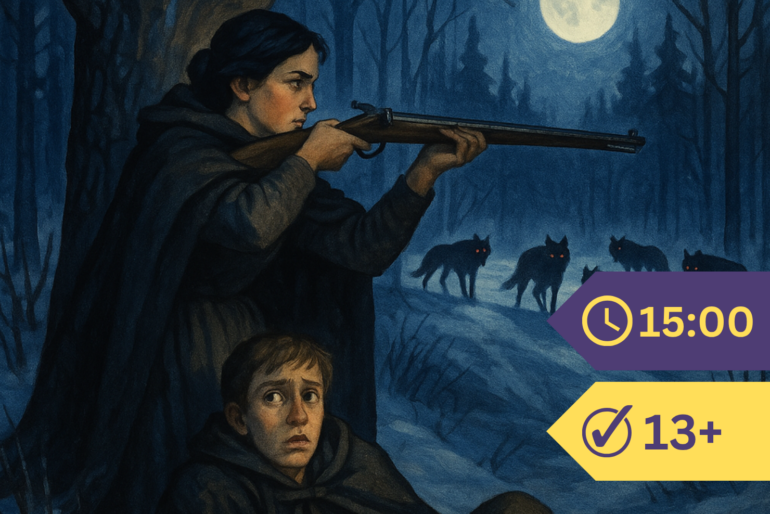
“The moon climbed higher. It cleared the dark mass of the thicket and flooded the whole forest the way footlights illuminate a stage. And then Solange and Laurent saw this: five wolves, seated on their haunches, drawn in a line across the road only a few feet away — while a sixth, bolder than the rest, walked slowly toward them.
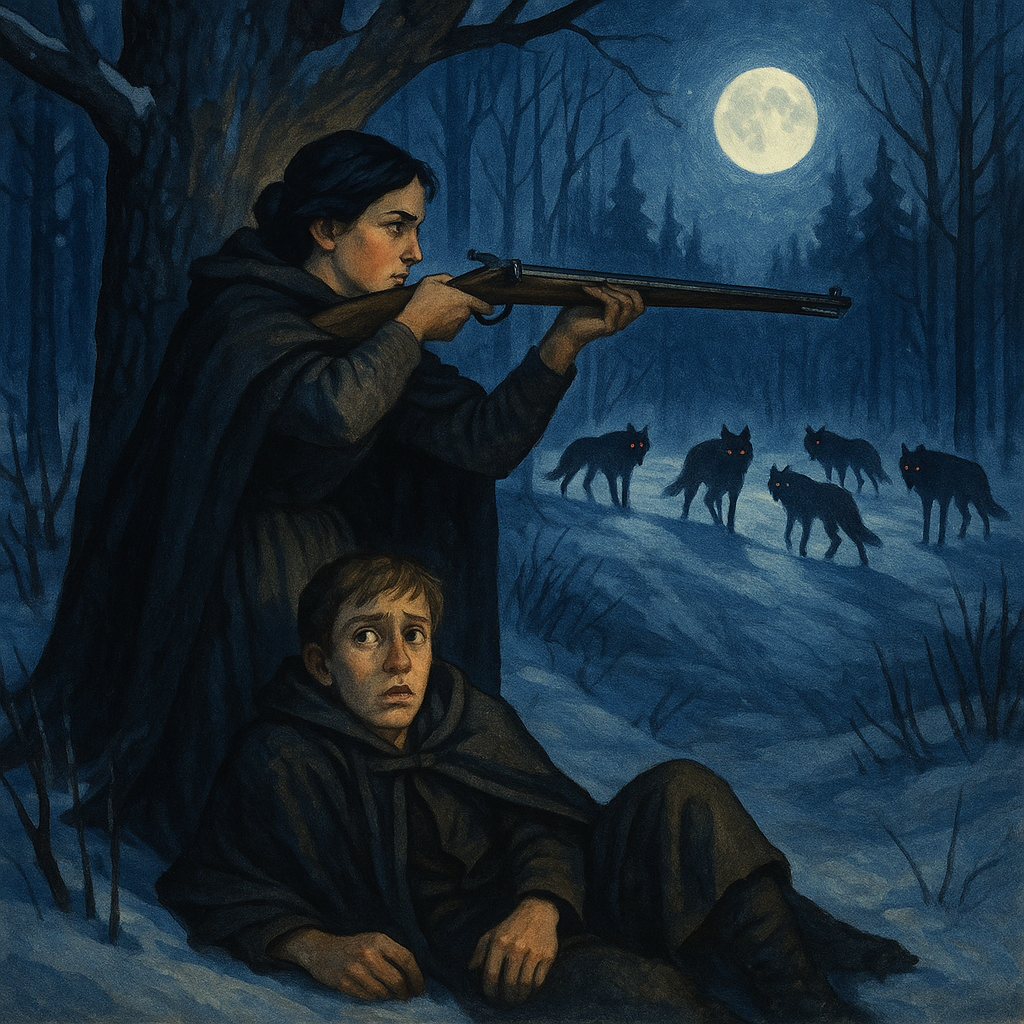
“‘Listen,’ said Laurent. ‘Aim at the one that’s coming. If you bring him down, the others will eat him and leave us in peace for a while.’
“The wolf kept advancing in short, cautious steps. They could see him clearly now: the bloodshot eyes, the ridges of his spine pressing through his hide, the sharp bones of his frame, the dull fur, the open jaw with its long tongue. ‘Hold the stock firm against your shoulder. Now — fire.’
“A shot. The beast leapt sideways and fell dead without a sound. The pack galloped off and vanished into the copse.
“‘Run, Solange!’ Laurent cried. ‘Drag him as far down the road as you can — there’s no danger yet, they won’t come back for a while.’
“She had started off when he called after her. ‘It might be worth cutting off the head — on account of the reward.’
“‘Have you a knife?’ asked Solange.
“‘Yes. At my belt.’
“It was a short-handled, broad-bladed hunting knife. She took it and ran to the dead wolf. She drove it into the throat, the warm blood running over her hands and down her skirt. She turned the blade, cut deep, hacked, and finally severed the head from the trunk. She dragged the carcass as far as she could by one leg, across the slippery snow, then came back to her lover with the bloody, bristling head in her hand.
“What Laurent had foreseen now happened. The wolves, frightened at first by the death of their leader, were soon drawn back by the smell of the blood. In the white moonlight, reflected off the snow like some fantastic fairy-tale stage set, the two young people watched the lean, ravenous pack crowd around the fresh prey — rubbing against each other, tearing it limb from limb, growling and snarling, wrenching off the flesh, until nothing was left. Not even a tuft of fur.
“Meanwhile Laurent was suffering greatly from his injuries. Solange, her nerves beginning to give way, struggled vainly against exhaustion. The gun slipped from her hands twice. The wolves, their meal finished, began to move closer again. She fired twice into the pack, but her numb fingers trembled and both shots went wide. At each report the wolves turned tail, trotted about a hundred metres down the road, waited — and came back.
“Then the two of them knew it was over. Solange dropped the gun. It never once crossed her mind to save herself alone. She lay down beside her lover, wrapped her arms around him, pressed her cheek to his, and under the same cloak they waited for the end — half frozen with cold, half burning with fever. Strange visions came and went. Now they were back in the soft June nights, the forest deep green around them, sheltering their peaceful meetings. Then the wood was bare again, lit with that eerie snowy light, full of shifting shapes, eyes like glowing coals, great open jaws that multiplied and came nearer, ever nearer.
“But neither Solange nor Laurent was meant to die that night. Providence — yes, young men, I do believe in a Providence — had arranged for me to be on that very road at that very hour on my way home from St. Bonnet-le-Désert in my carriage. My man was at the gun, watching the road ahead. No doubt our sleigh-bells had driven the wolves off, for we saw none. But as we drew near the elm where the lovers lay, my mare shied — and so drew our attention to them. I jumped down from the seat. My man and I got them into the carriage as best we could, covered them with every rug we had. They were unconscious and nearly frozen. We took the bloody wolf’s head with us too.
“It was about seven in the morning when we reached Ursay. The day was breaking over a landscape of spun glass and white velvet. M. Duflos’s farmhands and half the village, who had heard of Solange’s disappearance, came out to meet us. And in the very kitchen where we dined this evening, before a great fire of crackling heather, Laurent and his friend warmed themselves back to life and told the story of their terrible Christmas.”
One of our party said, “And what came of it, Doctor? Did they marry?”
“They did,” said our host. “The will of Providence is sometimes made so plain that even the most stubborn cannot miss it. After the adventure with the wolves, Solange’s parents gave their consent to her marriage with Laurent Grillet. The wedding was in the spring. The fifty-franc reward for the wolf’s head paid for the wedding dress.”
The doctor fell quiet. Night had fully settled. The sky, a deep turquoise, cast the first stars onto the river. The forest, dense and dark, closed off the horizon on every side. We saw Solange, the wolf-girl, dress her two boys and start for home, the youngest asleep on her shoulder. She passed very close to us and, glancing up, smiled at the doctor.
The doctor said, “Good-night, Solange.”