It was nearly midnight when the festivities were interrupted.
“Hush!” said Dick Bullen, holding up his hand.
It was the querulous voice of Johnny from the small room off the main one: “Oh, dad!”
The Old Man arose hurriedly and disappeared inside. Presently he reappeared. “His rheumatism is coming on again bad,” he explained, “and he wants rubbing.” He lifted the demijohn of whiskey from the table and shook it. It was empty. Dick Bullen put down his tin cup with an embarrassed laugh. So did the others. The Old Man examined their cups and said hopefully, “I reckon that’s enough — he don’t need much. You hold on, all of you, for a spell, and I’ll be back.” And he vanished with an old flannel shirt and the whiskey. The door closed imperfectly, and the following dialogue was distinctly audible:
“Now, sonny, where does she ache worst?”
“Sometimes here and sometimes there — but it’s most powerful from here to here. Rub there, dad.”
A silence seemed to indicate a brisk rubbing. Then Johnny:
“Having a good time out there, dad?”
“Yes, sonny.”
“Tomorrow’s Christmas — ain’t it?”
“Yes, sonny. How does she feel now?”
“Better. Rub a little further down. What’s Christmas, anyway? What’s it all about?”
“Oh, it’s a day.”
This exhaustive definition was apparently satisfactory, for there was a silent interval of rubbing. Presently Johnny again:
“Mom says that everywhere else but here everybody gives things to everybody at Christmas, and then she just lit into you. She says there’s a man they call Sandy Claws — some kind of stranger, not anyone from around here — who comes down the chimney the night before Christmas and gives things to children. Boys like me. Puts them in their boots! That’s what she tried to play on me. Easy now, pop — where are you rubbing? That’s a mile from the place. She just made that up, didn’t she, just to aggravate me and you? Don’t rub there — why, dad!”
In the great quiet that seemed to have fallen on the house, the sigh of the near pines and the drip of leaves outside were very distinct. Johnny’s voice was lowered as he went on:
“Don’t you take on now — I’m getting all right fast. What are the boys doing out there?”
The Old Man partly opened the door and peered through. His guests were sitting sociably enough, and there were a few silver coins and a lean buckskin purse on the table. “Betting on something — some little game or other. They’re all right,” he replied to Johnny, and recommenced his rubbing.
“I’d like to take a hand and win some money,” said Johnny reflectively, after a pause.
The Old Man glibly repeated what was evidently a familiar formula — that if Johnny would wait until he struck it rich in the tunnel, he’d have lots of money, and so on.
“Yes,” said Johnny, “but you don’t. And whether you strike it or I win it, it’s about the same. It’s all luck. But it’s mighty curious about Christmas — ain’t it? Why do they call it Christmas?”
Perhaps from some instinctive deference to the listening guests, or some vague sense of incongruity, the Old Man’s reply was so low as to be inaudible beyond the room.
“Yes,” said Johnny, with some slight abatement of interest, “I’ve heard of him before. There — that’ll do, dad. I don’t ache near so bad as I did. Now wrap me tight in this blanket. So. Now,” he added in a muffled whisper, “sit down here by me till I go to sleep.”
To assure himself of obedience he disengaged one hand from the blanket, grasped his father’s sleeve, and composed himself to rest.
For some moments the Old Man waited patiently. Then the unwonted stillness of the house excited his curiosity, and without moving from the bed he cautiously opened the door with his free hand and looked into the main room. To his infinite surprise it was dark and deserted. But even then a smoldering log on the hearth broke, and by the upspringing blaze he saw the figure of Dick Bullen sitting by the dying embers.
“Hello!”
Dick started, rose, and came somewhat unsteadily toward him.
“Where are the boys?” said the Old Man.
“Gone up the canyon on a little pasear. They’re coming back for me in a minute. I’m waiting round for them. What are you staring at, Old Man?” he added, with a forced laugh. “You think I’m drunk?”
The Old Man might have been pardoned the supposition, for Dick’s eyes were bright with moisture and his face flushed. He loitered and lounged back to the chimney, yawned, shook himself, buttoned up his coat, and laughed. “Liquor ain’t so plentiful as that, Old Man. Now don’t you get up,” he continued, as the Old Man made a movement to release his sleeve from Johnny’s hand. “Never mind manners. Sit just where you are — I’m going in a jiffy. There — that’s them now.”
There was a low tap at the door. Dick Bullen opened it quickly, nodded “Good-night” to his host, and disappeared. The Old Man would have followed but for the hand that still unconsciously grasped his sleeve. He could have easily disengaged it — it was small, weak, and thin. But perhaps because it was small, weak, and thin he changed his mind, and, drawing his chair closer to the bed, rested his head upon it. In that unguarded attitude the whiskey he’d drunk earlier took its advantage. The room flickered and faded before his eyes, reappeared, faded again, went out, and left him — asleep.
Meanwhile Dick Bullen, closing the door, confronted his companions.
“Ready?” said Staples.
“Ready,” said Dick. “What’s the time?”
“Past twelve. Can you make it? It’s near fifty miles, the round trip.”
“I reckon,” returned Dick shortly. “Where’s the mare?”
“Bill and Jack are holding her at the crossing.”
“Let them hold on a minute longer,” said Dick.
He turned and re-entered the house softly. By the light of the guttering candle and dying fire he saw that the door of the little room stood open. He stepped toward it on tiptoe and looked in. The Old Man had fallen back in his chair, snoring, his helpless feet thrust out in line with his collapsed shoulders and his hat pulled over his eyes. Beside him, on a narrow wooden bedstead, lay Johnny, muffled tightly in a blanket that hid all save a strip of forehead and a few curls damp with perspiration. Dick Bullen took a step forward, hesitated, and glanced over his shoulder into the deserted room. Everything was quiet. With a sudden resolution he parted his great mustache with both hands and stooped over the sleeping boy. But even as he did so a mischievous blast, lying in wait, swooped down the chimney, rekindled the hearth, and lit up the room with a shameless glow — from which Dick fled in bashful terror.
His companions were already waiting at the crossing. Two of them were struggling in the darkness with some strange, misshapen bulk, which as Dick came nearer took the semblance of a great yellow horse.
It was the mare. She was not a pretty picture. From her Roman nose to her rising haunches, from her arched spine hidden by the stiff machillas of a Mexican saddle to her thick, straight, bony legs, there was not a line of equine grace. In her half-blind but wholly vicious white eyes, in her protruding underlip, in her monstrous color, there was nothing but ugliness and vice.
“Now then,” said Staples, “stand clear of her heels, boy, and up with you. Don’t miss your first hold of her mane, and mind you get your off stirrup quick. Ready!”
There was a leap, a scrambling, a bound, a wild retreat of the crowd, a circle of flying hoofs, two springless leaps that jarred the earth, a rapid play and jingle of spurs, a plunge — and then the voice of Dick somewhere in the darkness. “All right!”
“Don’t take the lower road back unless you’re pushed hard for time! Don’t hold her in downhill. We’ll be at the ford at five. Go!”
A splash, a spark struck from the ledge in the road, a clatter in the rocky cut beyond — and Dick was gone.
Sing, O Muse, the ride of Richard Bullen! Sing, O Muse, of chivalrous men — the sacred quest, the doughty deeds, the fearsome ride and gruesome perils of the Flower of Simpson’s Bar! Alas — she is dainty, this Muse. She will have none of this bucking brute and swaggering, ragged rider, and I must follow him in prose, afoot.
It was one o’clock, and he had only gained Rattlesnake Hill. In that time Jovita had rehearsed to him all her imperfections and practiced all her vices. Three times she had stumbled. Twice she had thrown up her Roman nose in a straight line with the reins and, resisting bit and spur, struck out madly across country. Twice she had reared and, rearing, fallen backward — and twice the agile Dick, unharmed, had regained his seat before she found her vicious legs again. A mile ahead, at the foot of a long hill, lay Rattlesnake Creek. Dick knew this was the crucial test. He set his teeth grimly, put his knees well into her flanks, and changed his defensive tactics to brisk aggression. Bullied and maddened, Jovita began the descent. Here the artful Dick pretended to hold her in with extravagant cries of alarm. It is unnecessary to add that Jovita instantly ran away. Nor need I state the time made in the descent — it is written in the chronicles of Simpson’s Bar. Enough that in another moment she was splashing on the overflowed banks of Rattlesnake Creek. As Dick expected, the momentum she had built carried her beyond the point of balking, and, holding her well together for a mighty leap, they dashed into the middle of the swiftly flowing current. A few moments of kicking, wading, and swimming — and Dick drew a long breath on the opposite bank.
The road from Rattlesnake Creek to Red Mountain was tolerably level. Either the plunge had dampened Jovita’s fire, or she had recognized the superior wickedness of her rider — for she no longer wasted her energy in wanton conceits. Once she bucked, but from force of habit; once she shied, from a freshly painted meeting-house at the crossroads. Hollows, ditches, patches of new grass flew from beneath her rattling hoofs. She began to breathe harder, and once or twice coughed slightly, but there was no abatement of her strength or speed. By two o’clock Dick had passed Red Mountain and begun the descent to the plain. Ten minutes later the driver of the fast Pioneer coach was overtaken and passed by “a man on a pinto horse” — an event sufficiently remarkable to be worth noting. At half past two Dick rose in his stirrups with a great shout. Stars were glittering through rifted clouds, and ahead, out of the plain, rose two church spires, a flagstaff, and a straggling line of dark shapes. Dick jingled his spurs and swung his lasso. Jovita bounded forward, and in another moment they swept into Tuttleville and drew up before the wooden porch of the Hotel of All Nations.
What transpired that night at Tuttleville is not strictly a part of this record. Briefly: after Jovita had been handed to a sleepy groom — whom she at once kicked into unpleasant wakefulness — Dick sallied out with the barkeeper for a tour of the sleeping town. Lights still gleamed from a few saloons, but avoiding these they stopped before several closed shops, and by persistent knocking and judicious outcry roused the proprietors from their beds, persuading them to unbar their doors and open their wares. Sometimes they were met by curses, but oftener by interest and some sympathy for their errand. It was three o’clock before this was done, and with a small waterproof bag of India rubber strapped on his shoulders Dick returned to the hotel. Then he sprang back to the saddle and dashed down the lonely street and out onto the lonelier plain, where presently the lights, the line of houses, the spires, and the flagstaff sank below the horizon and were lost in the distance.
The storm had cleared. The air was brisk and cold, the outlines of landmarks sharp — but it was half past four before Dick reached the meeting-house and the crossroads. To avoid the rising grade he had taken a longer, more circuitous road, in whose heavy mud Jovita sank fetlock-deep at every bound. It was a poor preparation for a five-mile climb — but Jovita, gathering her legs under her, took it with her usual blind, unreasoning fury, and half an hour later reached the long level that led to Rattlesnake Creek. He threw the reins lightly on the neck of the mare, chirruped to her, and began to sing.
Suddenly Jovita shied with a bound that would have unseated a less practiced rider. A figure had leaped from the bank and seized her rein, and at the same time from the road ahead rose a shadowy horse and rider.
“Throw up your hands,” commanded the second figure, with an oath.
Dick felt the mare tremble, quiver, and apparently sink beneath him. He knew what it meant, and was prepared.
“Stand aside, Jack Simpson. I know you. Let me pass, or —”
He did not finish. Jovita rose straight in the air with a terrific bound, throwing the figure from her bit with a single shake of her vicious head, and charged with deadly force at the obstacle before her. An oath, a pistol shot — horse and highwayman rolled in the road — and the next moment Jovita was a hundred yards away. But Dick’s right arm, shattered by the bullet, dropped helplessly at his side.
Without slowing, he shifted the reins to his left hand. A few moments later he was forced to halt and tighten the saddle-girths that had slipped in the struggle — slow work with one arm, in the dark. He had no fear of pursuit, but looking up he saw that the eastern stars were already paling and the distant peaks had lost their ghostly whiteness, standing out black against a lightening sky. Day was coming. Then, completely absorbed in a single idea, he forgot the pain of his wound, mounted again, and dashed on toward Rattlesnake Creek.
But now Jovita’s breath came in broken gasps. Dick reeled in the saddle. And the sky grew brighter.
Ride, Richard — run, Jovita — linger, O day!
For the last stretch there was a roaring in his ears. He was dizzy and dazed as he swept down the hill and did not recognize his surroundings. Had he taken the wrong road — or was this Rattlesnake Creek?
It was. But the brawling creek he had crossed a few hours before had risen, more than doubled its volume, and now rolled a swift and resistless river between him and Rattlesnake Hill. For the first time that night Richard’s heart sank. The river, the mountain, the quickening dawn swam before his eyes. He shut them to recover himself. In that brief darkness, by some strange turn of mind, the little room at Simpson’s Bar rose before him — the sleeping father, the sleeping boy. He opened his eyes wildly, cast off his coat, his pistol, his boots, his saddle, bound his precious pack tightly to his shoulders, grasped the bare flanks of Jovita with his knees — and with a shout dashed into the yellow water. A cry arose from the opposite bank as the head of a man and horse struggled for a few moments against the battling current, and then were swept away amid uprooted trees and whirling driftwood.
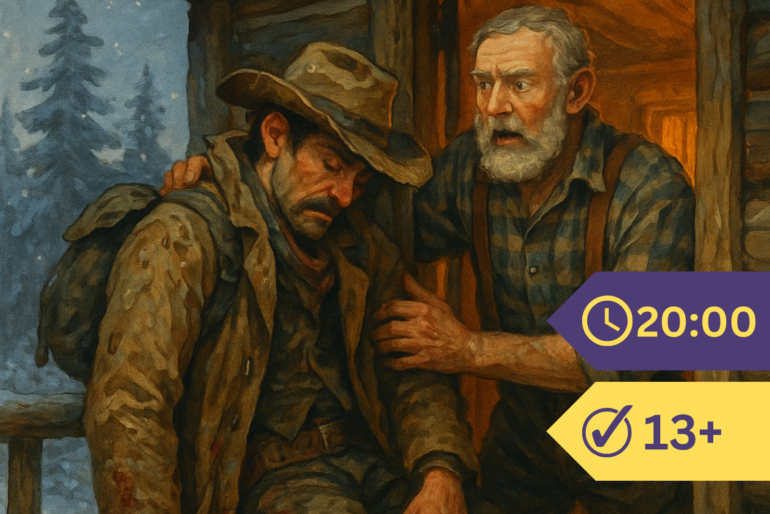
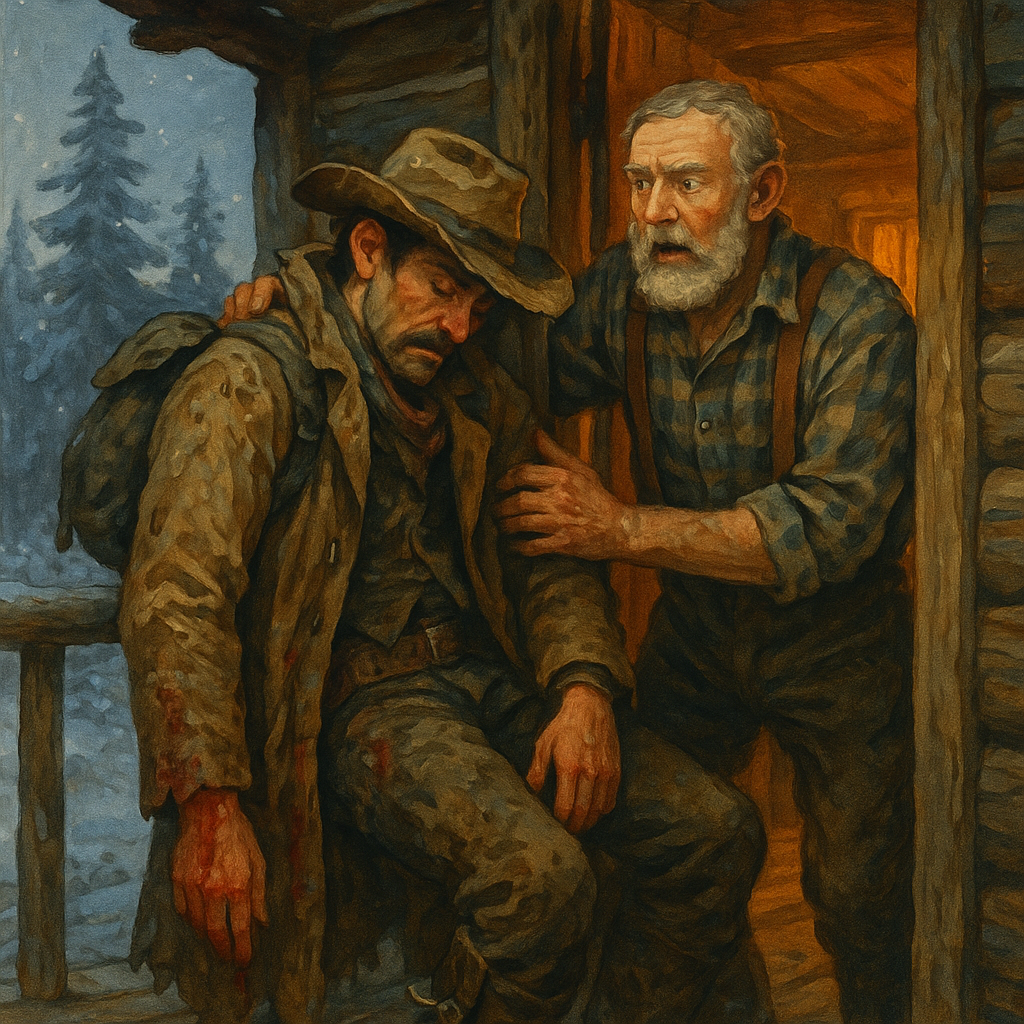
The Old Man started and woke. The fire on the hearth was dead, the candle in the outer room flickering in its socket, and somebody was rapping at the door. He opened it — and fell back with a cry before the dripping, half-naked figure that reeled against the doorpost.
“Dick?”
“Hush! Is he awake yet?”
“No — but Dick —”
“Never mind me. Get some whiskey, quick!” The Old Man flew — and returned with an empty bottle. Dick would have sworn, but his strength was not equal to the occasion. He staggered, caught the door handle, and motioned to the Old Man.
“There’s something in my pack here for Johnny. Take it off. I can’t.”
The Old Man unstrapped the pack and laid it before the exhausted man.
“Open it. Quick.”
He did so with trembling fingers. It contained only a few poor toys — cheap and plain enough, goodness knows, but bright with paint and tinsel. One was broken; another, I fear, had been ruined by the water; and on the third — ah, there was a sorry stain.
“It don’t look like much, that’s a fact,” said Dick ruefully. “But it’s the best we could do. Take them, Old Man, and put them in his stocking, and tell him — tell him, you know — hold me, Old Man —”
The Old Man caught him as he sank.
“Tell him,” said Dick, with a weak little laugh, “tell him Sandy Claus has come.”
And even so — bedraggled, ragged, unshaven, with one arm hanging helplessly at his side — Santa Claus came to Simpson’s Bar and fell fainting on the threshold. The Christmas dawn came slowly after, touching the far peaks with the rosy warmth of something very like love. And it looked so tenderly on Simpson’s Bar that the whole mountain, as if caught in a generous action, blushed to the skies.