I.
It was Christmas Eve in a great Bavarian town. A joyous crowd pushed through the snow-white streets — through the fog, the rumble of carriages, the clamour of bells — toward the outdoor booths and cook-stalls. Great fir trees hung with gewgaws were being carried about, grazing the ribbons and flowers of the market stalls and towering above the crowd like shadows of the Thuringian forests: a breath of Nature in the artificial life of winter.
Twilight was falling. The last lights of sunset sent a crimson glow through the fog from the gardens beyond the Residence; and in the town the air was so full of animation that every light blinking through a window-pane seemed to dangle from a Christmas tree. For this was no ordinary Christmas. It was the year of Our Lord 1870, and the birth of Christ had become one more pretext for toasting General Von der Tann and celebrating the triumph of Bavarian arms.
Around the corner of the inn called “The Bunch of Blue Grapes,” a trader came hurrying — one of those men who had followed the army with wallets and ledgers, doing a brisk business with French prisoners. He loaned money on watches, bought medals and money-orders, ferretted through hospitals and ambulances, and crept to the bedsides of the wounded to ask whether they had anything to sell. He was trotting along now with a small basket on his arm because the military hospital closed at five, and because two Frenchmen were waiting for him there, in that great gloomy building behind the iron gratings of its narrow windows — where Christmas found nothing to lighten its vigil but the pale lamps burning at the bedsides of the dying.
II.
These two Frenchmen were Salvette and Bernadou — two light infantrymen, two Provençals from the same village, enlisted in the same battalion, and wounded by the same shell. Salvette had proved the hardier of the two; he could get up now and take a few steps from his bed to the window. Bernadou, on the other hand, had no real desire to recover. Behind the faded curtains of his hospital bed he languished and grew thinner day by day; and when he spoke of home he wore that sad smile of invalids which holds more resignation than hope.
He was a little brighter today, though, remembering how Christmas was kept back in their beautiful land of Provence — like a bonfire lit in the very heart of winter. He thought of the walk home after midnight Mass, the bright, crowded churches, the dark village streets; then the long evening around the table, the three traditional candles, the aïoli, the dish of snails, and the lovely ceremony of the cacho fio — the Yule log that grandfather carries through the house and sprinkles with mulled wine while the family recites the blessing.
“Ah, my poor Salvette, what a dreary Christmas this will be. If we only had a few coins left, we could buy a small white loaf and a bottle of light wine. It would be good to sprinkle the log with you once more before—” His sunken eyes shone at the thought of the wine and the bread.
But what was to be done? They had nothing left — no watches, no money. True, Salvette had a money order for forty francs hidden in the lining of his vest. But that was kept in reserve for the day of their release — for the first halt at a French inn. It was sacred money, not to be touched.
And yet — Bernadou was so low. Who could say whether he would live through the journey home? While there was still time, might it not be better to celebrate Christmas together?
Without a word to his comrade, Salvette ripped open the lining of his vest. After a long, whispered negotiation with the trader, he pressed into the man’s hand a small stiff scrap of paper that smelled of powder and was stained with blood. Then he assumed a look of deep mystery, rubbed his hands, and laughed softly to himself as he glanced over at Bernadou.
As darkness fell, he stood with his forehead against the cold windowpane and didn’t leave his post until he saw the trader come around the corner breathlessly, a little basket on his arm.
III.
The solemn midnight, ringing from all the steeples of the great city, fell heavily over the sleepless wounded. The hospital was silent, lit only by the night lamps swinging from the ceiling. Gaunt shadows drifted over the beds and bare walls in a slow, constant swaying that seemed like the laboured breathing of everyone lying there. Now and then a dream spoke aloud, or a nightmare groaned. From the street below came vague murmurs of footsteps and voices, mingled with the cold resonance of the night — sounds rising like an exhalation from a cathedral: the sense of hurrying devotion, a religious mystery invading the hours of sleep, filling the dark city with the soft glow of lanterns and the jewelled light of church windows.
“Are you asleep, Bernadou?”
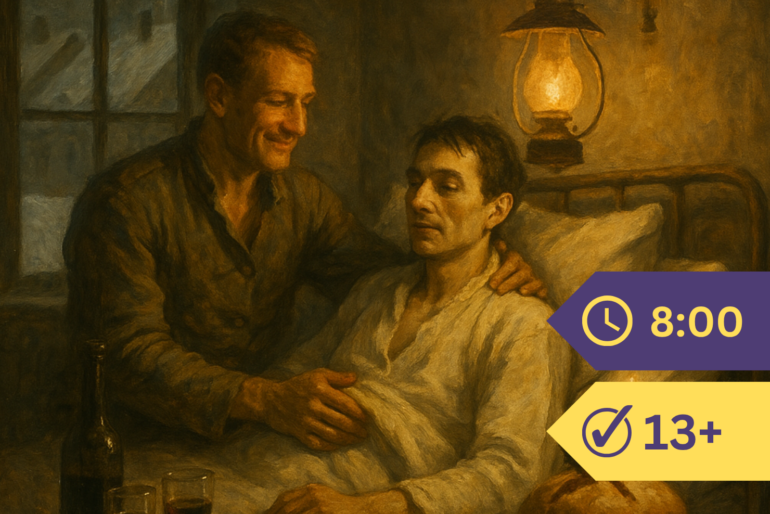
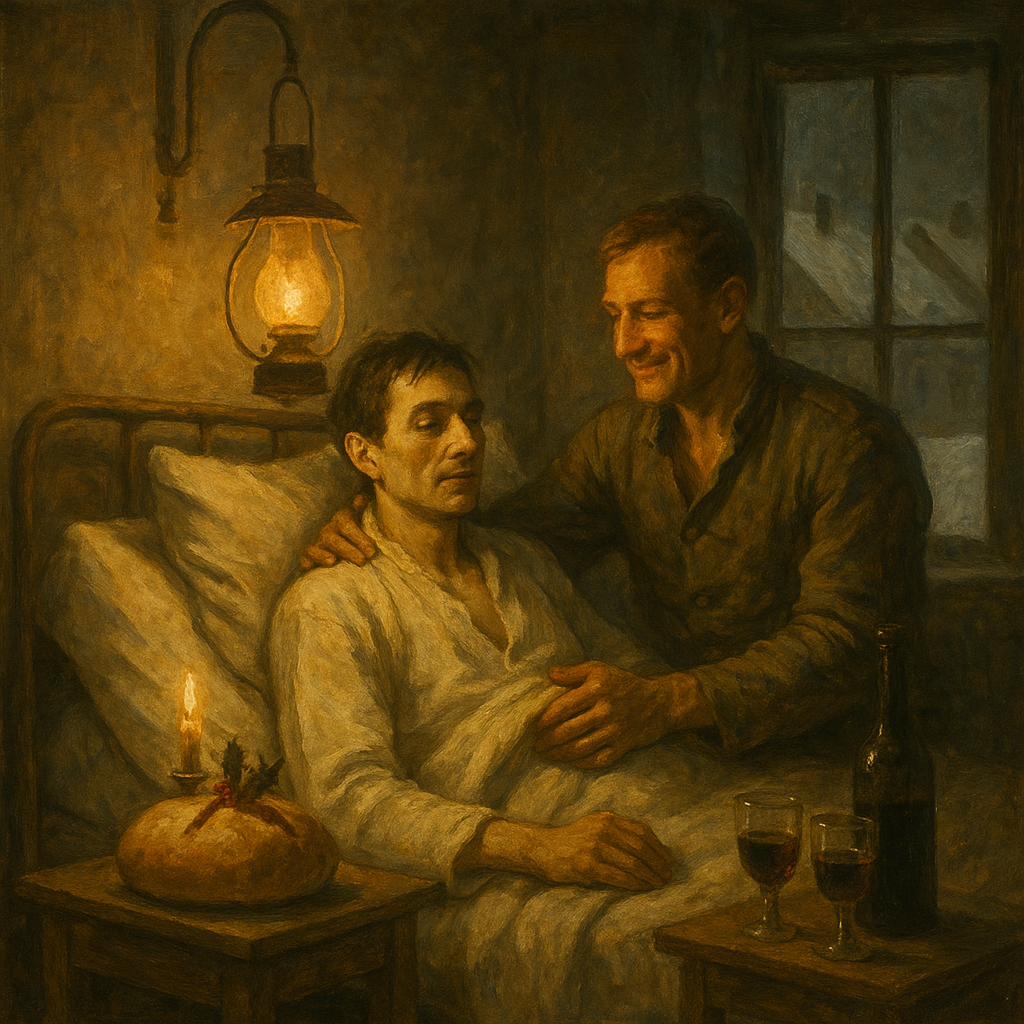
On the little table beside his friend’s bed, Salvette had set out a bottle of Lunel wine and a pretty round Christmas loaf with a twig of holly stuck in its top. The wounded man opened his eyes — dark and sunken with fever. In the uncertain light of the night lamps and the moon’s reflection on the long snow-covered roofs, this improvised Christmas supper struck him as something from a dream.
“Come, wake up, countryman. It will never do for two Provençals to let Christmas pass without wetting it with a draught of wine.” And Salvette lifted him on his pillows with a mother’s tenderness. He filled the glasses and cut the bread. They drank and talked of Provence. Bernadou seemed cheered by the wine and the memories. With the childishness that invalids recover in the depths of their weakness, he asked for a Provençal carol. His comrade was only too happy to oblige.
“Which shall it be — ‘The Host’ or ‘The Three Kings’ or ‘Saint Joseph Told Me’?”
“No — I want ‘The Shepherds.’ That’s the one we used to sing at home.”
“Very well then. Here goes: ‘The Shepherds.'”
And in a low voice, his head half under the bed curtains, Salvette began to sing. At the last verse — when the shepherds have laid down their offering of fresh eggs and cheeses, and Saint Joseph speeds them on their way with kind words —
“Shepherds,
Take your leave” —
poor Bernadou slipped back and fell heavily against his pillow.
His comrade, thinking he had simply drifted off to sleep, shook him by the arm and called his name. But the wounded man lay still. The twig of holly beside him looked like the green palm laid on the couch of the dead. Salvette had understood. Slightly tipsy from the wine, shaken by his grief, he lifted his voice and sang out — filling the silent ward with the joyous refrain of Provence:
“Shepherds,
Take your leave.”