It was just eight o’clock when the passenger train pulled out of Wayville station on the morning of December 24, 1891. The train was heavily laden with merry people — some heading home for the holidays, others going into the city for a last round of Christmas shopping. The mail car and express cars were packed to overflowing with parcels of every shape, and even the vestibule spaces between cars had been pressed into service for “through” pouches and packages. It was quite a jam of Christmas presents.
If it was a jolly crowd that left the little station, the crowd that stayed behind was not unhappy. A thick fog had settled over everything, and the small lamp in the telegraph and ticket office shed only a feeble light over the people gathered around the stove. There is always a crowd at a country station at train time, and a few privileged persons always manage their way into the office.
At his instrument, the telegraph operator Fred Clarke tapped away, sending messages of hope or grief across the continent, and now and then sharing a bit of news with his listeners. “No. 13 is five minutes late at Bloss,” he remarked. Then he smiled and added: “The general manager has just left High Ridge on his special, heading west. Must be quite a party — he’s ordered fourteen dinners at Glenmore, ready when he arrives. His car will pass here at 9:10.”
“What engine’s pulling the special?” asked Bob Ford, one of the listeners.
“No. 39.”
“That’s father’s old engine,” said Tom Martin quietly. He was a dark-eyed, dark-haired boy of fifteen, who had been gazing into the fire.
“He used to run her on all the specials, until he was killed in the accident at Oak Bridge two years ago,” said Bob Ford. “Many’s the time I fired for him on old 39. As brave and true a man as ever pulled a lever. You used to ride with us often — didn’t you, Tom?”
“Yes, until one day the general manager saw me in the cab and issued an order that no one but regular employees should ride the engines. I’ve never been on one since. But I learned a great deal about them — didn’t I, Bob?”
“You did, Tom; and for a boy, you can handle an engine as well as any youngster I know. What are you up to these days?”
“Since Father died, I do whatever I can to help support Mother — carry the mail between the depot and town, bring dinners out to the men, sell papers, run messages. I go to night school too. And I’ve been learning telegraphy from Fred.”
“Making a living at it?”
“Well enough. Though of course I can’t match what Father made, and we’re still trying to pay off the mortgage. Here it is Christmas time, and I’ve been saving money for six months to buy Mother a nice warm cloak. But when I went to price them I found my five dollars and a half wouldn’t stretch nearly far enough. I’d need three dollars more, at least.” He stared into the fire. “I would have loved to surprise her. But never mind — I’ll find her something else, and we’ll have a merry Christmas anyway.”
“You say you can telegraph,” said Bob, after a moment. “What are the wires saying now?”
Tom leaned toward the instrument and listened. His expression changed.
“The operator at High Ridge is asking whether No. 14 left on time.” He paused, listening intently. “Keep still! Rockville is saying — ” He read aloud, his voice tightening: Freight-train No. 37 broke into three sections at Cantwell. Engineer thought there was one break; rear section seemed under control; started back to couple on. Dense fog — met middle section coming at full speed — engineer and fireman thrown from engine. Engine and three cars running east downgrade at full speed. He stopped. “That’s terrible!” Then he held up a hand. “There’s more — Middle section, one mile behind, ten loaded stock-cars. Jack Flynn clinging to rear car. Must stop train if you can. If No. 14 has not yet left, switch her to west-bound track or she’ll be lost.“
The instrument went silent.
“Is that right, Fred?” Bob asked, barely breathing. “Or has Tom been pulling our legs?”
“It’s all true,” Fred answered. “That’s exactly what’s happened. What shall we do? What can we do?”
There was no answer. Every face in the room had gone pale, for they all understood the horror.
No. 14, the passenger train that had left just minutes ago, was rolling along at a leisurely thirty miles an hour, crowded with holiday travelers. Behind it — and gaining fast — was a runaway engine and three cars doing sixty miles an hour. And behind that was the heavy broken section, ten loaded stock-cars, coming nearly as fast. On the west-bound track, the general manager’s express was approaching head-on. Switching the runaway onto it would likely tear up the track entirely, and the loss of life could be just as great as letting the engine run on. The stoutest hearts in the room stood still.
Then out of the silence came a steady voice. It was Tom.
“All of you men — get outside and oil the track. Pour on oil, put on grease, smear it with tallow, anything you can find. That will slow the engine — perhaps enough. After the engine passes, keep at it. And remember — we’ve got to save Flynn’s life, and the cattle too.”
Fred and Bob led the men out at a run.
Tom was alone at the telegraph key.
Now. I must save No. 14. He thought quickly, his fingers hovering. I’ll need to keep the west-bound track clear — and then get No. 14 switched onto it at Lewistown.
With steady hands he grasped the key, and the first message went out:
Operator, Mount Vernon: Flag special train of general manager and tell him to wait for orders. T. M.
Back came the question almost immediately from the Mount Vernon office:
T. M., Wayville: Who has right to stop special? Track has been cleared for general manager’s train with regular right of way. By whose orders shall I tell him he has been flagged?
It was no time for explanations. Tom flashed back:
By orders of president of the U. S. R. R., per T. M.
O. K., answered Mount Vernon. The order was understood and would be obeyed.
Tom touched the key again.
Operator, Lewistown: Turn cross-over switch at your station; transfer passenger-train No. 14 from east- to west-bound track, and hold her there until released. T. M.
The reply came back:
T. M., Wayville: Track has been cleared for special of general manager. His train approaching from east with regular orders giving right of way. Make your order more definite, and give authority.
Tom answered without hesitation:
Operator, Lewistown: President of U. S. R. R. Co. does not have to show authority. Carry out the orders at once. Important. T. M.
O. K., ticked back the reply.
Tom sat back for a moment. If I can only delay the engine until No. 14 gets across to the other track, everything will be all right. He thought through the timing. No. 14 had been gone fifteen minutes; she was due at Lewistown in thirty. The runaway engine would be here in about five minutes, unless the oil had slowed her. But the passenger train would be overtaken about five miles this side of Lewistown. There was only one hope left.
Just then the ticket agent, Mr. Lenox, came downstairs, alarmed by the sound of running men. Tom told him the situation as quickly as he could.
“Mr. Lenox, I’m going to climb onto the runaway engine if it can possibly be done, and check her up.” He reached into his pocket. “I’ve five dollars here. Take it, and if I’m hurt, give it to my mother. Tell her I was going to get her a Christmas present — and tell her I know she’d tell me to do just what I’m going to do.” He paused. “God bless her. If I come out all right, don’t ever let her know. Promise me, quick.”
“Don’t think of such a thing, Tom,” the agent pleaded. “Why, it’s suicide! If you slow the engine down, the rear section will run into you and crush you. If you can’t slow her, you’ll run into the passenger train. In this fog you won’t know where you are until it’s too late. You are your mother’s only support. No one has ever boarded an engine moving as fast as this one — you must not attempt it!“
“It may well be suicide, Mr. Lenox. But it’s better to try and fail than to let all those people die without making an effort. I’m going. As for Mother — God bless her. Good-by.”
“Good-by, and Heaven help you, Tom,” said Mr. Lenox.
Tom pulled off his overcoat and jacket, tightened his belt, and went out to the platform. The men had oiled the track for several hundred yards. He didn’t tell them what he intended — they would have stopped him. Instead he found Bob and said quietly: “After the engine passes, get every man you can onto the track — more are coming all the time. Put on all the oil and tallow you can, but watch that nothing makes the cars jump the rails. That would kill the cattle and horses, and probably Flynn.” He glanced up the line. “I can hear her coming. I’ll go meet her at the far end of the platform.”
The engine could be heard long before it could be seen. Tom stationed himself at the far end of the depot, where the men had first begun to apply the oil — meaning he was positioned to catch the engine at its slowest point, after the greased rails had had the most effect.
The men scattered from the track.
When the engine struck the oiled rails she shuddered, and her wheels slipped and spun rather than gripping the steel. The momentum was so great that her speed hardly fell at first — but as she passed over successive sections of treated track, a real reduction became noticeable. Tom watched this with joy.
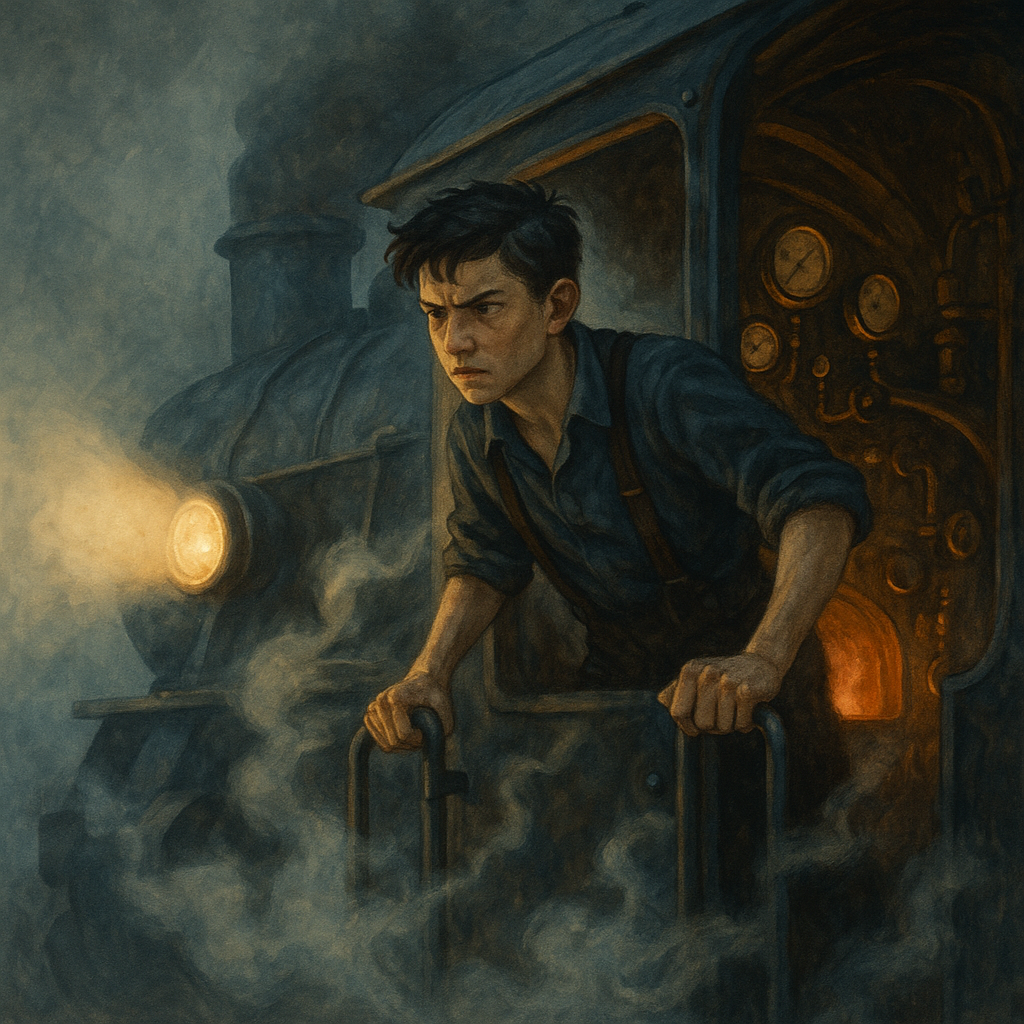
He turned and ran along the platform in the same direction as the engine, building as much speed as he could. The engine gained on him. He could feel the rush of air, the ground trembling, the roar filling his ears — and just as the step came level with him, he reached up, grasped the handles, and swung himself onto it. He rested there for a few seconds, heart hammering, then climbed slowly up into the cab.
His face was as white as the steam-gauge card. He was dripping with perspiration despite the cold.
He checked the gauges at once. The steam supply was nearly exhausted — the engine was running on sheer momentum down the grade. He closed the throttle, set the reverse lever one notch, and tried the air-brake. It worked, feebly, and checked her a little. But to get real control he needed to build up steam and get the air-pump running.
Tom crept along the flying engine to the tender and was relieved to find the water tank nearly full. Being a strong, wiry fifteen-year-old, he had no difficulty getting a brisk fire going. He went back to the cab and watched with satisfaction as the steam pressure began to climb.
Now he was between two fires. He must not let his engine run into No. 14. And he must stay ahead of the runaway section bearing down on him from behind. He peered out into the fog in both directions; he could see nothing, hear nothing of either threat.
On flew the steel horse, over culvert, bridge, and trestle — a thing of life on a wild holiday. Slowly the pressure needle climbed. Twenty pounds more and he would have complete control.
Tom worked the engine back another notch toward reverse and cautiously opened the throttle a little. The engine responded. She was slowing — gradually but certainly — and she handled.
By reversing her and applying emergency air, he thought, I could stop her in three or four lengths now. But I’ll hold off — in five minutes more No. 14 will have passed to the other track and the switch will be closed.
He throttled back a touch more, and the engine settled to a steady forty miles an hour.
Tom was leaning out the window, eyes straining into the fog, when — Boom! — a torpedo exploded beneath the wheels.
“No. 14 has stopped — to switch!” He exhaled. Boom! Boom! Two more. “Run slowly, under full control,” he said aloud. “That’s what those mean.”
Then he heard it — a thundering from behind, rising fast.
The broken section. Coming like a whirlwind. He threw the lever forward and opened the throttle wide. The engine seemed to leap. A minute later he caught a glimpse of lights on the rear of the passenger train — and knew he would be upon her within another minute.
The thundering behind him grew closer.
The light ahead is swerving left — she’s going to the switch. The question burned in his mind: Would it be closed in time for him to stay ahead of the pursuing section?
His engine reached the switch — and it had just been replaced.
“Thank God,” he murmured.
He was on the west-bound track. No. 14 was safe. Now it was a race for his own life.
Twelve miles of straight track lay ahead — a gentle downgrade, then a level mile, then a four-mile climb up to Mount Vernon. Tom crept back to the tender, opened the furnace doors wide, and threw in coal until the great firebox roared. On the downgrade the pursuing section closed to within two hundred feet. On the level it closed further still. But on the up-grade — with Tom shoveling steadily, keeping every inch of pressure — the locomotive slowly pulled away.
The freight section fell behind.
Tom closed the ash-pit door, returned to the cab, eased back the throttle, and tried the air-brakes. Three minutes later he pulled into the depot at Mount Vernon and came to a stop.
He looked out from his perch high in the cab and said to the station operator below: “Just wire Wayville that engine 303 has arrived here safely, and that Tom’s all right.”
A crowd of people surrounded the general manager’s private car on the platform, and they looked with considerable amazement at the young engineer seated in the cab of the still-smoking engine. The general manager, Mr. Holmes, had not been pleased at being flagged and delayed by what he assumed was some drunken operator who had imagined himself the president of the railroad. He had yielded only because he’d learned that the same mysterious person had ordered the east-bound passenger train switched to his track — which meant the passenger train could pull in at any moment and block his way.
“Well, young man,” said Holmes, coming forward. “What are you doing in that engine? Don’t you know it’s against orders? Where are the engineer and fireman? Get down from there. Where did you steal that engine?”
Tom could say nothing. But he did not move.
“Get down at once,” Holmes repeated, his voice sharp. “Officer — arrest that boy for stealing the engine!”
“Grandpa,” said a young girl who stood near the official, “give him a chance to explain. He doesn’t look as if he’d stolen anything.”
“I’ll attend to him, Mary. He’ll have his chance to explain — in court. Officer, get him down from there.”
The officer climbed up and shook Tom roughly by the shoulder. Tom seemed dazed. What a thing — to have braved everything, and to be received not with thanks but with threats of arrest.
That roused him.
“Don’t touch me, please — I’ll get down myself.” He climbed down, walked up to Holmes, and said steadily: “I did not steal your engine. But you’d better send her back to the grade and see what’s become of Jack Flynn. He was clinging to the rear car of a runaway section of train No. 37.”
Holmes stared. “The train broke in two? Where?”
“At Cantwell. It broke in three places coming down the grade. The center section struck the engine and hurled the crew off, starting the engine back the other way. I climbed onto the runaway engine at Wayville and brought her here. The rest of the train is about two miles back — unless the section has run back down to the level.”
There was a silence. The general manager studied Tom for a moment, then turned and ordered the engineer of No. 39 to take the engine back up the line.
They found Jack Flynn about two miles out — more dead than alive, limping up the track. Tom called his name the moment he came into view through the clearing fog. Flynn had ridden the broken section through the worst of it, been thrown to the top of a car, clung on, and finally set two brakes before the train stalled on the up-grade. He had dragged a tie across the track to hold the section before it could roll back.
“You can lay off till New Year’s Day,” Mr. Holmes told him, with unusual gentleness.
The train crews coupled the cars back on, and the whole train presently pulled into the Mount Vernon depot. By now the officer had decided not to put the handcuffs on Tom after all.
“Let the boy go,” Holmes told him. “Who are you, exactly?” he asked Tom.
“I am Thomas Martin’s son. My father used to run engine 39 — your special.”
Holmes looked at him more closely. “I thought I’d seen you before. Go into my car and get warm. Mary, get my overcoat for that boy.”
Tom walked, a little abashed, into the magnificent private car of the general manager, escorted by his granddaughter. She wrapped him in a large ulster, and he was soon at ease.
Mr. Holmes went to the telegraph office and directed that the passenger train, still held at Lewistown, be switched back to its own track and sent on its way. Then he asked who had sent the messages from Wayville. No one at the station had been present when they were sent — the operator had been out greasing the track in the fog and had supposed Tom was similarly employed.
“Very strange,” muttered Holmes. He entered his car and said to his son George, the train-master: “Do you know where the railroad’s president is today?”
“I think he’s in New York.”
Holmes held out the message copies. “Then who sent these?”
Tom flushed but said nothing.
The train-master read them and shook his head slowly. “They were sent from Wayville, by someone who had the running of the trains at his fingers’ ends. A trained dispatcher couldn’t have done better. I don’t know of any man at Wayville who could have managed it.” He turned. “Do you know who did it, Tom?”
“I don’t think it was very much of a thing,” Tom said. “Only a fellow had to think pretty quickly.”
“Did you do it?” asked Mr. Holmes, suddenly.
“Yes, sir.”
“You sent those messages?”
“Yes, sir.”
“And you’re — besides being a fireman and an engineer — a telegraph operator and train-dispatcher?”
“And president for an hour,” Mary chimed in, smiling.
“Yes, sir. I plead guilty to all of it. Though I was only acting president.”
“How dared you do such a thing?” Holmes asked.
Tom looked at him. “I dared do anything that would save human life. If someone hadn’t dared, what would have happened? There was only one thing to do, and I did the best I could.”
There was a pause.
“You are not employed by the company?”
“No, sir.”
“Would you like to be?”
“Yes, sir.”
Mr. Holmes turned to his son. “George, put Tom Martin on the payroll at fifty dollars a month as messenger in the general manager’s office. His salary began December first. He reports for duty January second.”
“Thank you, sir,” said Tom. It came from the heart.
When the train pulled back into Wayville, there was a large crowd at the depot, and Tom was met with cheers as he stepped from the private car. He nodded, took the mail-pouches, loaded them onto his hand-cart, and started immediately for town. Duty was first with him, as it always was.
The general manager and his guests mingled with the crowd and heard everything — Tom’s quick thinking at the telegraph key, the risk he had taken boarding the engine, the money he had left with Mr. Lenox for his mother. Tears stood in both men’s eyes when Lenox finished telling it.
“Saved hundreds of lives and thousands of dollars by his practical knowledge,” said Holmes. “A wide-awake boy — fearless and true. A thorough American boy. I like him.”
Christmas Day dawned bright and clear. Tom had bought his mother a rocking-chair with the money he had been able to save, and she was happy. At ten o’clock the express messenger arrived with a large box. Tom had it open at once, with all the curiosity of a wide-awake boy.
There was a beautiful cloak from Mrs. Holmes for his mother — exactly the one he had wanted to give her. There was an overcoat and a suit of clothes for Tom from George Holmes. From the general manager himself, a gold watch, with the inscription: He risked his life for others. December 24, 1891. From Mr. Holmes and his guests, a check to pay off the mortgage on the house. And last of all, in a small painted frame, a picture of engine No. 303 — the runaway he had ridden through the fog.
On the back of the picture was written, in a young girl’s hand: Be always brave and true, and you may indeed be president. Mary Holmes.
Of all the presents, Tom liked this one best.
That evening, the men from the depot came round with gifts of their own. It was a fitting end to a happy Christmas — and Tom knew, as he looked around at them all, that he had something no box could hold: the affection and respect of the men and boys who had known him always.