The moon was just peeping over the pines as Pete Shivershee made his way down the road from the lumber camp into the forest. He moved carefully, staying low, slipping from shadow to shadow behind the stumps and logs until he reached the trees. Then, as if the darkness gave him courage, he drew himself upright and started at a sharp trot toward the village.
He had good reasons for his caution. Pete was a Native man — not one of Cooper’s noble forest heroes, but a real, complicated person who made his living around the lumber camps, doing what work came his way. The men called him “Injun” and left it at that. Tonight, though, he had a difficult errand.
It was Christmas Eve. Snow covered the ground, and ice had stilled the roaring river. The men at Carter’s Camp had been debating how to celebrate the holiday, and they’d arrived at the only answer they knew: whiskey. The camp had strict rules against it — not for moral reasons, but because the foreman had noticed that work and drink ran in inverse proportion. He’d made it plain that anyone caught smuggling whiskey in would face a trial in which he himself served as judge, jury, and sentencing authority, with his considerable fists substituting for the usual proceedings. This had kept the camp mostly dry.
But Christmas had come, and the drinking men decided Pete Shivershee was their solution. Bill Gammon found him dozing by the stove, hauled him outside, and laid out the errand. Bill prided himself on knowing how to get things done. He handed over the money, Pete took it, and slipped away into the night.
Bill felt certain Pete would return. He’d stake his reputation on it.
Pete was in a hard position. If he loved anything in this world, it was whiskey. If there was anything he feared, it was Bill’s fist. These two facts were linked. The money jingling in his pocket promised comfort, but every promise had Bill’s face behind it. He trotted several miles through the forest until, turning a bend, he came upon a small log house in a clearing. He knew the place well. Jeff Hunt lived here with his wife, a French-Canadian woman, and their pack of children.
Jeff was, to put it charitably, a man who thought more highly of himself than the evidence suggested. His contribution to family life ran mostly to chopping wood, drawing water, and giving advice from his comfortable chair while his wife bent over the washtub. Mrs. Hunt was the only woman near the camp, so all the laundry fell to her — not just washing and ironing, but mending and darning too. Day after day she stood over the steaming tub while the younger children ran wild, and after they were in bed she sat up mending the clean clothes.
They were a lively pack, all but Marie, the oldest. She had never been strong, and now she was dying of tuberculosis. She lay all day on the little bed in the corner, watching her mother with sad, beautiful eyes. Mrs. Hunt’s heart nearly failed her sometimes when she looked at how thin that little form had grown, how flushed those cheeks. She knew the signs. There was nothing to be done.
Pete was always welcome at Jeff’s. His job was to carry the laundry to and from camp, and he felt more like himself here than anywhere else he knew. Everyone at the camp called him simply “Injun,” but Mrs. Hunt and Marie always said “Mr. Shivershee.” The little Frenchwoman’s warm “Meester Shivershee” was the nearest thing to respect Pete could claim in that world. One night, carrying the clothes home, he’d stumbled and dropped them in the mud. He had minded the thrashing Bill gave him far less than he’d minded Mrs. Hunt’s tears — all that work, for nothing.
Tonight Pete stopped from pure habit when he saw Jeff out front, splitting stove-wood by lantern light. Jeff was never sorry for an excuse to rest.
“Come in,” Jeff said cheerfully. “Clothes aren’t quite ready, but the wife’ll have them up soon — come in.”
Pete remembered he was due to pick up the laundry tonight. But his current errand was more pressing. “I’m heading to town,” he said. “Important business.”
“Big doings at camp tomorrow, I expect,” Jeff said. “Come in, Pete, get some supper.”
The mention of supper decided it, and Pete followed him inside.
It was a rough room, but warm. The board table was set for supper. In the corner, little Marie lay with the firelight falling over her thin face. Three of the older children were crying quietly, gathered around a box of plants — wilted things, yellow and stiff with frost. Mrs. Hunt was frying pork at the stove. When she looked up at Pete, her eyes were red.
Jeff settled in as host. “Sit down, Pete. Boys planning to celebrate tomorrow, I expect?”
Pete didn’t want to get into his errand. “What’s the matter with the children?” he asked.
“Oh, they’re upset about those flowers,” Jeff said. “They’d been growing some plants indoors to put in that corner where Marie sleeps — for Christmas, you know. But this afternoon the frost got them. All stiff as stakes now. Hard luck, especially at Christmas.”
“What is Christmas?” Pete asked.
Jeff opened his mouth and closed it again. “It’s a sort of day,” he said finally. “Different from other days. Hard to explain.”
Mrs. Hunt could explain. She paused on her way to the stove, a dish of pork in her hands. “It eez the day of the good Lord, Meester Shivershee. The day He was born. The day when all people should be glad.” But the thought of Marie and the dead flowers made her eyes fill.
Pete sat down. “What are flowers for?” he asked after a moment.
Jeff shrugged. “Women’s business. Makes a room look nice.”
Mrs. Hunt had a better answer. “It eez how we show our love, Meester Shivershee. What is more beautiful than flowers? We take them and place them with love, and we make others happy, and the good Lord who loves us all — He is pleased.” She stopped and pressed her apron to her eyes.
From the bed, Marie’s voice came barely above a whisper. “Never mind, mamma.” But the beautiful eyes were full of tears, because she knew that mamma would mind — that she couldn’t help it.
Pete finished his supper and stepped outside. Jeff followed him.
“The little girl — will she get well?” Pete asked.
“No,” Jeff said quietly. “No hope of it. She’s a fine girl.”
“All right,” Pete said, and trotted off toward town.
What was Pete thinking as he ran through the forest? He thought about Mrs. Hunt, who was the only person for miles who had ever called him “Mister.” He thought about the children crying over frozen plants. He thought about Marie’s eyes — sad, patient, full of tears. Those eyes seemed to follow him from tree to tree along the dark road.
By the time the village lights appeared, Pete was wondering what he could do about it.
Most of the shops were closed. The taverns were open and busy. As Pete moved down the street the money in his pocket pulled at him, and so did the memory of what Bill would do if he came back without a full jug. He walked past the front door of the tavern — Pete knew he was expected at the back — and slipped down the alley beside it.
The shop next door was a milliner’s, dark at the front. But in the back room, two women were still working by lamplight, finishing a hat for some village girl’s Christmas. A man dozed in a chair by the stove. And beside the women sat a basket of artificial flowers and bright ribbon.
Pete stopped in the alley and stared. He had never seen anything so beautiful. The thought came to him, simple and sudden: flowers for Marie. Flowers that wouldn’t die.
It was a hard moment, alone in the dark. The thrashing that was coming weighed against the memory of those eyes. But Pete had not forgotten the mud-stained laundry, or Mrs. Hunt’s tears, or the word “Mister.” He pushed the back door open and walked in.
There was a commotion. The women shrieked. The man came out of his chair. “What do you want here?” he demanded.
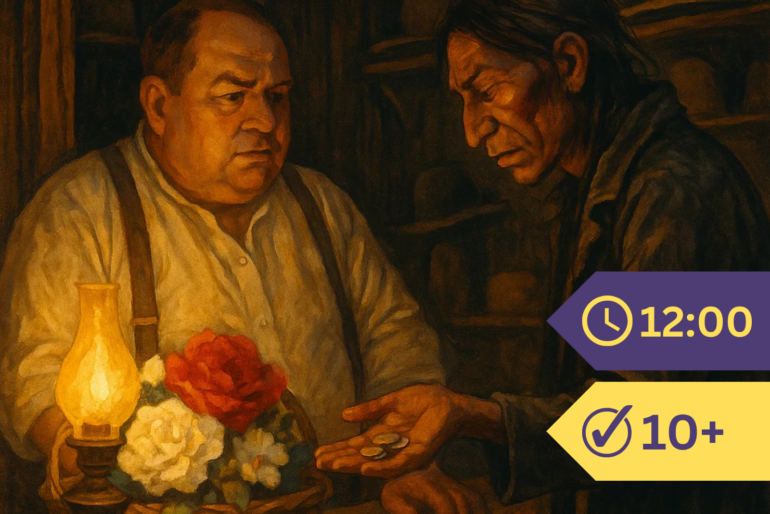
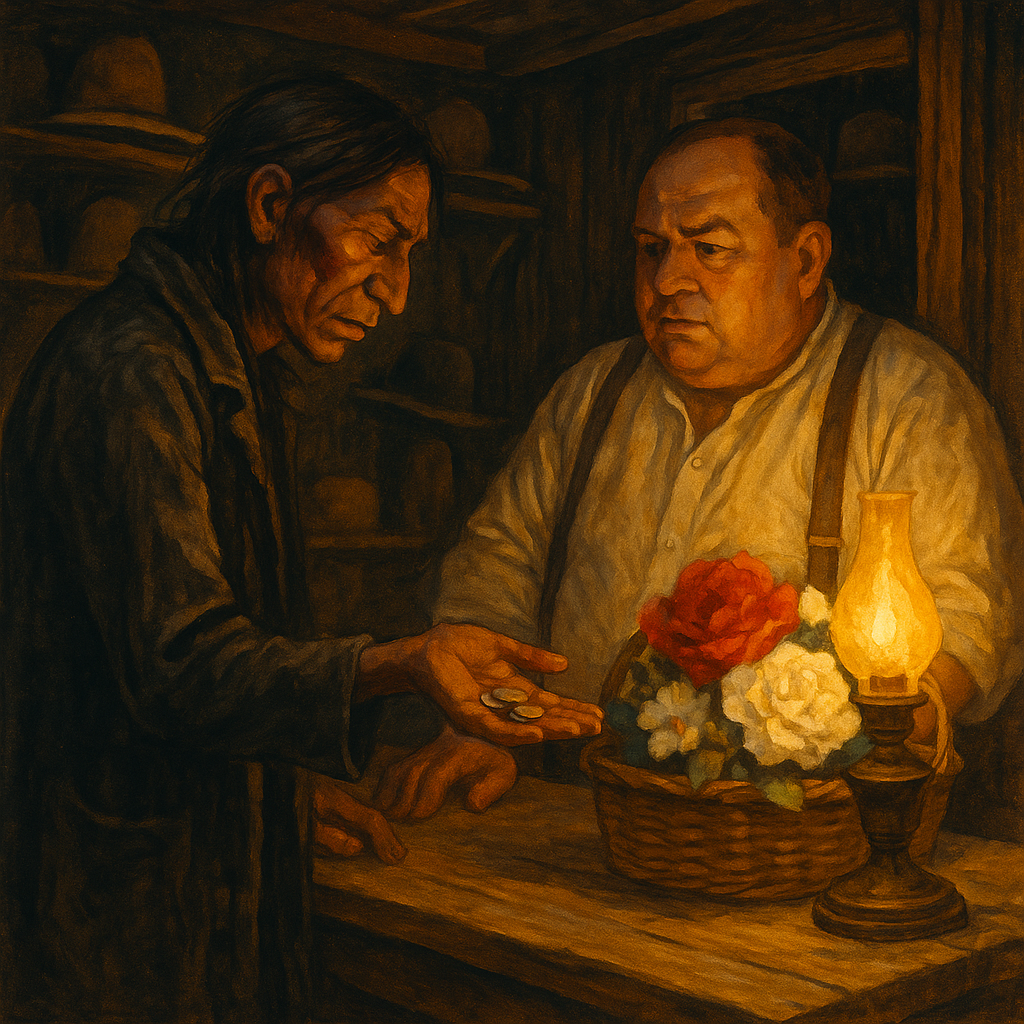
Pete held out his money.
The man paused. “You want to buy some of those flowers?”
“Flowers for a sick girl,” Pete said. “I’ll pay.”
He chose a large red rose and a white flower — the biggest, brightest ones in the basket. The shopkeeper named a high price and took the coins from Pete’s hand. Pete tucked the flowers carefully into the pocket of his ragged coat and went back out to the alley.
His money was nearly gone, but he had a plan. He went round to the tavern’s back door and bought as much whiskey as his remaining coins would cover. Then he headed out of town, stopping once at the pump to fill the jug to the brim with water. He stoppered it tight without raising it to his lips, not once, and started back to camp at his long trot, jug swinging in his hand.
He ran until Jeff Hunt’s cabin came into sight. He hid the jug behind a log and crept to the window.
Inside, Mrs. Hunt had fallen asleep over her mending, a lamp burning on the table. She had stayed up to finish the laundry so Pete could take it back with him. The box of frozen plants still stood nearby. Marie slept in the corner. Someone had hung clusters of moss and ground pine and red berries over her bed.
Pete went in quietly. Mrs. Hunt woke with a start. At the sight of Pete she smiled her tired smile. He gathered up the bundle of clothes. Then he pulled the red rose and the white flower from his pocket and laid them on the table beside the sleeping girl.
“Flowers for the little girl,” he said. “She’s sick. Make her think of Christmas. Good flowers. All color. No fade. No smell. No wear out.”
He picked up the bundle and slipped out before Mrs. Hunt could say a word.
When Bill Gammon woke on Christmas morning, he found the jug at the foot of his bunk. Pete was gone and didn’t come back.
The celebration at Carter’s Camp was a grim affair. Many were the curses aimed at Pete Shivershee that day, and had he been there I doubt even the flowers would have softened what was coming to him. But what his errand cost the camp, it returned threefold at Jeff Hunt’s cabin.
The Christmas sun came up bright and cold, sparkling through the pines, and its first beams fell across the little bed in the corner. They lit the red rose and the white flower, nestled in the evergreens above Marie’s pillow.
The children gathered around in wonder. Where could they have come from?
Marie’s face that morning was more peaceful than it had been in weeks. The beautiful eyes were softer, less sad. Perhaps the light and the flowers reached something in her that words couldn’t. Perhaps she was already thinking of somewhere ahead — of sunshine, and warmth, and a place where nothing dies.
As for Pete Shivershee — somewhere out in the winter woods, moving on or laying low — I like to think the Christmas morning found him too, and that he knew, in whatever way a person knows such things, that he had done right.