The name of the town doesn’t matter, but it was a big town in the middle of the country, and the first of these adventures happened to a little girl called Marian. She was only seven, so it was a rather young sort of adventure. The older ones came later, but this is the best one to begin with.
Marian’s house was on Peter Street, named for the church at one end of it, St Peter’s, which had a tall spire soaring into the sky. Marian’s daddy didn’t care for spires. They were too sharp and too slippery, he said. He liked church towers better, because they were like big laps, ready to catch God’s blessing. Marian’s daddy was a bit of an odd man, and nobody took much notice of what he said.
At the other end of the street was a field where builders were putting up houses, and Marian loved to watch them work. But one afternoon she grew tired of bricks and trowels, and climbed over a gate into the next field.
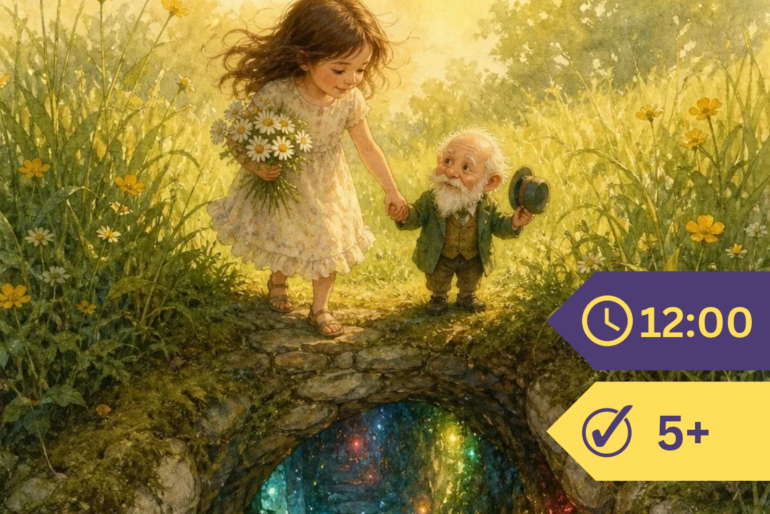
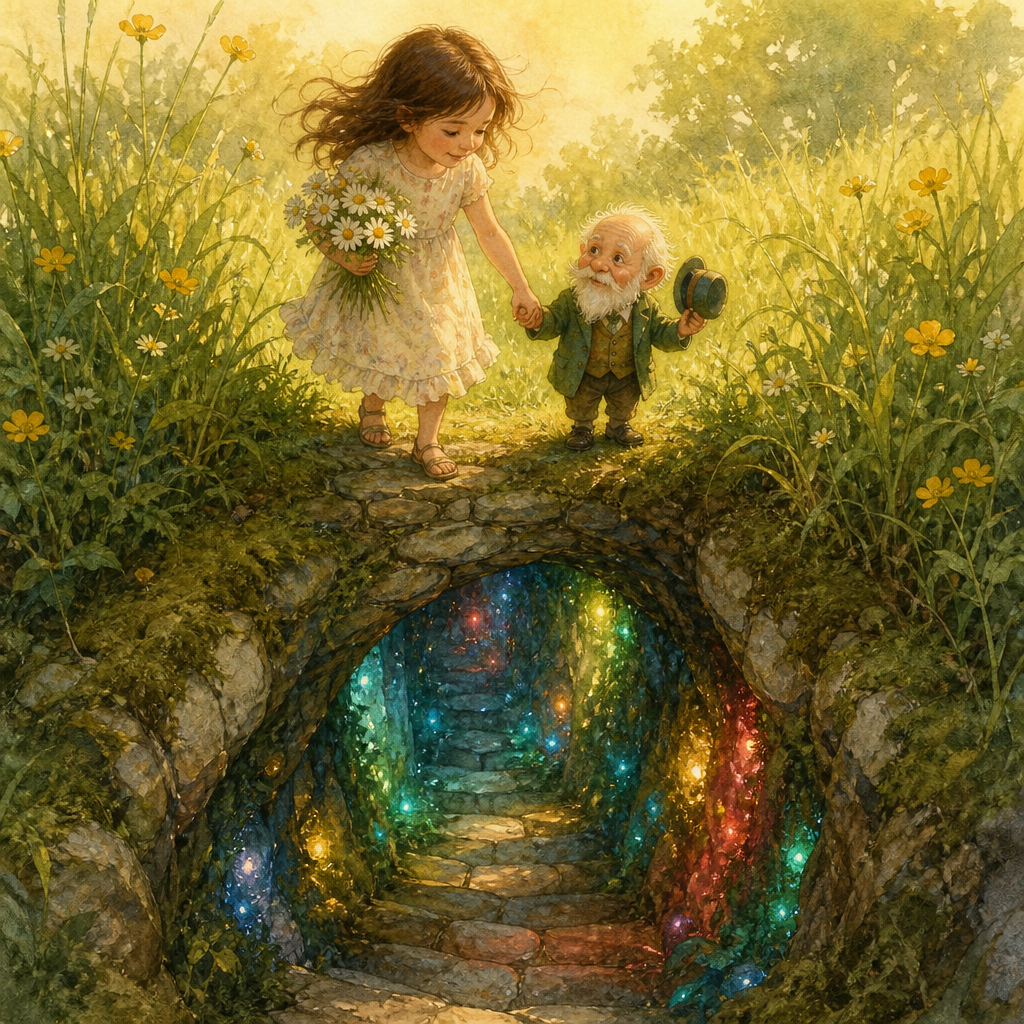
Here the grass was so tall it tickled her chin. Daisies stood taller than the grass, with calm faces like her mummy’s old nurse, and they didn’t mind a bit when Marian picked them. There were buttercups, too, shiny and fat, like the smiling man in the butcher’s shop.
It was such a big field that by the middle of it the builders’ voices had grown faint, and the tinkle of their trowels sounded like sheep-bells a long way off. When she turned round she could see the roofs and chimneys and church spires of the town, all wobbling in the heat as if they were tired and wanted to lie down. But they couldn’t, although they were so much older and bigger and stronger than Marian.
“I’d rather be me,” she thought, and with her bundle of flowers she lay down in the deep grass.
It was so hot that the grass stalks stood perfectly still, hundreds and hundreds of them, like trees in a forest or people in church waiting for the anthem. They weren’t even whispering. They seemed to be holding their breath and listening for something that a little girl couldn’t hear. She stared up at the sky, but it was so blue it made her eyes ache, so she closed them and watched the patterns on her eyelids. When she opened them again, the green between the grass blades was cool as ointment.
And nobody in the whole world, she thought, knows where I am.
She felt a tickle in the middle of her stomach.
“How do you do?” said a voice.
Marian jumped. A little man was looking up at her. He wasn’t even as tall as an afternoon tea-table. He held his hat politely in his right hand.
“What’s your name?” he asked.
Marian told him. She wasn’t a bit frightened.
“What’s yours?”
“I’m Mr Jugg,” he said.
“And who are you, Mr Jugg?”
“I’m the King of the Bumpies.”
When Marian was puzzled, a little straight line appeared between her eyebrows. “What are bumpies?”
“My hat!” he gasped. “Haven’t you ever heard of bumpies? Well, have you heard of angels?”
“Of course. Everybody has.”
“Then bumpies,” said Mr Jugg, “are baby angels. They’re called bumpies until they’ve learned to fly.”
“But why bumpies?”
“Because they bump,” said Mr Jugg, “not knowing how.”
Marian laughed. “Where do you live?”
“If you’d care to come with me, I could show you.”
“Oh, I should love to!”
He put on his hat, took her hand, and helped her up with her bunch of daisies. He led her across the field, through a hole in the hedge, and into a smaller field with some cows in it. From there they climbed a gate into a third field, where the grass was shorter still.
“How old are you?” he asked.
“Seven.”
“That’s very young,” said Mr Jugg. “I’m seven million.”
“Good gracious! And how old is Mrs Jugg?”
“She’s as old as I am, but she looks younger.”
In the middle of this field he stopped and stamped his foot three and a half times, three big stamps and one little one. The field opened. Marian saw a hole at her feet, with steps going down, down, down.
“This is where I live. Don’t be frightened. It’s quite safe. I’ll go first.”
He held her hand and went down one careful step at a time.
“Isn’t it rather dark?” asked Marian.
“Wait till I’ve shut the door. Then you’ll get a surprise.”
When their heads were below the ground he tapped twice on the wall. The hole closed over them, and the most wonderful thing happened. They were at the start of a long passage, almost a mile long, with a lovely downward slope, and along both walls shone hundreds of little lights of every colour: blue, green, yellow, crimson, and colours Marian had never seen or even imagined.
By the first step was a little cupboard. “That’s where I keep my scooter,” said Mr Jugg. “It saves time, and there’s room for two. Put your hands on my shoulders.”
Marian noticed that he suddenly seemed taller.
They set off. At first they glided slowly, because the slope was gentle, but they went faster and faster until all the coloured lights blurred into two bright streaks, one on each side. Marian could hardly breathe. What happens at the end? she thought. But halfway along, the passage began to climb. The streaks turned back into separate lights, the scooter slowed, and it stopped at last in front of a closed door, with another little cupboard in the wall beside it.
“Here we are,” said Mr Jugg, putting the scooter away. “I expect they’re all having tea.”
He opened the door. Marian nearly lost her breath again. She saw a great long room full of little tables, with bumpies sitting round every one. From the ceiling hung hundreds of coloured lights, and the clatter of talking and laughing, of spoons and plates and creaking chairs, was so loud that she could hardly hear Mr Jugg shouting in her ear.
“That’s Mrs Jugg, coming towards us.”
She was a stout little lady with a smiling face, exactly as tall as Mr Jugg but heavier by two and a half pounds. The bumpies were all sizes, but they wore the same clothes: little dark-green jackets, vests, knickers and socks. On every jacket were two little hooks behind the shoulders, for wings, though the bumpies only wore their wings during flying lessons. Suddenly they all stopped talking and stared at Marian. Some stood on their chairs to see her better. She blushed.
Mrs Jugg gave her a kiss. “Why, of course she shall have tea! Come to my table, my dear.”
The bumpies gave Marian three cheers and went back to their tea. And such a tea! Bread and butter with bumpy jam, and bumpy cream on top of the jam; bumpy cake with bumpy cherries; bumpy meringues; bumpy honey.
“Why, it’s just like a birthday tea!” said Marian.
“That’s because it is one,” said Mr Jugg. “Every tea’s a birthday tea down here. There are so many bumpies that it’s always somebody’s birthday.”
“Isn’t that a lot of bother? For you and Mrs Jugg, I mean?”
Mrs Jugg handed her another meringue. “There aren’t any bothers in Heaven.”
“But this isn’t Heaven. Is it?”
“Of course it is, my dear. Part of it.”
“But it’s under the ground.”
“Never mind that. Heaven’s everywhere. Only most people don’t know it.”
Marian felt lovely and shivery. Fancy Heaven being so close to home! Wait until she told Mummy! Mrs Jugg gave her more cake.
When the bumpies had finished, Mr Jugg clapped his hands. They all stood up, Mrs Jugg said grace, and then everyone rushed to a door that opened into an enormous playroom with even more lights, hundreds of swings and all sorts of rocking-horses. In a minute there was a bumpy on every one. Two of them took charge of Marian, and she had a lovely swing and a ride on a rocking-horse, and then they all played games: ring-a-ring o’ roses, bumpy in the corner, bumpy hide-and-seek, and angel’s buff.
Then Mr Jugg took her to the flying school, which was like a big gym. Pairs of wings hung from rows of pegs, and soft mattresses covered the floor so that falling bumpies wouldn’t hurt themselves. The ones Marian watched had nearly learned to fly. Soon they’d be proper angels, able to fly anywhere.
“And then,” said Mr Jugg, “they go to the upper school to learn history and geography and all about dreams and things. And after college they begin to work. There’s always heaps to do.”
“I see,” said Marian. “And now I really think I should go home.”
“Perhaps you should,” said Mr Jugg.
Mrs Jugg came with a big box of bumpy chocolates. Marian took one, and Mrs Jugg kissed her and said she must come again. “You haven’t seen a quarter of the place. There are miles and miles of it. Have another chocolate.”
Marian thanked her, and she and Mr Jugg went back to the passage. Now it ran downhill. They took the scooter, going slowly and then terribly fast, with the lights streaking past. But Marian knew what was coming now, and when the scooter slowed and stopped at the foot of the steps she wasn’t a bit afraid. Mr Jugg knocked twice on the wall. At the top of the steps the hole opened, and she saw the sky above it.
“Goodness,” she said. “How late it is!”
The sky was dark, and the stars were out.
“Poor Mummy! She’ll be so frightened.”
“Where do you live?” asked Mr Jugg. She told him. “I’d better fly you home. Half a tick.”
He fetched a pair of wings from the cupboard. “Climb on my back. We’ll be there in half a minute.”
She rode on his shoulders as if on a pick-a-back, and with one little jump they were in the air. They skimmed over the fields and down Peter Street as fast as an express train. At her front door he put her down.
“Which is your bedroom window?”
She pointed.
“Now I must say good night. No, I can’t come in. It’s against the rules for the King of the Bumpies.” He took off his hat, bowed, and was gone before she could blink.
She knocked. A moment later Mummy was hugging her as tight as tight, and then Daddy was hugging her too, and her brother Cuthbert, who had gone to bed, leaned over the banisters.
“Where have you been?”
“Why, where haven’t I been?” said Marian, and told them everything.
Cuthbert didn’t believe her. Cuthbert didn’t believe anything. He was nine, and had just started learning French. But Mummy believed her, and Daddy believed her. And here’s something else that happened.
Late that night, when everyone was asleep, Mr Jugg flew to Marian’s window. Marian’s guardian angel (everybody has one) was sitting quietly on the sill outside.
“Hullo!” said the angel. “Fancy seeing you here!”
He had once been a bumpy himself, you see, and Mr Jugg had taught him to fly.
“Good evening,” said Mr Jugg. “What do you think of this?”
It was a little dream he had brought for Marian.
“By George,” said the angel. “That’s a beauty.”
He slipped it softly under her pillow. She must have dreamed it, too, because when Mummy made the bed in the morning it was gone. But the loveliest dreams of all, sadly, are the ones we never remember.
A small verse from the author on how we adapt to our surroundings, left in his words.
Like the jungle he lives in,
Tiger wears a dappled skin.
Foxes on the plains of snow
White as their surroundings go.
So do fishes lose their sight,
Buried in the ocean’s night,
Little knowing lovely day,
Lies but half a mile away.
For the truth is plain to see,
As our haunts are, so are we;
And in cities you will find
Busy blind men just as blind.
Long ago they lost their eyes
Under bags of merchandise;
And they know not there are still
Angels on the window-sill.