It was bitter cold on the night before Christmas, somewhere south of the Grand Banks of Newfoundland — a wild, uneasy part of the Atlantic at the best of times, but on a Christmas Eve with the wind in the northwest it was a home of desolation. The wind, however, only served to increase the draft in the fire-room of the good steamer Astoria, bound from Liverpool to New York, and she was making a fair nineteen and a half knots.
When the cold spray came over the bow like a discharge of ice-shot and slashed the face of the first officer on the bridge, he only pulled his cap down tighter, hauled his muffler higher, squinted at the compass-card, and gritted his teeth. The mighty machine under his feet was dropping degrees of longitude astern at a rate that promised a splendid winter record, and that was enough for him.
Among the steerage passengers huddled below were a father and mother and their small daughter, Molly Ryan. The steerage was gloomy and close, and many of the poor women were sick. So Molly had stolen away while her parents dozed, meaning to catch a breath of fresh air on deck.
She was such a little body that no one discovered her where she huddled under the edge of the poop. The cold wind pierced through her, but she was fascinated by the darkness — a blackness so complete she could not tell whether the ship was sailing on the ocean or on nothing at all. After a time she climbed up and sat on the rail, looking at the ghostly foam as it hurled itself against the iron side and swept hissing away under the quarter.
She was in great danger, but she didn’t know it. She fancied she could see, away down in the black and white waters, a beautiful Christmas tree loaded with silver toys, appearing and disappearing with the foam. Molly had never had a Christmas tree. She had heard about them, and her fondest hope was that some day she might see one. She leaned farther out, looking down into the water.
She couldn’t know how close the bark Mary Ellis was.
The Mary Ellis was flying before the wind, thundering down into yawning hollows and flinging her bows aloft again with terrible force. Her course cut diagonally across the steamer’s bow. The skipper of the Mary Ellis was a rough, mean man who had been trying to save oil, and so her side-lights were not burning. The steamer’s lights were burning; the bark’s watch ought to have seen them. For some reason they did not. And so every moment, the two ships drew closer and closer together.
Just as a steward happened to catch sight of Molly and called out to her to get down, there was a sudden outbreak of shouts forward. The first officer sprang to the engine-room telegraph and signaled the engineer to stop — but a few seconds later there came a jar, a noise of rending wood, and the Astoria struck the Mary Ellis a glancing blow on her port quarter, carrying away a section of her bulwarks.
At that same instant Molly Ryan fell off the Astoria‘s rail into the sea.
“Man overboard!” screamed the steward.
It takes a long time to stop a steamer going nearly twenty knots, and by the time the first boat was lowered the Astoria was far beyond the spot where Molly had gone in. But when Molly came to the surface, half strangled, her little hands struck something hard and floating. With the last of her strength she climbed on top of it. It was the section of the Mary Ellis‘s bulwarks, knocked away in the collision.
More fortunately still, the captain of the bark had heard the cry “Man overboard” — and thinking it had come from his own vessel, he ordered a boat lowered. Groping through the blackness and the tumbling water, the crew of that boat found Molly, and took her aboard the bark.
“Only a kid?” exclaimed the captain, when she was brought to him. “Take her forward, some of you, and see she’s looked after.”
And having satisfied himself that the bark was not seriously damaged, he returned to his cabin to sleep.
A long, lean seaman who looked, for all the world, like a Connecticut farmer — and who went by the name of Farmer Joe — turned to a big sailor the crew called Handsome.
“Handsome, we’d best get her thawed out quick. There’s no time to lose.”
They carried Molly into the galley. She was quite unconscious, her clothes already beginning to freeze on her. The sailors fell into a general discussion of the best course of treatment, and after a while she was gently undressed, properly “thawed out,” and put to bed in a bunk in the forecastle. Handsome mixed a warm drink and poured it between her teeth. She gave a little gasp, opened her eyes, and gazed around.
“Oh,” she muttered. “There isn’t any Christmas tree, after all.”
And with that she fainted away again. The sailors looked at one another in solemn silence until finally one of them said, in a deep bass voice:
“Well, if she hain’t a-huntin’ for trees on the southerly end of the Grand Banks!”
“That’s what she’s looking for,” said Handsome, slapping one huge fist into the other, “and that’s what she’s going to get.” He and the other seamen sat down under the forecastle lamp and talked earnestly in low voices. After several minutes they all arose, and Farmer Joe said:
“Handsome, you’re considerable pert when you’re pert. But we must get to work right away.”
While the rough sailors were at work, little Molly passed from unconsciousness into sleep. The big seamen took turns watching over her. The forecastle was not a pretty bedroom — dark and dingy, full of the weird groaning of timbers, the booming shocks of seas against the hull, and the noise of falling water overhead. Up and away the bows would soar and then plunge down into foam again. But of course the sailors thought nothing of all this. The forecastle was their home, long ago as familiar as a parlour. And in spite of everything, Molly slept soundly, wrapped in a rough blanket with a pea-jacket spread over her shoulders, while the men worked quietly with a boat-hook, some small pieces of wood, oakum, and green paint.
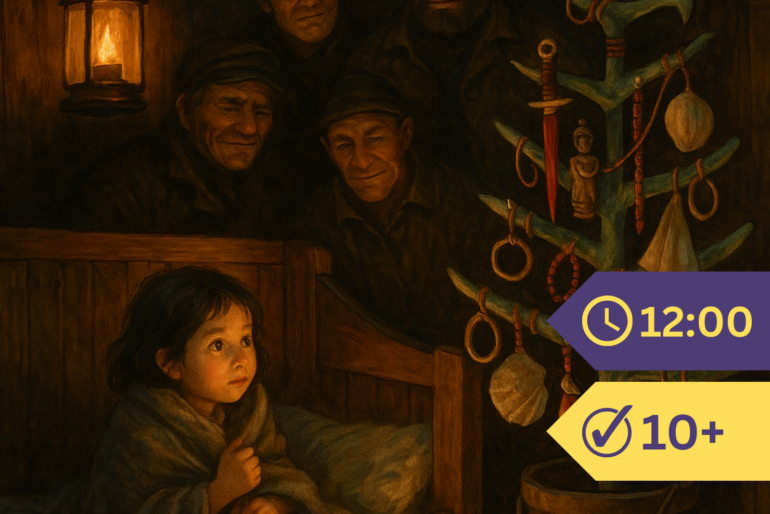
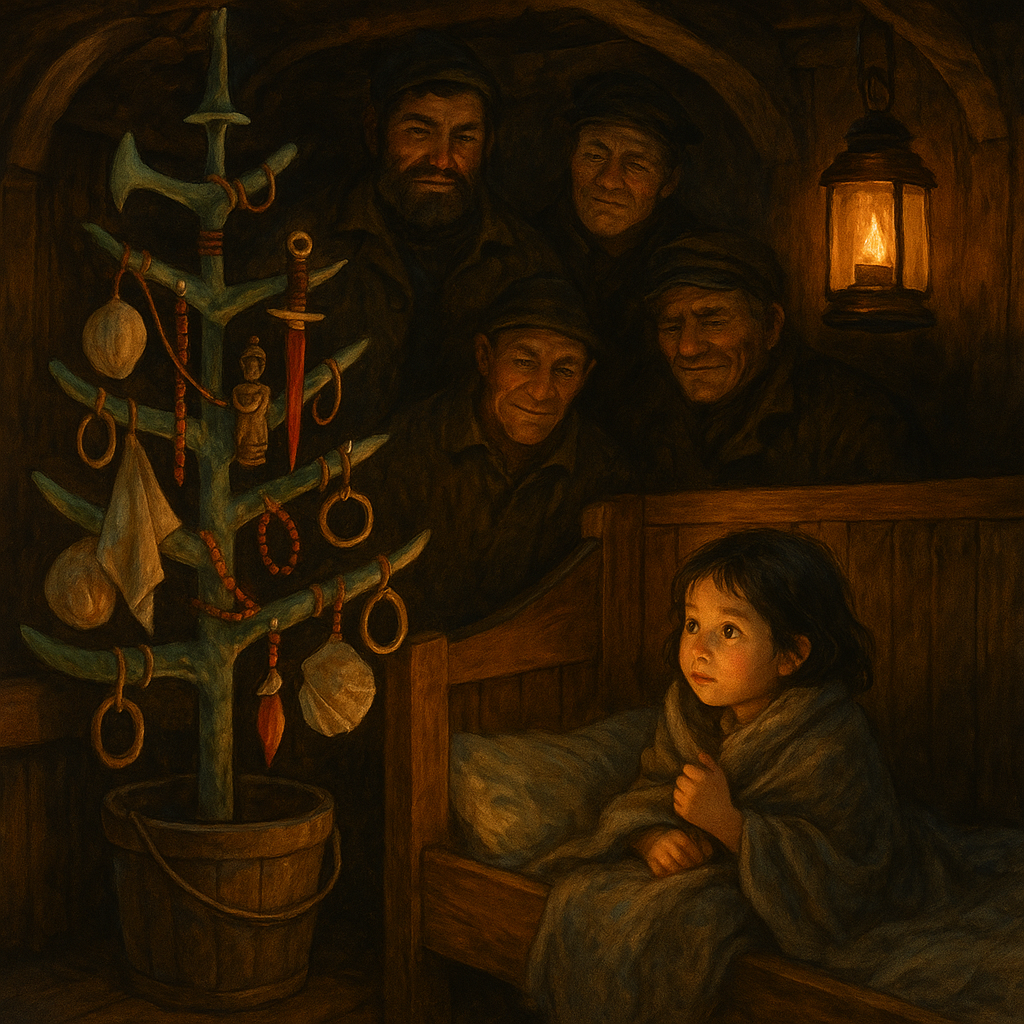
Whatever they were making, it was strange enough to look at — but their hearts were in it. At last it was finished and set up in a bucket against the bulkhead, where the lantern shed its fitful light full upon it.
“Werry good, too,” said Handsome, gazing at it. “But it won’t do unless it’s got somethin’ onto it.”
And then those sailor-men went rummaging in their sea-chests. As they had been voyagers in all parts of the globe, they brought forth some curious ornaments for their wondrous Christmas tree. Handsome contributed three large shells from the Indian Ocean, a dried mermaid, and a small Hindu idol which answered very well for a dolly. Another produced a South African dagger, a Chinese puzzle, and three brass nose-rings from a South Pacific island. Farmer Joe brought out a stuffed marmoset, an Indian amulet, and a tintype likeness of himself. A fourth sailor fished out a beautiful India-silk handkerchief and a string of coral. Handsome gravely hung them all on the Christmas tree. When everything was done he stepped back and studied the effect.
“Werry good, too,” he said.
“Yas,” said Farmer Joe. “I guess you couldn’t get any such tree as that to home.”
At six o’clock on Christmas morning Molly awoke. It was still dark, and the lantern’s light was but dim. The sailors were huddled back in the corner farthest from their wonderful Christmas tree, which had been placed where the child’s eyes were most likely to fall on it as soon as she sat up.
And so when Molly awoke, she did sit up and stare straight in front of her with sleepy eyes, trying to collect her thoughts and make out where she was. Gradually she became conscious of the tree. Her eyes opened wider and wider. She almost ceased to breathe. Then suddenly she clapped her hands together and, with a little scream of delight, cried joyously: “Why, it’s a Christmas tree!”
The sailors nudged one another, and Handsome could not restrain a chuckle. Molly heard, and looked around. A puzzled expression came over her face as she studied her surroundings.
“Is that a Christmas tree?” she asked.
“That’s wot it is!” cried the one they called English. “An’ we also is Santa Clauses.”
“Oh!” exclaimed Molly. “What funny Santa Clauses! I always thought there was only one.”
“Well, aboard this ‘ere bark there is several.”
“And oh!” cried Molly, clapping her hands and jumping out of the bunk, “what a lot of funny things I’ve got for Christmas! I never got much before.” She looked around at all of them, and then her face changed. “But I think I’d rather have my father and mother, please.” And she looked as if she were about to cry.
“Don’t go fer to cry,” said Handsome. “I’ll sing ye a song.”
“Oh, you are a nice Santa Claus!” cried Molly, brightening up.
“All the rest o’ you Santa Clauses join in the chorus,” said Handsome, standing up. And then he sang a long, rambling comic shanty about a crew of hopeless sailors who managed, somehow, to get from one catastrophe to another and still make it home to solid ground. The chorus roared through the forecastle:
Roll, boys, roll, boys!
Never mind the weather.
No matter how the wind blows,
We’ll all get there together.
At the end of the song all the seamen stood up, joined hands, and danced around, roaring out the chorus in such tremendous voices that the captain came running to the forecastle hatch to see what was going on. He dropped down among his men so suddenly that they all fell silent, braced for an outburst of anger.
But the captain slowly took in the meaning of the scene — the strange little tree, the child, the circle of red-faced sailors — and said:
“All right, lads. Amuse her and take good care of her. And when we get to New York, I’ll make it my business to find her father.”
He was as good as his word. In due time Molly was placed in the arms of her parents, who had been mourning her as dead. It was a joyous reunion, as you may imagine. But all the rest of her life Molly remembered her strange Christmas Eve at sea, and her wonderful Christmas tree.