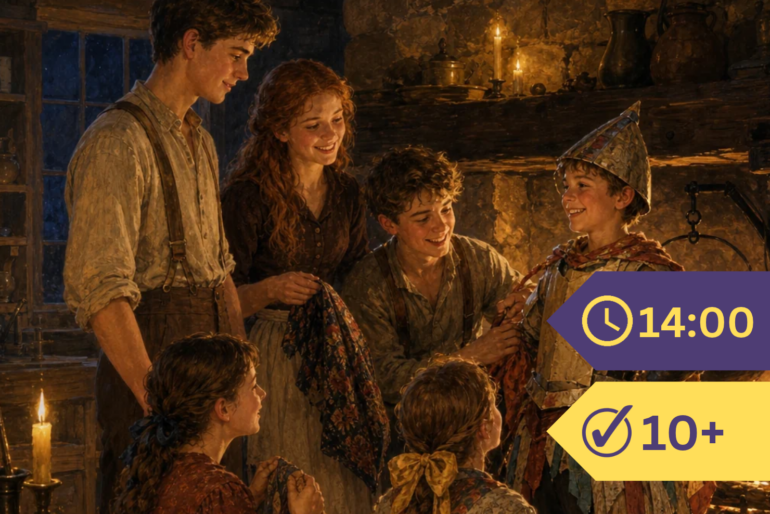
This is a story about some children who lived together in a little house on the prairie of a Western state, nearly two miles from any other house. There were three boys and three girls. The oldest girl was seventeen, and her oldest brother a year younger. Their mother had died two or three years before, and now their father had grown sick — more sick with every passing week — and died also.
The children had taken the best care of him they could, wondering and watching. But no care could do much, and he told them so. He told them all that he would not live long, but that when he died he would not be far from them, and would be with their dear mother. “Remember,” he said, “to love each other. Be kind to each other. Stick together, if you can. Or, if you must separate, love one another as if you were still together.” He lay still after that, with his eyes closed, but every now and then a sweet smile swept over his face, so that they knew he was awake and at peace. Then he roused himself once more, and said, “Love is the whole, George; love is the whole” — and so he died.
I don’t suppose the children, in the midst of their grief and loneliness, took in his meaning then. But afterward they remembered those words again and again, and found out why he had said them.
You would have thought it a queer little house. It wasn’t a log cabin — there weren’t many logs to be had on the prairie — but it was no larger than one. There was a little entryway at one end, and two rooms opening off to the right as you went in. A flight of steps led up to the loft, where the boys slept in two beds. That was all. But if they had no rooms for servants, they also had no servants for rooms. If they had no hot-water pipes, a large kettle hung on the crane above the kitchen fire, and there was hardly a moment of any day when you couldn’t dip out hot water. They had no gas lamps, but they went to bed the earlier and rose the more reliably to enjoy the great morning illumination of the sun. They lost but few steps going from room to room. They were never short of fresh air. They had no doorbell, so no guest was ever left waiting in the cold. And though they had no way to call from room to room except their own voices, they found no difficulty in that: if Ethan was upstairs and Alice wanted him to come down, she simply called.
Their father was buried, and the children were left alone.
The first night after the funeral they crept to their beds as soon as they could, after a supper nobody had the heart to eat. The next morning George and Fanny found themselves the first to meet at the kitchen hearth. Each had tried to be there before the other to make the morning fire. Each confessed that there had been little sleep, and that the night had seemed hopelessly long.
“But I have thought it all over,” said the brave, steady boy. “Father told us to stick together as long as we can. I know I can manage it. The children will all do their best once they understand. And I know — though Father didn’t quite believe it — I know I can manage the farm team. We will never get into debt. I will never drink. Drink and debt, as he used to say, are the only two devils. Don’t cry, Fanny — I know we can get along.”
“George,” said Fanny, “I know we can get along if you say so. I know it will be hard on you. There are so many things other young men do that you won’t be able to do, so many things they have that you might have had. But none of them has a sister who loves them as I love you. And, as he said — ‘Love is the whole.'”
I suppose those words at the hearth were almost the only sentimental words that ever passed between those two about their plans. But from that moment the plans went forward more perfectly than if they had been talked over at every turn and amended every day. That is the way with all true stories of hearth and home.
That very evening, when the day’s work of all six was done — and hard work it was — Fanny and George would both have been glad enough to take a book and rest. But George saw that the younger girls looked downcast and heavy, and that the boys were whispering on the doorstep, wanting to drift down to the blacksmith’s shop to escape the sadness of the house. He didn’t want them to begin the habit of loafing there with the idle boys and men who gathered from three miles around. So he laid down his book and said, as cheerfully as if he hadn’t laid his father in the grave the day before:
“What shall we do tonight that we can all do together? Something we’ve never done before. Let’s try what Mrs. Chisholm told us about. Let’s act a ballad.”
Of course the children were delighted. George had counted on that. Fanny looked across at him so gratefully and set down her book too. In a minute Ethan — the young carpenter of the family — was putting up sconces for tallow candles to light the scene. Fanny had Sarah and Alice out in the wood-house, sorting through shawls, old ribbons, and bright strips of calico for costumes. George was instructing Walter on how to arrange his armor and his horse. After a period of preparation considerably longer than the performance itself, they were ready to act out in the kitchen the ballad of Lochinvar.
The children had a happy evening. The little ones were almost frightened when they went to bed — they had been so merry. They gathered with George and Fanny and read the Bible as they had always done with their father, and the last verse was: Love is the fulfilling of the law. So the little ones went to bed, and left George and Fanny alone again together.
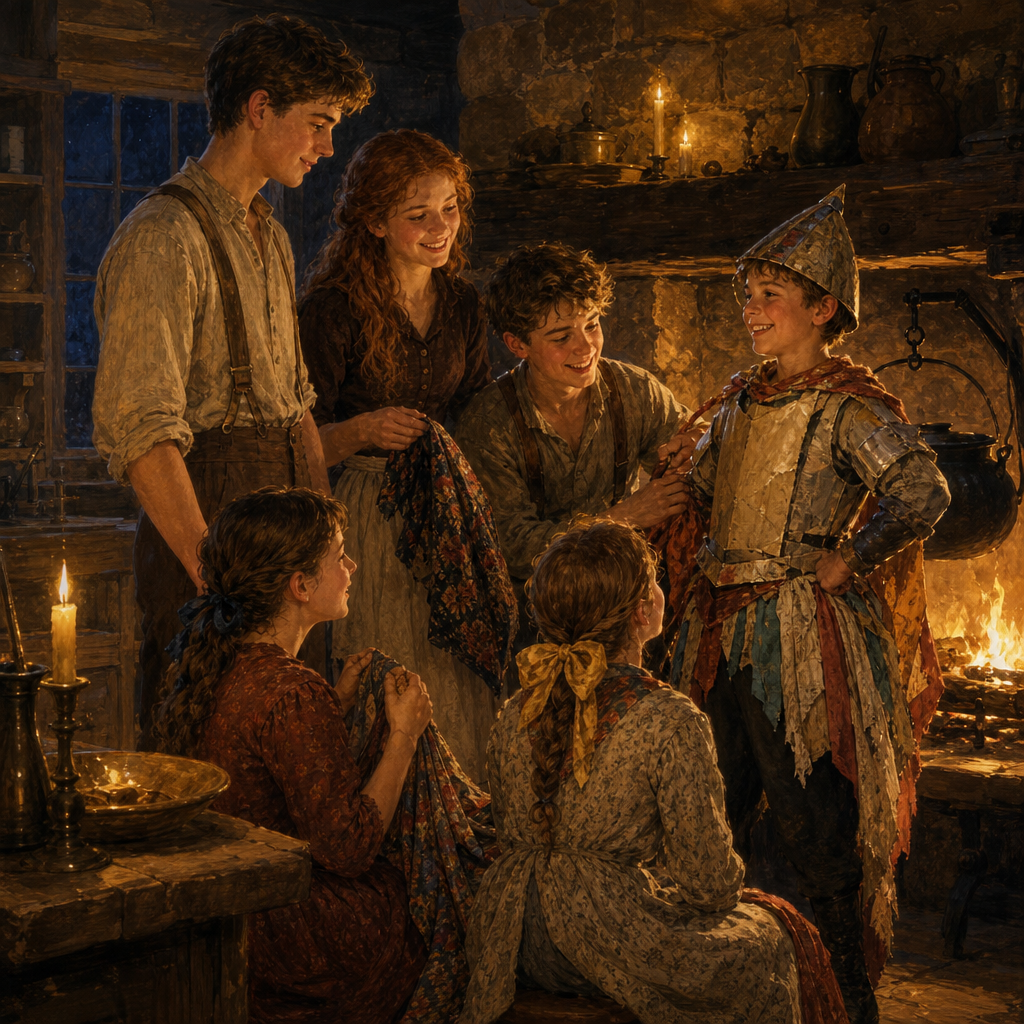
“Pretty hard, wasn’t it?” said Fanny, smiling through her tears. “But it’s so much better for them that home should be the happiest place of all. After all — ‘Love is the whole.'”
That night’s sacrifice — which the two older children made for their younger brothers and sisters, as it were over their father’s fresh grave — was the beginning of many such evenings. They read Dickens aloud. They cleared out the corn-room at the end of the wood-house for their plays and charades. The neighbors’ children liked to come in, and under the firm rule of early hours and good behavior, they were welcome. George and Fanny found they had not only a reputation for keeping their own little flock in order, but that the best families around trusted their children to the older pair’s care. All that pleasure and community grew from the simple remembrance that “love is the whole.”
Far from being a lonely and forsaken family, these boys and girls soon found themselves surrounded with friends. George was right that he could manage the team and keep the small farm going — not at its full production under his father, but well enough to keep them comfortable. Every now and then there was a decision to be made. Mr. Snyder came one day to offer George forty dollars a month and board to go off with a surveying party and carry chain for the engineers — good prospects for a young man, and the money was tempting. George and Fanny put an extra pine-knot on the fire after the children had gone to bed and talked it over. But George declined, with warm thanks to Mr. Snyder. “If I go away,” he said, “the whole household suffers. The boys can’t run the farm alone — they’d have to hire out, and they’re too young for that. After all, Mr. Snyder — love is the whole.” And Mr. Snyder agreed with him.
A few years on, after another long council over another pine-knot, with Walter now old enough to join George and Fanny at the hearth, it was agreed that Walter should hire out. He had a chance to go over to the Stacy Brothers in the next county — the largest stock farm in that part of Illinois. George and Fanny worried whether the rough company there might do him more harm than good, and told him their doubts plainly. Walter laughed. “Do you think I’m such a fool as to forget? Don’t I know that love is the whole? Shall I ever forget who taught us so?” And so it was settled that he should go.
He went. The Stacys’ great establishment was as different from the little cabin as could be imagined. But the other workers there — Norwegians, Welshmen, Germans, Yankees, all sorts of people — all had hearts just like his. A helpful young man, honest as a clock and steady in his work, who genuinely tried to serve whoever he could, made friends on the great stock farm exactly as he had in the corn-room at the end of the wood-house. Once a month when wages were paid he sent the lion’s share home to Fanny, in letters that each month were written a little better and seemed a little easier for him to form. And when Thanksgiving came, Mr. George Stacy sent him home for a fortnight with a special message for his sister: “He could not do without the boy, and he wished she would send him a dozen like Walter. He knew how to raise oxen, he said, but would Miss Fanny tell him how she brought up boys like that?”
“I could have told him,” said Walter afterward, “but I didn’t choose to. I could have told him that love was the whole.”
Ethan’s story was much the same. He hired out with a canal-boatman, and his “voyages” took him sometimes to the lake and once as far as Cleveland by sail — fresh-water adventures which he told with great comic drama, in the manner of Swiss Family Robinson or Sinbad the Sailor. But canal-boating didn’t hold him long. His experience handling grain brought him at last to Chicago, where he went to work at a grain elevator. He lived always the old home life. He fell in with three other young men — one from his church, one from the Custom House, one from his dinner-house — who used to come up to his little room on the seventh floor of the McKenzie House and sit on the bed and the chairs, just as the boys from the blacksmith’s had once filled the corn-room. The four of them formed a literary club “for reading Shakespeare and the British essayists.” They laughed at that grand title for years afterward. They called themselves the Club of the Tetrarchy, because they thought it fine to have a Greek name. Whatever its name, it kept them out of trouble. Those four boys grew up to be four influential men in Western life, and years later, when someone asked Ethan how he came to have so loyal a friend in Torrey, Ethan told the story of the seventh-floor room at the McKenzie House and said: “Love is the whole.”
Central to all his life remained that little cabin — two rooms and a loft. There is no day of Ethan’s life from that time to this that Fanny cannot tell you from his weekly letters home. She keeps them all, filed and in order, and on his seal-ring, with which the later letters were sealed, is carved the inscription: Love is the whole.
I cannot try to tell you Alice’s fortunes, or Sarah’s. Every day of their lives was a romance, as every day of yours and mine may be. As they all grew older their homes spread further apart. The boys became men and married. The girls became women and married. George never pulled down the old farmhouse, not even when he and Mr. Vaux built a handsome new house beside it. He put trellises on the old walls, trained cotoneaster and waxwork vines over them, carved a cross himself and fastened it in the gable. Above the door he hung a picture of the mother and child, with this inscription:
Holy cell and holy shrine,
Remember, thou that seest her bending
O’er that babe upon her knee,
All heaven is ever thus extending
Its arms of love round thee.
Such love shall bless our arched porch;
Crowned with his cross, our cot becomes a church.
In that little church he gathered the children of the neighborhood every Sunday afternoon to tell them stories and sing together. On weekdays he held children’s parties there that were thought the best events of the week. He and his wife and his own children came to believe the hours in the old cabin were the best hours of all. There were pictures on the walls. They painted the windows with flower pictures and colored them with autumn leaves. But there were only two inscriptions — one over each door — and both said the same thing: Love is the whole.
They told all these stories, and a hundred more, at a great Thanksgiving gathering after the war. Walter and his wife and children came from Sangamon County. The General and all his family came down from Winnetka. Fanny and the Governor and all their seven came all the way from Minnesota. Alice and her husband and her little ones came up the river from Quincy. Sarah and Gilbert, with the twins and the babies, came in their own carriage from Horace. There was a Thanksgiving dinner set for all six of the old children, their six husbands and wives, and twenty-seven grandchildren of the family.
In twenty years since their father died, those brothers and sisters had lived for each other. They had had separate houses, but spent the money in them for each other. No one of them had said that anything he owned was his alone. They had confided wholly in one another. They had passed through much sorrow, and in that sorrow strengthened each other. They had passed through much joy, and the joy had been multiplied tenfold because it was shared. At the Thanksgiving gathering some of the younger generation acted the ballad of Lochinvar — and that set Fanny and Sarah to telling the oldest nephews and nieces the stories of the cabin days.
But Fanny said, when the children asked for more: “There is no need of any more. Love is the whole.”