One Christmas Eve, Joel Baker was in a most unhappy mood. He was lonesome and miserable; the chimes making merry Christmas music outside disturbed rather than soothed him, the jingle of sleigh-bells fretted him, and the shrill whistling of the wind around the corners of the house and up and down the chimney seemed to grate harshly on his ears.
“Humph,” said Joel wearily. “Christmas is nothing to me. There was a time when it meant a great deal, but that was long ago — fifty years is a long stretch to look back over. There is nothing in Christmas now, nothing for me at least. It is so long since Santa Claus remembered me that I venture to say he has forgotten there ever was such a person as Joel Baker in all the world. It used to be different. Santa Claus used to think a great deal of me when I was a boy. Christmas nowadays isn’t what it was in the good old time — no, not what it used to be.”
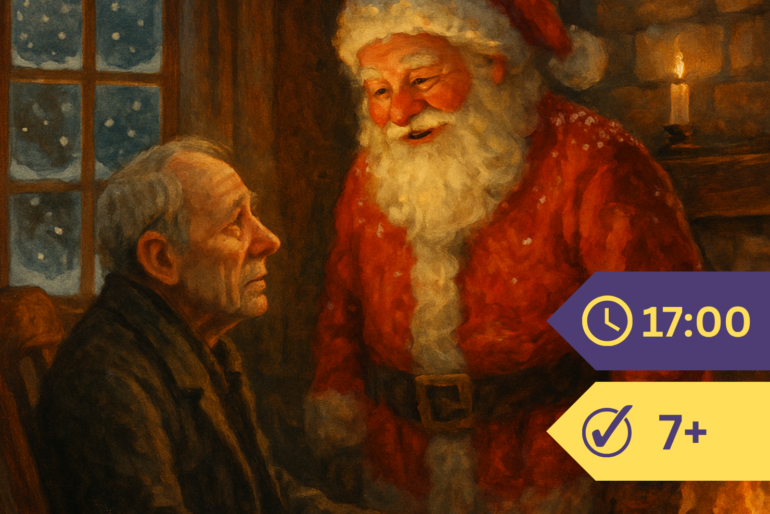
As Joel sat absorbed in these gloomy thoughts, he became suddenly aware that somebody was entering — or trying to enter — the room. First came a draught of cold air, then a scraping, grating sound, then a strange shuffling, and then — all at once — Joel saw a pair of fat legs and a still fatter body dangle down the chimney, followed presently by a long white beard, above which appeared a jolly red nose and two bright twinkling eyes, with a fur cap pulled down over the head and forehead, white with snowflakes.
“Ha, ha!” chuckled the fat, jolly stranger, emerging from the chimney and standing well to one side of the hearthstone. “Ha, ha! They don’t build the big wide chimneys they used to, but they can’t keep Santa Claus out — no, they can’t keep Santa Claus out! Ha, ha, ha! Though the chimney were no bigger than a gas pipe, Santa Claus would slide down it!”
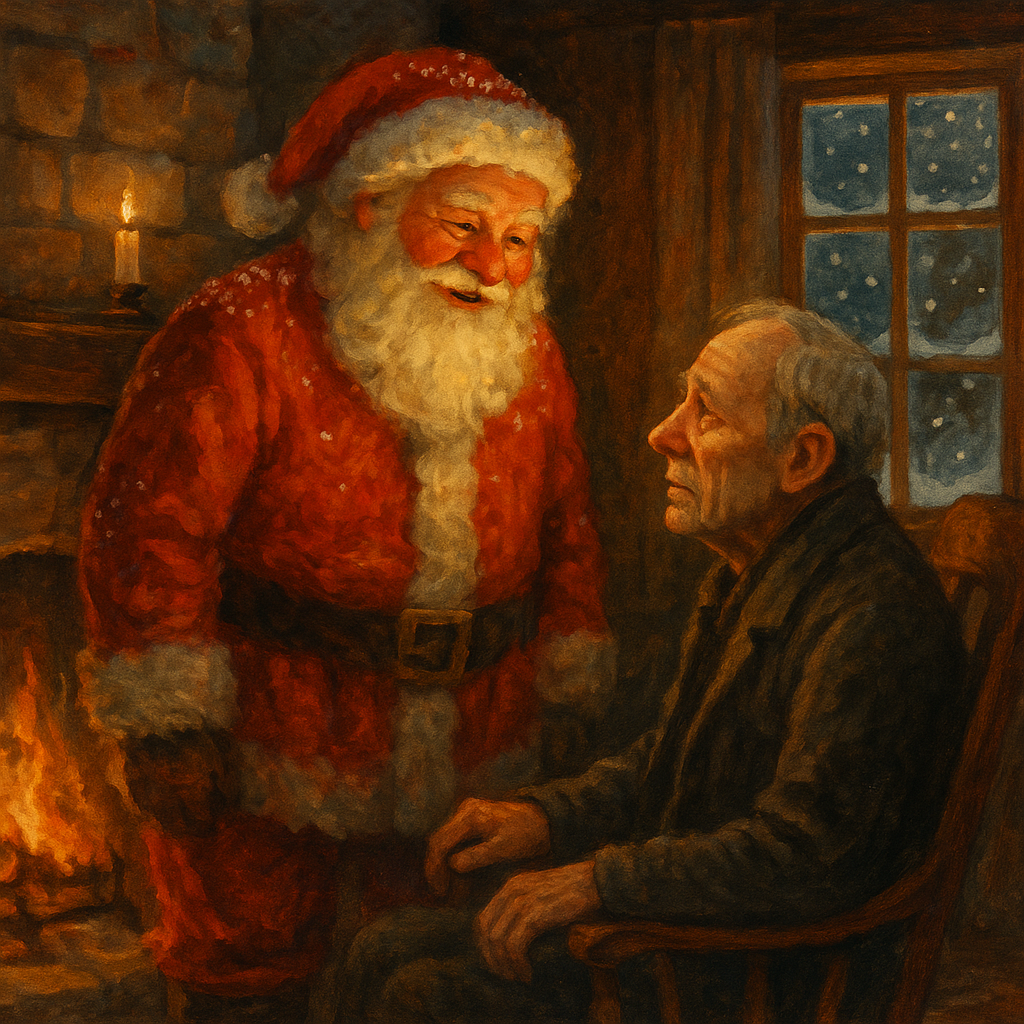
It didn’t require a second glance to assure Joel that the newcomer was indeed Santa Claus. Joel knew the good old saint — oh, yes — he had seen him once before. That had been when Joel was a little boy, but he had never forgotten how Santa Claus looked.
Nor had Santa Claus forgotten Joel, though Joel had thought he had; for now Santa Claus looked kindly at Joel, smiled, and said: “Merry Christmas to you, Joel!”
“Thank you, old Santa Claus,” replied Joel, “but I don’t believe it’s going to be a very merry Christmas. It’s been so long since I’ve had one that I don’t believe I’d know how to act if I did.”
“Let me see,” said Santa Claus. “It must be going on fifty years since I saw you last — yes, you were eight years old the last time I slipped down the chimney of the old homestead and filled your stocking. Do you remember it?”
“I remember it well,” answered Joel. “I had made up my mind to lie awake and see Santa Claus. I had heard tell of you, but I’d never seen you, and Brother Otis and I decided we’d lie awake and watch for you to come.”
Santa Claus shook his head reproachfully.
“That was very wrong,” said he, “for I’m so easily frightened that if I’d known you boys were awake I’d never have come down the chimney at all, and then you’d have had no presents.”
“But Otis couldn’t keep awake,” explained Joel. “We talked about everything we could think of, till Father called out that if we didn’t stop he’d have to send one of us up to the attic to sleep with the hired man. So in less than five minutes Otis was sound asleep and no pinching could wake him up. But I was bound to see Santa Claus — I don’t believe anything would have put me to sleep. I heard the big clock in the sitting room strike eleven, and I had begun to wonder if you were ever going to come, when all of a sudden I heard the tinkle of the bells around your reindeer’s necks. Then I heard the reindeer prancing on the roof and the sound of your sleigh-runners cutting through the crust and slipping over the shingles. I was a little scared, and I covered my head with the sheet and quilts — only I left a little hole so I could peek out and see what was going on. As soon as I saw you I got over being scared, for you were jolly and smiling, and you chuckled as you went around to each stocking and filled it up.”
“Yes, I remember the night,” said Santa Claus. “I brought you a sled, didn’t I?”
“Yes, and you brought Otis one too,” replied Joel. “Mine was red and had ‘Yankee Doodle’ painted in black letters on the side; Otis’s was black and had ‘Snow Queen’ in gilt letters.”
“I remember those sleds distinctly,” said Santa Claus. “I made them especially for you boys.”
“You set them up against the wall,” continued Joel, “and then you filled the stockings.”
“There were six of them, as I recollect?”
“Let me see — there was mine, and Otis’s, and Elvira’s, and Thankful’s, and Susan Prickett’s. Susan was our hired girl. No, there were only five, and as I remember they were the biggest we could beg or borrow from Aunt Dorcas, who weighed close to two hundred pounds. Otis and I didn’t much like Susan Prickett, and we were hoping you’d put a cold potato in her stocking.”
“But Susan was a good girl,” said Santa Claus. “You know I put cold potatoes only in the stockings of children who are bad and don’t believe in Santa Claus.”
“At any rate,” said Joel, “you filled all the stockings with candy and popcorn and nuts and raisins — and I remember you said you were afraid you’d run out of popcorn balls before you got all the way around. Then you left each of us a book. Elvira got the best one, which was The Garland of Friendship and had poems in it about the bleeding of hearts and so forth. Father wasn’t expecting anything, but you left him a new pair of mittens, and Mother got a new fur boa to wear to meeting.”
“Of course,” said Santa Claus. “I never forgot Father and Mother.”
“Well, it was all I could do to lie still,” continued Joel, “for I’d been longing for a sled, and the sight of that red sled with ‘Yankee Doodle’ painted on it just made me wild. But somehow I began to get powerfully sleepy, and I couldn’t keep my eyes open. The next thing I knew, Otis was nudging me in the ribs. ‘Get up, Joel,’ says he; ‘it’s Christmas and Santa Claus has been here.’ ‘Merry Christmas! Merry Christmas!’ we cried as we tumbled out of bed. Then Elvira and Thankful came in, not more than half dressed, and Susan came in too, and we just made Rome howl with ‘Merry Christmas! Merry Christmas!’ to each other. ‘If you children don’t make less noise in there,’ cried Father, ‘I’ll have to send you all back to bed.’ The idea — asking boys and girls to keep quiet on Christmas morning when they’ve got new sleds and Garlands of Friendship!”
Santa Claus chuckled; his rosy cheeks fairly beamed with joy.
“Otis and I didn’t want any breakfast,” said Joel. “We decided a stockingful of candy and popcorn and raisins would hold us for a while. I do believe there weren’t enough buckwheat cakes in the township to keep us indoors that morning. Buckwheat cakes don’t amount to much alongside a red sled with ‘Yankee Doodle’ painted on it and a black sled named ‘Snow Queen.’ We didn’t care how cold it was — so much the better for sliding downhill! All the boys had new sleds — Lafe Dawson, Bill Holbrook, Gum Adams, Rube Playford, Leander Merrick, Ezra Purple — all of them had new sleds, except Martin Peavey, who said he reckoned Santa Claus had skipped him this year because his father had broken his leg hauling logs from the Pelham woods and had been kept indoors six weeks. But Martin had his old sled, and he didn’t need to ask any favors of any of us, either.”
“I brought Martin a sled the next Christmas,” said Santa Claus.
“I don’t doubt it. But did you ever slide downhill, Santa Claus? I don’t mean such hills as they have out here in this new country, but one of those old-fashioned New England hills that was made especially for boys to slide down — full of bumps and dips, and about ten times longer coming up than going down! The wind blew in our faces and almost took our breath away. ‘Merry Christmas to you, little boys!’ it seemed to say, and it untied our mufflers and whirled the snow in our faces, just as if it were a boy too and wanted to play with us. An old crow came flapping over us from the cornfield beyond the meadow. He said ‘Caw, caw’ when he saw my new sled — I suppose he’d never seen a red one before.
“Otis had a hard time with his sled, and he wondered why it wouldn’t go as fast as mine. ‘Have you scraped the paint off the runners?’ asked Wralsey Goodnow. ‘Course I have,’ said Otis; ‘broke my own knife and Lute Ingraham’s doing it, but it doesn’t seem to make any difference — the darned thing won’t go!’ Then what did Simon Buzzell say but that it was probably because Otis’s sled was named ‘Snow Queen.’ ‘Never did see a girl sled that was worth a cent, anyway,’ says Simon. Well, that just about finished Otis entirely. ‘It isn’t a girl sled,’ says he, ‘and its name isn’t “Snow Queen”! I’m going to call it “Dan’l Webster,” or “Oliver Optic,” or “Sheriff Robbins,” or after some other big man!’ And the boys plagued him so much about that sled that he scratched off the name, and as I remember it did go better after that.
“About the only thing that marred the harmony of the occasion, as the editor of the Hampshire County Phoenix used to say, was the ashes that Deacon Morris Frisbie sprinkled out in front of his house. He said he wasn’t going to have folks breaking their necks just on account of a lot of frivolous boys that were headed for the gallows as fast as they could go! Oh, how we hated him! We’d have snowballed him too, if we hadn’t been afraid of the constable who lived next door. But the ashes didn’t bother us much — every time we slid past we’d give them a kick, and that scattered them nicely.”
The bare thought of it made Santa Claus laugh.
“Going on toward nine o’clock,” said Joel, “the girls came along — Sister Elvira and Thankful, Prudence Tucker, Belle Yocum, Sophrone Holbrook, Sis Hubbard, and Marthy Sawyer. Marthy’s brother Increase wanted her to ride on his sled, but Marthy said a red sled was her choice every time. ‘I don’t see how I’m going to hold on,’ said Marthy. ‘Seems like I’d have my hands full just keeping my things from blowing away.’ ‘Don’t worry about yourself, Marthy,’ said I, ‘for if you’ll look after your things, I rather think I’ll manage not to lose you on the way.’
“Dear Marthy — seems as if I could see you now, with your hair tangled and blowing in the wind, your eyes all bright and sparkling, and your cheeks as red as apples. Seems too as if I could hear you laughing and calling, just as you did as I toiled up that old New England hill that Christmas morning — calling: ‘Joel, Joel, Joel — aren’t you ever coming, Joel?’ But the hill is long and steep, Marthy, and Joel isn’t the boy he used to be; he’s old and gray and feeble. But there’s love and faith in his heart, and they keep him tottering toward the voice he hears calling: ‘Joel, Joel, Joel!’“
“I know,” murmured Santa Claus very softly. “I see it all.”
“Oh, that was so long ago,” sighed Joel. “So very long ago. And I’ve had no Christmas since — only once, when our little one — Marthy’s and mine — you remember him, Santa Claus?”
“Yes,” said Santa Claus. “A toddling little boy with blue eyes —”
“Like his mother,” interrupted Joel. “And he was like her in every way — so gentle and loving. We called him Joel, for that was my father’s name and it ran in the family. He wasn’t more than three years old when you came with your Christmas presents for him, Santa Claus. We had told him about you, and he used to go to the chimney every night and say a little prayer about what he wanted you to bring him. And you brought it all, too — a stick-horse, and a picture-book, and some blocks, and a drum. They’re on the shelf in the closet there, and his little Christmas stocking with them. I’ve saved them all, and I’ve taken them down and held them in my hands — oh, so many times.”
“But when I came again,” said Santa Claus —
“His little bed was empty, and I was alone. It was too much for his mother. Marthy was so tender-hearted; she drooped and faded after that. So now they’ve been asleep side by side in the burying ground these thirty years.
“That’s why I’m so sad whenever Christmas comes,” said Joel, after a pause. “The thinking of long ago makes me bitter, almost. It’s so different now from what it used to be.”
“No, Joel — oh, no,” said Santa Claus. “It is the same world, and human nature is the same and always will be. But Christmas is for the little ones, and you, who are old and grizzled now, must know it and love it only through the gladness it brings to children.”
“True,” groaned Joel. “But how can I know that gladness when I have no little stocking hanging in my chimney corner — no child to please me with his chatter? See, I am alone.”
“No, you’re not alone, Joel,” said Santa Claus. “There are children in this great city who would love and bless you for your kindness if you but touched their hearts. Make them happy, Joel. Send by me this night some gift to the little boy in the old house yonder — he is poor and sick, and a simple toy will fill his Christmas with gladness.”
“His little sister too — take her some presents,” said Joel. “Make them happy for me, Santa Claus. You are right — make them happy for me.”
How sweetly Joel slept. When he awoke, sunlight streamed through the window and seemed to bid him a merry Christmas. How contented and happy he felt! It must have been the talk with Santa Claus that did it all; he had never known a sweeter sense of peace. A little girl came out of the house across the way. She had a new doll in her arms, and she sang a merry little song and laughed with joy as she skipped along the street. And at the window sat the little sick boy, and the toy Santa Claus had left him seemed to have brought him strength, for his eyes sparkled and his cheeks glowed, and it was plain to see his heart was full of happiness.
And oh, how the chimes rang out, and how joyfully they sang their Christmas carol that morning! They sang of Bethlehem and the manger and the Babe; they sang of love and charity, until all the Christmas air seemed full of angel voices —
Carol of the Christmas morn —
Carol of the Christ-child born —
Carol to the listening sky
Till it echoes back again:
“Glory be to God on high,
Peace on earth, good will toward men!”
So all this music — the carol of the chimes, the sound of children’s voices, the smile of the poor little boy across the way — all this sweet music crept into Joel’s heart that Christmas morning, and with it came a peace so quiet and so full that his heart cried out amen and amen to the glory of the Christmas time.