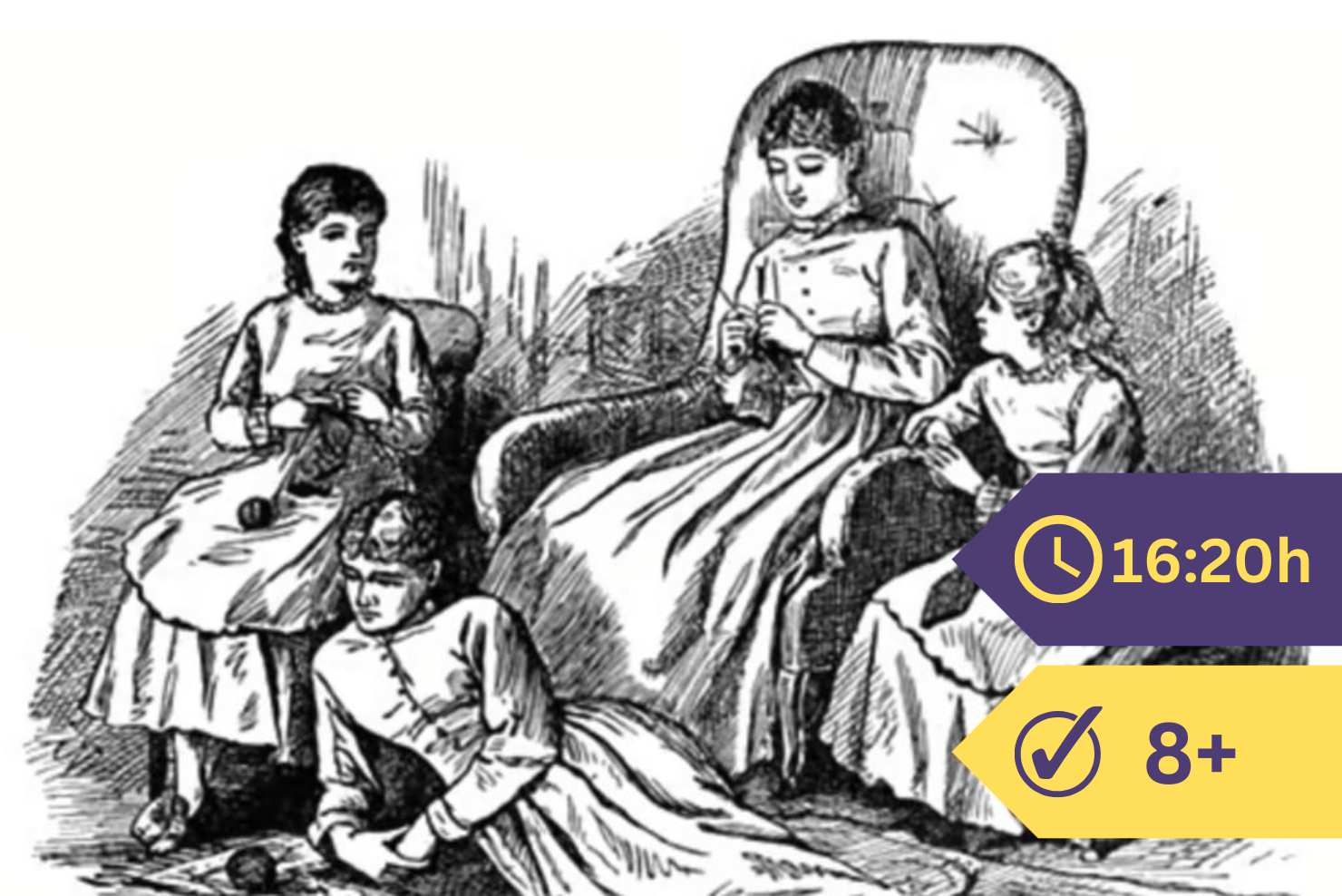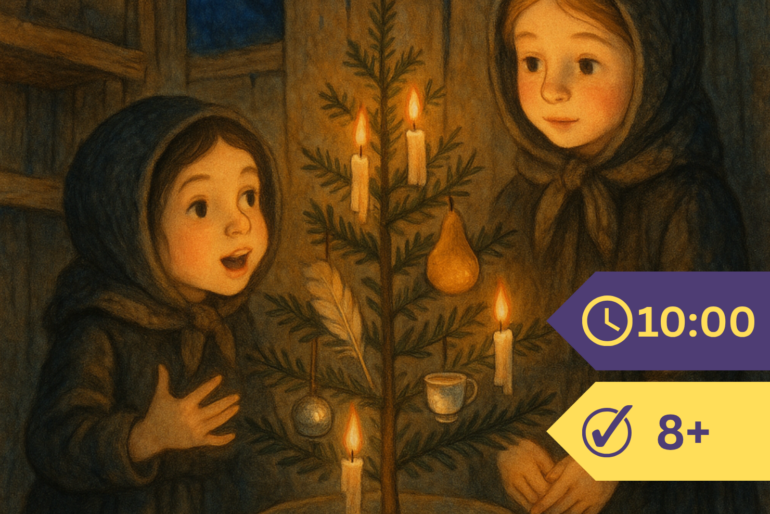
Two little girls with sober faces were swinging on the front gate of an old farmhouse one December afternoon. They were well bundled against the cold—dark woolen dresses, thick knitted hoods, blanket shawls tied at the back—but they had forgotten all about the weather.
“We’ll be awful ashamed to say we didn’t get anything,” said Prudence, the elder. “They’re sure to ask a lot of questions.”
“Well, we’ll just have to stand it—that’s all,” said little Rebecca sturdily. “It isn’t our fault we don’t have any Christmas.”
“But don’t you suppose, if we spoke to Aunt Jane, she’d—”
“No,” interrupted Rebecca. “It wouldn’t do a mite of good. She’d say she didn’t believe in Christmas. You know she would, Prue.”
They had come to live with their aunt and uncle five years ago, very small and very vague about most things—Christmas included. But this fall they had started at the district school, and for the past fortnight it had been all anyone talked about. To have no part in any of it was bad enough. To confess it on Monday to their schoolmates seemed worse still.
At that moment their aunt came around the side of the house—tall and angular, iron-gray hair pulled tight from her temples.
“How many times have I told you girls not to swing on that gate?” she cried. “You’ll have it off the hinges yet.”
They jumped down and were steered, quickly, into the kitchen.
“There’s no need to idle around just because school isn’t keeping this week,” she said. “It’s all foolishness having a vacation. I don’t believe in it.”
“But it’s for Christmas, Aunt Jane,” ventured Prudence. “It’s tomorrow night, you know.”
“No, I don’t know. And if school is going to fill your heads with nonsense I’ll take you away mighty quick. I don’t believe in Christmas. There’s no sense in giving a whole pack of presents right and left. Now, what are you crying about, Prudence? If one or the other of you isn’t always crying about something!”
“She’s thinking what the girls will say when we tell them we didn’t get anything,” explained Rebecca, for Prudence couldn’t speak. “They’re sure to ask.”
“Let them ask, then! Seems like feeding and clothing you and sending you to school isn’t enough—you want a whole raft of presents besides. Well, you won’t get them. Now, Prudence, stop that crying and go upstairs and get your patchwork. And you, Rebecca, go down to the cellar for a pan of apples. And I want them peeled better than you peeled those yesterday.”
But whipping together squares of calico and peeling apples did nothing to ease the disappointment. Rebecca, finding Prudence’s quiet tears too painful to watch, turned her chair away and went over in her mind all her small possessions—a queer-shaped gourd the hired man had given her, a glittering stone she’d found in the pasture. But Prue had seen those a hundred times.
Then, suddenly, an idea came to her. It was so brilliant that for a moment she was fairly dizzy with excitement. Her whole face lit up—and she forgot all about the potatoes until a sharp “What under the sun are you staring at, Rebecca?” brought her back to herself.
“I wasn’t staring, Aunt Jane. I was just thinking about something.” She tried to signal to Prue across the room, but Prue shook her head—the signals were too mysterious. Her tears kept falling, one by one, onto the patchwork in her lap.
When household duties called Aunt Jane upstairs, the pan of potatoes went down with a crash, the knife followed after, and Rebecca flew to her sister and threw both arms around her.
“We won’t be ashamed next Monday, Prue! I’ve thought of something—we can make a Christmas tree for ourselves, and we can hang up our stockings too. We can pretend to have Christmas, and it’ll be just as real to talk about as the real thing.”
“Pretend it?” said Prue slowly. “I don’t understand.”
“I can’t tell you now—there comes Aunt Jane. But don’t cry any more. It’ll be all right.”
On Christmas Eve, old Reuben Paine noticed a light coming through every crack of the old henhouse—a tumbledown place given up to ruin long ago. He set down his milk pails and went quietly over to look.
What he saw through a crack in the siding made him stand for a full minute, staring straight before him.
“I declare. I never saw the beat,” he muttered as he turned away.
He carried his pails into the kitchen, where his sister stood frying potatoes for supper.
“Where are the children, Jane?” he asked.
“Dear only knows. I sent them to the well much as an hour ago and they haven’t come back.”
“I wish you’d let me show you where they are, Jane.”
Something odd in her brother’s voice made Miss Jane turn sharply. “Nothing’s happened to them?”
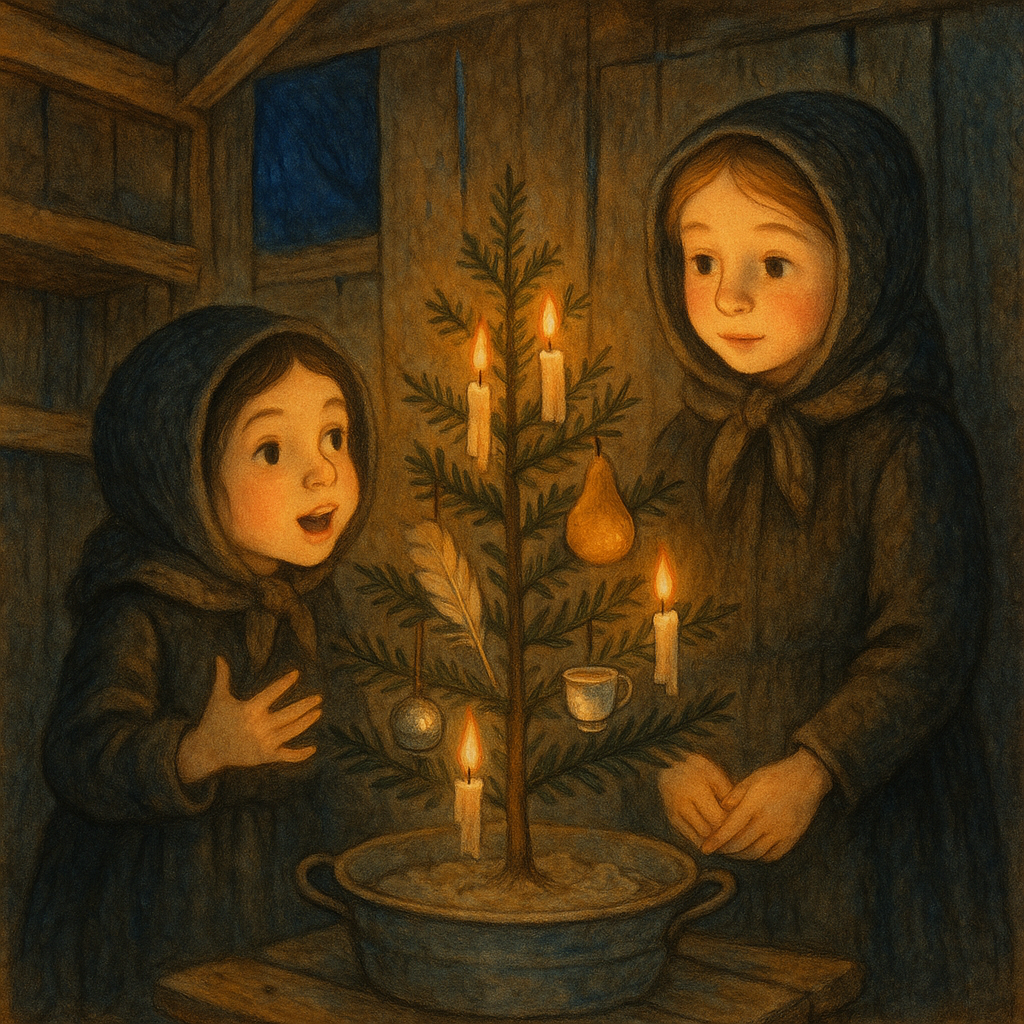
“No. But they’re out in the old henhouse, Jane, and—they’re having a Christmas tree.” He paused. “The poor little things. They’ve got a small hemlock standing in a washtub of ashes, and it’s covered all over with candle stubs. There’s a gourd hanging on it, and a stone, and the parlor duster, and the tidy Priscilla Newcome knit, and mother’s china cup. It’s just pitiful to see them, Jane.”
Miss Jane didn’t answer. She was very busy stirring the potatoes. But presently she pushed the pan to the back of the stove, took her shawl and hood from their peg, and said in a muffled voice, “I suppose I might as well go and see for myself what they’re up to.”
A few minutes later, brother and sister stood side by side at the henhouse door. Inside, the presents had all been taken down from the little tree, and Rebecca was talking eagerly.
“Now you see what a splendid plan it was, Prue. On Monday we can say we had a Christmas tree, and you can say you got a tidy, and a book, and a beautiful stone you mean to use for a paperweight—and I can tell what I got. And it’ll all be true, Prue—that’s the best of it. And nobody’ll ever know in this wide world that we only pretended Christmas.”
Prue sighed. “It’s better than nothing, I suppose,” she said drearily. “But we’d better go in now—Aunt Jane will be wondering.”
Reuben drew his sister quickly aside as the girls came out.
“Can’t we give them some sort of Christmas, Jane?” he asked.
For a wonder, she spoke no word of blame. “I haven’t got anything against their having a Christmas, if you choose to pay for it,” she said, her voice softer than usual. “The only reason I didn’t give them one before was because I didn’t think you had money to spare for such foolishness.”
“I’m not so poor I can’t spend a bit once a year for the poor little creatures,” Reuben said. “I’ll go down to the store soon as supper’s over and see what I can do.”
Prue and Rebecca wondered what made their uncle and aunt so quiet at supper that evening, and why Aunt Jane’s voice was so much kinder than usual. They had no idea there had been witnesses to their pretended Christmas in the old henhouse.
When Reuben came home from the village at nine o’clock, his arms were full of bundles—a little toy bedstead, two china dolls, a tea set, a small toy kitchen, a doll’s carriage, a bag of candy, and half a dozen big oranges.
Husband and wife went together into the room where the two little girls lay fast asleep—and stopped short. By the light of a small lamp on the mantel they saw a sight that moved them both deeply. Under the mantel hung two gray hand-knit stockings, packed full.
Miss Jane went forward and emptied them. From Prue’s she drew out an old case knife, an ancient bead pincushion, an almanac, a china dog from the spare-room mantel, a lamp mat, and a toilet bottle. From Rebecca’s came a match-safe, a shell box, a photograph frame, a hairbrush, a broken ink bottle, and a small battered silver cup that was a relic of Miss Jane’s own babyhood.
“Well! I never in all my born days!” she said under her breath. “Reuben, look here.”
But Reuben, his emotion not to be contained, had already gone back to the kitchen. Miss Jane found him there ten minutes later sitting by the stove with his hands over his face. He looked up as she entered.
“If I had to get those presents all over again,” he said slowly, “I wouldn’t rest till I’d bought the whole store out. The poor little creatures.”
“You got enough, goodness knows,” said Miss Jane, pretending to search for something in the corner cupboard. “They’ll be as pleased in the morning as two crickets.”
And they were. There were no happier children in the old district schoolhouse that Monday than the two whose pretended Christmas had become a wonderful reality.