It was Christmas Eve, and a devilishly cold night. The snow fell in great flakes, which the wind beat against the window-panes. The distant chimes reached us, confused and faint through the heavy, cottony atmosphere. Passers-by, muffled in their cloaks, glided along hurriedly, brushing past the walls of the houses, bending their heads into the wind. Wrapped in my dressing-gown, I smiled as I drummed on the window-pane — smiled at the passers-by, at the north wind and the snow — with the smile of a happy man who is in a warm room with his feet in a pair of flannel-lined slippers sinking into a thick, soft carpet.
My wife sat in a corner of the hearth with a great piece of cloth before her, which she cut and trimmed; and every now and then she raised her eyes, which met mine. A new book lay on the mantelpiece awaiting me, and a log in the fireplace whistled as it spat out those little blue flames that tempt one to poke it.
“There is nothing so stupid as a man trudging along in the snow. Is there?” said I.
“Sh-h-h!” said my wife, laying down her scissors. She stroked her chin thoughtfully with her tapering pink fingers — slightly plump at the tips — and looked carefully over the pieces she had just cut out.
“I say it is absurd to go out into the cold when it is so easy to stay home by the fire.”
“Sh-h-h!”
“What the deuce are you doing that is so important?”
“I — I am cutting out a pair of suspenders for you,” and she resumed her task. Her hair was coiled a little higher than usual, and from where I stood behind her, I could just see, as she leaned over her work, the nape of her neck, white and velvety. Innumerable soft little locks curled there gracefully, and this pretty down reminded me of those ripe peaches into which one drives one’s teeth greedily. I leaned nearer to look — and kissed my wife on the neck.
“Monsieur!” exclaimed Louise, turning suddenly around.
“Madame!” and we both burst out laughing.
“Come, come — on Christmas Eve!”
“Monsieur apologizes?”
“Madame complains?”
“Yes; Madame complains. Madame complains of your not being more moved, more thrilled by the spirit of Christmas. The ding-ding-dong from the bells of Notre Dame awakens no emotion in you; and when the magic-lantern went by under your very window, you were perfectly unmoved, utterly indifferent. I watched you attentively, though I pretended to work.”
“Unmoved? Indifferent? I? When the magic lantern went by! Ah, my dear, you judge me very severely, and really —”
“Yes, yes; laugh if you will. It is nevertheless true that the pretty memories of your childhood are lost.”
“Come, my pet, would you like me to stand my boots in the fireplace tonight before I go to bed? Would you like me to stop the magic-lantern man and fetch him a sheet and a candle-end, as my mother used to do? I can almost see her as she handed him the sheet. ‘Be careful you don’t tear it, now,’ she would say; and we all clapped our hands in the mysterious darkness. I remember all those joys, dear; but, you see, so many things have happened since. Other pleasures have pushed them out.”
“Yes, I understand — the pleasures of your bachelorhood! I am sure this is the first Christmas Eve that has ever found you by your own fireside, in your dressing-gown and without a supper — because you always had supper; that goes without saying —”
“Why, I don’t know —”
“Yes, yes; I wager you always had a supper.”
“Well, perhaps once or twice, though I scarcely remember. I may have had supper with a few old friends. And what did it all amount to? Two pennies’ worth of chestnuts and —”
“And a glass of sugar and water.”
“Well, just about. Oh, it was nothing much, I can assure you! It sounds great at a distance. We talked awhile, and then we went to bed.”
“And he says all that with the straightest face! You have never breathed a word of these simple pleasures to me.”
“But, my dear, what I tell you is the absolute truth. I remember once, however, at Ernest’s, when I was in rather high spirits, we had a little music afterwards — Will you push me that log? Well, never mind; it is almost midnight, and time for all reasonable people to —”
(Louise, rising and throwing her arms around me.) “Well, I don’t choose to be reasonable, and I mean to eclipse the memory of those penny chestnuts and all that sugar and water!” (Pushing me hastily into my study and locking the door.)
“What the deuce is the matter with you, my dear?” I cried from the other side of the door.
“Give me ten minutes, no more. Your paper is on the mantelpiece; you haven’t seen it tonight. You’ll find the matches in the corner.”
Then I heard the rattle of china, the rustle of silky stuffs. Could my wife have gone crazy? At the end of about ten minutes she unlocked the door.
“Don’t scold me for shutting you out,” said she, embracing me. “Look at me. Have I not made myself beautiful? See — my hair just as you like it, high, and my neck uncovered. But my poor neck is so extremely shy that it could never have displayed itself in the broad light, if I had not encouraged it a little by wearing a low-necked gown. After all, it is only right to be in full-dress uniform at a supper with one’s husband.”
“What supper?”
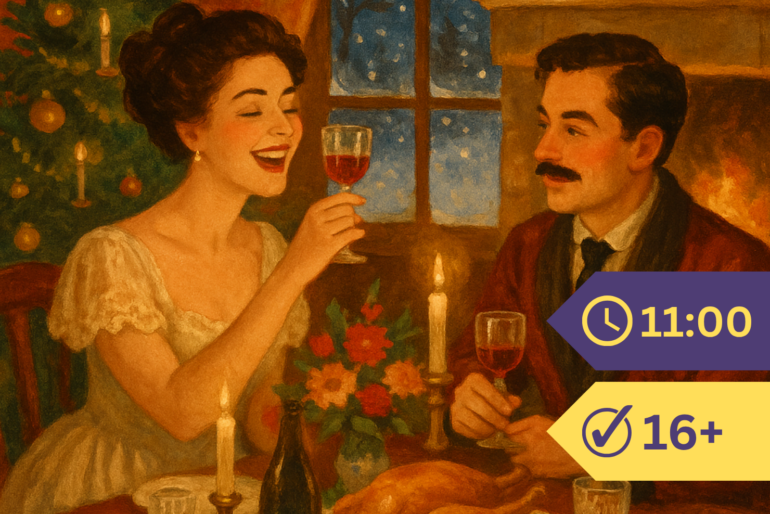
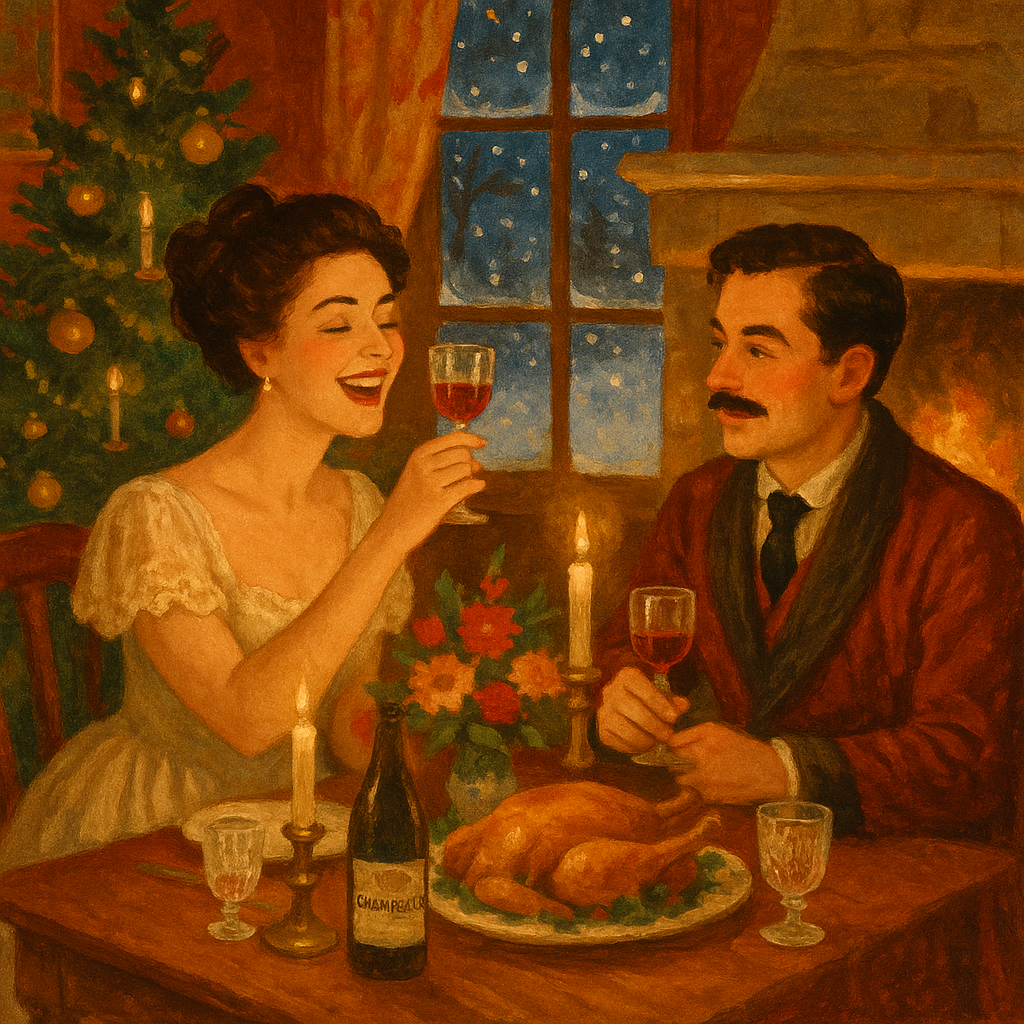
“Why, our supper! Don’t you see my illumination and the table covered with flowers and good things to eat? I had it all ready in the alcove; but to push the table before the fire and make something of a toilet, I had to be alone. I have a bottle of old Chambertin for you. Come, Monsieur, come to supper; I am as hungry as a bear! May I offer you this chicken wing?”
“This is a charming idea of yours, my love, but I really feel ashamed — in my dressing-gown.”
“Take it off, sir, if you are uncomfortable, but do not leave me with this chicken wing on my hands. Wait — I want to wait upon you myself.” Rising, she swung her napkin over her arm and rolled her sleeve up to the elbow. “Isn’t that the way the waiters do at the restaurants?”
“Exactly. But stop a moment, waiter — will you permit me to kiss your hand?”
“I haven’t time,” she said, smiling, and drove the corkscrew bravely into the neck of a bottle. “Chambertin — a pretty name. And, besides, do you remember, before we were married — blast it, what a hard cork! — you told me you liked it on account of a play by Alfred de Musset, which you never gave me to read, by the way. Do you see those little Bohemian glass tumblers I bought especially for tonight? We will drink each other’s health in them.”
“And his too, eh?”
“The heir’s, you mean? Poor little love of an heir — of course! Then I shall hide the two glasses and bring them out again this day next year, eh, dear? They will be the Christmas-supper glasses, and we will have supper every year before the hearth, you and I alone, until our very old, old age.”
“Yes; but when we have lost all our teeth —”
“Never mind; we shall have nice little soups, and it will none the less be very sweet. Another piece for me, please, with a little jelly — thank you.”
As she held out her plate to me, I caught a glimpse of her arm, its pretty contours disappearing into the lace.
“What are you looking up my sleeve for instead of eating?”
“I am looking at your arm, dear. You are exquisitely pretty tonight; do you know it? Your hair is wonderfully becoming, and that gown — I had never seen that gown before.”
“Naturally! When a person sets out to make a conquest!”
“You are adorable!”
“Are you quite sure that I am adorable tonight, charming, ravishing?” Then, looking at her bracelet attentively: “In that case I don’t see why — I don’t see —”
“What is it you don’t see, dear?”
“I don’t see why you don’t come and kiss me.”
And as the kiss was prolonged, she threw her head back, showing two rows of pretty white teeth, exclaiming between peals of laughter —
“Give me some more pâté! I want some more pâté! Take care — you are going to break my Bohemian glass, the fruit of my economy! There is always some disaster when you try to kiss me. You remember at Madame de Brill’s ball, two nights before we were married, how you tore my gown while we were waltzing in the little parlour?”
“Well, it is very difficult to do two things at once — keep time with the music and kiss your partner.”
“I remember when mamma asked me how I tore my gown, I felt I was blushing to the roots of my hair. And Madame D., that old witch, said to me with her thin smile, ‘What a brilliant colour you have tonight, my child!’ I could have choked her! I said I had caught my gown on a nail in the door. I was watching you out of the corner of my eye. You were twirling your moustache, and you seemed quite vexed. You keep all the truffles for yourself — how kind of you! Not that one; I want that big black one there, in the corner. Well, after all, it was none the less very wrong, because — no, no, don’t fill my glass; I don’t want to get tipsy — because if we had not married (that might have happened, you know; they say that marriages hang by a thread), well, if the thread had not been strong enough, here I was left with that kiss on my shoulder — a pretty plight!”
“Nonsense! It does not stain.”
“Yes, sir, it does; I beg your pardon, but it does stain — and so much so that there are husbands, I am told, who spill their blood to wash out those little stains.”
“I was only jesting, dear. Heavens! I should think it did! Fancy! Why —”
“Ah, I am glad to hear you say so. I like to see you get angry. You are just a wee bit jealous, aren’t you? Well, upon my word! I asked you for the big black one, and you are quietly eating it!”
“I am very sorry, my love; I beg your pardon. I forgot all about it.”
“Yes, just as you did when we were being married. I was obliged to touch your elbow to make you answer yes to the Mayor’s kind words!”
“Kind words?”
“Yes, kind words. I thought the mayor was charming. No one could have been more gracious in addressing me. ‘Mademoiselle, do you consent to take this great big ugly little man who stands beside you for your lawful —'” (Laughing with her mouth full.) “I was about to say to him, ‘Let us understand each other, Monsieur; there is much to be said for and against.’ Heavens! I am choking!” (Bursts into great peals of laughter.) “I was wrong in not making some reservations. There! I am teasing you, and that is stupid. I said yes with my whole heart, I assure you, my darling, and the word was only too weak. When I think that all women, even the bad ones, use that same word, I feel ashamed of not having invented a better one.” (Holding up her glass.) “Here is to our golden wedding!”
“And here is to his christening, little mother!”
In an undertone: “Tell me, dear — are you sorry you married me?”
(Laughing.) “Yes.” (Kissing her on the shoulder.) “I think I have found the stain. Here it is.”
“Do you realize it is two o’clock? The fire is out. I am — you won’t laugh? Well, I am just a little dizzy.”
“That was a famous pâté!”
“A famous pâté! We will have a cup of tea in the morning, eh, dear?”