It was a bitter cold night in November, 1865. The Howard family, after an early supper, had gathered around the fire — laughing, chatting, waiting out the hour before the two little girls, Louise and Jean, would go to bed.
Mr. Howard sat swaying gently in the big Boston rocker. There was a strained, anxious look on his pleasant face, and he answered the children’s questions in an absent-minded way that was startling.
“Now, Papa,” said Louise, “that’s three times you’ve said ‘Yes, dear,’ when you should have said ‘No.’ What’s the matter — are you thinking?”
“Papa is thinking very hard, deary,” said the mother quietly. “He has a hard problem to solve.”
Their father looked at the two eager faces for a moment, then said, “Come here, chicks. I’ll tell you all about it.”
The children sprang to him. Clasping them both in his arms, he began: “Let me see how wise and sensible you can be. You are both well-grown girls now — do you think you could make a sacrifice for our sakes? For mama’s and mine?”
“Oh, yes, yes! Of course we could,” both children answered at once. “What is it?”
“Could you two little girls give up your Christmas tree this year? Do you think you could?”
The curly heads drooped softly to his shoulder. He went on:
“It is just this way. I am in the employment of the government — a servant of Uncle Sam. The war has been cruel and long. All the money has been needed for the poor soldiers, so Uncle Sam hasn’t paid me for some months — and I heard at the office today that he won’t be able to do so for some time to come. Almost all my money is used up. I dare not spend a penny on anything but food and clothes for us all, dear girls. A Christmas tree and presents are out of the question. I want you both to help us bear this; for, believe me, my little lassies, it is harder for us than it will be for you.”
“Oh, Papa,” wailed Jean, “we’re too little to bear such dreadful things. Why, I ‘most think I couldn’t live without a Christmas tree! Why, we always have a tree!“
The father sighed as he kissed the tear-wet face of his darling. “What has my big girl to say?” he asked, looking at Louise. The brown curls were tossed back from the flushed face.
“Papa, don’t mind Jeanie — she’s too little to bear things. But I’m a big girl. Only” — here a sob was choked down — “you see we’re so used to it, you know.”
“We will not talk about it any more tonight,” said mama. “It is time to go to bed.”
As the children went slowly up the stairs, Louise heard her father say, “If the Hon. Hugh McCulloch could know how I suffer for my children’s sake tonight, he would make an effort in my behalf.”
Everything went wrong at school the next day. The pretty young teacher looked at Louise in amazement, for the child’s thoughts seemed to be everywhere but on her lessons.
After school hours, the busy teacher looked up from her weekly reports to find Louise gazing at her intently.
“Well, dear — what is it?”
“Why, Miss Annie, I did not say anything.”
“No, dear, not with words — but you know that the eyes talk. What is the trouble?”
“I want to ask some questions. I know the owner of the United States is Uncle Sam — but what’s his last name? And who is the Hon. Hugh McCulloch? And do you know where they live?”
“You funny child!” laughed Miss Graham. “I have never heard of Uncle Sam’s family name — but Mr. McCulloch is an intimate friend of his; in fact, he carries his purse and pays all his bills. And he lives in Washington.”
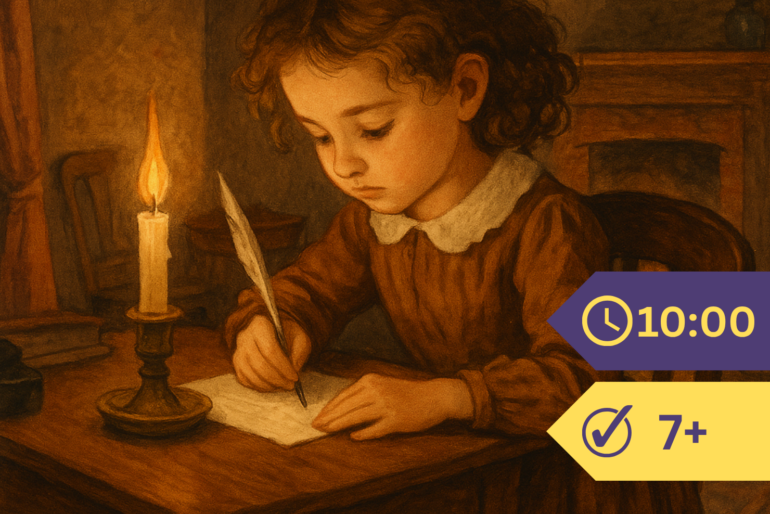
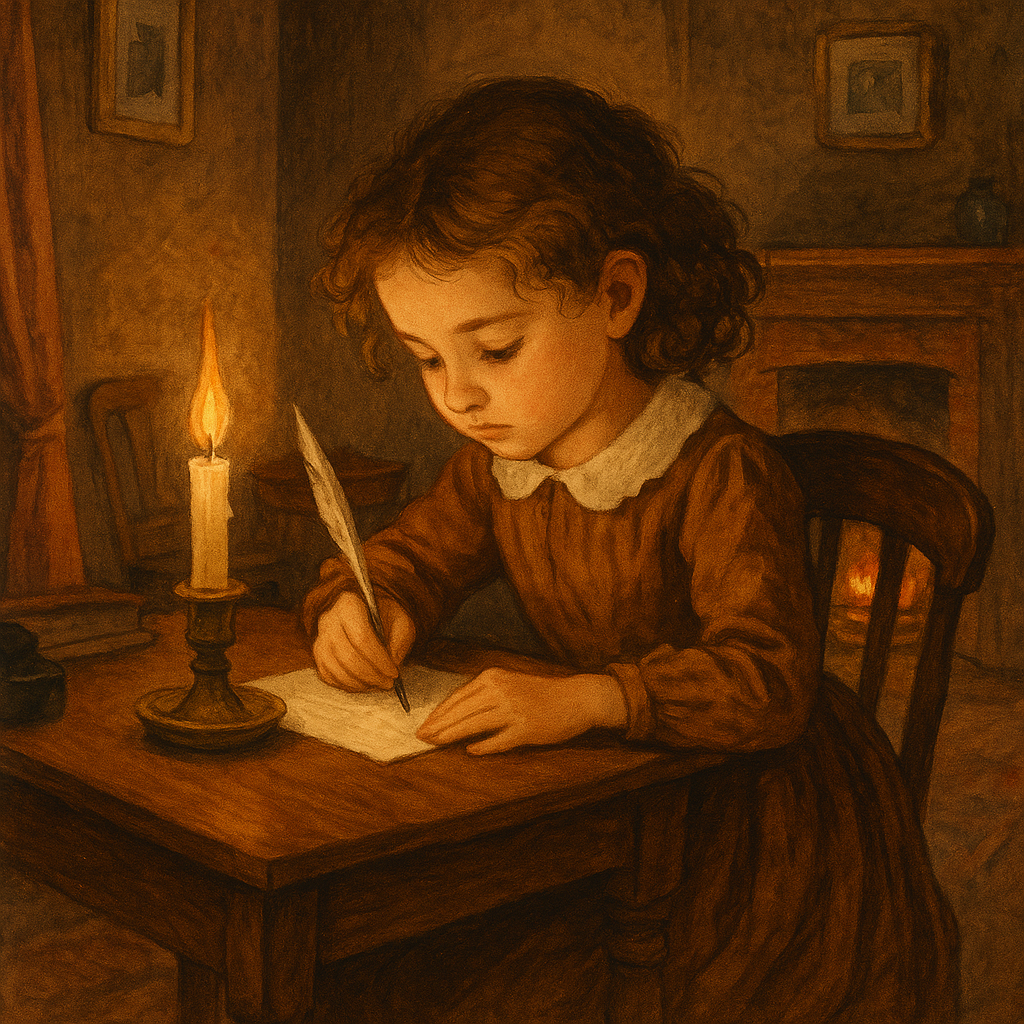
“Oh! Well, I am going to write to him — a big letter.”
“Indeed? What about, dear? Can I help you in any way?”
“You have helped me, Miss Annie. I think I can get it written all right. I — excuse me, but I can’t tell you about it, because it’s something about my father’s business.”
Miss Graham smiled at the little one’s dignity, but she drew the excited child to her and said warmly, “That’s quite right, my dear. Go to your desk and write your letter. I will give you a stamp for it.”
Late that afternoon the important letter was taken to the post office. Can you imagine the great man’s expression when his secretary handed him a letter addressed in funny, childish writing?
This was the correspondence that followed:
HONEREBLE HUGH McKULLOCH.
WASHINGTON.
Nov. 30, 1865.
Dear Mr. McKulloch: Won’t you plese excuse me for Writing to you. I am in such trouble and want you to help me please — my papa says we can’t have a chrismus tree this year, now is n’t that too offley bad? He says uncle sam owes him some money and he can’t get it. My papa is in the revernue busness, the revernue busness has stamps in it his name is mr henry Howard, 52 Sprague St Newark N. J. won’t you plese ask him to pay him else we can’t have a tree, my teacher says you pay all the bills for him. wont you ask Uncle Sam to let you pay my papa? my little sister Jeanie crys all the time, she wouldent care mutch if she was ded, she feels so bad shes so littel not to have a tree. have you got any little girls. May be the war would n’t let you get paid too. I hope your little children won’t have to go without any tree. Won’t you plese beg uncle sam to pay up his bill to my papa plese exkuse bad speling and Writing my mamma always helps, but she dont know about this nether does my papa. Truly your littel friend,
Louise Howard.
P. S. Arent you glad the war is over.
Dec. 4, 1865.
My dear little Friend: I was very much pleased to receive your letter. I am glad you wrote to me in your trouble, for I can and will help you.
The check for the amount the Revenue Service owes your father will be forwarded to him, without fail, by the 22d of the month — so, dear child, tell him to proceed with his arrangements for the tree. It will be all right.
I have a dear little girl like you. Her name is Louise, too. She was pleased with your letter, and wishes she could have a picture of you and little Jeanie. Can you not send her one?
Yes, my little girl will have a tree too, so I am sure of the happiness of three children, at least. Wishing you and Jeanie a Merry Christmas, I am yours sincerely,
Hugh McCulloch, Secretary of the Treasury.
P. S. Yes, I am very glad the war is over.
Dec. 28, 1865.
Dear Mr. McCulloch: My papa was so surprised when i got the big letter all seeling wax. he laughed and kissed me hard and said what a child but he was glad and so was mamma. I was so glad and so was Jeanie we both cryed, we thought mamma did too — she says she dident. oh what a beautiful little tree we had, not so Big or so fine as other years, but we liked it better, ever so much better than others because we dident expect it.
You are such a kind Gentleman, do you see those round spots on this letter, they are kisses from Jean and me to you, this is our picture taken with the tree, do you like it, do you see that littel man hanging right in front, — thats george Washington, its a pen-wiper a littel boy in my fathers sunday school class made it for his chrismus gift those are my skates hanging on the tabel and thats jeanies doll, is n’t she nice. Jeanie has light hair and blue eyes I have brown hair and gray eyes anser soon.
Your loving friend,
Louise Howard.
P. S. I am glad you are pleased about the war being over, — but do you know theres a dredful lot of sick soljers in our hospittel yet — I go and sing to them every saturday afternoon.
Jan. 15, 1866.
My dear little Louise: I was more than pleased — I was delighted — with your picture. I had it on my library table on New Year’s day, and it created great interest, and also admiration. The tree is beautiful, but to me your happy little faces are more so. My little Louise clapped her hands with joy when she saw it. I inclose to you a picture of her.
I knew that was George Washington before you told me. It is a striking likeness. I think that is a very nice tree for hard times.
I will close with many kind wishes for the new year — indeed, for your whole future.
Sincerely your friend,
Hugh McCulloch.
That was the end — no, not quite. I think if the great Secretary could have looked into the children’s room at bedtime, and seen the two little white figures kneeling at their mother’s knee, his heart would have glowed within him; for the ending of their prayer, said in unison, was always this:
“God bless papa and mama and Mr. Hugh McCulloch, and make Louise and Jean good girls. Amen.”