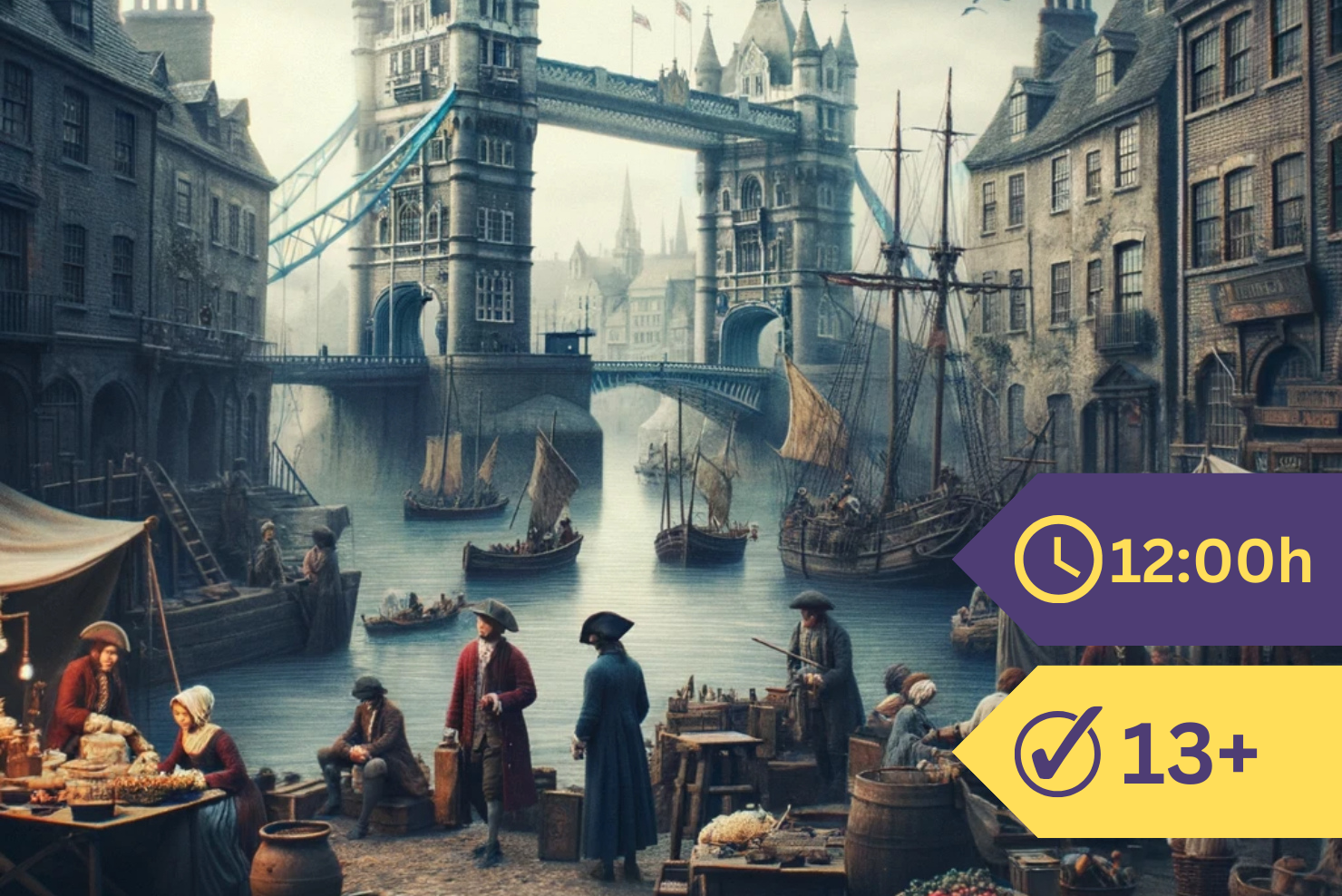
At one period of its reverses, the House fell into the occupation of a Showman. He was found registered as its occupier in the parish books, so there was no need for any clue to his name. But he himself was less easy to find, for he had led a wandering life, and settled people had lost sight of him, and people who prided themselves on respectability were shy of admitting they had ever known anything of him. At last, among the marsh lands near the river’s level that lie about Deptford and the neighbouring market-gardens, a grizzled personage in velveteen, with a face so cut up by varieties of weather that he looked as if he had been tattooed, was found smoking a pipe at the door of a wooden house on wheels. The wooden house was laid up for the winter near the mouth of a muddy creek, and everything near it — the foggy river, the misty marshes, the steaming market-gardens — smoked in company with the grizzled man. The funnel-chimney of the wooden house on wheels was not remiss either, but took its pipe with the rest in a companionable manner.
On being asked if he was the one who had once rented the House to Let, Grizzled Velveteen looked surprised and said yes. Then his name was Magsman? That was it — Toby Magsman, lawfully christened Robert, but called in the trade, from an infant, Toby. There was nothing against Toby Magsman, he believed? If there was any suspicion of such — mention it!
There was no suspicion of such, he might rest assured. But some inquiries were being made about that House, and would he object to say why he left it?
Not at all; why should he? He left it along of a Dwarf.
Along of a Dwarf?
Mr. Magsman repeated, deliberately and emphatically: along of a Dwarf.
Might it be compatible with Mr. Magsman’s inclination and convenience to enter, as a favour, into a few particulars?
Mr. Magsman entered into the following particulars.
It was a long time ago, to begin with — before lotteries and a deal more besides were done away with. Mr. Magsman was looking about for a good pitch, and he saw that house, and said to himself: I’ll have you, if you’re to be had. If money will get you, I’ll have you.
The neighbours cut up rough and made complaints, but Mr. Magsman didn’t know what they would have had. It was a lovely thing. First of all, there was the canvas representing the Giant in Spanish trunk-hose and a ruff, who was himself half the height of the house and was run up with a line and pulley to a pole on the roof, so that his head was level with the parapet. Then there was the canvas representing the Albino Lady, showing her white hair to the Army and Navy in correct uniform. Then there was the canvas representing the Wild Performer a-scalping a member of some foreign nation. Then there was the canvas representing a child of a British Planter, seized by two Boa Constrictors — not that we ever had any child, nor any Constrictors either. Similarly there was the canvas representing the Wild Ass of the Prairies — not that we ever had any wild asses, nor would have had them at a gift. Last, there was the canvas representing the Dwarf, and a fair likeness too (considering), with George the Fourth in such a state of astonishment at him as His Majesty couldn’t with his utmost politeness and stoutness express. The front of the House was so covered with canvases that there wasn’t a spark of daylight visible on that side. MAGSMAN’S AMUSEMENTS — fifteen foot long by two foot high — ran over the front door and parlour windows. The passage was an arbour of green baize and garden stuff. A barrel-organ performed there unceasing. And as to respectability — if threepence isn’t respectable, what is?
But the Dwarf is the principal article at present, and he was worth the money. He was billed as MAJOR TPSCHOFFKI, OF THE IMPERIAL BULGRADERIAN BRIGADE. Nobody could pronounce the name, and it was never intended anybody should. The public always turned it, as a regular rule, into Chopski. In the trade he was called Chops, partly on that account and partly because his real name, if he ever had a real name (which was very dubious), was Stakes.
He was an uncommonly small man, he really was. Certainly not so small as he was made out to be, but where is your Dwarf who is? He was a most uncommonly small man with a most uncommonly large head; and what he had inside that head nobody ever knew but himself — even supposing himself to have ever taken stock of it, which would have been a stiff job for even him to do.
The kindest little man that never grew! Spirited, but not proud. When he travelled with the Spotted Baby — though he knew himself to be a natural Dwarf and knew the Baby’s spots to be put on artificial — he nursed that Baby like a mother. You never heard him speak ill of a Giant. He did allow himself to break out into strong language respecting the Fat Lady from Norfolk, but that was an affair of the heart; and when a man’s heart has been trifled with by a lady, and the preference given to another, he isn’t master of his actions.
He was always in love, of course — every human natural phenomenon is. And he was always in love with a large woman. I never knew a Dwarf who could be got to love a small one. Which helps to keep them the curiosities they are.
One singular idea he had in that head of his, which must have meant something or it wouldn’t have been there. It was always his opinion that he was entitled to property. He never would put his name to anything. He had been taught to write by the young man without arms who got his living with his toes (quite a writing-master he was, and taught scores in the trade), but Chops would have starved to death before he’d have gained a bit of bread by putting his hand to a paper. This is the more curious to bear in mind, because he had no property, nor hope of property, except his house and a saucer. When I say his house, I mean the box, painted and fitted outside like a regular six-roomed residence, that he used to creep into — with a diamond ring (or quite as good to look at) on his forefinger — and ring a little bell out of what the Public believed to be the Drawing-room window. And when I say a saucer, I mean a china saucer in which he made a collection for himself at the end of every entertainment. His cue for that he took from me: Ladies and gentlemen, the little man will now walk three times round the Caravan, and retire behind the curtain. When he said anything important in private life, he mostly wound it up with this formula, and it was generally the last thing he said to me at night before he went to bed.
He had what I consider a fine mind — a poetic mind. His ideas respecting his property never came upon him so strong as when he sat upon a barrel-organ and had the handle turned. After the vibration had run through him a little while, he would screech out: Toby, I feel my property coming — grind away! I’m counting my guineas by thousands, Toby — grind away! Toby, I shall be a man of fortune! I feel the Mint a-jingling in me, Toby, and I’m swelling out into the Bank of England! Such is the influence of music on a poetic mind. Not that he was partial to any other music but a barrel-organ — on the contrary, hated it.
He had a kind of everlasting grudge against the Public, which is a thing you may notice in many phenomena that get their living out of it. What riled him most in the nature of his occupation was that it kept him out of Society. He was continually saying: Toby, my ambition is to go into Society. The curse of my position towards the Public is that it keeps me out of Society. This doesn’t signify to a low beast of a showman; he isn’t formed for Society. This doesn’t signify to a Spotted Baby; he isn’t formed for Society. I am.
Nobody ever could make out what Chops did with his money. He had a good salary, paid on the drum every Saturday as the day came round, besides having the run of his teeth — and he was a tremendous eater, but all Dwarfs are. The saucer was a little income, bringing him in so many halfpence that he’d carry them for a week together tied up in a pocket-handkerchief. And yet he never had money.
Most unexpectedly, the mystery came out one day at Egham Races. The Public was shy of being pulled in, and Chops was ringing his little bell out of his drawing-room window and snarling to me over his shoulder as he knelt down with his legs out at the back-door — for he couldn’t be shoved into his house without kneeling down, and the premises wouldn’t accommodate his legs — was snarling: Here’s a precious Public for you; why the Devil don’t they come on? when a man in the crowd holds up a carrier-pigeon and cries out: If there’s any person here as has got a ticket, the Lottery’s just drawn, and the number as has come up for the great prize is three, seven, forty-two! Three, seven, forty-two!
I was giving the man to the Furies myself for calling off the Public’s attention — for the Public will turn away, at any time, to look at anything in preference to the thing shown them — I say, I wasn’t best pleased with the man for calling out, and wasn’t blessing him in my own mind, when I saw Chops’s little bell fly out of the window at an old lady, and he gets up and kicks his box over, exposing the whole secret, and he catches hold of my legs and says to me: Carry me into the van, Toby, and throw a pail of water over me or I’m a dead man, for I’ve come into my property!
Twelve thousand odd hundred pounds was Chops’s winnings. He had bought a half-ticket for the twenty-five thousand prize, and it had come up. After he had been mad with excitement for a week, Mr. Chops came round and behaved liberally and beautifully to all. He then sent for a young man he knew who had a very genteel appearance and was a tout at a gaming-booth, and Mr. Chops said to this fellow, who gave his name as Normandy (which it wasn’t):
Normandy, I’m going into Society. Will you go with me?
Says Normandy: Do I understand you, Mr. Chops, to intimate that the whole of the expenses of that move will be borne by yourself?
Correct, says Mr. Chops. And you shall have a princely allowance too.
The tout lifted Mr. Chops upon a chair to shake hands with him, and replied in poetry, with his eyes seemingly full of tears:
My boat is on the shore,
And my bark is on the sea,
And I do not ask for more,
But I’ll go — along with thee.
They went into Society, in a carriage and four greys with silk jackets. They took lodgings in Pall Mall, London, and they blazed away.
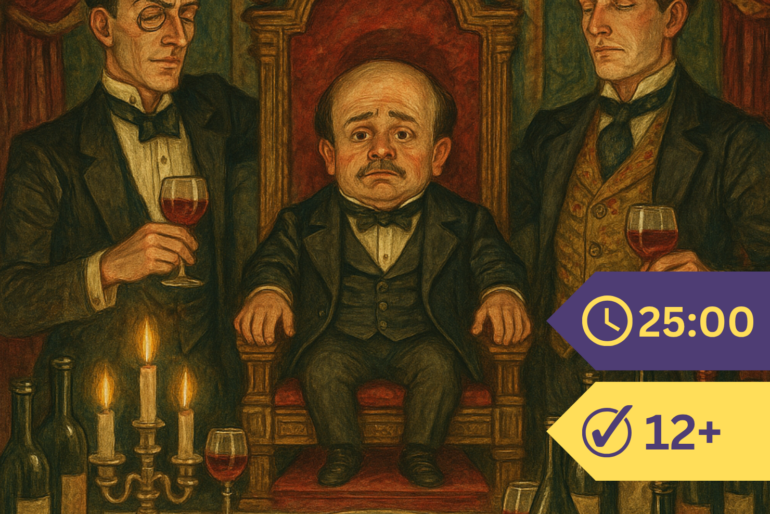
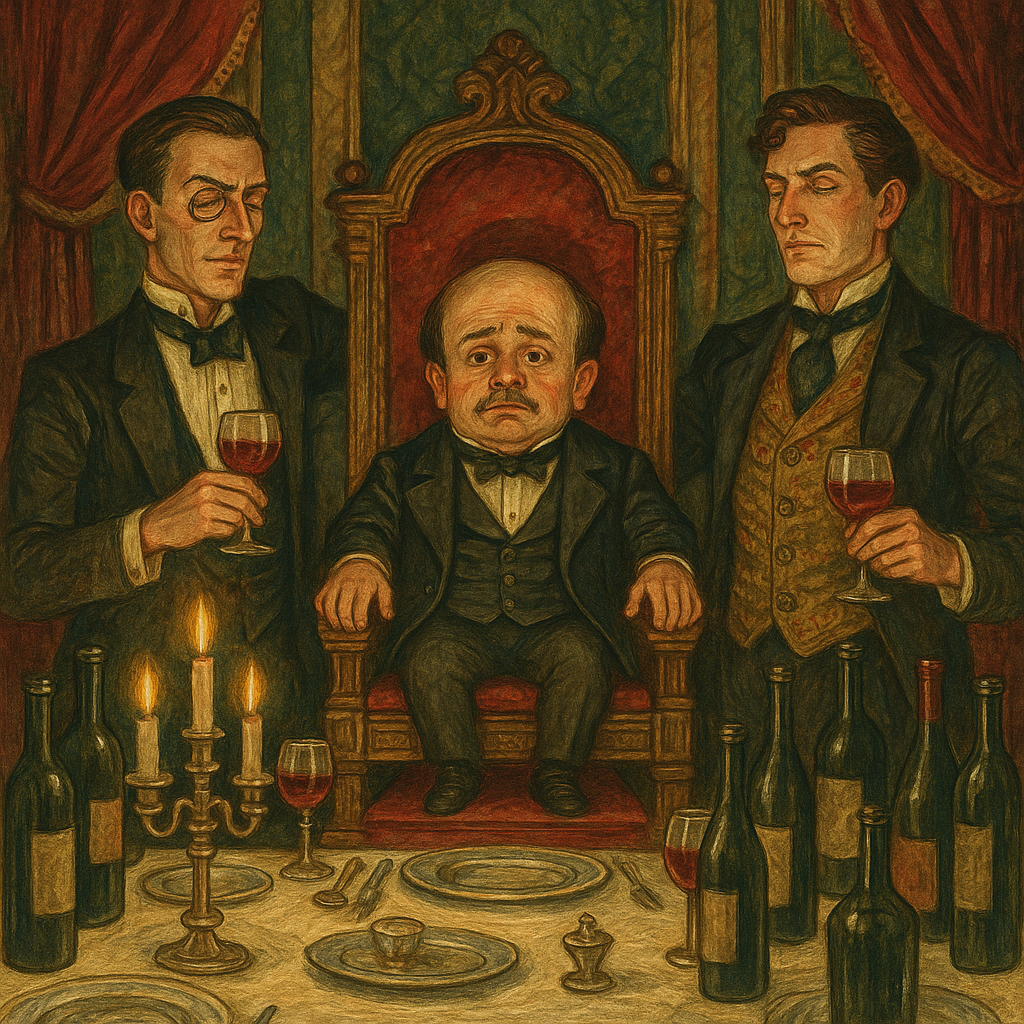
In consequence of a note brought to Bartholomew Fair the following autumn by a servant got up wonderfully in milk-white riding clothes, I smartened myself and went to Pall Mall one evening appointed. The gentlemen were at their wine after dinner, and Mr. Chops’s eyes were more fixed in that head of his than I thought good for him. There were three of them — in company, I mean — and I knew the third well. When last met, he had on a white Roman shirt and a bishop’s mitre covered with leopard-skin, and played the clarinet all wrong in a band at a Wild Beast Show.
This gentleman took on not to know me, and Mr. Chops said: Gentlemen, this is an old friend of former days. And Normandy looked at me through an eye-glass and said, Magsman, glad to see you! — which I’ll take my oath he wasn’t. Mr. Chops, to get him convenient to the table, had his chair upon a kind of throne, but he hardly appeared to me to be king there in any other point of view, for his two gentlemen ordered about like Emperors. They were all dressed magnificently, and as to wine, they swam in all sorts.
I made the round of the bottles, first separate and then mixed, and altogether passed a pleasant evening, but with a tendency to feel muddled, until I considered it good manners to get up and say: Mr. Chops, the best of friends must part, I thank you for the variety of foreign drinks you have stood so handsomely, I drink towards you in red wine, and I takes my leave. Mr. Chops replied: If you’ll just carry me downstairs, Magsman, I’ll see you out. I said I couldn’t think of such a thing, but he would have it, so I lifted him off his throne. He smelt strongly of Madeira, and I couldn’t help thinking as I carried him down that it was like carrying a large bottle full of wine with a rather ugly stopper, a good deal out of proportion.
When I set him on the door-mat in the hall, he kept me close by holding on to my coat-collar, and he whispered:
I ain’t happy, Magsman.
What’s on your mind, Mr. Chops?
They don’t use me well. They aren’t grateful to me. They put me on the mantelpiece when I won’t have in more champagne, and they lock me in the sideboard when I won’t give up my property.
Get rid of them, Mr. Chops.
I can’t. We’re in Society together, and what would Society say?
Come out of Society! says I.
I can’t. You don’t know what you’re talking about. When you have once gone into Society, you mustn’t come out of it.
Then if you’ll excuse the freedom, Mr. Chops, were my remark, shaking my head grave, I think it’s a pity you ever went in.
Mr. Chops shook that deep head of his to a surprising extent, and slapped it half a dozen times with his hand, and with more good sense than I thought was in him. Then he says: You’re a good fellow, but you don’t understand. Good night, go along. Magsman, the little man will now walk three times round the Caravan, and retire behind the curtain. The last I saw of him on that occasion was his trying, on the very edge of insensibility, to climb up the stairs one by one with his hands and knees. They’d have been much too steep for him if he had been sober, but he wouldn’t be helped.
It wasn’t long after that that I read in the newspaper of Mr. Chops’s being presented at court. It was printed: It will be recollected — and I’ve noticed in my life that it is sure to be printed that it will be recollected whenever it won’t — that Mr. Chops is the individual of small stature whose brilliant success in the last State Lottery attracted so much attention. Well, I said to myself, Such is Life! He has been and done it in earnest at last!
(On account of which, I had that canvas new-painted: him with a bag of money in his hand, presenting it to George the Fourth, and a lady in Ostrich Feathers falling in love with him — sword and buckles correct.)
I took the House that is the subject of present inquiries, and I ran Magsman’s Amusements in it thirteen months — sometimes one thing, sometimes another, sometimes nothing particular, but always all the canvases outside. One night, when we had played the last company out — a shy company, through its raining hard — I was taking a pipe in the back room along with the young man with the toes, whom I had taken on for a month (though he never drew a crowd — except on paper), and I heard a kicking at the street door.
The noise not leaving off, I laid down my pipe, took up a candle, and went down to open the door. I looked out into the street but saw nothing, and noticed nothing, until I turned round quick because some creature had run between my legs into the passage. There was Mr. Chops!
Magsman, he says, take me on the old terms, and you’ve got me; if it’s done, say done!
I was all in a maze, but I said: Done, sir.
Done to your done, and double done! says he. Have you got a bit of supper in the house?
Bearing in mind those sparkling varieties of foreign drink we’d guzzled away at in Pall Mall, I was ashamed to offer him cold sausages and gin-and-water; but he took them both and took them freely, having a chair for his table and sitting down at it on a stool, like old times. I, all in a maze the whole while.
It was after he had made a clean sweep of the sausages — beef, and by my best calculations two pounds and a quarter — that the wisdom in that little man began to come out of him like perspiration.
Magsman, he says, look upon me. You see before you one who has both gone into Society and come out.
Oh! You are out of it, Mr. Chops? How did you get out, sir?
SOLD OUT! says he. You never saw the like of the wisdom his face expressed when he made use of those two words.
My friend Magsman, I’ll impart to you a discovery I’ve made. It’s valuable; it’s cost twelve thousand five hundred pounds; it may do you good in life. The secret of this matter is, that it isn’t so much that a person goes into Society, as that Society goes into a person.
Not exactly keeping up with his meaning, I shook my head, put on a deep look, and said: You’re right there, Mr. Chops.
Magsman, he says, twitching me by the leg, Society has gone into me, to the tune of every penny of my property.
I felt that I went pale, and though naturally a bold speaker, I could hardly say: Where’s Normandy?
Bolted. With the silver plate, said Mr. Chops.
And the other one? meaning him who had formerly worn the bishop’s mitre.
Bolted. With the jewels, said Mr. Chops.
I sat down and looked at him, and he stood up and looked at me.
Magsman, he says, and he seemed to me to grow wiser as he grew hoarser, Society, taken in the lump, is all dwarfs. At the court of St. James’s, they were all doing my old business — all going three times round the Caravan in the old court-suits and properties. Elsewhere, they were most of them ringing their little bells out of make-believes. Everywhere, the saucer was going round. Magsman, the saucer is the universal institution!
I perceived, you understand, that he was soured by his misfortunes, and I felt for Mr. Chops.
As to the ladies who drain a man dry, says he, giving his head a tremendous knock against the wall, there’s plenty of them in Society, and worse than any I ever met with in the trade. Lay in cashmere shawls, buy bracelets, strew them and a lot of handsome fans and things about your rooms, let it be known that you give away like water to all who come to admire, and the ladies who don’t exhibit for so much down on the drum will come from all points of the compass to flock around you, whatever you are. They’ll drill holes in your heart, Magsman, like a colander. And when you’ve nothing left to give, they’ll laugh at you to your face and leave you to have your bones picked dry! Here he gave himself the most tremendous knock of all, and dropped.
I thought he was gone. His head was so heavy, and he knocked it so hard, and he fell so stony, and the sausagerial disturbance in him must have been so immense, that I thought he was gone. But he soon came round with care, and sat upon the floor, and said to me, with wisdom coming out of his eyes if ever it came:
Magsman! The most material difference between the two states of existence through which your unhappy friend has passed — he reached out his poor little hand, and his tears dropped down upon the moustache which it was a credit to him to have done his best to grow, but it is not in mortals to command success — the difference is this. When I was out of Society, I was paid lightly for being seen. When I went into Society, I paid heavily for being seen. I prefer the former, even if I wasn’t forced upon it. Give me out through the trumpet, in the old way, tomorrow.
After that, he slid back into the trade as easy as if he had never left it. But the organ was kept from him, and no allusions were ever made, when company was in, to his property. He got wiser every day; his views of Society and the Public were luminous, bewildering, astounding; and his head got bigger and bigger as his wisdom expanded it.
He performed well and drew them in most excellently for nine weeks. At the end of that period, when his head was a sight indeed, he expressed one evening — the last company having been turned out and the door shut — a wish to have a little music.
Mr. Chops, I said (I never dropped the “Mr.” with him; the world might do it, but not me). Mr. Chops, are you sure you are in a state of mind and body to sit upon the organ?
His answer was this: Toby, when next I meet with them on the road, I forgive them both. And I am.
It was with fear and trembling that I began to turn the handle, but he sat like a lamb. It will be my belief to my dying day that I saw his head expand as he sat — you may judge from that how great his thoughts were. He sat out all the changes, and then he came off.
Toby, he says, with a quiet smile, the little man will now walk three times round the Caravan, and retire behind the curtain.
When we called him in the morning, we found him gone into a much better Society than mine or Pall Mall’s. I gave Mr. Chops as comfortable a funeral as lay in my power, followed myself as Chief Mourner, and had the George the Fourth canvas carried first, in the form of a banner. But the House was so dismal afterwards that I gave it up and took to the van again.