In a village in India there once lived a merchant who got up early, worked hard and stayed up late, and still stayed poor. Bad luck dogged him so persistently that at last he decided to go to a distant country and try his fortune there. Twelve years passed. His luck turned, and he gathered such wealth that he had plenty to live on in comfort for the rest of his days. He began to long for his native village, where he wanted to spend his old age among his own people. To carry his riches safely across the many long miles home, he bought some magnificent jewels, locked them in a little box, and wore it hidden on his body. To avoid the attention of the thieves who haunted the roads and made their living by robbing travellers, he set out in the poor clothes of a man with nothing to lose.
Dressed this way he travelled quickly, and a few days’ journey from his village he came to a city. Now that he was no longer afraid of thieves, he decided to buy better clothes and look like the rich man he had become. In his new clothes he walked to the city gate, where there was a bazaar full of shops selling costly silks, carpets and goods from every country. One shop was finer than all the rest. Its owner sat among his wares, nicely arranged, smoking a long silver pipe. The merchant went straight there, greeted him politely, sat down and began making purchases.
The shopkeeper, Beeka Mull, was very shrewd. As they talked, he soon felt sure that his customer was richer than he looked and was trying to hide it. After a few purchases, he invited the newcomer to share some refreshment, and they were soon chatting pleasantly. Beeka Mull asked where the merchant was headed, and when he heard the name of the village, he said:
“Ah, be careful on that road. It’s a terrible place for thieves.”
The merchant went pale. It would be bitter, he thought, to be robbed just at the end of his journey of everything he had worked so hard for. But this smooth, prosperous Beeka Mull surely knew what he was talking about, so after a moment he said:
“Lala-ji, would you do me a favour and lock up a small box for me for a short while? When I get to my village, I can bring half a dozen strong men from my family and claim it.”
The shopkeeper shook his head. “I’m sorry, I couldn’t. That isn’t my business, and I’d be afraid to take the responsibility.”
“But I know no one in this city,” the merchant pleaded, “and you must have somewhere you keep your own valuables. Please do this as a great favour.”
Beeka Mull politely and firmly refused. But the merchant felt he’d already given away that he was richer than he looked, and he didn’t want to make more people aware of it by asking elsewhere, so he kept pressing, until at last Beeka Mull agreed. The merchant brought out the box of jewels, and Beeka Mull locked it in a strong chest with other precious stones. With many compliments and promises, they parted.
In an Eastern bazaar, where the shops are open at the front and their goods spill onto raised terraces by the roadside, a long conversation like theirs couldn’t help but be noticed by the other shopkeepers. If the merchant had known it, nearly every shopkeeper in that district was a thief, and the cleverest and biggest of them all was Beeka Mull. But he didn’t know. He only felt a little uneasy at having handed his wealth to a stranger. So as he strolled down the street making a purchase here and there, he asked a few questions about Beeka Mull’s honesty. Every rogue he asked, guessing there was something in it for them, praised Beeka Mull as a model of every virtue.
His fears settled, the merchant went on to his village with a lighter heart. A week or so later, he returned to the city with half a dozen strong young nephews and friends to help him carry home his precious box.
In the great marketplace in the middle of the city, the merchant left his friends, saying he would fetch the box and rejoin them. Then he went to Beeka Mull’s shop and greeted him.
“Good day, Lala-ji.” The shopkeeper pretended not to see him. He said it again.
“What do you want?” snapped Beeka Mull. “You’ve said good day twice. Why don’t you say what you want?”
“Don’t you remember me?”
“Remember you? Why should I? I’ve plenty to do remembering good customers without remembering every beggar who comes whining for charity.”
The merchant began to tremble. “Lala-ji, surely you remember me and the little box I left with you? You promised, very kindly, that I could come back and claim it, and—”
“You scoundrel!” roared Beeka Mull. “Get out of my shop! You impudent rascal! Everyone knows I never keep treasure for anyone. I have trouble enough with my own! Be off!” And he started to shove the merchant out. When the poor man resisted, two bystanders helped Beeka Mull and threw him into the road like a bundle dropped from a camel. He slowly picked himself up from the dust, bruised and battered, but too numb to feel the pain, because all he could feel was the horrible knowledge that he was ruined. He dragged himself a short way from where the fat, furious Beeka Mull stood among his disordered silks and carpets, found a wall to lean against, and with his head in his hands gave himself up to misery and despair.
He sat there as if turned to stone while darkness fell. Around eleven that night, a cheerful young man named Kooshy Ram passed with a friend and saw the hunched figure by the wall. “A thief, I suppose,” said Kooshy Ram. “No,” said his friend, “thieves don’t sit in full view like that, even at night.” They walked on and thought no more about him. At about five the next morning, Kooshy Ram came back the same way and was astonished to see the miserable merchant still sitting exactly as before. Something must be wrong with a man who sat all night in the open street. Kooshy Ram went over and shook his shoulder gently. “Who are you? What are you doing here? Are you ill?”
“Ill?” said the merchant in a hollow voice. “Yes. With a sickness no medicine can cure.”
“Nonsense!” said Kooshy Ram. “Come with me. I think I know a medicine that will cure you.” He pulled the merchant to his feet and took him home, gave him something to drink and then a meal, and asked him to tell his story.
Meanwhile the merchant’s companions in the market, not very quick-witted, assumed that since he hadn’t come back he must have gone home by himself. When they got tired of waiting, they went back to their village and left him to his own affairs. He would have fared badly if it hadn’t been for his rescuer. Kooshy Ram had been left a great deal of money as a boy, with no one to advise him how to spend it. He was high-spirited, kind-hearted and shrewd, but he threw his money around like water, usually on whatever or whoever was nearest, and most often on himself! Now he had taken it into his head to help this miserable merchant, and he meant to do it. The merchant, for his part, felt his confidence return and told him everything.
Kooshy Ram laughed heartily at the thought of a stranger trusting his wealth to Beeka Mull.
“He’s the greatest rascal in the city,” he cried, “unless you believe what some people say of me! Well, there’s nothing to do for now but stay here quietly, and I think in a little while I’ll find a medicine for your sickness.” The merchant took heart and gratefully accepted his new friend’s hospitality.
A few days later, Kooshy Ram invited some friends over and talked to them for a long time. The merchant couldn’t hear the conversation, but he heard roars of laughter, as if at a good joke. The laughter echoed dully in his own heart, because the more he thought about it, the more he despaired of ever getting his fortune back from Beeka Mull.
One day Kooshy Ram came to him and said, “Remember the wall where I found you that night, near Beeka Mull’s shop?”
“Of course.”
“This afternoon, go and stand in that same spot and watch. When someone gives you a signal, go up to Beeka Mull, greet him, and say, ‘Lala-ji, would you kindly give me back that box of mine you’re keeping for me?'”
“What’s the point?” said the merchant. “He won’t do it any more now than he did before.”
“Never mind. Do exactly what I say, word for word, and I’ll answer for the rest.”
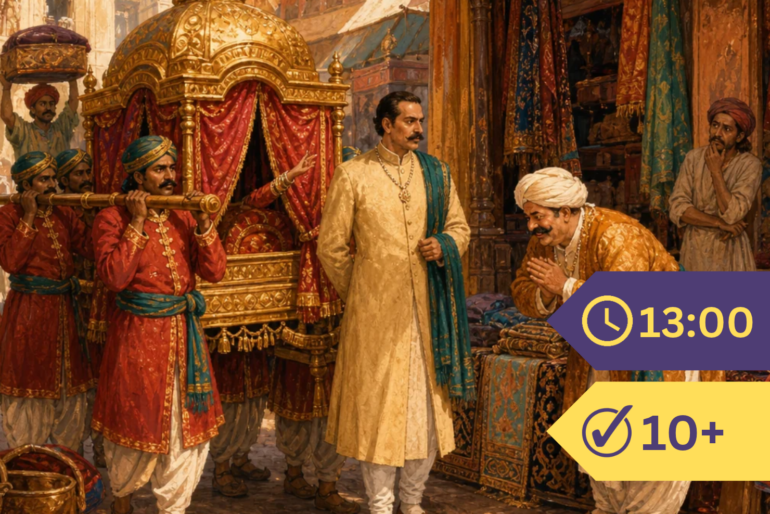
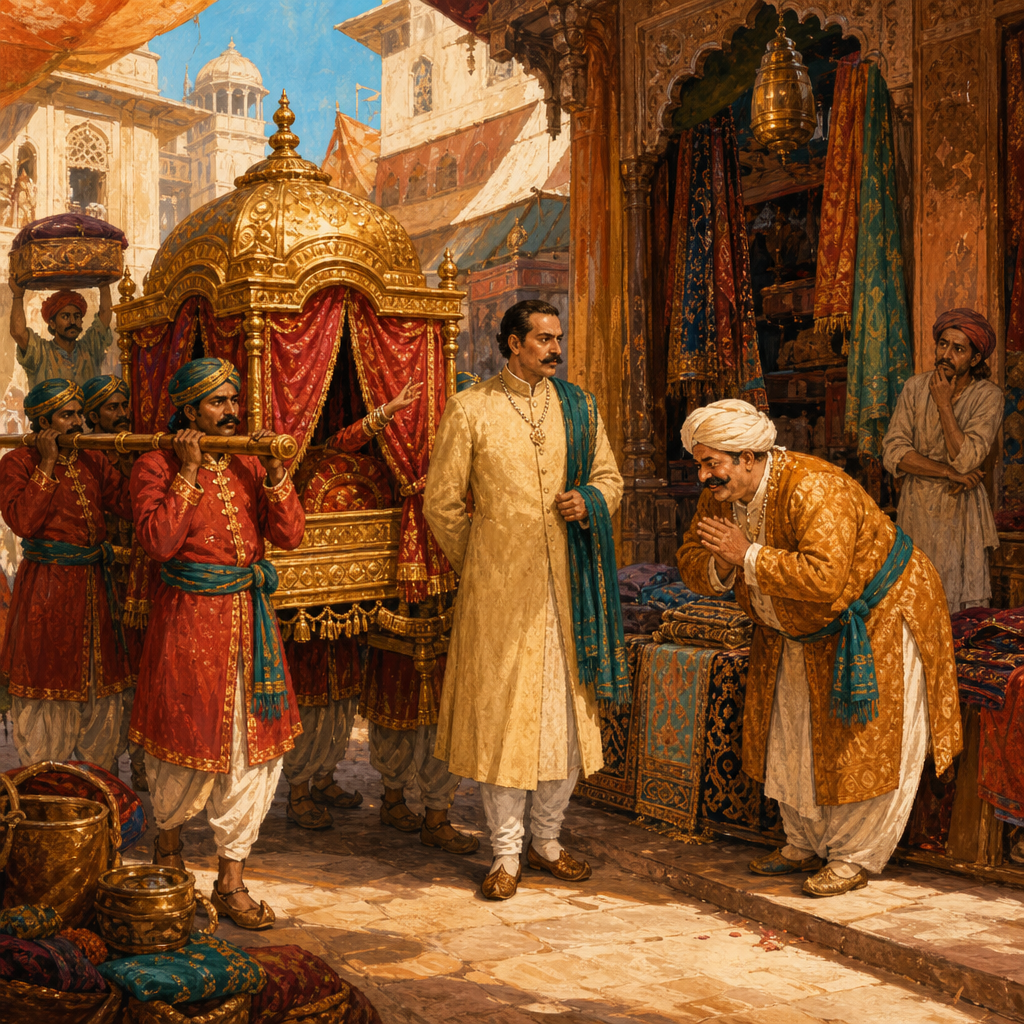
So that afternoon the merchant stood by the wall, as he’d been told. He noticed that Beeka Mull saw him, but neither paid any attention to the other. Presently, up the bazaar came a gorgeous palanquin, the kind in which ladies of rank are carried, borne by four bearers in rich uniforms, with magnificent curtains and trimmings. Beside it walked a grave-looking gentleman, whom the merchant recognised as one of Kooshy Ram’s friends. Behind him came a servant with a box on his head, covered with a cloth.
The palanquin was carried at a brisk pace and set down at Beeka Mull’s shop. The fat shopkeeper was on his feet at once, bowing low as the gentleman came forward.
“May I ask who it is in the palanquin that honours my humble shop with a visit? And how may I serve her?”
The gentleman whispered at the curtain, then explained that this was a relative travelling to another city, but her husband could not go any further with her, so she wished to leave a box of jewels with Beeka Mull for safekeeping. The shopkeeper bowed to the ground. This was not really his line of business, he said, but if it would please the lady he would be delighted, and he would guard the box with his life. The servant carrying the box was called up and the lid opened, and a mass of jewellery was revealed to the dazzled shopkeeper, whose mouth watered as he turned over the rich gems.
The merchant had watched all this from a distance. And now he saw, could he be mistaken? no, he distinctly saw a hand beckoning through the curtain on the side away from the shop. The signal! Was this the signal? The hand beckoned again, impatiently. So he walked forward quietly, greeted Beeka Mull, who was sitting turning over the contents of this astonishing box, which fortune and some fools were putting into his care, and said:
“Lala-ji, would you kindly give me back that box of mine that you’re keeping for me?”
The shopkeeper looked up as if stung. But a thought flashed through his mind: if this man made a fuss again, he’d lose the confidence of these new, richer customers. So he controlled himself and said:
“Why, of course! I had quite forgotten.” He fetched the little box and put it into the merchant’s trembling hands. The merchant pulled out the key, which hung on a string round his neck, and opened the box. When he saw that all his treasures were there, he rushed into the road with the box under his arm and began dancing like a madman, shouting and screaming with laughter. Just then a messenger came running up and said to the gentleman beside the palanquin:
“The lady’s husband has come back and will travel with her after all, so there’s no need to leave the jewels.” The gentleman quickly closed and relocked the box and handed it to the waiting servant. Then a yell of laughter came from the palanquin, and out jumped, not a lady, but Kooshy Ram, who ran to join the merchant in the middle of the road and danced as wildly as he did. Beeka Mull stood staring stupidly at them. Then, with a shrill cackle, he flung off his turban, bounced into the road with the other two and began dancing and snapping his fingers until he was out of breath.
“Lala-ji,” said the gentleman who had played the part of the lady’s relative, “why are you dancing? The merchant dances because he’s recovered his fortune. Kooshy Ram dances because he’s a madcap and has tricked you. But why do you dance?”
“I dance,” panted Beeka Mull, glaring at him with bloodshot eyes, “because I knew thirteen different ways of cheating people by pretending to trust them. I didn’t think there were any more, and now here’s a fourteenth! That’s why I dance!”