It was Christmas Eve, a fact that David Pearson registered less from any feelings of his own than from observing that the Union League Club was just a little duller than usual — which was saying something. His cronies were scattered among dozens of festive affairs, invitations to which he had persistently declined, preferring a few days of comparative solitude to the noise and gaiety in which he took no interest. He was distinctly and uncompromisingly an old bachelor, and if he had possessed any sense of the fitness of things he would have been sitting in a dimly lit room beside an open fire, watching wreaths of tobacco smoke form tender pictures of days gone by. But he disregarded all the best traditions; his apartment blazed with light while he studied the financial pages of the Post.
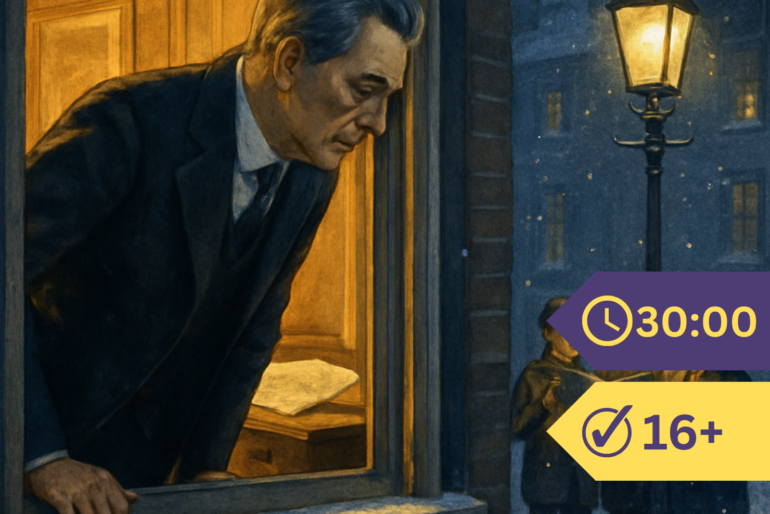
His attention was caught by the sound of boys’ voices singing in the street, and, idly curious, he raised his window slightly to listen.
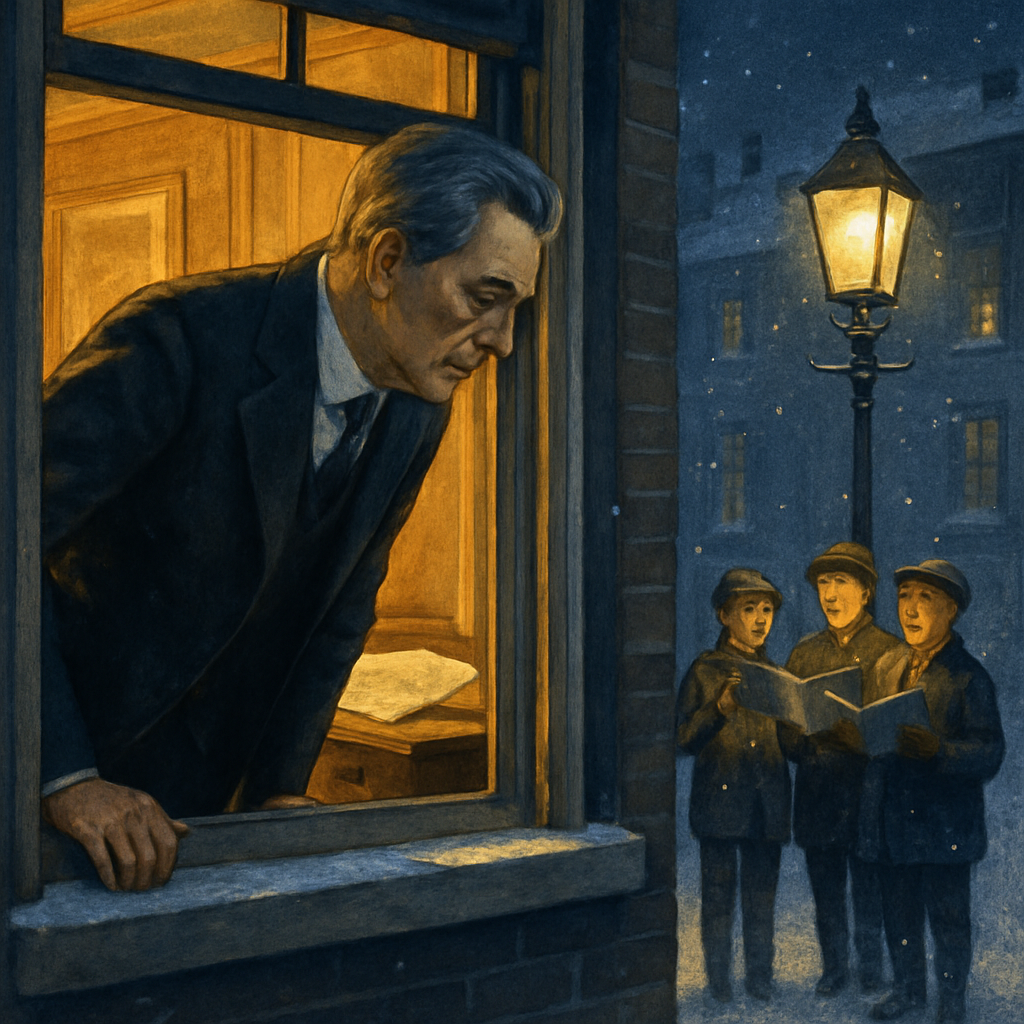
“God rest you, merry gentlemen,
Let nothing you dismay.”
The singing was particularly bad, but it interested Pearson because he had sung that carol himself, years ago, and he felt a small thrill to think that some pleasures of his childhood had proved impossible to improve upon.
“When did I last sing that?” he mused. “It must have been the Christmas just before I went to college.” He smiled broadly at the recollection — his principal ambition then had been to force his voice down low enough to sing bass — and he began to hum a counterpoint to the treble floating up from the street.
“Little Julia Connor used to sing the soprano quite prettily,” he remembered. “Poor Julia! The last time I saw her, her voice had grown shrill and hard from constantly telling four children not to do things. But she was a lovely slip of a girl in those days — when all a girl needed was to be pretty and modest, and everything came to her.
“What a noisy crowd it was at that party. After the singing was over, Julia slipped away into a quiet corner by herself. We were too boisterous for her. I remember feeling sorry for her, she seemed so neglected, so I went over and sat beside her, and we talked about the high-school days that were just ended. The others romped away into another part of the big house and forgot all about us. Then I began to notice how pretty she was, and what white, tapering hands she had. She didn’t object when I took one of them in mine and squeezed it a little, and she didn’t object either when I put my arm around her shoulder, but just pretended not to notice. And then I kissed her. She couldn’t help noticing that.
“‘Oh, David! You mustn’t! It isn’t right!’ she said — but very softly, with no indignation in her voice. So I kissed her again, a little harder. Then she drew away and hung her head.
“She was a very pretty girl.
“‘Julia, I love you,’ I declared manfully, for I wanted more kisses and, I think, so did she. I drew her closer, repeated it, and was rewarded.
“‘And I love you, too, David,’ she said.
“Too soon the others came looking for us, but before the evening was over we found a few minutes more together. ‘We won’t tell anybody just yet,’ she said, and I agreed promptly. And within a week she quarreled with me because I had danced three times in one evening with another girl, who was a much better dancer.
“‘You have broken my heart,’ she said sadly. ‘I will never trust another man as long as I live.’
“And now pretty little Julia has four children and a hard, shrill voice.”
“While shepherds watched their flocks by night,
All seated on the ground.”
The boys in the street started another song, and David Pearson recalled another Christmas — just a few months before his graduation, when he was home for the holidays. A big church fair had been arranged for Christmas Eve, and the moving spirit was Esther Wallace.
“I wonder how the rector would ever have managed without Esther,” Pearson mused. “In fact, people used to say that if Esther Wallace didn’t pay a little more attention to her own affairs and a little less to those of the church, the first thing she knew she’d be an old maid. She must have been thirty then. And the way she pounced on me and made me help with the decorations — because, as she said, it would keep me out of mischief for a few days! It was a good deal of fun, at that, and there was nothing churchish about Esther, so I didn’t mind. We became very well acquainted, and when the evening of the fair arrived and it was a great success, she kept telling me it would never have been half so good without my help.
“‘You’ve been a dear boy to give up your holiday like this,’ she said.
“I felt that for once I was appreciated, and kept following her around all evening, ready to do anything she wanted. Of course she had to stay till the last to attend to everything, and of course I had to stay in case there was anything I could do. And then I went into the little side room with her to help her with her coat. Those were the days of the huge sleeves, and as I tucked them into her coat I put my arms around her and gave her a vigorous hug.
“‘My, but you’re strong!’ she said. ‘Do you go in for athletics at college?’ It was a rather dampening, matter-of-fact way to take it, but I ignored the remark and kissed her resolutely.
“‘Oh, David! You mustn’t! It isn’t right!’ she said.
“‘Why not?’ I demanded.
“‘Well, for one thing, I’m years and years older than you.’
“I swore it made no difference and kissed her several times more.
“‘You’re so strong,’ she murmured, and made a show of resistance.
“But it was the footsteps of the janitor going around turning out the lights that ended the matter for just then. I walked home with her, putting my arm around her waist whenever we came to a dark stretch of street. In the porch of her house I started again, and again my strength was too much for her.
“‘I love you, Esther,’ I said at last, as it seemed the only thing to do.
“‘And I love you, too, David,’ she responded. ‘But you must think of your career and what your father would say. I’m much too old for you.’
“I didn’t want to think what father would say and declared it made no difference — that I was a man and had a right to my own life. She sighed and said I would forget all about her when I went back to college, and I denied it with a few dozen more kisses for emphasis.
“Heavens, what a relief it was to me a few months later to get a note from her saying it was all a mistake, and that she was going to marry the rector. And so I wrote:
“‘You have broken my heart. I will never trust another woman as long as I live.'”
“It came upon the midnight clear,
That glorious song of old.”
“Hmm. That’s funny! I suppose that song really has more to do with my being here tonight than any other one thing. What a row father and I were having that Christmas! I wanted to leave his business and have him furnish me with capital for a venture of my own, and he refused. So I said I would quit anyhow, go to South Africa, and make my own way. We had quite a crowd at the house for the holidays, and it naturally percolated everywhere that things were in a general mess in the family. Then, after dinner Christmas Eve, they all began singing carols in the music room. One by one they dropped out and left the singing to Clara Forrester. Mother had been sounding Clara’s praises until I was tired of her very name, and so I sulked off into the den.
“A little later Clara came in, humming, and pretended to be looking for something. She fiddled around a while, and then, standing behind my chair, deliberately changed the line ‘And man at war with man hears not the love song that they bring’ — only she sang it: ‘the love song that I bring.’ It was neatly done, but I knew those old hymns pretty well and recognized the change. The point was that I was worn out with the row and welcomed anything that might prove a congenial diversion.
“‘You have a beautiful voice,’ I said, by way of starting conversation.
“‘Thank you kindly, sir, she said,’ she warbled, and sat down on the arm of my big chair. ‘You don’t seem very Christmassy,’ she remarked, and proceeded to impart a little cheerfulness to the atmosphere of the den. Mother caught sight of us and kept the rest of the crowd steered in other directions. It was not long before I began to feel that life was not such a gloomy vale of tears after all.
“And so it came about quite logically that I pulled her down onto my lap and kissed her.
“‘Oh David! You mustn’t! It isn’t right!’ she protested, but not violently.
“‘Why not?’
“‘Well, you see, we’re not — that is, you’re not—’
“‘Oh yes I am,’ I declared, for she was a very nice girl and it seemed the right thing to reassure her, especially as the terms were pleasingly vague.
“‘You are what?’
“‘What you meant.’
“So we fenced back and forth, but she cornered me, and if it had to be, I might as well make a good job of it. I drew her very close, kissed her thoroughly, and said:
“‘I love you, Clara.’
“‘And I love you, too, David,’ she whispered, and snuggled in my arms.
“‘You won’t go to South Africa, will you?’ she pleaded, a little later. ‘I wouldn’t like it in South Africa.’
“And of course I promised, and went straight to my father and agreed to his plans without reservation. Then, because Clara’s family moved to Chicago, and I insisted on not marrying until I had made a place for myself in the world independently of my position in father’s business, and would not go to Chicago — she broke off the engagement with a note which read:
“‘You have broken my heart. I will never trust another man as long as I live.’
“It was fully six months before she married into the beef trust.”
“O little town of Bethlehem,
How still we see thee lie.”
“There seems to be no limit to the number of ways a man can make an idiot of himself, but Christmas time apparently collects them all in one group and dares you to escape. My luck has not failed me yet, and I suppose I am immune by now. But I tremble to think of the things that might have happened. There was Maybelle Grahame, for example — that was a narrow escape.
“It was the mistletoe that did it. I am probably no more reluctant than most men to contribute my share to the fun on these occasions, but I think I would have hesitated a long time before making any advances toward Maybelle in any other circumstances. She was a girl the world had not been kind to, and she made up for it in brass. Christmas was her field day. She used to get herself invited to the most exclusive places, and everyone always treated her as though she had come in by the tradesmen’s entrance when no one was watching the door.
“It must have been at the Thatchers’ — they were cousins of hers. The others would be caught from time to time as they quite inadvertently found themselves beneath the sprig of little white berries, but Maybelle could stand there by the hour and was as safe as if she had been in an empty house. You couldn’t help feeling sorry for her. At least I couldn’t. So I made a special effort to be nice to her, and then, waiting until no one was looking — on the principle that charity should not be made a public matter — I caught her waiting patiently under the bough and did the only decent thing.
“Did she appreciate it? Did she take it at its face value and let it go at that? She did not. She hung on with both arms, and the next thing we knew we were discovered, and her enthusiasm was misinterpreted. So I had to protect myself, and for the remainder of the two days the party lasted I had to make good. I endured it as well as I could, not being especially interested in any of the other company, and comforted myself with the thought that in a day or two I would be back in town and could escape.
“Escape Maybelle? What a chance! She telephoned twice a day. She wrote notes complaining of my neglect and saying that all her people were talking about it. She invited me to dinners and things until I exhausted all my excuses and had to run them in duplicates. Finally she wrote and asked in so many words if she had been misled by my actions at the Christmas party. I replied that she apparently had. And then she wrote:
“‘You have broken my heart. I will never trust another man as long as I live.’
“And I believe she never did, for the last I heard she was still unmarried.”
“Hark the herald angels sing,
‘Glory to the newborn King!'”
David Pearson drew a deep breath of relief. He always did when he thought of that escape, but on this occasion it reminded him of another adventure — one that had had an element of peril of a different sort, and which had likewise begun under the mistletoe.
“I wonder when someone will tabulate the various kinds of kisses and list opposite each the occasions on which they shall be permitted. When a man kisses a woman under the mistletoe he doesn’t mean anything by it, and the woman has no business taking advantage of the situation to ensnare him. I could never understand why Alice Harrison did it. There were plenty of men anxious to make love to her and tell her how badly her husband was treating her. Possibly it was because I was not in that crowd, and she wanted to complete the collection. I don’t know that I am any more squeamish than most men, but somehow I never got past the old-fashioned idea that another man’s wife is simply unavailable, and theft is not in my line.
“Still, when I kissed Alice that Christmas Eve, the way she responded undermined whatever resolve I possessed.
“Lord, the cleverness of that woman! Having started the whole thing, she turned away with a little laugh and pretended it was an isolated incident, to be immediately forgotten. She played me like an experienced angler until I was mad about her, and almost forcibly dragged her into a dark corner of the conservatory — where I returned her gift of the early evening with all the accumulated interest.
“‘Oh David! You mustn’t! It isn’t right!’ the hypocrite gasped.
“‘Why not?’ I demanded — hoarsely, I believe, is the proper word.
“‘I’m a married woman,’ she explained.
“Of course my proper answer was that she should have thought of that sooner, but instead I made the usual remarks about her ‘brute of a husband.’ I presume that to the admirer of a married woman her husband is always a brute. As a matter of fact, my recollection of Harrison is that he was a very decent fellow who probably never did anything that Alice had not provoked him into. After indicating that such a husband did not deserve such a wife, I made my declaration:
“‘I love you, Alice.’
“‘And I love you, too, David,’ she whispered, and then — ‘But we must hurry back or we will be missed.’
“We were able to see each other only occasionally, and for mere fleeting moments, until one day she telephoned saying she would be alone that evening and I might call. But there happened to be a rather unpleasant murder trial in the news at the time, and after reading some of the evidence I decided not to. She was very angry at first, and then very tearful.
“‘I don’t believe you love me at all,’ she said plaintively.
“The time seemed ripe, so I said perhaps there had been a mistake. And the woman had the effrontery to say:
“‘You’ve broken my heart. I will never trust another man as long as I live.'”
“Nowell! Nowell! Nowell! Nowell!
Sing we clear.”
“Oh, well. Those were the days when Christmas meant pandemonium, a great deal of fussing about presents, and a great deal of indigestibly rich food,” David Pearson’s recollections continued. “And when I think how I used to miss all that after I really began to have serious interests in life, I am surprised at myself. Loneliness is the self-pity of a man with no resources of his own. So it was quite natural, before I had developed my attitude of independence toward existence, that I should feel lonely — especially around Christmas time. It was the psychological moment for the arrival of Helena Burch. I wonder if that woman was ever married. She was rather vague in her allusions to her experience in that direction. But it didn’t matter then and doesn’t matter now. She was not encumbered at that time, at least. It was just after my first generally known success in the market.
“Where did I meet her? Must have been at one of those informal and somewhat questionable parties of Blake’s. She was quite a regular fixture at various bachelor apartments. One evening she asked what I was doing for Christmas, and I told her I supposed I should be deserted as usual.
“‘So shall I,’ she said. ‘Let’s have a little dinner and a mutual sympathy evening at my apartment.’
“It sounded interesting, and I accepted. I never did know quite what to make of Helena at first. She had a Bohemian ease about her, and yet everything was entirely proper. There was an invisible but clearly defined line beyond which you simply would not think of trespassing. At least I wouldn’t.
“The evening was a great success. The dinner was perfectly conceived and the table appointments exquisite. She was a connoisseur in wines and had mastered the art of removing all the self-consciousness from the act of eating. Then, while I smoked, she played and sang — in a careless, intimate sort of way, as much as to say, I know I haven’t much of a voice, but you’re a friend, and you know I’m trying my best. So eventually I became quite mellowed, and when she was tired singing and came over to sit beside me, I naturally drew her to me and kissed her.
“‘I love you, Helena,’ I said.
“‘And I love you, too, David,’ she answered. But even at the time a faint chill came over me — there was no conviction in her voice. Perhaps it was an echo of my own absence of ardor, but to me, recalling other Christmases, her tone sounded hard and cold, and there was little warmth in her embrace. However, it passed for what it was worth.
“I saw her several times after that, usually at her apartment. Then one evening she said:
“‘David, I think I’d like to have a nicer place than this, but I can’t quite afford it. I’ve been looking at an apartment over on Riverside Drive. It’s just what I want, and I could entertain you so much better there.’
“‘I couldn’t ask for any better entertainment,’ I protested.
“But she enlarged on the advantages of the more expensive place — it would only cost ten thousand a year, and ten thousand, she averred, was nothing to me, but her income was so limited, and so on.
“And then I was very thankful that I had been a model of discretion. I said I would think it over, but I never went back. She telephoned several times and tried to make dinner engagements, but I always managed to evade. Finally one day she said, in a tearful voice:
“‘David, aren’t you coming to see me any more?’
“‘I think I had better not,’ I told her, and then I wondered if she would say it. She did.
“‘You have broken my heart. I will never trust another man as long as I live.’
“But I had heard it done so much better that it made no impression.”
“When Christ was born of Mary free —
In Excelsis Gloria!”
“How different was that Christmas dinner with Margaret Swayne! I wonder why I didn’t marry her. Perhaps it was because I had no encouragement, and had grown too old to care to engage in a long, stern chase. John Walton accomplished it, but it took him more than a year of hard work. She had been a widow about five years when she took pity on me and invited me to what she called ‘a solitary feast of the forsaken’ at her house. I think it was the most homelike place I ever visited — no tinsel and show, just the plain warmth of a wholesome woman. We talked about old friends and old times, even about her dead husband, without a trace of mawkish sentiment. I began to feel that I was leading an extremely lonely life and losing touch with everything except business.
“Later, in her little drawing room, we ran out of topics of conversation and she put a record on the phonograph. We listened in silence through half a dozen of them.
“‘Margaret,’ I said at last, ‘what would you say if I were to make Christmas love to you?’
“She laughed happily. ‘Do so by all means, if you think you ought to,’ she said. ‘But always remember that Christmas love, like Christmas presents, is not durable.’
“‘Your levity,’ I said, ‘has broken my heart. I will never trust a woman again as long as I live.’
“‘David,’ she said solemnly, ‘have you ever trusted one?’
“And I was forced to admit that I had not.”
“God rest you, merry gentlemen,
Let nothing you dismay.”
“Hang it, they’re beginning all over again.”
David Pearson leaned out of the window and bargained with the waifs to end the concert, in consideration of a piece of gold, which was forthwith paid. Whereupon the old bachelor returned comfortably to his study of the financial pages of the Post.
But beside a fireplace in a distant home, a middle-aged woman who had once been slim and fair was singing snatches of song as she and her husband decorated a fir tree and wrote the names of four children on many parcels. And she did not think of David Pearson all evening.
And in a quiet rectory another woman was making a list of poor families that must not be forgotten in the morning. And she did not think of David Pearson all evening.
And in another home the wife of a millionaire was sewing busily on a silken trifle that was to be her own gift to her husband. And she did not think of David Pearson all evening.
And in a mission in the slums an unusually unprepossessing woman was being wept upon by a group of grateful mothers. And she did not think of David Pearson all evening.
And in a far distant city a woman was telling her husband how happy she was that they had left an old life behind them. And she did not think of David Pearson all evening.
And in a handsome apartment a mature but still beautiful woman was entertaining one of the merriest of gatherings. And she did not think of David Pearson all evening.
And in one of the most homelike homes of all, a pleasant-faced woman was enjoying the spectacle of a large house-party of young folk engaged in the pastimes of Yule. And she did not think of David Pearson all evening.
Yet he had remembered all of them.