I. A Question of Nourishment
“How is he now?” said Robert, as he came in from his day’s work — every moment of which he had spent thinking of his child. He spoke in a whisper to his wife, who met him in the narrow entry at the head of the stairs. And in a whisper she replied.
“He is certainly no worse,” said Mary. “The doctor says, maybe a shade better. At least” — she sat down on the lower step, took her husband’s hand, and still whispered — “at least he said that the breathing seemed to him a shade easier, one lung a little more free, and that it is now a question of time and nourishment.”
“Nourishment?”
“Yes, nourishment — and I own my heart sank when he said so. Poor little thing, he loathes the slops, and I told the doctor as much. I told him the struggle to get them down his poor little throat brought on more flush and fever than anything. And then the doctor begged me not to try that again, asked if there were really nothing the child would take, and suggested everything so kindly. But the poor little thing, weak as he is, seems to rise up with supernatural strength against them all. I am not sure, though — perhaps we may do something with the old milk and water. That is really my only hope now, and that is why I spoke to you so cheerfully.”
Then poor Mary explained at greater length that Emily had brought in a little manual about the use of milk with young children, and that they had sent round to the Corlisses’, who always had good milk, and had prepared a pint according to the formula — and that though dear little Jamie had refused the groats and the barley and everything else, at six o’clock he had gladly taken all the watered milk they dared give him, and that it had now rested on his stomach for half an hour, so that she could not help hoping the tide had turned — only she hoped with trembling, because he had so steadily refused cow’s milk only the week before.
This whispered exchange in the entry, reviewing the bulletins of the day, is really the beginning of this Christmas story. Never mind which day it was — it was a little before Christmas, one of the shortest days, but I have forgotten which. Enough that the baby, for he was a baby still, just entering his thirteenth month, did relish the milk, so carefully measured and prepared, and hour by hour took his little portion of it as if it had come from his mother’s breast. Enough that three or four days went by this way, the little thing lying so still on his back in his crib, his lips still so blue, his skin of such deadly color against the white of his pillow — and that twice a day, as Dr. Morton came in and felt his pulse and listened to the labored breathing, he smiled and looked pleased and said, “We are getting on better than I dared expect.” Every time he asked, “Does he still relish the milk?” and was so glad to learn that he took to it still, and every day he added a teaspoonful or two to the hourly portion — and so poor Mary’s heart was lifted day by day.
This lasted until St. Victoria’s Day. Do you know which day that is? It is the second day before Christmas. And here, properly speaking, the story begins.
II. St. Victoria’s Day
On St. Victoria’s Day the doctor was a full two hours late. Mary was not anxious. She was beginning to feel brave about the boy, and no longer counted the minutes until she heard the doorbell ring. When he came, he lingered in the entry below — or she thought he did. He was long coming up the stairs. And when he came in she saw that he was excited about something — was himself still panting for breath.
“I am here at last,” he said. “Did you think I should fail you?”
Why, no — poor innocent Mary had not thought any such thing. She had known he would come, and baby was so well that she had not minded the delay.
Morton glanced up at the close-drawn shades that shut out the light. “You did not think of the storm?”
“Storm? No!” said poor Mary. She had noticed, when Robert went to the door at seven and she closed it after him, that some snow was falling. But she had not thought of it again. She had kissed him, told him to keep up good heart, and come back to her baby.
Then the doctor told her that the storm which had begun before daybreak had been gathering more and more severely; that the drifts were already heavier than any he remembered in all his years in Boston; that after half an hour’s trial in his sleigh he had been glad to get back to the stable with his horse; and that everything he had done since, he had done on foot, in difficulty she could not conceive of. He had spent so long downstairs brushing off the snow that he might be fit to come near the child.
“And really, Mrs. Walter, we are doing so well here,” he said cheerfully, “that I will not try to come round this afternoon, unless you see a change. If you do, your husband must come up for me. But you will not need me — I am sure of it.”
Mary felt quite brave to think they should not need him for twenty-four hours, and said so, and added, with the first smile he had seen in a fortnight: “I do not know anybody to whom it matters less whether the streets are blocked or open. Only I am sorry for you.”
Poor Mary — how often she would think of that speech before Christmas Day went by. But she did not think of it at all through St. Victoria’s Day. Her husband did not come home to dinner; she did not expect him. The children came home from school at two, rejoicing in the long morning session and the half-holiday afternoon that had been earned by it. They had some story of their frolic in the snow, and after dinner went quietly away to their little playroom in the attic. And Mary sat with her baby all the afternoon, needing no other company. She could count his breathing now, and knew how to time it by the watch, and she knew it was steadier and slower than the day before. And he really almost showed an appetite for his hourly portion. Her husband was not late; he had taken care of that, leaving the shop an hour early. And as he came in and looked at the child from the other side of the crib and smiled so cheerfully across at her, Mary felt she could not enough thank God for his mercy.
III. St. Victoria’s Day in the Country
Five and twenty miles away was another mother, with a baby born the same day as Jamie. Mary had never heard of her and never has heard of her, and unless she reads this story, never will hear of her until they meet together in that other home, look each other in the face, and know as they are known. Yet their two lives, as you shall see, are twisted together — as indeed are all lives, only they do not know it, as how should they?
A great day for Huldah Stevens was this St. Victoria’s Day, not that she knew its name any more than Mary did. Indeed it was only in recent years that Huldah Stevens had cared much for keeping Christmas Day. But of late they had all thought of it more, and this year, on Thanksgiving Day at old Mr. Stevens’s, after great joking about the young people’s housekeeping, it had been settled with some laughter that the same party should meet at John and Huldah’s on Christmas Eve — all Huldah’s side of the family besides — for a late dinner or early supper, as the guests might please to call it. There was seldom much difference between the meals in the profusion of these country homes. The men were rarely at home at noon in any case, for they were all in the milk business, as you will see. What with collecting milk from the hill farms on the one hand, and carrying it for the three o’clock morning milk train on the other, any hours that you, dear reader, might consider regular country hours were long since set aside. But after much discussion, it had been settled at the Thanksgiving party that all hands in both families should meet at John and Huldah’s as near three o’clock as they could on the day before Christmas, and there Huldah was to show her powers at her first proper family gathering.
So this St. Victoria’s Day was a great day of preparation for Huldah, if she had only known its name, which she did not. She was of the kind that prepares in time, not the kind that is caught out when the company arrives with the work half done. As John started on his collection route that morning at about the hour Robert, in town, was kissing Mary goodbye, Huldah stood on the step with him and looked with satisfaction at the gathering snow, thinking it would make better sleighing the next day for her father and mother to come over. She reminded him not to forget her box of raisins when he came back, and to ask at the express office whether anything had come up from town, bade him goodbye, and turned back into the house — not entirely displeased to have it nearly to herself.
She washed her baby, gave him his first feeding and put him to bed. Then, with the coast fairly clear — what woman does not enjoy a clear coast, if only it be early enough in the morning? — she dipped boldly into her flour barrel, rolled up her sleeves, and set to work on the pie crust that was to appear tomorrow in the fivefold forms of apple, cranberry, Marlboro, mince, and squash. Careful and discriminating in the fine chemistry of her mixtures and the skilled manipulation of her hands, but in no way dreading the outcome. A long, lively, active morning she had of it. Step by step she advanced through her elaborate plan — which was well laid out in her head but had never been trusted to words, far less to tell-tale paper. From the oven came the pies at last, and she was satisfied with the color. From the other oven came the turkey, which she proposed to serve cold as a relay dish for any who might not arrive at the right moment. Into the empty oven went the clove-studded ham, which had been filling the kitchen with its aroma as it boiled. In the pretty molds in the woodshed stood the cranberry jelly hardening to its proper consistency, and in other molds the calf’s foot jelly was already setting firm as she had directed.
By two o’clock — the earliest John ever returned — Huldah’s kitchen was cleared, her table fit to cut cloth upon, every pan and plate put away, the tools hung on their hooks, a fresh towel on the roller. Everything gave sign of victory, the whole kitchen looking only a little nicer than usual. Huldah herself was dressed for the afternoon, and so was the baby; and no one but as keen an observer as you or I would have known that she had been in action all along the line and won at every point.
Then for the first time it occurred to Huldah to look outdoors and see how fast the snow was gathering. She knew it was still falling. But the storm was a quiet one, and she had had too much to do to be gazing out of windows. She went to the shed door, and to her amazement saw that the north woodpile was wholly drifted in. Nor could she, standing there, see the fences along the road.
Huldah ran back into the house, opened the parlor door and drew up the curtain — and indeed there were no fences visible from the front of the house either. On the northwest, where the wind had full sweep between her and the barn, the ground was bare. But all that snow — and who could say how much more — was piled up before her, so that had Huldah not known every landmark, she would not have suspected any road had ever been there. She looked uneasily out the northwest windows, but she could not see an inch to windward: dogged snow — snow — snow — as if it would never be done.
Huldah knew very well then that there was no husband coming for the next hour, nor most likely the next after that. She knew what she had to do; and knowing it, she did it. She tied on her hood and buttoned her rough coat tight around her, passed through the shed and crossed that bare strip to the barn, opened the door with some difficulty — snow was already drifting into the doorway — and entered. She gave the cows and oxen their water and the horses theirs, went up into the loft and pitched down hay enough for all, went down to the pigs and cared for them, took a barn shovel and cleared the path where she had had to plunge through snow at the doorway, put the shovel back, and crossed home again to her baby. She thought she could see the Empsons’ chimney smoking as she went — that seemed companionable.
She took off her boots and coat and hood, said aloud “This will be a good stay-at-home day,” brought her writing desk to the kitchen table, and began on a long letter to her brother Cephas in Seattle.
That letter was finished — eight good pages — and a long-delayed letter to Emily Tabor, whom Huldah had not seen since her own wedding, and a long overdue reckoning of her milk accounts brought up to date — and still no John. Huldah had the table fully set, you may be sure of that. But for herself, she had had no heart to go through the formalities of a proper lunch or dinner. A cup of tea and something to eat with it as she wrote served better, she thought — she could eat when the men came. It is a way women have. Not until it grew quite dark, and she set her kerosene lamp in the window so John might see it when he turned the Locust Grove corner, did Huldah once feel herself lonely, or permit herself to wish she did not live in a place where she could be cut off from all the world. If John had gone into partnership with Joe Winter and we had lived in Boston — that was the thought that crossed her mind. Dear Huldah — from the end of one summer to the beginning of the next, Joe Winter does not come home to dinner; and what you experience today, so far as your husband’s absence goes, is what his wife experiences in Boston ten months of every year, save Sundays.
I do not mean that Huldah winced or complained. Not she. Only she did think if. Not long. Very soon she was planning how she would arrange the table tomorrow — whether Mother Stevens should carve the chicken pie, or whether she would have that in front of her own mother. Then she fell to planning what she would make for Cynthia’s baby, and then to wondering whether Cephas was in earnest in that half-teasing thing he had written about Sibyl Dyer — and then the clock struck six.
No bells yet — no husband — no one.
Lantern out and lighted. Rubber boots on, hood and coat. Shovel in one hand, lantern in the other. The roadway was still bare, but a drift as high as Huldah’s shoulders had built up at the barn door. Lantern set on the ground; snow shovel in both hands now. One, two, three — a cubic foot of snow out. One, two, three — another out. And so on and so on, till the doorway was clear again. Lantern in one hand, shovel in the other, she entered, drew water for cows and oxen, shook down more hay, saw to the pigs again. This time she made straw beds for the horses and cattle, and lingered a minute or two, for there was something companionable about the barn at night. Then she shut them in, in the dark, and crossed the cleared roadway to the shed, and so home again. Certainly Mrs. Empson’s lamp was in her window — that halo of light in the falling snow looked like society.
This time Huldah undressed the baby, put on the little yellow flannel nightgown — and made the business last as long as she could — then, still making believe to be jolly, lit another lamp, ate her own supper, cleared it away, and opened the new Harper’s that John had brought her the day before.
But the Harper’s was dull reading, though she generally found it so attractive. And when her Plymouth-Hollow clock consented to strike eight at last, Huldah — who had stinted herself to read till eight — gladly put down the “Travels in Arizona,” which seemed to her as much like the “Travels in Peru” of the month before as those had seemed like the “Travels in Chinchilla.” Rubber boots again, lantern again, coat and hood again. The men would be in no state for milking when they came. So Huldah gathered their pails, took shovel and lantern, dug out the barn drift again, and went over to milk little Carry and big Fanchon.
Though the milking of a hundred cows passed through those roofs and out again every day, Huldah was far too set in her ways to abandon the custom she had inherited from generations of farmwives, and her husband was well pleased to humor her in keeping always at least two of the finest cows he could choose for the family’s own use. Ordinarily he or Reuben did the milking — that was not Huldah’s share. But on this eve the gentle creatures were glad when she came in, and in two trips back and forth Huldah had carried her well-filled pails into the dairy.
This helped the hour along, and just after nine o’clock struck, she could hear men’s voices and the scrape of a sled. She ran out with the lantern to the shed door, pulled on her boots and coat and hood in an instant, crossed to the barn, slid open the great barn door, and stood there with her light — another Hero waiting for another Leander to come buffeting toward her through the snow.
A sight to see were the two men, to be sure. And a story they had to tell. On their separate routes they had fought snow all day, breaking roads with the help of farmers where they could, been forced to give up more than half the outlying farms, sending word that those farmers should try to bring tomorrow’s milk to whatever stations they could arrange. At last, by good luck, they had both ended up at the depot in the hollow, each having gone there to learn when the milk train might be expected in the morning. There was little reason to expect it at all. Nothing had passed the stationmaster since the morning express — called lightning in irony — had slowly pushed through with three or four engines, five hours late. A messenger had just come down from those engines, stuck at Tyler’s Summit, to telegraph Boston that they were all blockaded, the snow drifting under their wheels faster than they could clear it. Above the station, nothing had yet passed Winchendon. Five engines had gone out from Fitchburg eastward, but in the whole day had not reached as far as Leominster. It was very clear that no milk train, nor any other train, would be on time the next morning.
Such was, in brief, John’s report to Huldah — given after the horses were rubbed dry and locked in the barn, after the men had changed into dry clothes, and after each of them, sitting on the fireside of the table, had drunk his first cup of tea and eaten his first round of toast dipped in warm milk. After the toast, they were going to begin on Huldah’s fried potatoes and sausages.
Huldah heard their stories with all their infinite little details; knew every corner and turn by which they had husbanded strength and got themselves through; was grateful to the Corbetts and Varnums and Prescotts and the rest, who with their oxen and their strong right arms had given such loyal help for the common good. And she heaved a deep sigh when the story ended with the verdict: “No trains on time tomorrow.”
“Bad for the Boston babies,” said Reuben bluntly, putting into words what the others were feeling.
“Poor little things!” said Huldah. “Alice has been so good all day.” And she gulped down just one more sigh, disgusted with herself as she remembered that if of the afternoon — if John had only gone into partnership with Joe Winter.
IV. How They Broke the Blockade
Three o’clock in the morning saw Huldah’s fire burning in the stove, her water boiling, her slices of ham on the griddle; quarter past three saw the men come in from the barn, where they had been shaking down hay for the cows and horses and yoking the oxen for the tremendous task of the day. It was bright starlight above — thank heaven for that. The great band of snow cloud that had been drifting steadily east across a continent was, it seemed, only twenty hours wide — perhaps two hundred miles — and at about midnight its last flakes had fallen, and all the sky was washed black and clear. The men were well rested by five hours of hard sleep. They were properly dressed for their great encounter and started upon it cheerily, as men who meant to do their duty — and to both of them had come the thought that life and death might be trembling in their hands.
They did not take out the sleighs today, nor the horses. Such milk as they had collected on St. Victoria’s Day was already stored at the station and at Stacy’s; the best they could do today would be to break open the road from the Four Corners to the station so as to place as many cans there as possible before the down-train came. From the house, then, they had only to drive the oxen down to work with the other teams from the Four Corners. And it was only by pleading with him that Huldah persuaded Reuben to take a lunch can for them both. Then, as Reuben left the door and John stayed a moment to kiss her goodbye and tell her not to be alarmed if they did not come home that night — she gave John the full milk can into which she had poured every drop of Carry’s milk, and said, “It will be one more; and God knows what child may be crying for it now.”
So they parted for twenty-eight hours. In place of Huldah’s first great family gathering, she and the baby reigned alone that day, holding their little court with never a visitor. When lunchtime came, Huldah looked half-mournfully, half-merrily at her array of Christmas dainties and would not touch one of them. She toasted some bread before the fire, made a cup of tea, boiled an egg, and would not so much as set the table. As has been said before: this is the way with women.
And of the men — who shall tell the story of the courage and endurance, the unfailing goodwill, the resourcefulness in strange emergency, the mutual help and common courage with which all those men worked that day at the well-nigh hopeless task of breaking open the highway from the Four Corners to the station? Well-nigh hopeless indeed. At first, with fresh cattle and united effort, they made nearly two miles’ headway by ten o’clock — bringing yesterday’s milk more than halfway to the delivery point. But by ten it was evident that the sharp northwest wind, bearing so heavily on the oxen and even on the men, was filling in the very road they had opened, cutting them off from behind and leaving the way for today’s milk worse than when they had started. In one of those improvised councils — such as fought the battle of Bunker Hill and threw the tea into Boston Harbor — it was determined at ten o’clock to divide the working party. The larger group would work back to the Four Corners and keep that trunk road open as best they could; while six teams, with their owners, would press forward to the station and make a new base at Lovejoy’s, where exhausted oxen could be stabled.
And so it proved. By three in the afternoon, John and Reuben and the rest of the advance party — all of it, as is the custom of New England — gathered around the fire at Lovejoy’s. After twelve hours of effort they were beaten at every point but one. The mile of road they had opened in hours of steady labor was drifted over again, as smooth as the surrounding fields, and if anything more treacherous. The oxen, which had worked patiently and kindly, handled well by good-tempered men, were now confused and half dead with exposure; many had had to stand in that biting wind after gigantic effort and had barely escaped with their lives. All the men had managed to gain was moving their depot of milk — two hundred and thirty-nine cans — as far as Lovejoy’s barn. They gave little thought to what might have worked down to the Four Corners behind them; their communications that way were cut off again. What they thought of and planned for now was simply how the cans at Lovejoy’s could be put on any downward train. They knew by this point that all trains had lost their schedules and their grades — that this milk would go into Boston by the first engine that ran there, whether it rode in a freight car or a palace car.
What train that might be, they did not know. From the hill above Lovejoy’s they could see poor old Dix, the stationmaster, with his wife and boys, doing his best to make a show of shoveling in front of his little station. But Dix’s best was limited — he had but one arm, having lost the other in a railroad collision, and so as a kind of pension the company had placed him at this small flag-stop, where there was a roof over his head, a few tickets to sell, and generally very little else to do. It was plain that no railroad working party had gotten through to Dix’s station either way. As to whether any would before dark — who could say? Snow drifts are mighty uncertain. The track of that road runs generally northwest, and today’s wind might have swept out its cuts as persistently as it had filled in the crossroads. From Lovejoy’s barn they could see that the track was perfectly clear for the half-mile where it crossed the Prescott meadows.
After a full conference, the enterprises of the night were determined. After thorough refreshment on Mrs. Lovejoy’s green tea and a continuous relay of bacon and eggs — and cutting and returning to her mince pies, which did not, I am sorry to say, compare at any point with Huldah’s — each man thrust doughnuts into his pockets, drew on his long boots and buckskin mittens, and, unencumbered now by the care of animals, started on the evening’s work.
The sun was just taking its last look from the western hills, where Reuben and John could see Huldah’s chimney smoking. The plan was to take Lovejoy’s heavy hand-sledges, knock together two or three more in jumper fashion, and work their way across the meadow to the railroad causeway — barely half a mile from Lovejoy’s — and establish a milk depot there. By going and coming often, following tracks well known to Lovejoy along the sheltered side of walls and fences, eight men felt sure they could have all their milk by the rail by midnight. Meanwhile, Silas Lovejoy — a boy of fourteen — was to put on snowshoes, go down to the station, explain the situation to old Dix, and get a red lantern and permission to flag down the first train where it swept out of the Pitman cut onto the causeway.
Old Dix had no more authority to grant this permission than the humblest street-sweeper in the city, and they all knew it. But the fact that Silas had asked for it would show a willingness on their part to defer to authority, if authority there had been — and this satisfied the New England love of law. On the other hand, the train would be stopped, and this satisfied the New England determination to get the thing done regardless. John wrote a note to Dix to give Silas added weight, and it was generally agreed that if Dix wasn’t difficult, he would give the lantern and whatever permission he had to give. Silas was then to work his way up the road and station himself as far beyond the curve as he dared, and stop the first down-train — tell the conductor where the men were waiting with the milk, ride down to them on the train, and his duty would be done. In case Dix proved difficult, Silas was provided with Lovejoy’s own lantern, but was told not to show it at the station until his interview was finished.
Silas started cheerfully on his snowshoes. John and Lovejoy started at the same moment with the first hand-sledge of cans. First of all into the sledge, John placed Huldah’s well-known can — a little shorter than the others, with a different handle. “Whatever else gets to Boston,” he said, “that can goes through.”
They built the base of their pyramid of cans and met the three new sledges with their builders as they went back for more. The party enlarged the base, and as they worked, Silas passed them cheerfully with his red lantern — old Dix had not been difficult at all. He had given the lantern and all the permission he had to give, and some intelligence besides: an accumulated force of seven engines with a large working party had left Groton Junction heading east at three o’clock. Nothing had come up through Groton Junction from Boston, and from Boston, Dix had learned, nothing more would leave until early morning. No trains had arrived in Boston from any direction for twenty-four hours. So long had the blockade lasted.
It was clear that the down-train might reach them at any moment. Still the men resolved to leave their milk in place while they went back for more, relying on Silas and the railroad working party to load the cans if the train happened to pass before they returned. Back they went to Lovejoy’s for the next relay, and met John and Reuben successfully bringing in their second load. But no one need have hurried — trip after trip they built their pyramid higher, and by ten o’clock, when all the cans were in place by the rail, the train had not yet come.
John and Reuben proposed going up into the cut to relieve poor Silas, who had not been heard from since he had swung away so cheerfully like the boy in the poem, climbing ever upward. But they had barely started when a horn from the meadow called them back, and retracing their steps they met a messenger: a fresh team from the Four Corners had reached Lovejoy’s with a dozen men who had managed to bring down nearly a hundred more cans as far as Lovejoy’s mowing lot. It was possible, in two or three hours, to bring these over as well — and while the first train was probably close at hand, it was worth placing this supply ready for a second. So poor Silas was left a little longer to his loneliness, and Reuben and John turned back to the mowing lot. They passed Lovejoy’s house, where they found Mrs. Lovejoy and Mrs. Stacy in the shed finishing off two more sledges and claiming credit for their skill; and after another cup of tea — for no man touched spirits that day or that night — they reported to the new station by the mowing lot.
And Silas Lovejoy — who had turned the corner into the Pitman cut and so lost sight of the station light, his father’s windows, and the lanterns of the men at the pyramid of cans — held his watch there, hour by hour, with such courage as the sense of an advance gives boy or man.
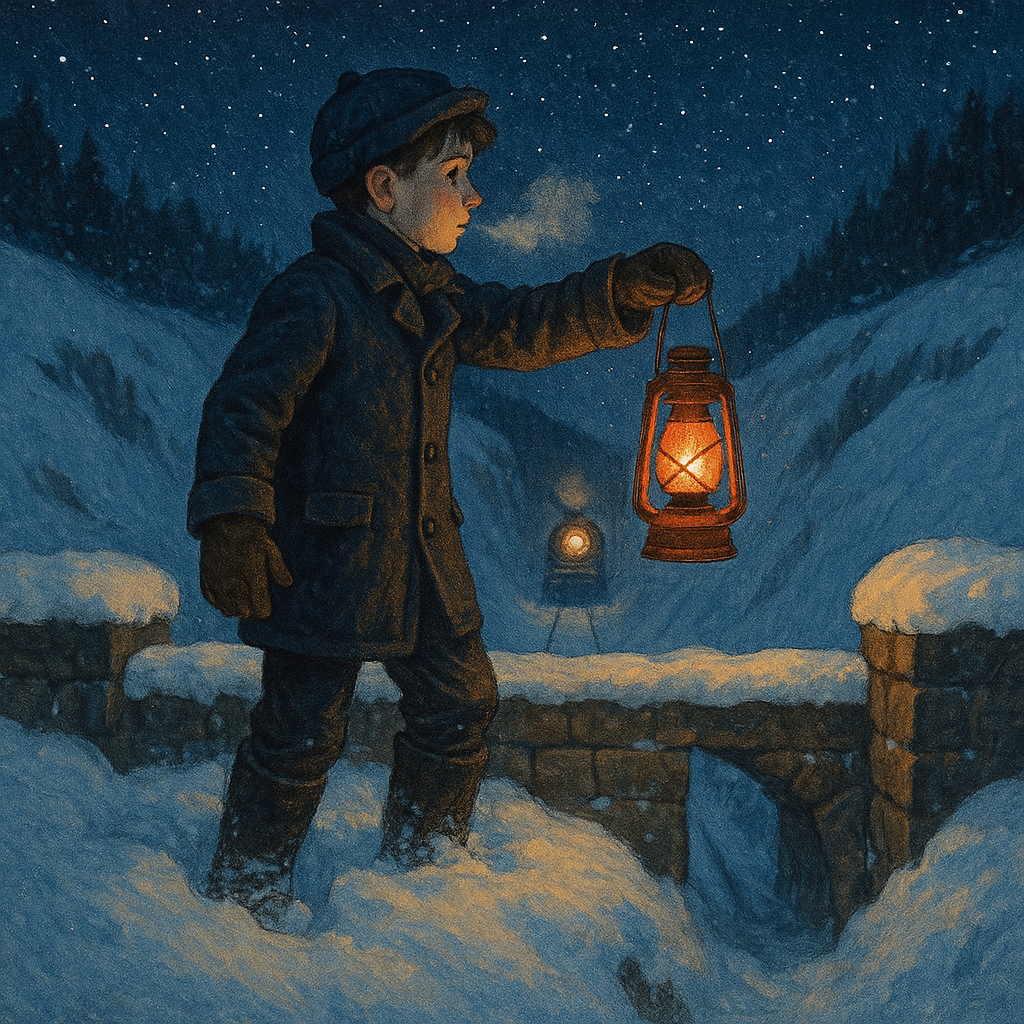
He had his shovel. Going over the causeway he had slipped off his snowshoes and hung them on his back. In the Pitman cut there was heavy wading — knee-deep, waist-deep — and he set the red lantern on his snowshoes and scouted ahead. Waist-deep, neck-deep, and he fell forward on his face into the yielding snow. “This will not do,” said Silas to himself, regaining his balance and throwing himself backward. Slowly he turned, worked back to the lantern, worked out to the causeway, and fastened the snowshoes on again. With their help he skimmed up to Pitman’s bridge, which he had picked for his station. He knew that from there his lantern could be seen for a mile, and that the train could safely stop so close to the open causeway he had just crossed.
So Silas walked back and forth, and sang, and recited pieces he had memorized, and mused on the future of his life, and sang again in the loneliness. No sound of clock, no dog, no waterfall broke that utter stillness. The wind, thank God, had at last died, and Silas paced his long oval under and beyond the bridge with no sound but his own voice when he chose to raise it. He expected, as they all did, that every moment the whistle of the train sweeping into sight a mile away would break the silence — so he paced and shouted and sang.
“This is a man’s duty,” he said to himself. “They would not let me go with the regiment — not even as a drummer boy. But this is duty such as no drummer boy of them all is doing right now. Company, march!” and he stepped off smartly with his left foot. “I am placed on guard here quite as much as if I were on picket duty in Virginia. Who goes there? Advance, friend, and give the countersign.” Not that anyone did go there, or could go there — but the boy’s fancy was ready, and so he amused himself in the first hours.
Then he began to wonder whether they truly were hours, as they seemed, or whether this was a wretched illusion — whether time felt slow to him because he was only a boy who didn’t know how to occupy his mind. So he resolutely said the multiplication table from beginning to end and from end to beginning, first silently, then aloud to make it slower. Then he tried the Ten Commandments. Thou shalt have none other gods before me — easy to say that beneath those stars. He said them again. No — it was no illusion. I must have been here for hours. Then he began on Milton’s hymn:
It was the winter wild,
While the heaven-born child,
All meanly wrapt, in the rude manger lies.
“Winter wild, indeed,” said Silas aloud — and if he had only known it, at that moment midnight had passed already, and Christmas Day was born.
Only with speeches fair
She wooes the gentle air
To hide her guilty front with innocent snow.
“Innocent, indeed,” said poor Silas, still aloud — “much did he know of innocent snow!” And vainly did he try to recall the other stanzas, pacing back and forth, round and round, beginning now to wonder where his father and the others were, whether something had gone wrong with them. Surely they could not have forgotten he was here. Would that train never come?
If he weren’t afraid of it arriving the moment he turned his back, he would run to the causeway to look for their lanterns — perhaps they had a fire. Why hadn’t he brought an axe for a fire? That rail fence above would have served perfectly — and wasn’t there a load of hickory left since Thanksgiving, not five rods away? Surely one of them could have come up with an axe. But maybe there was trouble below. They might have come with an axe — with an axe — with an axe — with an — “I am going to sleep!” cried Silas aloud, as his head dropped heavily onto the handle of the shovel he was resting on in the lee of the stone wall. “I am going to sleep — that will never do. Sentinel asleep at his post. Order out the relief. Make ready. Fire. That, sir, for sentinels asleep.” And so Silas laughed grimly, and began his march again.
He took his shovel and began digging at where he guessed the track might be buried beneath him — anything to keep warm and keep awake. Why did they not come up to him? Why was he here? Why was he all alone — he who had never been alone before? Was he alone? Was there companionship in the stars — or in the good God who held the stars? Did God put me here? If he put me here, will he keep me here? Or did he put me here to die — to die in this cold? It is cold. It is very cold. Is there any use in my dying? The train will come, and they will see a dark shape lying under the bridge, black on the snow, with a red lantern beside it. Then they will stop. Shall I — I will — just go back to see if the lights are at the bend. I will leave the lantern on the edge of this wall —
And so Silas turned, half-numb, worked his way nearly out of the gorge, and stopped — he heard, or thought he heard, a baby’s cry. “A thousand babies are starving, and I am afraid to stay here to give them their life,” he said aloud. “There is a boy fit for a soldier! Drumhead court-martial! Prisoner, hear your sentence! Deserter! Good enough for deserters!” And so poor Silas worked his way back again to the lantern.
Now he saw that Orion was bending toward the horizon, and he knew the night must be breaking. With new hope, throwing down the shovel, he began his soldier’s march again — as well as one can march in trailing snowshoes — tried again on No war nor battle sound, broke down at Cynthia’s seat and the music of the spheres, but at last — working on “beams,” “long beams,” “that with long beams” — he caught the stanza he was feeling for, and broke out exultant with —
At last surrounds their sight
A globe of circular light
That with long beams the shame-faced night arrayed;
The helmed cherubim
And sworded seraphim
Are seen in glittering ranks —
“Globe of circular light — am I dreaming, or have they come?!”
They had. The headlamp swept full over the valley, and the scream of the engine was welcomed by the freezing boy as if it were an angel’s whisper. Not unprepared did it find him. The red lantern swung to and fro in a steady hand, and he was in position on his firmest footing as the train slowed and the engine passed him.
“Don’t stop for me,” he cried, as he grabbed the side of the tender and the workmen dragged him in. “Only run slow until you’re clear of the ledge — we’ve made a milk station at the crossroad.”
“Good for you!” said the fireman, understanding in a moment. The heavy snow-plow threw out the snow steadily; in ten seconds they were clear of the ledge and could see the fire-light shimmering on the great pyramids of milk cans. Slower and slower ran the train, and by the blazing fire it stopped — for once, because its crew chose to stop. The working party on the train cheered as they tumbled out of the cars and took in the situation, and were cheered in return by the men from the village.
Two or three cans of milk stood warming on the embers, ready for the men on the train. An empty passenger car was opened and the pyramids of cans were hurried into it — forty men now assisting.
“You’ll find Joe Winter at the Boston station,” said John Stevens to the conductor of the express, whose lightning train had thus become a milk convoy. “Tell Winter to distribute it among all the carts, so everybody gets some. Good luck to you. Goodbye!” And the engines snorted again, and John Stevens turned back — not for a moment thinking that he had just made his Christmas present to a starving city.
V. Christmas Morning
The children were gathered around Robert Walter’s knees, each spelling out a verse of the second chapter of Luke, on Christmas morning. And Robert and Mary knelt with them, and they said together, Our Father, who art in heaven. Mary’s voice broke a little when they came to daily bread — but with the children, and her husband, she went on to the end, and could say thine is the power, and believe it too.
“Mamma,” whispered little Fanny, as she kissed her mother after the prayer, “when I said my prayer upstairs last night, I said our daily milk — and so did Robert.” This was more than poor Mary could bear. She kissed the child and hurried away.
For last night at six o’clock it had become plain that the milk was sour, and little Jamie had detected it first of all. Then with every old device they had tried to go back to the remedies of before; but the child, with that old uncanny strength, had pushed them all away. Christmas morning broke, and poor Robert, as soon as there was light enough, had gone round to the neighbors — the nearest friends they had tried the night before — and from all had brought back the same answer. One had sent round a sample, but the boy detected the taint and pushed it away untasted. Dr. Morton had been warned the day before. He arrived earlier than usual with condensed milk from his wife’s stores — but that would not do either. Poor Jamie pushed it away. There was something — a smokiness, some difference — who could say what? — it would not answer.
The doctor could see at a glance how his patient had fallen back in the night. That anxious, imploring look, as his head lay on the little pillow, had all returned. Robert and his friends Gaisford and Warren had gone down to the various railroad stations on the chance that another line was running. Perhaps their trains were doing better. The doorbell rang again. “Mrs. Appleton’s love to Mrs. Walter — perhaps the child will try some fresh beef tea.” As if poor Jamie did not hate beef tea; still Dr. Morton resolutely forced three spoonfuls down.
Half an hour more, and Mrs. Dudley’s compliments: she had heard that Mrs. Walter was out of milk, and took the liberty of sending round some particularly nice Scotch oatmeal, her brother having just brought it from Edinburgh. “Do your best with it, Fanny,” said poor Mary — but she knew that if Jamie took those oats it would be only because they were a Christmas present.
Half an hour more. Three more spoonfuls of beef tea after a struggle. Doorbell again. Carriage at the door. Would Mrs. Walter come down and see Mrs. Fitch? It was really quite particular. Mary went down half-dazed, she did not know why.
“Dear Mrs. Walter, you do not remember me,” said an eager young woman, crossing the room and taking her by both hands.
“Why, no — yes — do I?” said Mary, crying and laughing together.
“Yes — it was at church, at the baptism. My Jennie and your Jamie were christened the same day. And now I hear — we all know how low he is — and perhaps he will share my Jennie’s breakfast. Dear Mrs. Walter, do let me try.”
Then Mary noticed that the young woman’s cloak and hat were already off — which had not seemed strange to her before — and the two went quietly upstairs together; and Julia Fitch bent gently over the baby and cooed to him and smiled at him, but could not make the poor child smile. They lifted him so gently on the pillow — but only to hear him cry. She brought his head gently to her heart and offered him what she had, but he was frightened and did not know her and had forgotten what it was she offered, and cried again; and so they had to lay him gently back down.
And then — as Julia was saying she would stay, that they could try again, that there were things they could do — the doorbell rang again, and Mrs. Coleman had come herself with a little white pitcher, and herself ran up the stairs with it, and herself knocked at the door.
The blockade was broken, and
THE MILK HAD COME.
Mary never knew that it was from Huldah Stevens’s milk can that her boy drank the first drop of his new life. Nor did Huldah know it. Nor did John know it, nor the men who had fought that day at his side. Nor did Silas Lovejoy know it.
But the good God and all good angels knew it. Why ask for more?
And you and I, dear reader — if we can ever forget that our daily bread comes to us always because a thousand brave men and a thousand brave women are at work in the world — we will not forget it as we sit down together on this blessed Christmas morning.