Cousin Jane was an elderly lady who had never married, and who had outlived all her close relatives. A scattering of cousins — young and old, poor and comfortable — were all the family she had left; and since she had more money than she needed for herself, she was generous to them all on birthdays and at Christmas.
One holiday season she was parcelling up a number of gifts to send by express. An interruption threw her plans into confusion and hurried her through the finishing touches. Two of the packages were misdirected: the one meant for a certain Miss Martha Redfield was carefully addressed to Miss Mary Rutherford, while Mary’s parcel was plainly marked with Martha’s name. In the gathering dusk of the afternoon, Cousin Jane had also, without realising it, swapped the gift cards, so that the message intended for Martha went into the box meant for Mary, and vice versa.
In due course each parcel was delivered according to its label, if not according to intention. When Martha Redfield — a bright-eyed girl of fifteen — opened hers, she found a charming box decorated with painted flowers and satin ribbon bows.
“A box of candy!” she exclaimed, surprised.
“Is that all?” her mother asked, a flicker of disappointment crossing her face. “Well, dear,” she added more cheerfully, “you don’t often have a present of candy. It will be a treat.”
“Of course it will,” said Martha.
But there was a wondering, unsatisfied look on both their faces.
“I don’t know what I expected,” Martha said presently, with a half-laugh. “And you know, Mother, that Cousin Jane is so good to us that I ought to be pleased with anything she sends. But — somehow —”
“She might have sent you something useful,” said Mrs. Redfield, “for the money it must have cost.”
“Well — I don’t know.” Martha turned about with a sudden change of tone. “I’m not sure but I like this better, after all. Cousin Jane always sends useful things, because she knows we need them. But just for once — to be treated as if she didn’t know we needed them! As if we had as good a right to eat fancy candy as her rich cousins — eh, Mother?”
“If you look at it that way!”
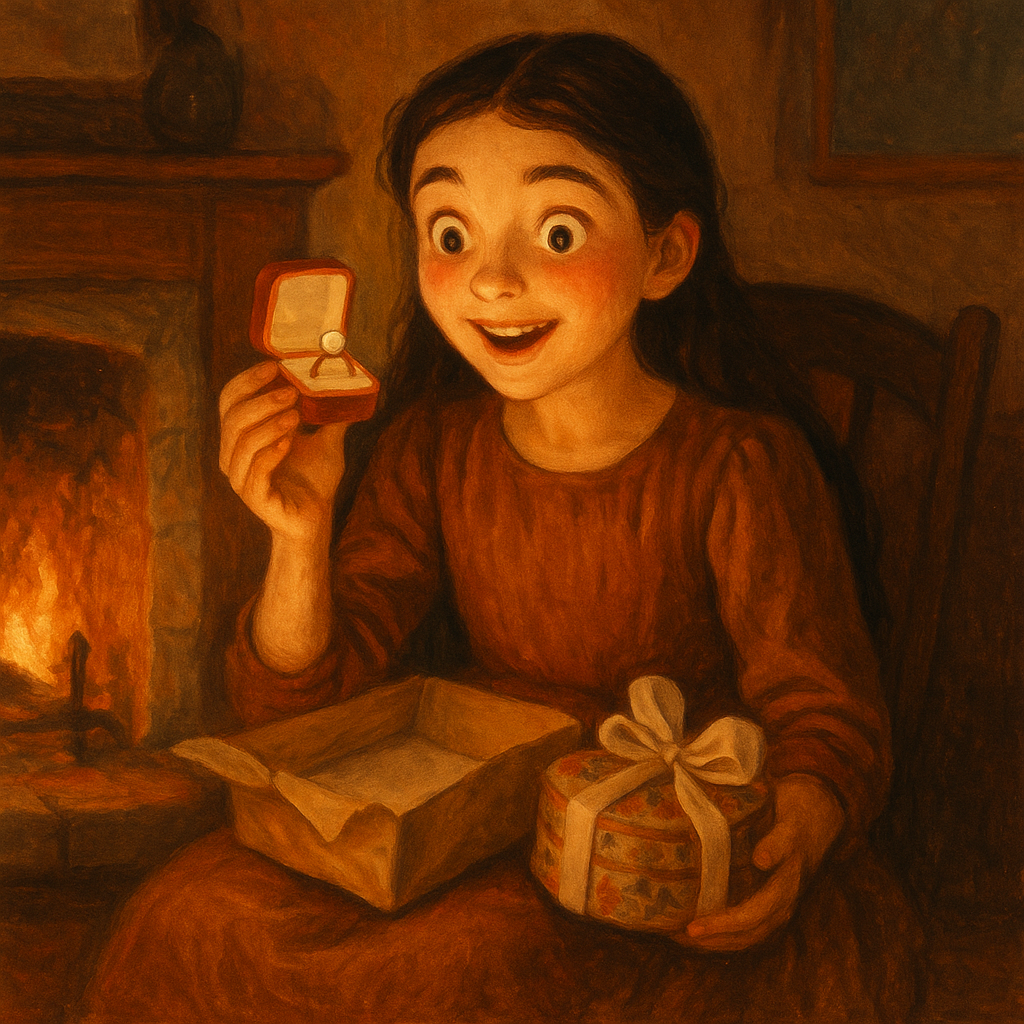
“Never mind — we’ve got it, and I’m going to sample it right now. Which will you have — buttercups or violets? Here’s all kinds: nut-caramels, nougats, fig paste — lumps of delight! Help yourself, Mother!” Martha rattled on, digging through the box. “Did I ever have a box of candy before? Oh — what is this, I wonder?” She pulled out a tiny box wedged between two candied apricots. “What do you think it is, Mother? ‘Something nice for Betsy Price’? It doesn’t exactly look like a sugar-plum.”
“It looks much more like a ring,” said Mrs. Redfield.
“And so it is. Why, Mother!“
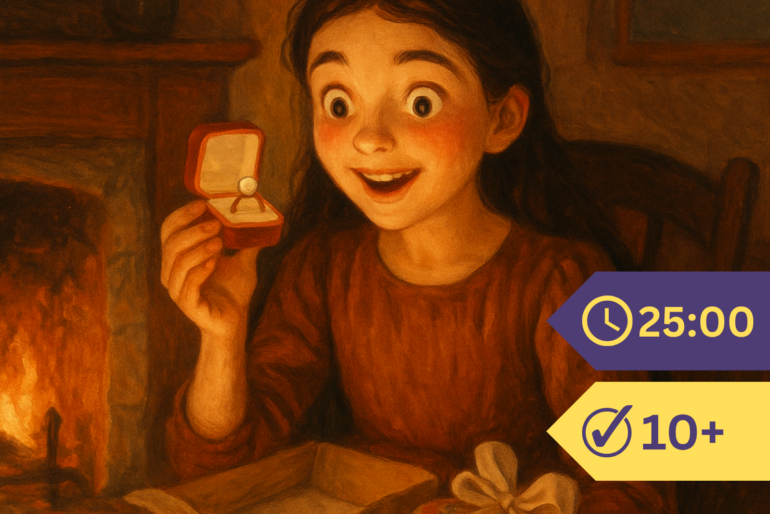
Martha’s eyes went wide as moons, for the lid of the little satin-lined case had sprung open to reveal a lovely single pearl set on a slim gold hoop.
“A pearl ring!” Mrs. Redfield exclaimed, equally startled. “Well, that is a surprise!”
Martha clasped her hands and rolled her eyes in theatrical delight. “The desire of my heart, the dream of my life!” she cried. “But it can’t be true. I’m asleep in the middle of a fairy tale. I shall wake up in the moonlight with a cold in my head, and the pearl will be a popcorn — I know it!”
“Don’t be silly,” said her mother. “If it’s a fairy tale, Cousin Jane is the fairy — as usual. Here’s her card.”
She had found a slip of card with Cousin Jane’s name on one side, and on the other, in prim, old-fashioned handwriting:
Merry Christmas to my dear Cousin, with the hope that this little gift will prove useful and ornamental.
The package addressed to Miss Mary Rutherford arrived at a very different sort of house from the plain little Redfield home. It was a delightful old red-brick place set among vines and shrubbery, with a big sunny parlour full of books, pictures, flowers, and singing-birds. Mary Rutherford was only a year older than Martha, but she was taller, better dressed, and carried herself like a young lady rather than a schoolgirl. She had soft white hands that had never been roughened by work, and sweet, graceful manners that made you certain she had always been shielded from anything disagreeable.
“What has Cousin Jane sent you, my dear?” her mother asked as the parcel was opened.
“Ye-s,” came Mary’s rather hesitant reply. “Pretty enough, I suppose. It seems to be a sort of work-bag.”
Mrs. Rutherford raised her eyebrows.
“A work-bag? How curious. Let me see it.”
Mary handed it over, and they inspected it together. It was quite large, made of plum-coloured silk with a sky-blue lining and satin drawstrings. A circle of small pockets, each embroidered with a motto in blue floss, ringed the outside; inside were scissors, a thimble-case, an emery-cushion, and a darning needle — all handsomely mounted in silver. The pockets were filled with papers of needles and spools of silk and thread. A completely furnished work-bag, in short, and thoroughly satisfactory — as a work-bag. As a gift, it seemed to be a failure.
Mrs. Rutherford looked curiously at the embroidered mottos.
“They’re nicely worked,” she said. “But I can’t quite make them out.”
“Oh, yes, Mama. One of them is, ‘Never too late to mend.'”
“Very appropriate, I’m sure.”
“But rather pointed, don’t you think? Another is, ‘A stitch in time saves nine.’ Does Cousin Jane think I go in rags and tags, do you suppose?”
“Oh, it’s only decoration,” said her mother. “It’s fashionable to revive old sayings.”
“Here is one from the Bible,” continued Mary. “‘Whatsoever thy hand findeth to do, do it with thy might.’ And here is another — from Proverbs, isn’t it? — ‘She worketh willingly with her hands.’ It’s a bagful of good advice. I dare say I needed it.”
“Did Cousin Jane’s card come with it?” asked Mrs. Rutherford. “Perhaps she didn’t send it after all. It would be much more like Grandmother Darrow.”
“No — here is the card:”
Kindest love to my dear Cousin, and wishing she may always possess the pearl of great price.
“What has the pearl of great price got to do with a silk work-bag, Mama?”
“I’m sure I don’t know. Unless she thinks that King Lemuel’s is the only pattern for a perfect woman.”
“It’s not quite clear, even so,” returned Mary. “But it is a handsome bag, at all events.”
She took it quietly to her room, and no more was said. But in her heart she was mortified and disappointed. Cousin Jane’s gifts to her had always seemed to confer a kind of distinction — the choicest books, the fine engravings on her bedroom wall, the Florentine mosaics that were her prettiest ornaments. Cousin Jane had never sent her anything commonplace. Far from expecting it this time, Mary had been hoping for something still more particular. It had been only a smiling remark of Cousin Jane’s — an allusion to her pretty hands — that had given her the idea. But I thought, she said to herself, hanging the bag on its hook, I did think she meant to send me a pearl ring.
In time Cousin Jane received two letters of acknowledgment. The first, from Martha, overflowed with gratitude:
How can I thank you enough, you dear, dear Cousin Jane, for your beautiful gift? Ornamental? I never had anything so ornamental before! And useful, too, in a way I feel better than I can express. How did you guess at the wish of my heart? It’s like a lovely dream come true. Thank you a thousand times for your constant kindness to —
Your grateful, affectionate,
Martha.
The letter from Mary Rutherford was cooler:
Dear Cousin Jane: Thank you very much for your kind gift. I hope it will help me to find “pearls of great price” — more than one of them, perhaps. I am ashamed to own that I have not been a diligent seeker after such treasure. But “it is never too late to mend,” and some day I hope you will see that your suggestions have taken effect. With best love from Mama and my brothers,
Your always affectionate cousin,
Mary Rutherford.
These letters puzzled Cousin Jane considerably. She read Mary’s twice over and laid it down with a sigh.
“It’s hardly what I expected from her,” she said to herself. “But poor little Martha is pleased, at any rate — more delighted with her work-bag than Mary is with her pearl ring. I took real pains with that ring, too. It’s a very fine pearl, whether she knows it or not. She never even mentions the candy, and I thought most girls were pleased with fancy chocolates. ‘Hopes I will see that my suggestions have taken effect’ — what does she mean by that, I wonder? I think I’ll have to write and ask her.”
But Cousin Jane was not one for personal letters. She had considerable business correspondence, and many other uses for her time, so she never did write. Several months later, however, she had occasion to visit the distant city where the Rutherfords lived, and after settling her affairs, she went to spend a night with her cousins.
It was always pleasant to visit them. Mrs. Rutherford was a gracious, gentle woman; her sons were intelligent, well-bred young men; and Mary — who had always been a lovely child — seemed to her now quite the ideal young girl, pure and fair as a lily. Secretly, Cousin Jane had always been a little sentimental about Mary Rutherford. She never said so to anyone; but in her heart, she loved her best of all the cousins.
That evening, as she sat alone with Mary in her room, she thought the girl looked more like a lily than ever. Mary had asked her to come in after saying good night to the rest of the family, and she began to talk with a sweet seriousness that her cousin found charming.
“I’ve been wishing for a long time to see you alone,” she said. “There were too many things to write, and I never can write a letter that satisfies me. But I did want you to know how much a certain present of yours has done for me.”
“Really? I wonder you don’t wear it, then!” — for Cousin Jane had noticed with surprise that the pearl ring was not on Mary’s finger.
“I can’t exactly wear it,” Mary answered, surprised in her turn. “But it has been about with me a great deal, I assure you. And without vanity, I think I can tell you that it has done a good work for an idle, self-indulgent girl.”
“If you are the girl, I never heard you described by those adjectives,” said Cousin Jane, warmly.
“Because everyone has spoiled me. You were the first to suggest to me that it was never too late to mend.”
“That’s news to me,” returned her cousin. “I never thought you needed mending. What do you mean, child?”
“Why, the work-bag, you know. Don’t you remember that beautiful silk bag, with the proverbs on the pockets, and the silver things inside? The card, too, with such a dear wish on it? Here it is — card and all. It has been my best friend ever since you sent it; though I’m ashamed to confess it was a disappointment — just at first.”
She took the work-bag from its hook and held it out before her cousin, who could hardly believe the evidence of her own eyes.
“What are you doing with Martha’s bag?” was her astonished outcry. “I never sent that to you. I sent it to Martha Redfield.”
“To Martha Redfield?” Mary repeated, dropping the bag in bewilderment. “What do you mean, Cousin Jane? Who is Martha Redfield?”
“One of my cousins — or at least, her father was. He’s gone now, and she and her mother have none too much to live on. Martha is in high school, and means to teach as soon as she can.”
“And you sent the work-bag to her? You meant the mottos for her? And the card too?”
“I never even noticed there were any mottos,” said Cousin Jane. “I bought the bag at the Women’s Exchange — it looked strong and serviceable, and I knew Martha would have plenty of use for such a thing. I put the silver scissors and so forth inside to make it a little more festive. As for the card” — holding it up to the light and studying it through her spectacles — “that has no business to be here. It should have gone with the pearl ring, of course.”
“The pearl ring!” exclaimed Mary, catching her breath.
“Certainly. The ring I sent you in a box of candy.”
“A box of candy, too? Cousin Jane!“
Mary sat down hastily and stared before her with an unusual expression. Her hands clenched in her lap; she bit her lip to hold back tears; and then she laughed, a little hysterically.
“I hope,” she sobbed, unable to control herself any longer — “I hope Martha Redfield is happy with my ring! It was the thing I wanted you to give me! And one doesn’t have a box of lovely chocolates every day, either — but you like a little — to offer your friends —”
She broke down; and Cousin Jane, seeing the truth at last, cried out indignantly:
“You shall have another box tomorrow! And Martha shall send back the ring. She might have known it wasn’t meant for her!”
“No, no, Cousin Jane! Please don’t!”
Mary pulled herself together with a visible effort.
“I couldn’t bear for that to happen,” she said, dashing away her tears. “Just think how she would feel! Oh, I know exactly how she would feel. Please don’t!”
“But I meant it for you,” protested Cousin Jane, clasping Mary’s hand and holding it fondly. “This is just the dear little hand to wear pearls. They suit it — and they suit you.”
“How sweet of you to say so!” Mary blushed with pleasure, but persisted. “Martha thinks you meant it for her, all this time — and how mortifying it would be for her now, to have to give it up! It was foolish and babyish of me to cry about it; I’m ashamed of myself. And really I couldn’t take it from her — I should always feel as if I had robbed her. Besides” — with a sunshiny smile and a squeeze of Cousin Jane’s hand — “I should have to give up my beloved work-bag, don’t you see? And I cannot possibly part with that. You listen now while I tell you what a Moral Regenerator my bag has been.”
There was a long talk after this — the kind of talk that girls pour out to sympathetic older people who are not their mothers or sisters. Cousin Jane discovered that, sweet and lily-like as Mary always seemed, she had been in danger of growing up indolent, purposeless, even a little selfish — and that the work-bag and its pointed mottos had opened her eyes to exactly that. Things were different now. It appeared that Mary’s mother had been relieved of various household cares — “all the mending, for instance!” — and that the Moral Regenerator had led to the organising of a small guild to work for the Children’s Hospital, where such work was badly needed. Mary was very simple and modest about it all, but very much in earnest, full of enthusiasm and self-forgetting energy. Listening to her, Cousin Jane thought that putting one’s heart into such work might be one of the ways of seeking — and finding — “the pearl of great price.”
Late the following afternoon, Cousin Jane stopped over between trains to call on the Redfields. She had faithfully promised Mary not to breathe a word about the mistake; but after that talk, she was curious to see whether the ring had a story to tell as well as the work-bag.
Fortunately, Mrs. Redfield was not at home. Martha sat alone in the little parlour, studying her lessons between firelight and twilight; but she sprang up to greet her visitor with delighted surprise.
“Cousin Jane! You’re the very person I was wishing for this minute. It’s like a fairy godmother who comes when you think of her.”
“Indeed? And why did you happen to think of a fairy godmother just now?” asked Cousin Jane, smiling as she took the armchair Martha pushed toward the fire.
“I don’t know. I was trying to study, but the firelight kept catching this —” she lifted her ring finger — “and then I fell to thinking of you, and wishing I could tell you something.”
“So you can, you see. I’ve come to listen.”
“I see you have! And it truly is like a fairy godmother,” cried Martha, her eyes bright with happy excitement. “Because it’s been a sort of fairy tale, you know, ever since I got my ring. Did you guess that it was going to make a real happy girl, a real good girl, out of crosspatch Martha?”
“Was she not happy and good before?” asked Cousin Jane.
“Well — not much. Not always, anyhow.”
Martha laughed and poked the fire until the sparks flew up.
“You see, it comes easy to some girls to be angels,” she went on, “but I’m not one of them.”
“Comes easy — why? Because their lives are easy?”
“Partly. It’s easier to be good when you’re comfortable, and you know your mother isn’t worrying about the house-rent, or the winter clothes, or ‘any old thing.’ But some girls are good in spite of all that — they’ve been born sweet, and troubles only make them sweeter. Little Martha was not cut from that pattern.”
“What is Martha’s pattern, then?” laughed Cousin Jane.
“She was cut on the bias, I’m afraid. And it made her pull the wrong way. She used to see everything through blue glasses.”
“Used to? And what does she do now?”
“She looks through a big, beautiful pearl,” said Martha, gaily, “and it makes all the difference in the world.”
“Suppose you tell me about it,” said Cousin Jane, very much interested.
“May I sit on the hassock at your feet while I tell you? And do you mind not having the gas lit?”
“Not at all. I can see your face by the firelight.”
“I think I did not want you to see my face,” Martha replied, settling herself on the hassock. “But no matter. I’m going to make an honest confession.”
“That’s always good for the soul, my dear.”
“You’ve been very good to Mother and me, Cousin Jane. And my name,” Martha began, “is Gip. Only you have to spell it backward.”
“Gip?” Cousin Jane looked puzzled.
“Spelled backward,” repeated Martha.
“Oh!” And Cousin Jane understood.
“Yes, just so. As I said — you’ve been awfully good to us, and Mother has been grateful. She has welcomed the new gowns and the old ones made over. She has blessed you, with tears in her eyes, for the cheques that carried her through tight places. As for me — I’ve said in my heart every time, ‘Cousin Jane treats us like paupers, and we are paupers; but I hate it — I hate it — I hate it! I wish she would ever send us something we didn’t need.'”
“Oh!” said Cousin Jane again.
“Yes, just so,” said Martha, her cheeks red with honest blushes. “I was as mean as that, and I never, never deserved to be rewarded with this dear, lovely ring. But all the same — it was a beautiful inspiration. What made you think of it, Cousin Jane? I wish you’d tell me!”
“Impossible, my dear,” replied Cousin Jane, remembering her promise to Mary. “Perhaps it was just a beautiful inspiration, as you say.”
“It has been one to me, at all events. I don’t know if I can make you understand — but it uplifted me, and it cast me down. It made me proud, and it made me ashamed.”
“They were natural feelings,” said Cousin Jane, kindly. “And both were wholesome.”
“You think so? Oh, you do understand!” Martha exclaimed with feeling. “I’m not a shining light yet — far from it. But whenever I look at this pearl, I think of what I ought to be, and it gives me some of the right kind of thoughts — it truly does.”
“I’m truly glad to hear it, Martha.”
“I thought you’d like to know — it puts a kind of pearliness into all my views of life. And on the other hand” — with a twinkle of honest mischief — “when the girls at school admire it and envy me, it’s no use denying that I do feel rather splendid.”
“You foolish child!” laughed Cousin Jane. But she liked the foolishness, and the girlish confidences, which were different from Mary Rutherford’s — but as natural and innocent in their own way.
Mrs. Redfield came in by and by, the lamp was lit, and Martha ran off to make a cup of tea. Afterward she walked with Cousin Jane down to the station. As she kissed her goodbye, Cousin Jane thought that her mistake had done no one any harm. On the contrary — it had shown her, as she might never have seen them otherwise, the true natures of two lovable girls.