Letter the First
New York, N.Y., December 26, 1904
Friend Wife,
The miserablest night I ever spent in all my born days — the solitariest, with no seconds — was this very Christmas night just past, in New York City. And I’ve been plenty lonesome in my time, I’ll tell you.
You remember how I once shipped before the mast — the wrong mast — and the old tub bumped a reef and went down with all hands except mine. I grabbed hold of a large wooden box and floated myself onto a dry spot, which knocked the wind out of my stomach considerable, but I hung on kind of unconscious till the tide went out. When I came to, I looked around to see where in the world I was and found I was on a little pinhead of an island about the size a freckle would be on the moon. All around was mostly sky, excepting for the water. And me with nothing to drink it with.
I sat down hard on the box and felt as blue as all the swear words ever sworn. There was nothing in sight to eat, and that made me so hungry that me and the box fell over backward together. As I lay there sprawled out with my feet up on the box, I looked between my knees and read those beautiful words — “Eat Buggins’ Biscuit” — in plain sight on the end of the crate.
Well, me and friend Buggins inhabited that place — about as big as one of Man Friday’s footprints — for going on four weeks. When the tide was in I held the box over my head to keep my powder dry. Along toward the end of my visit, just before the ship that saved me hove into sight, I began to feel a mite tired of the place. I thought I was unhappy, and I had a sneaking idea I was lonesome. But I see now I was mistaken. I hadn’t spent a Christmas night alone in a big city yet.
Then there was the time I was prospecting for our mine and got snowed up in a pass. I reckon I’ve told you how I caught typhoid fever and wrestled it out all by my lonesome — unparalleled thirst, delirium dreams, and a self-acting stomach, down to the final blissful “Where am I at?” and on through the long convalescence till my limbs changed from twine strings back into human members. Six weeks doing time as doctor, patient, trained nurse, and fellow-Mason all in one — that was being alone right smart. But it wasn’t a patch on the little metropolis of Manhattan on Santa Claus Day.
Then there was the rather unrestful evening out in western Texas, when a fellow sold me a horse right cheap and later a crowd of gentlemen accused me of stealing it, and I was put in jail with a promise of being lynched before breakfast. That was uncomfortable some, too. But I wished last night that my friend Judge Watson hadn’t come along that night and identified me. It would have saved me from New Yorkitis.
Then there was the night when I proposed for your hand and you sent me to your pa, and he said if I ever came near again he’d sic the dogs on me. I spent that night at a safe distance from the dogs, leaning on a fence and not noticing it was barbed wire till I looked at my clothes and my hide the next morning. I watched your windows till the light went out and all my hope with it — and on after that till, as the poet says, till daylight doth appear.
But there’s no use making a catalog of every time I’ve been lonesome. The point is: last night beat everything else on my private list of troubles. My other lonely times were when I was actually alone. But the lonesomest of all was in the heart of the biggest crowd on this continent.
There were people aplenty. But I didn’t know one gol-darned soul. I had plenty of money, but nobody to spend it on — except tip-takers. I was stopping at a big hotel with luxury spread over everything, thicker than sorghum on corn pone. But lonely — honey, I was so lonely that as I walked along the streets, I felt as if I’d like to break into some of those homes and compel the family at gunpoint to let me sit in and dine with them.
I felt like asking one of the bellboys to take me home and get his mother to give me a slice of goose and let her talk to me about her folks.
There were some four million people in a space about the size of our ranch. There were theaters — but who wants to go to the theater on Christmas? It’s like going to church on the Fourth of July. There were dime museums, penny vaudeville shows, dance halls. There was a big dinner for newsboys; the Salvation Army and the Volunteers gave feeds to the poor. But I couldn’t qualify. I wasn’t poor. I had no home, no friends, no nothing.
The streets got emptier and emptier. A few other wretches were marooned like me in the hotel corridors. We looked at each other like sneak-thieves patrolling the same street. Waiters glanced at us with something like pity, as much as to say: “If it weren’t for strays like you, I’d be home with my kids.”
The worst of it was, I knew there were thousands of people in town in just my fix. Perhaps some of them were old friends of mine I’d have been tickled to death to meet up with — or at the very least people from my state. Texas is a big place, but we’d have been brothers and sisters — or at least cousins once removed — for Christmas’ sake. But they were scattered around at the St. Regis or the Mills Hotel, the Martha Washington or somewhere, while I was at the Waldorf-hyphen-Astoria.
It was like those two men that Dickens — I believe it was Dickens — tells about. Somebody gives fellow A a concertina, but he can’t play; winter’s coming on and he has no overcoat. He can’t wear the concertina any more than he can tootle it. A few blocks away is Mr. B, who can play a concertina something grand, but he hasn’t got one and his fingers itch. He spends all his ready money on a brand-new overcoat, and just then his aunt sends him another. He decides to swap one overcoat for a concertina, and advertises in an exchange column. About the same time, A advertises that he’ll trade one house-broken concertina for a nice overcoat. But does either A or B ever find the other’s advertisement? Not on your life.
That was the way with all of us in New York. The town was full of lonesome strangers, and we went moping around, stumbling over each other and not daring to speak.
They call us “transients” here. It’s like a common sailor lost at sea — he’s only a “casualty.” So us poor homeless dogs in New York are only transients. Do you know, I was so lonely I could have stood out in the square like a lonely old cow in the rain and just mooed for somebody to take me in.
I’d have telegraphed for you and the children to come to town, but Texas is so far away and you’d have got here too late — and you couldn’t come anyway, being sick as you wrote me, and one of the kids having malaria. How is his blessed self today? I hope you’re feeling better. Telegraph if you aren’t, and I’ll take the first train home.
Well, last night I ate a horrible mockery of a Christmas dinner in a deserted restaurant, and it gave me heartburn (in addition to heartache) and a whole stable of nightmares. I went to bed early and stayed awake late. Lord, that was an awful night.
I tried Philosophy — the next station beyond Despair. I said to myself: “You old fool, why in the name of all that’s sensible should you feel so excited about one day more than another?” I wasn’t so lonely the day before Christmas; I’m not so lonely today — but on Christmas itself I was like a small boy with the mumps and the earache on the Fourth of July. The firecrackers will pop just as lively another day, but — well, the universe was simply thrown all out of gear.
You remember reading me once about Mr. Aldrich’s idea of the last man on earth — everybody killed off by a pestilence, and him sitting there all by his lonesome, and what would he have done if he’d heard his doorbell ring? Well, I reckon he’d have done what I’d have done if I’d met a friend — given one wild whoop, wrapped his arms around the man’s neck, kissed him on both cheeks, and died with a faint gurgle of joy.
Finally, I swore that if I ever found myself corralled again in a strange city on Christmas, I’d put on a sandwich board and march up and down the streets with a sign like this:
I’m lonely!
I’m homesick for a real Christmas!
There must be others.
Let’s get together!
Meet me at the Fountain in Union Square!
We’ll hang our stockings on the trees.
Perhaps some snow will fall in ’em.
Come one — come all! Both great and small!
I bet such a board would stir up a procession of exiles a mile and a half long. We’d get together and have a good crying match on each other’s shoulders and wring each other’s hands while the band played “Auld Lang Syne.”
But it’s over now. I’ve lived through the game of Christmas solitaire in a big city, and I feel as relieved as a man just getting out of a dentist’s office — missing a few molars and aching considerable, but full of a pleasing emptiness.
Let me say right here, and put it in black and white: if I’m ever dragged away from home again on Christmas, I’ll take laughing gas enough for a day and two nights — or I’ll take some violent steps to get company, even if I have to hire a horse and a lasso and round up Broadway like a herd of unbranded stray cattle.
This is a long letter for me, honey. Love and kisses to the sweet little kids and to the best wife a fellow ever had.
Your loving,
Austin
P.S. I pulled off the deal all right. The syndicate buys the mine. I get five hundred thousand in cash and five hundred thousand in stock, and I start for home in three days. We’ll hang our stockings on New Year’s Day.
Letter the Second
New York, N.Y., December 28, 1905
Friend Wife,
Well, I’ve been and went and gone and done it! And golly, but it was fun — barring wishing you and the little ones had been here too. Next year we’ll arrange it, for I’m going to do it again. You remember Artemus Ward’s man who “had been dead three weeks and liked it.” Well, that’s me. This camping out in New York is getting to be a habit. I’m sending you a bundle of newspaper clippings as big as a stovepipe hat — all about Yours Truly.
As you may recall from my last Christmas letter, the Fates accepted my challenge. After a series of financial strokes, I’d felt rich enough to spend a year abroad with the family. But a cablegram called me to America in early December for a directors’ meeting, and I left you all in Italy expecting to return at once. A legal complication kept me postponing from day to day, until finally an important hearing — in which I was a valued witness — was postponed until after the holidays. I found myself faced with another Christmas far away from my people. The first two days I spent in vigorous profanity, declining invitations from business acquaintances to share their homes. Then I set out to make the occasion memorable.
“If I’ve got to be alone this Christmas,” I said to myself, “I’ll make it the gol-blamedest, crowdedest solitude ever heard of this side of the Mississippi.”
I looked for the biggest place in town under one roof. Madison Square Garden was it. You remember it — we were there together for the Horse Show, so-called. The Garden holds a right smart number of people; at a political meeting once they got fourteen thousand in, with still room for Grover Cleveland to stand and make a speech.
Well, feeling flush and reckless, I decided to go see the manager — or janitor, or whatever he is. And go I did.
“Could I rent your little establishment for one evening?” I said. “Christmas night?”
“Certainly, sir,” says he. “There happens to be nothing doing this Christmas.”
“How much would it set me back?” says I, very polite.
“Only one thousand dollars,” says he, smiling.
“My dear fellow,” says I with a low bow, “I don’t want to buy your establishment. I only want to borrow it for one evening.”
“One thousand is our bargain-counter limit,” says he. “I couldn’t go lower for the Czar of Russia.”
I hesitated, remembering the time when a thousand dollars would have kept me comfortable for about three years. It’s hard to get over the habit of counting your change. Then the manager, seeing me groggy, turned a little less polite.
“If that’s more than you care to pay for a single room, you can get a cot for five cents on the Bowery.”
That riled me. I flashed a wad of bills on him that made his eyes look like two automobile headlamps. He could see it wasn’t funny money, either. I shifted my cigar and said:
“I was only hesitating, my boy, because I wondered if your nice Garden would be big enough. You haven’t got a couple more to rent at the same price?”
He wilted and caved in like a box of ice cream just before you get it home. He began to bow lower, and we cut for a new deal.
He asked what might I be wanting to use the Garden for.
“Oh, I won’t bulge the walls or strain the floor,” I said. “I only want it for a Christmas tree. I’m going to invite my friends to a little party.”
“Whew, but you must be popular!” he says. “Who on earth are you?”
“I’m Colonel D. Austin Crockett, of Waco,” I said, as meek as I could manage.
“Pleased to meet you, Colonel. What are you running for? District Attorney?”
“Neither. I’m a stranger in New York.”
“But these friends of yours — is all of Waco coming up on an excursion?”
“If you’ll stop cross-examining a minute,” I said, “and let me explain, it will save considerable time. I am a stranger here to about four million people. They are strangers to me. We ought to know each other. So I’m going to give a little Madison Square Garden warming and invite them in.”
“What are you going to sell them?”
“I’ve nothing to sell. I’m going to entertain them.”
“Well, I’ve heard of Southern hospitality,” says he, “but this beats me. How much you going to charge a head?”
“Nothing. Everything free. Admission included.”
“Absolutely not,” he exclaimed. “Not in my building. Not for ten thousand dollars. Do you realize that if you offered these New York, Brooklyn, Bronx, Hackensack, and Hoboken folks a free show, more than two thousand women would get trampled to death? Did you ever see a bargain-counter crowd on Twenty-third Street? That’s only for a chance to get something they don’t want at a cut price. But a genuinely free show — there are enough Take-One people in these parts to fill the old Roman Coliseum.”
Well, the upshot was, he persuaded me to charge an admission. We settled on one dollar a head. I wrote out a card and sent it to all the papers at advertising rates. It cost a right smart sum, but it looked neat:
TO EVERY STRANGER IN NEW YORK, AND HIS LADY
If you are not otherwise engaged on Christmas night, the honor of your presence at Madison Square Garden is requested by
David Austin Crockett
Colonel, Fifth Texas Cavalry, C.S.A.
Music, Dancing, Refreshments, Souvenirs.
For the purpose of keeping out the undesirable element, a charge of $1.00 will be made.
I knew those magic words “Refreshments” and “Souvenirs” would hit ’em hard. I asked the papers to give the event some editorial notice, but they were very cold about it and said the best they could do was send their dramatic critics to review the show afterward. A lot of good that would do me. So I took more advertising space.
In a day or two I was visited at the hotel by one of the most impertinent young fellows I ever met up with. He sent up a card: James J. James, Publicity Expert. I said to show him in, and he sort of oozed through the door — he was that oily. He looked around to see if we were alone, then winked slow and important.
“What’s your game, Colonel? I can’t quite make it out. It looks like a new scheme, all right, but it ain’t quite as slick as it ought to be.”
“Look here, you cub,” I roared, “if you imply I have any crooked motives in this, I’ll shoot you so full of holes you’ll look like a mosquito net!”
He wasn’t a bit scared. He simply winked the other eye and said in a kind of foreign-sounding language:
“Forget it, Colonel! Cut it out! My business is producing fame, not merit. Once more I ask — what’s your aim here?”
I overcame a desire to kick him through the ceiling and told him I proposed to entertain the strangers in New York.
“Strangers in New York? Why, that means everybody! There’s been only one man born in New York since the war, and he’s kept in a jar at a dime museum. Your idea is to give old New York a Christmas party. Very pretty! But if you insist on spending money all over the place, you might as well get a run for it. What you want is a press agent. People in New York can’t understand or believe anything except through the language of the press agent. You take one on your staff, and in three days you’ll be so famous that if a child in kindergarten is asked who is the Queen of Holland, it will answer: ‘Colonel Crockett, of Waco.'”
Well, he poured out the most remarkable string of talk I ever heard, and before I knew it he had made me promise to trust my scheme to him, to be surprised at nothing that might appear in the papers, and to refer all reporters to him.
The next morning I found my name on the front page of every journal, with my picture in most of them. The stories were entirely invented — I had apparently stopped runaway carriages on Fifth Avenue by lassoing the lead horse, broken up a music-hall show by showering the chorus girls with diamonds, captured three burglars in my hotel room and sent them away with a hundred-dollar bill each to help them resist temptation, and been asked simultaneously to be president of all three of the big life insurance companies. And so on — you can read for yourself in the clippings, only for heaven’s sake don’t believe any of it. In every article was a neat allusion to my Christmas party.
I wanted to find James J. James and have strong words with him, but he dodged me around the city. He kept his word, though. For the last few days I’ve been the most talked-about man in New York.
And now — to tell about my little party.
For two days a regiment of men was working in the Garden under my direction and at my expense. It was like paying the war appropriation of a small country. But it was worth it.
At six o’clock Christmas night, the crowd began to line up at the doors. At six-thirty, a platoon of police arrived. By six-forty, the line had reached twice around the Garden. At six-forty-five they sent for more police. By seven-fifteen, every street was solid with people. They called out the reserves. The fire department came and played the hose on the outer edges of the crowd, which thinned things off somewhat. The ambulances gave out and the fainting women were carried home in express wagons and wheelbarrows. The subway was the only line that could run cars.
At eight-thirty the doors opened. You should have seen the rush. The Galveston flood wasn’t in it.
At eight-forty-five, the Garden was full and they closed the doors.
The Garden was a beautiful sight. On the tower outside, in big electric letters, there was a sign: MERRY CHRISTMAS TO YOU AND YOURS.
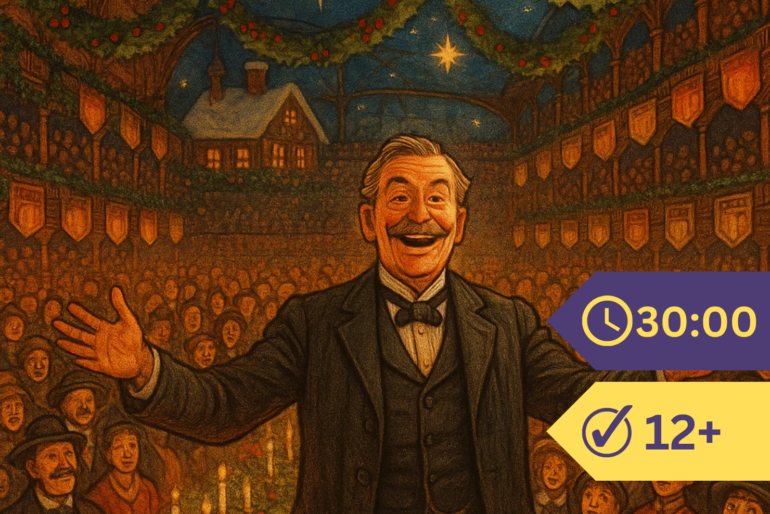
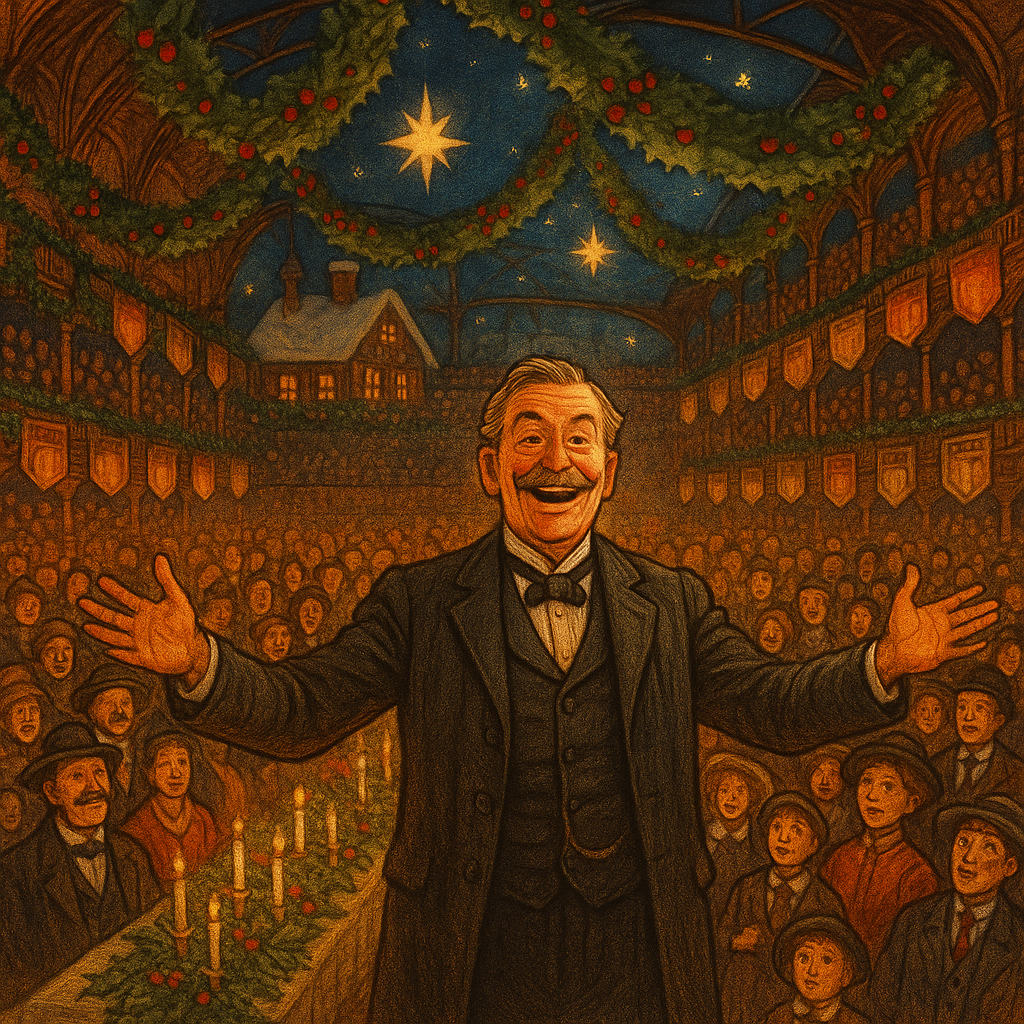
Inside, it was decorated with holly leaves and berries — tons and tons of it. At one end was built a big house with a chimney and an old-fashioned fireplace. The roof of the house was covered with cotton snow, and the sky behind it was full of electric stars that twinkled something beautiful. There was a moon that looked like the real thing.
Four bands played from the balconies, and a chorus of angels with real wings and electric halos sang “Peace on Earth, Good Will to Men.”
By and by all the bands burst out gorgeous, and then Santa Claus appeared in a sleigh drawn by six real stuffed reindeer. He ran along the sky on hidden grooves and drove up to the roof of the house and slid down the chimney with a pack of presents. He filled all the stockings with candy and toys, and attendants passed them out to the children. You should have heard them squeal with joy — poor little ones, living in hotels and apartments where Santa Claus would have had to come up through the steam radiator or the gas-log pipe to get in. My Santa Claus had to make sixteen trips to satisfy them all.
The Garden was divided into sections, one for every state and territory, each with its own shield in electric lights and colors. There was a native of every state in charge, and every state had its own Christmas tree, reception room, and refreshments. Some of the people I noticed seemed to have been born in several states at once, the way they passed from one booth to another filling up their pockets and stomachs. I reckon they paid for it the next day in doctors’ bills.
But there was not a sign of rowdiness. That dollar admission was a regular sieve for straining out the rough element. There were policemen everywhere, and every other man was a plain-clothes detective. And on advice from the management I cut out all drinks except soft stuff. So there were no jags, except what some folks had brought from their Christmas dinners and loaded plum puddings.
And then, of course, that peculiar something that gets into us all at Christmas time filled everybody with a sort of loving fellowship and a hankering to hug their neighbors.
In the center of the hall there was a big sign in electric letters:
EVERYBODY IS HEREBY
INTRODUCED TO EVERYBODY ELSE
— FOR TO-NIGHT ONLY —
At every state booth you’d see people gathering and recognizing old friends or introducing themselves to new ones. At the Texas booth there was a tremendous crowd. A lot of them turned out to be old friends of ours — school friends of yours, ranch friends of mine, people I had worked for, people who had worked with me. A lot of them sent their love and a Merry Christmas to you.
I had advertised that people who wanted to exchange Christmas presents could have them hung on the State trees, and my attendants handed out claim checks. There weren’t many mix-ups. Old Miss Samanthy Clay got a box of cigars meant for Judge Randolph, and he got a pair of silver-buckle garters meant for her. But most things came out right, and several people were so surprised at getting presents in New York that they burst out crying. Major Calhoun’s whiskers were soaking wet with tears when he got a bottle of fine bourbon from Judge Payton.
Rich folks who had once been poor men met people from the old days who had watched their rise. But the Christmas spirit made them forget to be snobs. You’d hear millionaires telling plain people how they used to scrape and save to buy their mothers little Christmas gifts — what ridiculous things they used to give and get!
All evening, as fast as anybody went out, they let somebody else in. Along about eleven o’clock people began to go home, then a new crowd came in — folks who had put the children to bed and came back for more fun, and others who had spent the evening at dinner and drifted over late.
All the theater people and singers came. Some of them told me what a godsend such a gathering was to them, homeless by profession. A lot of them brought their wives and babies. One father was playing Romeo in Newark, his wife was playing Little Eva in Harlem, and their daughter was playing Camille on Broadway — you should have seen the three of them rejoicing around the Kansas tree!
About midnight the big refreshment hall was opened, and everybody who could squeeze in sat down to long tables where I had supper served. I had some of the best after-dinner speakers in town — Mayor McClellan gave us all a welcome, and then there was Chauncey Depew, and Simeon Ford, and Augustus Thomas, and Wilton Lackaye, and General Horace Porter, and a passel of others. They all made the most surprising toasts to your poor old husband. They called me Daddy and sang about me being a jolly good fellow. One of them christened me “Santa Crockett.” Why, my ears burned so hot I nearly set my collar on fire. It sure was worth everything I spent, and I had a terrible time keeping from blubbering. I must have swallowed about four hundred Adam’s apples.
Finally they called on me for a speech. I just kind of stammered — I don’t know what I said. The papers report it this way: “Merry Christmas, my children! This old world sure is some comfortable, after all. The only trouble is that the right people can’t seem to get together at the right time often enough. But this Christmas supper tastes to me terrible much like More. I’m going to try it again. And I hereby invite you all that ain’t in any better place or any better world to meet me here a year from to-night. And so God bless you all — and God bless everybody!”
Then after a lot of singing and hand-shaking we all went home, tears in every eye and smiles on every mouth. The leftover food and toys made more than the twelve baskets full of Scripture. I sent them around to the hospitals and orphanages. I’ve already engaged the Garden again for next Christmas and paid a deposit. It’s not the extravagance it looks, either — while my expenses were high (twelve thousand-odd dollars), they took in at the door nearly eighteen thousand. I sent the profit to the Salvation Army and the Volunteers, and now I’m being prayed for and hallelujah-ed everywhere there’s a bass drum. But I’d do it again if it cost me twenty thousand. It’s worth that and more to have your heart nearly break wide open with joy and fellowship.
It was broad daylight when I got to bed, worn out with happiness. I curled up like I was a little boy again in the days when I used to get up Christmas morning, cold and early, look at my presents, and then crawl back under the covers with a double armful of toys to keep warm and sleep some more.
If only you and the chicks had been there! Next time, you shall be.
Your loving,
Austin