I.
Once upon a time — fairy tales always begin with once upon a time — there lived in a fine old castle on the Rhine a certain Baron von Schrochslofsleschshoffinger. You will not find it an easy name to pronounce; in fact, the baron never tried it himself but once, and was laid up for two days afterwards. So we shall call him “the baron” for shortness, particularly as he was a rather dumpy man.
After hearing his name, you will not be surprised to learn that he was an exceedingly bad character. For a baron, he was considered enormously rich — a hundred and fifty pounds a year would not be thought much in most places, but it will buy a great deal of sausage, which, along with wine grown on the estate, formed the chief sustenance of the baron and his household.
Notwithstanding this princely revenue, the baron was never satisfied. He oppressed and ground down his unfortunate tenants to the very last penny he could squeeze out of them. In all his exactions he was aided and encouraged by his steward Klootz — an old rascal who took a malicious pleasure in his master’s cruelty, and chuckled and rubbed his hands with apparent delight whenever any of the poor farmers couldn’t pay their rent, or gave him any opening for oppression.
Not content with making his tenants pay double for the land they farmed, the baron would go round periodically to their cottages and help himself to anything that caught his eye — a fat pig, a side of bacon, whatever was to hand. Things went from bad to worse, and by the time our story begins, between the alternate squeezings of the baron and his steward, the poor tenants had very little left to squeeze out of them.
The only help the poor souls had was the baron’s daughter, Lady Bertha, who always had a kind word — and frequently something more substantial — for them when her father was out of the way.
I am not going to describe Bertha, for the simple reason that if I did, you would suppose she was the fairy I’m going to tell you about, and she isn’t. I will say only this: she was exceedingly tiny — the nicest girls always are — with long silken black hair and a dear dimpled face full of warmth and mischief. Fill in the rest with the details of the nicest girl you know, and you will have some idea of her. On second thought, I don’t believe you will, because your portrait won’t be half good enough — but it’ll do.
Bertha was naturally distressed at her father’s goings-on and did her best to make amends. She quietly arranged for portions of the castle larder to find their way back to the families from whom they’d come. And when the baron tried to be too friendly with one of the maids — which he occasionally did after dinner — Bertha had only to say, in a tone of mild remonstrance, “Pa!” and he dropped the matter instantly and stared very hard at the far wall.
Bad as this disreputable baron was, he had a real respect for his daughter’s goodness. Like a lion tamed by Una’s innocence, the rough old rascal seemed to lose half his roughness in her presence. She operated on him as a moral restraint — which was possibly why he never stayed downstairs after dinner, but always retired to a favourite turret. Once he was settled with his second bottle, off went Bertha with her maid and a basket, to leave meals with the poor tenants who always received her with blessings.
Of late, however, another reason had led her to take even greater interest in her walks, and she occasionally returned with brighter eyes and a rosier cheek than the gratitude of her pensioners alone could explain.
The fact was, some months before, Bertha had noticed a young artist who seemed fated to be sketching points of interest in whatever road she had to take. There was one particular tree, exactly in the path from the castle gate, which he had sketched from at least four different angles — and Bertha began to wonder what on earth could be so very remarkable about it.
At last, just as Carl von Sempach had begun seriously to consider whether he might climb the tree and sketch it from the inside, a small accident settled matters for him. The maid — possibly paying more attention to the handsome painter than to the road — stumbled and fell. The basket fell too. Carl, as a gentleman, could do no less than help gather up the young woman and the dinner, and so the acquaintance was made.
It was not allowed to drop. Handsome Carl and good little Bertha were soon head over heels in love, with serious thoughts of a cottage in a wood, and so on — when their happiness was disrupted by being spotted, on one of their walks, by the baron.
The baron, being a thorough aristocrat, had naturally higher plans for his daughter than a “beggarly artist,” and accordingly he stamped, and swore, and threatened Carl with everything from heavy boots to blunderbusses if he ever came near the castle again.
This was unpleasant — but I fear it did not entirely put a stop to the young people’s meetings, though it made them less frequent and more secret than before.
Now, I am perfectly aware this was not at all proper. No correctly regulated young lady would have secret meetings with a young man her father hadn’t approved. But then, consider what a dreadful old tyrant of a father she had. It’s my sincere belief that if you had been in her shoes (they would have been three sizes too small for you, but never mind), you would have done precisely the same.
Such was the state of things on Christmas Eve — fairy tales never have a year to them, so I shan’t give one — only, if anything, rather more so.
The baron had woken in an exceedingly bad temper, and everyone in the castle had felt its effects all day. His two favourite wolf-hounds, Lutzow and Teufel, had received so many kicks from his heavy boots that they hardly knew which end their tails were on. Even Klootz himself scarcely dared approach his master.
At midday, two of the principal tenants came to ask for a little more time to pay their rent. The baron was only too glad to have a fair excuse to vent his ill-humour. He heaped the poor fellows with every abusive name he could think of — being called names in German is no small matter, I assure you — and swore by everything he could think of that if their rent was not paid by tomorrow morning, their families would be turned out into the snow, which was at that moment lying many inches deep on the ground.
They were still begging for mercy when the baron, now thoroughly enraged, decided to throw them out himself. He chased them as far as the outer door — and there found fresh fuel for his anger.
Carl, who still managed to visit Bertha despite the paternal prohibition, had come to wish her a happy Christmas. He was saying his farewell at the front door, beneath which a great bush of mistletoe hung in time-honoured fashion. What they were doing under it at the precise moment of the baron’s arrival I cannot say with certainty — but his fury was tremendous.
His language was quite unfit for print. He swore until he was purple in the face, and if he had not providentially been seized with a fit of coughing — and sat down heavily in the coal-scuttle, mistaking it for a three-legged stool — there is no knowing what might have followed.
Carl and Bertha helped him up: somewhat blackened behind, but otherwise not much the worse. The interruption seemed to have broken the peak of his temper; after swearing a little more while Carl made his departure, the baron appeared, if not cheerful, at least slightly less volcanic.
II.
After so eventful a day, it is hardly surprising the baron felt in need of consolation. He changed his trousers and retreated to his favourite turret, where he settled down to address the irritations of his mind by copious and systematic means.
Bottle after bottle was emptied; pipe after pipe was filled and smoked. The fine old Burgundy was gradually working on the baron’s head, and he was beginning to feel more comfortable.
The winter afternoon had deepened into evening twilight, dimmed further by the slow aromatic clouds from the baron’s pipe. They curled upward to the carved ceiling of the turret and spread into a canopy that grew lower with every successive puff. The fire — piled mountain-high earlier that afternoon — had reached that state of perfection beloved by lazy men everywhere: it no longer needed any attention, but simply burned itself hollow, tumbled inward, blazed cheerfully for a moment, then settled into a warm glow and did the whole thing again. The carved heads of improbable men and impossible women, worked so cleverly around the panels of the old oak wardrobe opposite, flickered and nodded in the firelight like old acquaintances.
The baron was gazing at this carving and emitting volumes of smoke with leisurely reflectiveness, when a clatter among the bottles on the table made him turn round.
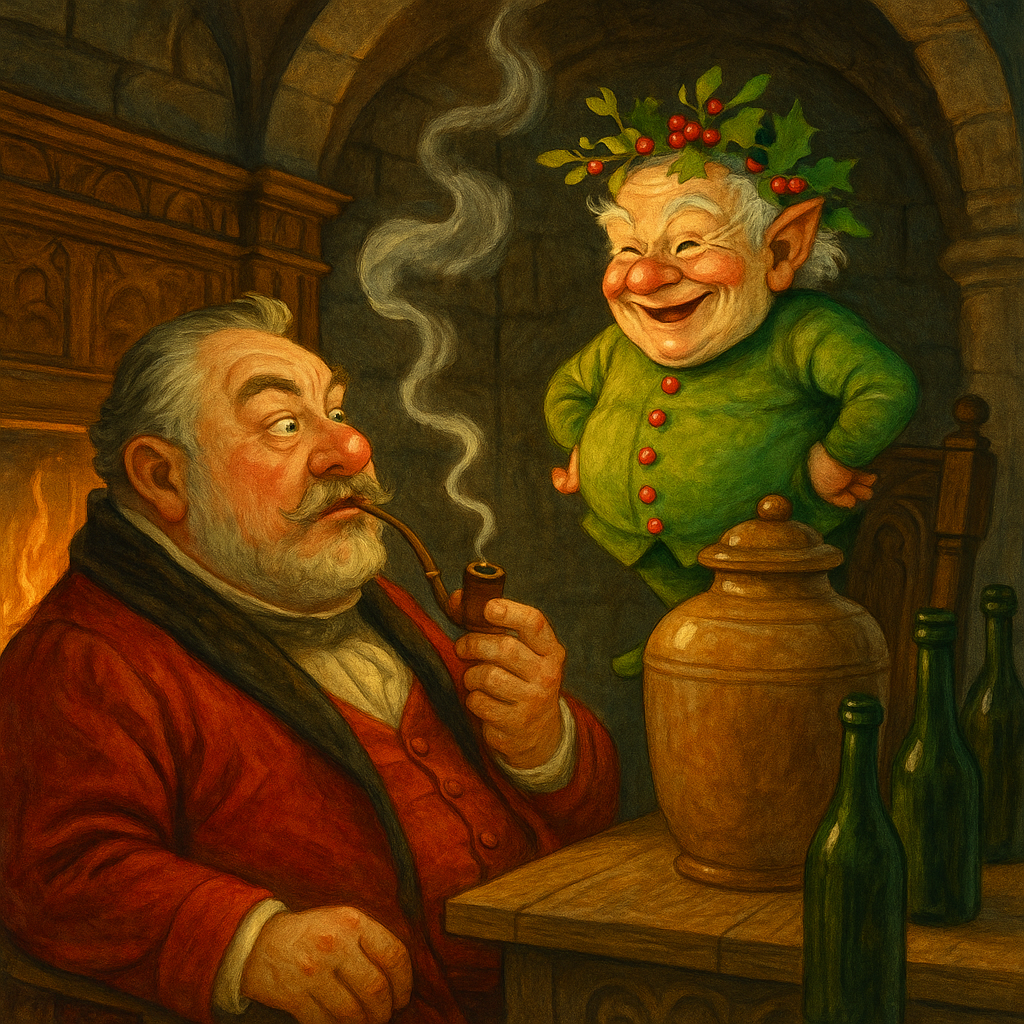
He was not a nervous man. Nevertheless, what met his eyes did unsettle him somewhat, and he was obliged to take four distinct puffs before he had recovered enough to say, “Who the — Pickwick — are you?” (The baron actually said “Dickens,” but as that’s a strong expression, we’ll substitute something milder.)
Before I let the visitor answer, I ought to describe him.
If this were not a true story, I should have preferred to make him a figure of manly beauty. But I am committed to accuracy: he was not what most people would call handsome — not in figure, anyway, though his face was quite another matter.
His body was roughly the size and shape of a large plum pudding, clothed in a tightly-fitting bright green doublet with red holly berries for buttons. His limbs were long and slender in proportion to a height of not more than three feet. Around his head he wore a crown of holly and mistletoe, the round red berries sparkling amid silver-white hair.
But the face! It would have done anyone good just to look at it. Despite the silver hair and an occasional wrinkle around the laughing eyes, it seemed to brim with perpetual youth. His mouth — well furnished with sound white teeth that looked perfectly capable of doing justice to any holiday feast — was always curved in a warm, beaming smile that broke into hearty laughter every now and then. Fun and good fellowship were in every feature.
This personage was, at the moment the baron noticed him, comfortably perched on top of the large tobacco jar on the table, nursing his left leg.
“You don’t ask very nicely, old gentleman,” he replied. “But I don’t mind telling you. I’m King Christmas.”
“Eh?” said the baron.
“Ah!” said the goblin. (You’d guessed he was a goblin by now, of course.)
“And what’s your business here?” said the baron.
“Don’t be crusty,” the goblin replied. “I merely looked in to wish you the compliments of the season. Talking of crust — what sort of wine is this?” He helped himself to a generous pour from the baron’s very best flask. He held the glass sideways, then the other way, winked at it twice, sniffed it, and went through the remaining ceremony that connoisseurs favour. Then he drank it with great deliberation and smacked his lips expertly. “Johannisberg — not half bad, for you. But I’ll tell you what, baron: you’ll need to bring out something better than this when I next put my feet on your table.”
“Well, you’ve got some cheek,” said the baron. “Still — you’re rather amusing. Now you’re here, we may as well be comfortable. Smoke?”
“Not anything you’re likely to offer me.”
“Confound your impudence!” roared the baron. “That tobacco is as good as any in all Rhineland.”
“Nasty cough you’ve got, baron. Don’t excite yourself, my dear boy. I mean no offence — you speak according to your experience, which is all any of us can do. Try one of mine, and I think you may change your mind.”
The baron took the offered cigar. Not a word passed until it was half consumed, at which point the baron removed it from his lips for the first time and said, softly, with the air of a man sharing a remarkable discovery, “Das ist gut.”
“I thought you’d say so. And now, since you like the cigar — would you try a small glass of what I call wine? I must warn you: it’s rather potent, and may have effects you’re not accustomed to.”
“Never mind that, if it’s as good as the cigar,” said the baron. “I’m still four bottles short of my usual tally.”
“Well — don’t say I didn’t warn you.” From some mysterious pocket the goblin produced a big-bellied black bottle crusted with the dust of what looked like several ages. It struck the baron as peculiar that the bottle, now that it appeared, seemed nearly as large around as the goblin himself — but he was not a man to be thrown by trifles, and he pushed his glass forward as composedly as if the whole business were perfectly ordinary.
The glass was filled. The baron drank. He said nothing — but he pushed his glass forward again, which said everything.
“Aha! You’re smiling,” said the goblin. And so the baron was — actually smiling, a thing not witnessed in living memory by anyone in the castle. “That’s the stuff, isn’t it?”
“I believe you, my boy!” The baron laid his hand on his chest, not on his stomach, which surprised even himself. “It warms one here.”
“The spell is beginning,” said the goblin. “Another glass?”
The baron had another. The smile on his face expanded into something so genuinely warm that his entire countenance was transformed. You would not have known him.
“Upon my word,” he said at last, “I feel so light I almost think I could dance. I used to be able to. Shall I try?”
“If you ask my opinion,” the goblin replied, “decidedly no. The spirit is willing, but trousers are fragile, and you might split them.”
“By thunder, so I might. I didn’t think of that. But I feel I must do something youthful!”
“That’s the effect of your change of nature,” said the goblin. “Don’t worry — I’ll give you plenty to do presently.”
“Change of nature? What are you talking about, you old conundrum?”
“You’re another. But listen: what you’re feeling is the consequence of my magic wine. It has changed you into a fairy. That’s what’s the matter.”
“A fairy! Me!” exclaimed the baron. “Get away. I’m far too fat.”
“Nonsense. We’ll put you in training, and you’ll soon be slim enough to slip into a Christmas stocking. Not that you’ll be called upon to do so — but I’m giving you a general idea of your future figure.”
“Me, thin? That’s more absurd than being a fairy. But I do feel rather peculiar, I must say. You’re not serious, are you?”
“Quite serious. You don’t dislike it, do you?”
“Well — no, not entirely. It is strange. I feel remarkably friendly. I feel as though I should like to shake someone’s hand, or pat them on the back.”
“Yes,” said the goblin, “I know how it is. Odd sensation, when you’re not used to it. But come — finish that glass, for we must be off. We have a great deal to do before morning.”
“Right,” said the baron. “I’m in exactly the right mood for an adventure.”
They walked in silence along the corridors of the old castle. They carried no light, but the baron noticed that everywhere they stood was perfectly illuminated, and everything went dark again as soon as they moved on. The goblin spoke first.
“I say, baron — you’ve been rather a brute in your time, haven’t you.”
“Hmm,” the baron reflected. “I don’t know. Well — yes. I rather think I have.”
“How jolly miserable you’ve made those two young people. You know who I mean.”
“You know about that too?” said the baron.
“Of course I do. I know everything, my dear fellow. And you have been quite the tyrant in that quarter. Aren’t you blushing, you old monster?”
“I’m not sure,” said the baron, scratching his nose as though that were where he expected to feel it. “I believe I have treated them badly, though, now I come to think of it.”
They had reached the door of Bertha’s chamber. It opened of itself at their approach.
“Come along,” said the goblin. “You won’t wake her. Now, old flinty-heart — look there.”
What the baron saw was enough to soften any father. Bertha lay asleep, her face gently flushed, dark hair curling softly at her temples, her expression one of such perfect peace and goodness that the room seemed warmer for it. And the baron, who would normally have felt nothing of the kind, stood and looked at her for a long, long moment.
I would not swear to it — but I believe he sighed.
Then his gaze drifted past the sleeping girl, past the last embers of the fire, to somewhere further back — to the face of another young woman, very like her, who had taken her own grace and sweetness to wherever such things go, many years before.
The goblin spoke to his thought, low and sharp.
“Wonderfully like her, isn’t she, baron.”
The baron slowly bowed his head.
“You made her very happy, didn’t you.” The goblin’s voice had turned mocking. “A faithful husband — tender and true. She must have been a happy wife. And no wonder you’re so cautious now about entrusting your daughter’s happiness to any young man, however decent. A good husband, after all, makes a good father, doesn’t it? You’d naturally want to protect her from bitter words, from a temper turned cruel — from a blow struck in a moment of drunken anger by a heavy hand. Hard words break no bones, they say — but a blow is soon struck, eh, baron?”
The goblin had come close, his hand on the baron’s arm, his last words hissed like steam.
The baron’s great frame swayed. The veins in his forehead stood out like cords. When he finally spoke, his voice was barely recognisable.
“Release me. Let me go — let me do something — anything — or I shall go mad.”
He stumbled out of the room and strode blindly down the corridor. At the outer door of the castle — which swung open at their approach — the goblin said:
“This way, baron. I told you there was work to do before morning.”
“Work.” The baron passed his hands through his hair. “Yes. Work. The harder the better.”
They stepped into the courtyard. Snow lay deep on the ground; the baron’s heavy boots sank into it with a crisp, crushing sound. He was bareheaded and seemed not to notice. At last a keener blast of the night wind cut through him, and his teeth chattered.
“Cold,” he muttered. “Very cold.”
“Yes, baron,” said the goblin. “Cold enough for us — healthy and well-fed and warmed with wine. Considerably colder for those who are hungry and half-clothed and expected to sleep in it.”
“Sleep in it?” The baron stopped. “Who sleeps in snow? I wouldn’t turn my dogs out on a night like this.”
“No — your dogs are well housed. I was speaking of your tenants. You ordered Wilhelm and Friedrich turned out tomorrow if they can’t pay. A fine bed for the children — and such a white coverlet. Come and see.”
The baron said nothing. A few minutes brought them to the first cottage. The fireless grate, the carpetless floor, the cracked windowpanes — all told the same story. In one corner a man, a woman, and three children lay huddled together for warmth, their ragged covering barely covering them. In the man the baron recognised Wilhelm — one of those who had begged at the castle that very day. The hollowed faces, the bones near the surface of the skin, showed what winter and hunger had done.
“Death is breathing in their faces even now,” said the goblin quietly. “It’s hardly worth turning them out into the snow, is it? They’d only sleep a little sounder, that’s all.”
The baron shuddered — and then, without a word, pulled the warm coat from his own shoulders and laid it over them.
“Bravely done,” said the goblin drily. “Keep them warm tonight, by all means — they’ll enjoy the snow all the more tomorrow.”
But a strange thing happened. The baron, who had expected to feel the cold more sharply now that his coat was gone, felt instead a warmth spreading from somewhere around his heart outward through his whole body.
“Don’t speak of that again,” he said, quietly and with some pain. “I’d rather sleep in the snow myself.”
“You’d rather they were comfortable? Truly?”
“With all my heart — if there were only some way to manage it.”
“Leave that to me,” said the goblin, and clapped his hands three times.
Before the echo of the third clap had died, the cottage was swarming with tiny figures — fairies, dozens of them, each equipped for a different trade or occupation. A fairy glazier was already fitting new glass into the broken windows; fairy carpenters were rehinging the doors; fairy painters were making the cupboards look fresh and bright; a fairy housemaid laid and lit a fire that roared up cheerfully, while another dusted and polished everything in sight; a fairy butler uncorked bottles, and a fairy cook spread a most tempting supper on the table. High above, the baron could hear a fairy slater patching the roof. A fairy doctor was mixing a cordial for the sleepers. There was even a fairy clergyman who, having no immediate employment, stood to one side rubbing his hands and looking pleasant, in readiness for any christening or wedding that might be required.
Every trade and profession seemed represented — with one exception, as the baron used to report to his bachelor friends afterwards: “Every business under the sun — but devil a bit of a lawyer.”
The baron was seized with a violent desire to help. He attempted to assist the carpenter, taking the skin off his knuckles. He tried to carry the housemaid’s broom, and nearly fell over her. Eventually he gave it up and stood to one side with the goblin, feeling rather useless but warmer than he had felt in years.
He was just about to ask how it was that the sleeping family hadn’t woken from all the noise, when a small fairy who had been tinkering with the old wall clock touched some spring inside it. The clock gave its preparatory whirr — and at the very first stroke of the hour, the cottage, the goblin, the fairies and everything vanished completely. The baron found himself standing in his turret chamber, in his slippers, having just struck his toe against the fender with considerable force.
He rubbed his toe for quite some time.
Then he rubbed his nose.
Then he scratched thoughtfully at the top of his head.
The clock on the stairs was striking three. The fire had gone out.
He reflected a little longer, and decided it would be best to go to bed.
III.
The morning was the very ideal of Christmas Day. A bright winter sun made everything look cheerful and clean without quite melting the pure surface of the snow, which lay like a white lawn across the ground and glittered on the leaves of the evergreens.
The baron had not had a particularly good night. He was wide awake long before his usual hour — turning first on one side, then the other, then flat on his back with his reddened nose pointing at the ceiling. At last, around daybreak, he gave it up and got out of bed.
His dressing did not go smoothly. He had one boot on before he thought of his stockings. He caught himself attempting to put his trousers on over his head. His mind was clearly elsewhere, pulled by an impulse he could not quite act on.
At last the good impulse won. This wicked, rough old baron, in the stillness of the bright Christmas morning, got down on his knees and prayed.
Stiff were his knees, and slow his tongue — neither had done such work in a very long time. But it is said that heaven does not require eloquence; and who is to say there was not some gladness that Christmas morning?
When the baron appeared downstairs at such an early hour, the household was alarmed. They were not reassured when he ordered the larder emptied into baskets and told the servants to follow him. One old retainer declared privately, with great sorrow, that he feared the master had gone insane.
Mad or not, the baron must be obeyed. In very short order he was tramping through the snow, three servants trailing behind him with bulging baskets, toward the cottages of his tenants.
At Wilhelm’s door, the family huddled in terror when they heard the baron’s knock — the children pressing against their mother, the father stumbling through words of entreaty, certain they were to be put out on the spot.
The sight of those pale, pinched faces undid the baron completely.
“What? Turn you out? Of course not — I’ve brought your breakfast. Here, you idiots, unpack, and be quick about it — can’t you see these people are hungry? Now then — where’s the corkscrew?”
The corkscrew was a tool the baron was well practised with, and he applied it with far more success than he had managed with the fairy carpenter’s nails. Before long the poor tenants were seated at a roaring fire, eating with the fierce appetite of people who have gone without for too long.
The baron felt a tightness in his throat watching them. He had already passed the back of his hand across his eyes twice when he thought no one was looking — but he lost all control when the father, Wilhelm, tears streaming down his face and a large mouthful of beef in his cheek, pushed back his chair and flung himself at the baron’s feet with blessings.
“Get up, you scoundrel!” roared the baron. “What the devil do you mean by that? Get up!”
At this moment the door opened and in walked Mynheer Klootz — who had heard nothing of his master’s change of heart, and who, seeing Wilhelm at the baron’s feet and hearing what sounded like an angry voice, assumed the man was begging for more time. He grabbed Wilhelm by the collar.
“Not a chance, my fine fellow,” he announced, turning his back on the baron to drag his victim toward the door. “You’ll have wolves for bedfellows tonight.”
The baron’s grey eyes narrowed. His frame quivered. Then he delivered a kick — not a glancing or tentative kick, but a kick that employed every muscle from hip to toe and sent the steward into the door like a billiard ball off a cushion.
It was followed, without delay, by several dozen more in the same style.
Fritz and Carl — who had suffered their own share of Klootz’s petty tyrannies over the years — saw their moment and joined in with tremendous enthusiasm. By the time the steward finally made it out of the cottage, I do not believe he retained a single intact bone from the waist down.
The baron and his men then visited the remaining cottages. At every one they were received with fear, and left with blessings.
When the baron returned home, he felt more genuinely at ease than he had in years. He found Bertha — who had not been up when he left — in a considerable state of anxiety about what he could possibly have been doing.
“Mind your own affairs,” he told her — roughly, though he didn’t mean it at all.
The gentle eyes filled with tears. The baron was immediately distraught.
“Eh — what’s this? Tears? No, surely. Bertha must forgive her old father. I didn’t mean it. And yet — well, on second thoughts, yes, perhaps I did.” Bertha’s face clouded again. “My little girl thinks she has no business here, eh? Is that it? Well then, my pet — suppose you make it your business to write a note to young Carl von Sempach. Tell him I was rather rude to him yesterday — that I’m sorry for it — and that if he’s willing to overlook the matter, he’s very welcome to come for a family dinner today, and a slice of the pudding —”
“Pa — you don’t mean — surely you don’t — do you really mean —”
The baron’s eyes were twinkling nineteen to the dozen.
“You dear, dear, dear old pa!” And Bertha, at the imminent risk of upsetting the entire breakfast table, flung herself at his neck and kissed him — thoroughly, and at length. I would not have thought she could possibly have had any left for Carl, but I expect she managed.
IV.
Carl came to dinner. And the baron, not many years afterwards, became a grandfather — and made a thoroughly jolly one at that.
As for Klootz: he recovered from his bruises, but was dismissed. On examination of his accounts, it was discovered that he had been systematically stealing nearly a third of the baron’s annual income for years. He was made to pay it all back, and the baron used the money to build new cottages for his tenants and restock their farms. He was not the poorer for it in the end — his tenants, working now with the energy of gratitude, made the estate far more prosperous than before.
Was the goblin ever explained? Certainly not. Don’t be impertinent.
An empty bottle, crusted with cobwebs, was found the next morning in the turret chamber. The baron naturally supposed it was the goblin’s magic bottle — but on examination it proved to be labelled Old Jamaica Rum, which of course had nothing to do with anything at all.
Still, the baron never quite enjoyed any other drink as much afterwards. And as he did not, from that time forward, get drunk more than twice a week on average, or swear more than eight oaths a day, King Christmas may be said to have reformed him to a quite reasonable degree.
He maintained to his dying day that he had been changed into a fairy, and grew very annoyed indeed if anyone contradicted him.