I always give myself a Christmas present. That particular year, the present was a carol party — which is about as good fun, all things consenting kindly, as a person can have.
Several things must consent, as will appear. First, there must be good sleighing. Second, a fine night for Christmas Eve. Our carolling is not the shivering business of your English East Anglians, plodding afoot through countries where no one knows what a sleigh-ride is.
I had asked Harry to train sixteen of the best voices from the chapel school to eight or ten good carols — without letting them know why, in case a February thaw on the twenty-fourth of December should ruin everything before it began. I had told Howland he must reserve for me a span of good horses and a sleigh large enough to pack sixteen small children into, tight-stowed. Howland is always good about such things; he knew what the sleigh was for, having done it in other years, and doubled the horses of his own accord, because the children would like it better, and “it would be no difference to him.” Sunday night the wind hauled round to the northwest and everything froze hard. Monday night it moderated, and the snow began to fall steadily — so steadily — and by Tuesday night even the Metropolitan horse-car people gave up their unequal contest with the weather, all good men and angels rejoicing. And so by Thursday evening there was one hard, compact roadway from Copp’s Hill to the far edge of town, fit for horse and man alike, without jar or fatigue.
When Lycidas and I came down to the chapel at seven o’clock, Harry had gathered his eight girls and eight boys and was running them through their last rehearsal:
Carol, carol, Christians, Carol joyfully; Carol for the coming Of Christ’s nativity.
I think the children had got wind of what was coming, or perhaps Harry had hinted to their mothers. Certainly they were warmly dressed. When Howland came round himself with the sleigh fifteen minutes later, he had piled in so many rugs and bear-skins that one might have thought the children were to be fetched newborn from their cradles. Great was the rejoicing as the harness bells rang under the chapel windows; Harry never did get his final da capo on that last carol. Not that it mattered — they were perfect in it before midnight.
Lycidas and I tumbled in on the back seat, each with a child on his lap to keep warm. I was flanked by Sam Perry, and he by John Rich, both of the mercurial age, and therefore good for errands. Harry was somewhere in front, similarly flanked, and the twelve other children lay in between us like sardines when you first open the tin. I had invited Lycidas because, besides being my best friend, he is the best fellow in the world, and so deserves the best that Christmas Eve can offer. Under the full moon, on the still white snow, with sixteen children at their happiest, there can be nothing better than two or three such hours.
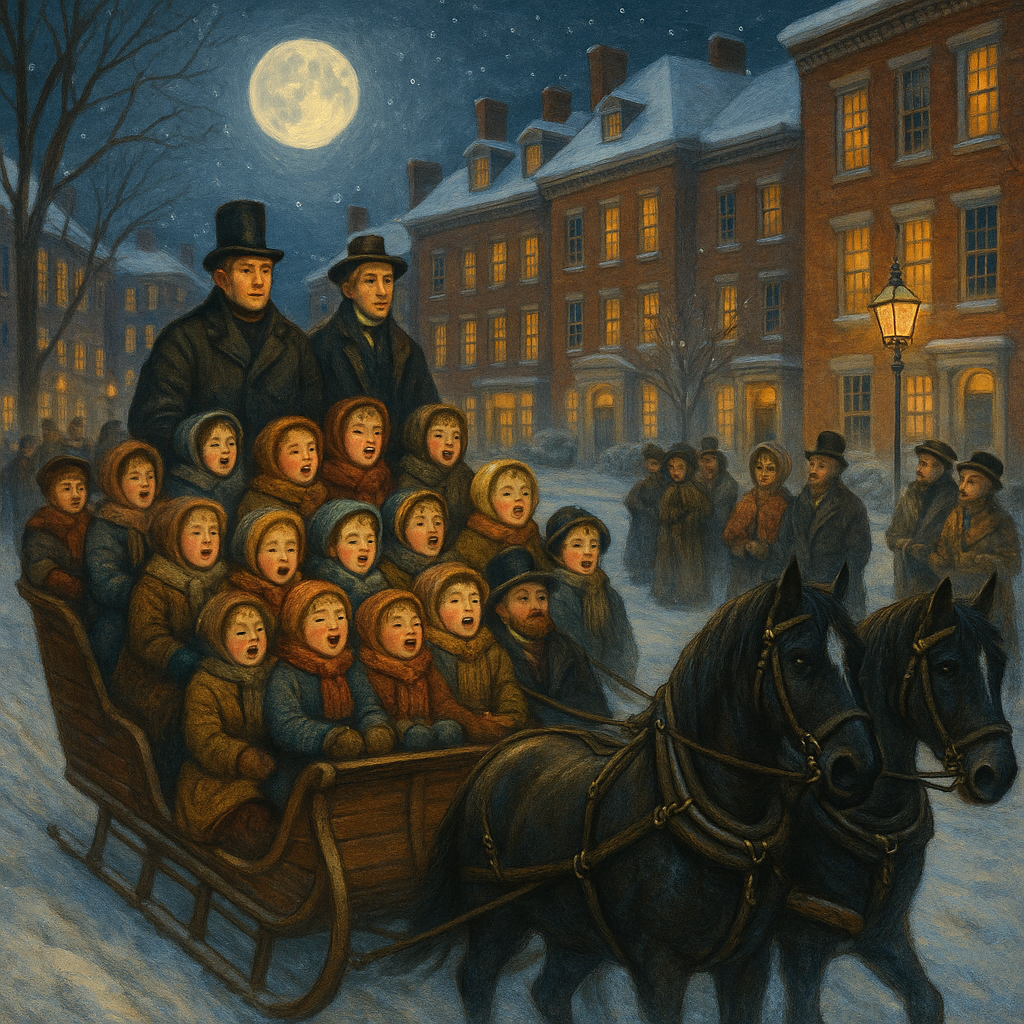
“First, driver — out along Commonwealth Avenue. That will settle the horses. Stop on the left after Fairfield Street.” So we dashed up to the front of Haliburton’s house, where he was keeping his first Christmastide. The children, whom Harry had hushed for a block or two, broke out with full voice under his strong lead in Shepherd of Tender Sheep — that ancient hymn of Clement of Alexandria, who taught it in his Sunday school nearly seventeen hundred years ago, never dreaming of bells and snow. As the children closed with Swell the triumphant song to Christ, our King, Haliburton himself came running out and begged me to bring them in. I told him no: we had a long journey before us and must not stop by the way. The children broke into Hail to the Night, Hail to the Day, rather a favourite — quicker, more to the childish taste — and with shouts of “Merry Christmas!” we were off again.
Off along the length of Commonwealth Avenue and back into town, up Chestnut Street, through Louisburg Square, and down the slope of Pinckney Street to Walter’s house, where the children were singing Carol, carol, Christians before anyone inside knew we had come. Kisses flung from the window; kisses flung back from the street. Then one of the girls began When Anna Took the Baby — a scrap of old Ephrem the Syrian, though they didn’t know it — and all fell in cheerily. When Harry made to move on (two carols per house was the rule), the little ones begged for just one more, because Mrs. Alexander had been so kind when she showed them the German embroidery stitches. The rules were bent.
Then up the hill and over to the North End, as far as the horses could manage up Moon Court, so the children might sing to the Italian image-seller who had given Lucy the plaster boy-and-dog when she was sick in the spring. For the children chose where they would go, and they will remember the Italian image-seller long after they have forgotten the sermons he never heard. He listened to Now Is the Time of Christmas Come and Jesus in His Babes Abiding for the first time in his life.
On up Hanover Street, where a chapel was being dressed with evergreens; down State Street to stop at the Advertiser office, because Mr. Hale had run the boys’ “Literary Entertainment” advertisement for nothing — and up in the old compositors’ loft, the tired typesetters were relieved to hear Nor War Nor Battle Sound and The Waiting World Was Still. Even the editor relaxed from his gravity, and the Daily the next morning wished everybody a Merry Christmas with rather more warmth than usual. Then away again — to confectioners who had given the children sweets, to a favourite schoolmistress’s house, to the homes of millionaires who had prayed for these children with tears the children never knew about, to Dr. Frothingham’s on Summer Street, and out to Dover Street Bridge, so that the poor old chair-mender there might hear our carols once more before he heard them better sung in a world where nothing needs mending.
King of glory, king of peace! Hear the song, and see the Star! Welcome be thou, heavenly King!
Twenty places, at the least. The grandest houses in Boston and the humblest. Everywhere a merry Christmas wished and returned; everywhere a small crowd gathered round us, and then we dashed away to gather another. We left each one with the happy thought of the star, the manger, and the Child.
Part II
At nine o’clock we brought up at my house on D Street, three doors from the corner, and the children sang their very best for Polly and my six little girls. Then, for the first time, we let them jump out and run in. Polly had hot oysters waiting, and a Christmas cake cut into sixteen pieces for them to take home and dream on. By ten o’clock, or a little after, all the girls and the youngest children were safely at their own doors. Four of the older boys — our two flankers and Harry’s left and right — begged to stay to the last and walk back from the stable: “Rather walk than not, indeed.” To this we happily agreed.
As Lycidas and I stepped into those modest homes to return the children, to report them well-behaved, and to wish fathers, mothers, and watchful aunts a Merry Christmas, the welcome of those houses was perhaps the best part of the whole evening. Here was the big sailor-boy we hadn’t seen since he returned from sea — a mere child when he sailed away on Perry’s ship, and now home again after going round the world. Here was brave Mrs. Masury, whom I hadn’t seen since her mother died. “I got so used to watching through the night then,” she told me, “that I cannot sleep well yet. I wish you knew some poor soul who needed me tonight — if only in memory of Bethlehem.”
“You take a deal of trouble for the children,” said Campbell, crushing my hand in his great fist. “But you know they love you, and I would do as much for you and yours.” Which I knew was true.
“What can I send your children?” asked Dalton, who had been finishing sword-blades all evening. (Fort Sumter had blown him no good wind in one sense, but it had set him up in the world with his new sword-factory.) “Here’s an old-fashioned tape-measure for the girl, and a Sheffield wimble for the boy. What — no boy? Let one of the girls have it then; it will count as one more present for her.” And he pressed his brown-paper parcel into my hand. From every house, however humble, a word of love as sweet as though the voices of angels were singing in the sky.
I bade Harry good-night, took Lycidas to his lodgings, wished his wife a Merry Christmas, and came back down to the sleigh. The streets were stiller now, the moon brighter than ever, and I felt — as perhaps you will understand — that this was not the time to stop, but just the time to begin. So I tucked the four remaining boys together where they could chatter, took one more turn along the avenues, and found myself passing through Charles Street, thinking vaguely of Cambridge, when I noticed lights still burning in the Woodhull house.
Fanny came to the door herself. I started to joke about Santa Claus, but saw in an instant that I must not. She said she had hoped I was her husband.
In a moment I understood. Her mother had been stranded on the Springfield train coming in for Christmas, been badly chilled, and was now in bed with pneumonia. Both Fanny’s children had been ailing when the old lady arrived, and that morning the doctor had pronounced it scarlet fever. Fanny had not undressed since Monday — nor slept, I thought, in the same time. While we had been singing carols and laughing in the moonlight, this poor young woman had been waiting and hoping that her husband or her brother Edward, both of whom were out searching, would bring back the nurse they had not yet been able to find. At midnight, no nurse had come, and neither man had returned. Professional nurses, dear reader, are shy of scarlet fever.
I told Fanny it was better this way. I wrote a note for Sam Perry to carry to his aunt: Dear Mrs. Masury — I have found the poor soul who needs you tonight. Come back in this carriage. I sent him to take a cab from Barnard’s, over to Albany Street. And really, as I sat with Fanny trying to calm her, it seemed less time than it has taken me to tell this story before Mrs. Masury’s gentle knock came at the door. I left them together, having made Fanny promise to consecrate the new day — just then being born — by trusting that her children were in better hands than hers, and going to bed. As I passed through the hall, the gaslight fell on a print of Correggio’s Adoration, beneath which Woodhull had written years before: Ut appareat iis qui in tenebris et umbra mortis positi sunt — “That it may shine upon those who sit in darkness and the shadow of death.” Darkness and the shadow of death indeed; and what light like the light that a woman such as Mary Masury brings.
And so — but for one more accident, as we call these things — I should have left the boys at the corner of Dover Street and gone home with my Christmas lesson complete.
It happened, as we crossed Park Square, that I recognized a tall man plodding through the snow, head down, right shoulder higher than his left, stooping forward in his walk — and by those tokens I knew Tom Coram, prince among Boston princes. Not the famous Thomas Coram who founded the Foundling Hospital (though he was a Bostonian too, and a much older one); but Tom Coram, who would build a hospital tomorrow if you showed him the need, without waiting to die first, and who always helps forward whatever is princely — a civic statue, a school in Richmond, a struggling newspaper, a widow who wants a hundred dollars. I called out to him, and Howland, by a fine instinct, drew up the horses.
We wrapped him in the sleigh rugs and turned the horses’ heads — five hours now since they first set out on this tangled errand of theirs. “I was thinking of you at that very moment,” Coram said. “Wondering whether you could teach me Japanese before Saturday.” Japan was a novelty then, and I asked how he’d come to need it. His firm’s Shanghai house had just sent agents across to Edo, under the new commercial treaty, to establish the first American trading house there. Everything looked promising — and that afternoon’s post had brought a letter from his brother John confirming the venture, along with, for amusement, the Japanese bill of particulars on which they’d founded their first cargo order. The Japanese document was there in beautiful script, stretching down the tissue paper. The translated English order, however, John had left on his own desk in Shanghai. “And so I must wait for the next East India mail,” said Tom philosophically, “certain that seven English trading houses have had correspondents less enthusiastic about Japanese penmanship than my brother.”
I said I thought I could do better than teach him the language by Saturday. Did he remember writing a note to old Commodore Percival for me, five years ago? He did not. Did he remember giving me fifty dollars for a delicate boy I was sending to sea, because I was not satisfied with the navy’s outfitting allowance? He didn’t remember that either — which was not strange, for it was the sort of thing he did every day. “Well,” I said, “that boy is back — strong, healthy, and able. More to the point: he had the whole charge of Perry’s supply operation on shore at Yokohama, was honourably discharged there, and reads Japanese better than you read English. If it will help your cause at all, he can be at your breakfast table tomorrow morning.” We had just stopped at Coram’s door as I said it.
“Ingham,” said Coram, “if you were not a minister, I should say you were romancing.”
“I sometimes write a tale for The Atlantic,” I replied, “but the words of my lips are plain truth. Go to bed; don’t dream about Japanese; and next time you’re in a difficulty, send for the nearest minister. — George,” I called to one of the boys, “tell your brother Ezra that Mr. Coram wishes him to breakfast at Pemberton Square tomorrow morning at eight.” “Yes, sir,” said George. And Thomas Coram laughed, said “Merry Christmas,” and we parted.
It was high time everyone was in bed. But glad I am, as I write, that running into Coram kept us out a little longer — because there was one more delay yet.
We were sweeping past the Old State House, the boys singing Carol, carol, Christians into the quiet streets, when I caught sight of Adams Todd — an old fellow-apprentice of mine, now chief pressman at the Argus office. He’d heard our singing earlier, at the Advertiser, and hailed me now.
“What drove you out from your warm boiler room?” I asked.
“Boiler room!” said Todd. “Two rivets loose, steam filling the press room, police frightened, neighbourhood in an uproar — had to damp the whole fire. She’d have run a week without hurting a fly, really — just the occasional puff in the street. But here we are. We’ll lose the early mail. Seventy-eight print tokens still to be worked.”
I understood at once. Todd and I had once worked an Adams hand-press fly-wheel together for five minutes as a test of young strength; I could picture exactly how he was running his paper right now — on relays of exhausted hired men. He confirmed it: Christmas Eve, and not a man in the city who would hire on for press work at any wage. “Not a man can stand the grind ten minutes,” he said, “and the ones we have are giving out. We’ll lose our whole carrier delivery.”
“Todd,” I said, “is this a night to be talking of wages or losses? When will you learn that love governs the court, the camp, and the newspaper office?” And I scribbled on the back of an envelope to Campbell: Come to the Argus office, No. 2 Dassett’s Alley, with seven men not afraid to work. I gave it to John and Sam, sent Howland with the boys to deliver it at Campbell’s house, and walked down with Todd to the press room. I challenged him to five minutes at the fly-wheel in memory of old times; the tired relays laughed to see us take hold. Then — when I had cooled off and pulled on my heavy cardigan jacket — Campbell arrived, tumbling down the stairs with his seven great sons, wondering what round of mercy the minister had found for them this time. I started home knowing I would have my Argus with my morning coffee.
Part III
And so I walked home. Better so, perhaps, after everything, than riding in the lively sleigh with its tinkling bells.
What an eternity it seemed since I had started out with those children. Bethlehem, Nazareth, Alexandria, Rome — Clement and Ephrem and Ambrose and all the singers — Vincent de Paul and all the wonder-workers — Milton and Herbert and all the carol-writers — what a crowd of people had been keeping Christmas with Sam Perry and Lycidas and Harry and me. And here were Yokohama and the Japanese, the Daily Argus and its tens of thousands of readers, and poor Fanny Woodhull and her sick household, all keeping Christmas too. For a world of this size, these are a good many “waits” to be sounding in one man’s ears on one Christmas Eve.
As I passed through Charles Street, I noticed that lights were still on in Lycidas’s lodging. Still up — that was making a night of it! But there were few hours of the day or night when I had not been in Lycidas’s room, so I let myself in with the night-key he’d given me and ran up the stairs two at a time.
I pushed open the door — which was ajar — and saw such a scene of confusion as I had never seen in Mary’s tidy parlour. A great ball of white knitting wool unrolled across the floor. A Christmas tree lay across the hearthrug, far too tall for the room; a large sharp-pointed clasp-knife lay beside it, used for lopping branches. Two big baskets of wrapped presents were overturned. But what frightened me most was the centre table — cloths piled on it, handkerchiefs and napkins and I know not what, all brown and red and almost black with blood.
Heart-sick, I turned to the bedroom doorway — and felt a wave of relief just to see someone. It was bad enough, however. Lycidas, just now so strong and well, lay pale and exhausted on the bed, the clothing removed from his right thigh and leg, while Mary and Dr. Morton bent over him. I learned afterwards that Lycidas, while trimming the Christmas tree and talking merrily with his wife and Morton — who had come round late with presents and stayed to help hang glass balls and apples — had given himself a deep and dangerous wound with the point of the knife, and lost a great deal of blood before the bleeding could be controlled. Just before I arrived, the improvised tourniquet had slipped in Mary’s unpractised hand at the very moment Morton was about to secure the artery, and the blood came in a gush that forced his whole attention back to stopping the flow. He knew I had entered only by the frightened housemaid’s “Ah, Mr. Ingham!” from behind the bed-head.
“Fred,” said Morton, without looking up, “I am glad you are here.”
“What can I do?”
“Whiskey — first of all.”
“There are two bottles,” said Mary, who was holding the candle, “in the cupboard behind his dressing-glass.”
I took the housemaid with me and struck a light in the dressing-room — the poor girl fumbled dreadfully with the match — and found the cupboard locked. The key was doubtless in the pocket of Mary’s other dress; I didn’t ask. I tried my own bunch of keys, willed with all my force that one of them would fit, and it did. Inside: a bottle of bedbug poison; one marked “bay rum”; one unmarked; two bottles of mineral water from Saratoga. Then a bottle of cologne, and one with a manuscript label I couldn’t read in the dim light. “Bring that candle.” Eau distillée. Montreal. What on earth Lycidas wanted with distilled water from Montreal I couldn’t imagine. But then Morton’s voice came clear from the other room: “As quick as you can, Fred.”
“One moment — yes!” At last: Bourbon Whiskey. “Where is the corkscrew?”
“I don’t know, sir,” said the girl. “Run down and find one — quickly. His wife cannot leave him.” Off she ran; the first thing I heard was the clatter as she pitched headlong down the last six stairs. I could only hope she hadn’t broken her leg. Meanwhile I was driving a silver dessert-fork into the cork and trying the blade of my penknife on the other side.
“Now, Fred.” — “Yes, one moment.” The penknife blade broke off; the fork pulled straight out, bringing two small crumbs of cork with it. Nothing. Will that girl never come?
I cast around, seized a goblet from the washstand, took Lycidas’s heavy clothes-brush, and knocked off the neck of the bottle. Have you ever done this, reader, with one of those modern pressed-glass bottles? It shattered like a Prince Rupert’s drop — crumbled into seventy pieces — a sharp reek of whiskey on the floor — and I standing there holding only the thick glass base, with two jagged spikes pointing uselessly at the ceiling. I poured what little remained in the bottom into the goblet and carried it in to Morton as calmly as I could manage.
He had me give Lycidas as much as he could swallow, then showed me how to substitute my thumb for his and compress the artery. When he was satisfied he could trust me, he bent back to his work in silence, speaking only what he had to say to brave Mary, who seemed to have three hands because he needed them. When it was secure at last, he glanced at the ashen face — beads of sweat on the forehead and upper lip — and laid his finger on the pulse.
“We’ll have a little more whiskey. No, Mary, you’ve already done more than enough — Fred, bring it.”
The truth was that poor Mary was nearly as white as Lycidas. She refused to faint — that was the only reason she didn’t — and for a moment I half-expected her to fall. I went back to the dressing-room for the second bottle and bit steadily at the cork with my teeth, which of course only wrenched the top of it off. Morton called my name; I stepped back. “No — bring your whiskey first.”
Mary had quietly slid to the floor.
I went again in despair. But then I heard the housemaid’s step — first flight, second flight — and she burst in in triumph, holding —
A screwdriver.
“No,” I whispered. “The curved thing, that draws corks. Find one somewhere and don’t come back without it.” She vanished for the second time.
“Frederic.” Morton had never called me by my full name before. Should I risk the clothes-brush again? I pulled open Lycidas’s own drawers — papers, boxes, everything neat as a pin, not a tool of any kind.
“Frederic!” “Yes,” I said. But why was I saying yes? Father of mercy, tell me what to do.
And my mazed eyes — did you ever shed tears from sheer agitation? — fell on an old razor-strop, made by C. WHITTAKER, SHEFFIELD. The word Sheffield seemed to stand out from the rest in large black letters, like a vision. They make corkscrews in Sheffield. If only this Whittaker made corkscrews. And what, anyway, was a Sheffield wimble?
My hand went to my coat pocket — the brown-paper parcel Dalton had pressed into it three hours before.
“Where are you, Frederic?” “Yes,” I said, for the last time. Twine off. Paper off. And I learned that a Sheffield wimble is one of those ingenious pocket instruments they sell in covered arcades, where a hoof-pick, a gimlet, a screwdriver, and a corkscrew all fold into a single handle.
“Yes,” I said. Pop said the cork. Bubble, bubble, bubble said the whiskey. Bottle in one hand, full tumbler in the other, I walked in.
Morton poured a great deal of that whiskey down Lycidas’s throat — I won’t say how much — and I gathered from what he said later about the pulse that every drop was needed. I believe Mary had some too.
That was the turning-point. Lycidas was exceedingly weak, and we took turns sitting with him through the night, giving stimulants and light food at short intervals — Morton very particular that we not raise his head more than necessary. But there was no real danger after that.
As Morton and I left the house on Christmas morning — I to preach, he to visit his patients — he said: “Did you make that whiskey?”
“No,” I said. “But poor old Dalton had to supply the corkscrew.”
I went down to the chapel. Polly had brought my sermon round to me — there’d been no time to go home to D Street and back — and there it was, all ready, with its text from Isaiah:
They helped every one his neighbour, and every one said to his brother, Be of good courage. So the carpenter encouraged the goldsmith, and he that smootheth with the hammer him that smote the anvil.
There were the prepared illustrations I had finished the day before: how Mary Magdalen comforted Joanna the court lady, and the court lady comforted Mary Magdalen; how Simon the Cyrenian and Joseph of Arimathea and the beggar Bartimaeus gave each other strength; how on the sinking ship the tentmaker proved to be the captain, and the centurion learned his duty from his prisoner. Good illustrations, every one of them, from eighteen hundred years ago. But as I preached I caught the eye of Frye, who is always critical, and I thought: Frye would not take his illustrations from eighteen hundred years ago. And I saw dear old Dalton nodding in his pew, and Campbell sound asleep, and Jane Masury turning to look for her mother at the door, and the sailor Ezra Sheppard gazing past me at the window as if his thoughts were already the other side of the world.
And I said to them all: “O, if I could only tell you what every twelve hours of my life tells me — how woman helps woman, and man helps man, once only the ice is broken — how rich we all become the moment we discover we are all brothers and sisters, and how poor we all are unless we can reach out at any moment for a brother’s hand — then I might make you understand, in the lives you lead every day, something of what the new kingdom is to be.”
But I did not dare tell Dalton what Campbell’s sons had done for Todd’s press that night. And I did not dare tell Campbell by what unconscious kindness old Dalton had saved Lycidas’s life. Perhaps the sermon would have been better if I had.
That evening, when we had our tree at home, I did tell the whole story to Polly and the children. I gave Alice her tape-measure — precious now, with a small dark spot of Lycidas’s blood on it — and Bertha her Sheffield wimble.
“Papa,” said Clara, who is the next child, “all those people gave presents to each other, didn’t they — just like in the picture in your study?”
“Yes,” I said. “Though they didn’t all know they were giving them.”
“Why don’t they give like that every day?” said Clara.
“Because it is only for thirty-six hours out of the three hundred and sixty-five,” I said, “that all people remember at once that they are all brothers and sisters. And those are the hours we call, therefore, Christmas Eve and Christmas Day.”
“And when they always remember it,” said Bertha, “it will be Christmas all the time! What fun!”
“I suppose the people who came from Sharon brought roses,” said Bertha. And Alice, who is eleven, and goes to the Lincoln School, and therefore knows everything, said: “Yes — and the Damascus people brought Damascus wimbles.”
“This is certain,” said Polly. “Nobody ever tried to give a straw, but the straw — if he really gave it — carried a blessing.”