An open door and open arms always greeted Beth whenever she came home. As the family’s grown-up daughter and big sister, and a hospital nurse besides, she could never say for certain when she’d be able to visit — so every homecoming was a red-letter day.
This year her mother and three younger siblings had built their hopes high on having Beth home for Christmas Eve and Christmas Day. So each face clouded over when word came that she couldn’t be with them after all: eight little children from the orphanage had been brought to the hospital a week earlier, ill with a spreading sickness, and none of them were well enough yet to leave.
“Christmas won’t be half as nice without you, Beth — and you won’t have any Christmas at all,” sobbed little Dudie, pressing her curly head against her sister’s shoulder.
“Yes, I will, sweetheart,” Beth said gently, “because I’ve planned a happy day for these poor little ones. Some of them have never hung a stocking in their lives, and I’ve promised them a dinner all to themselves. Every nurse on the ward is helping, and several families have sent boxes of outgrown clothes and toys. Each child has told me the one thing they most wish for, and I hope we can grant every wish.”
“There’s one boy, David,” she went on, her face growing thoughtful. “He seems never to have known much kindness — no gentleness, no one in his corner. He won’t believe in Santa Claus, and he’s been trying so hard to spoil the other children’s excitement that I finally warned him he might just find a switch in his own stocking. Poor little fellow — the children on the street only ever called him by an unkind name, teasing him about his limp, and I think all that jeering turned him bitter. But there’s real good in him. I do hope this Christmas can reach it. Now I must be off. A merry Christmas to you all!”
“Here’s my contribution to your dinner, dear,” her mother said, hanging a little basket of fresh cakes on Beth’s arm. With kisses all around and a whispered “Bless you, my brave girl,” Beth hurried back to her duties, followed by loving eyes until a bend in the road hid her from view.
“Such a slip of a girl, taking the whole weight of this little family on herself,” her mother sighed.
“I wish every snowflake falling on Beth turned into a dollar,” said young Robert.
“There’s something in life better than dollars,” his mother said.
“Is there?” the boy asked, glumly.
That evening, eager little ears in the Children’s Ward heard for the very first time the old, gentle story of the first Christmas — and then all about the wonderful Santa Claus. Beth finished by reciting “‘Twas the Night Before Christmas,” and every face in the row was glowing. Even David’s, for a few moments — until the old look of doubt crept back.
“It’s all a fake!” he sneered. “Don’t be silly and think you’ll hear Dancer and Prancer and Vixen and Comet — you’ll only get fooled.”
“I hope they all give you a good hard kick,” said little Jake, indignantly.
“No, Jakey — no unkind wishes tonight,” Beth said. “Don’t you remember I told you Christmas came to bring peace, and goodwill, and love? Jakey, the greatest thing in all the world is love.”
At the foot of each little white cot stood a small white chair, where every child neatly folded their clothes for the night. But on this evening — the night before Christmas — a stocking hung across the back of every chair.
David flatly refused to hang his. So after he fell asleep, Beth hung it for him.
At the first light of dawn, the most wakeful pair of eyes in the ward flew open. A little figure in a white nightgown crept down to the foot of her cot, felt her stocking almost fearfully — and then shrieked with joy. All down the row, one child after another did the same.
“Why don’t you look at yours, Dave?” cried Jakey.
“‘Cause it’s a fake,” he muttered.
“If you don’t believe Santa’s been here, just look at them footprints!” Jake tugged at his arm until David glanced toward the fireplace — and there, sure enough, were two huge footprints in the drift of soot.
(The truth was simpler: soot had blown from the chimney in the night, and the janitor, on his early rounds, had stepped in it and left the marks. But no one told the children, and they drew their own happy conclusions.)
It shook David. Cautiously, he looked into his own stocking. It wasn’t full — but there was something in it. A switch.
The other children crowded around his bed, delighting in their toys. David buried his face in his pillow with a smothered sob.
“Nobody never loved me,” he wailed.
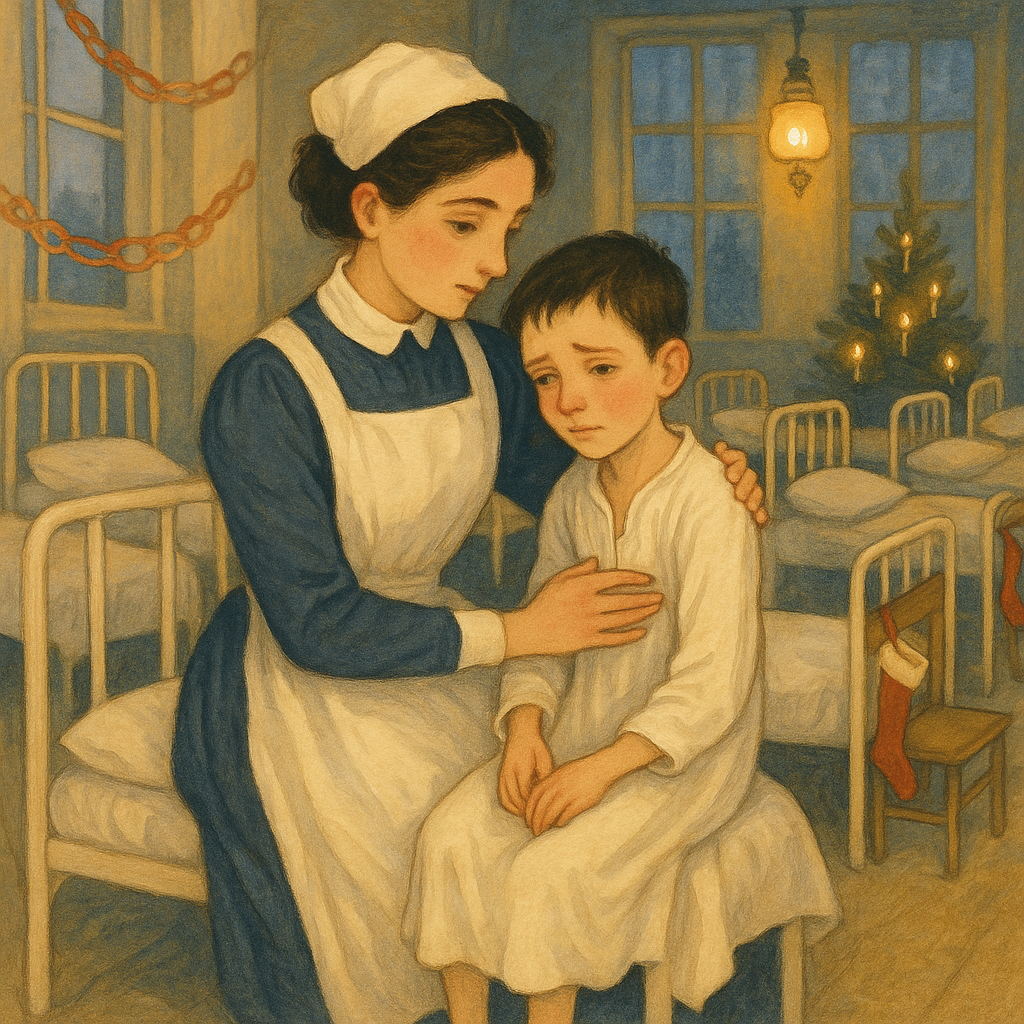
Nurse Beth came at once and sat down beside his cot. She wrapped her arm around him and talked to him tenderly, and her loving words began to soften his stubborn little heart — and for the first time, he started to understand what peace and goodwill really meant.
A while later — quite mysteriously to him, while his attention was turned the other way — a second stocking appeared, this one full to overflowing with things almost too good to be true. His chest gave a throb of gratitude. Bit by bit, the spirit of the day crept into him. And he never forgot, as long as he lived, that Beth told him something extraordinary: that he, himself, could grow up to be a kind of Santa Claus — going about making other people happy — if only he chose to.
“Christmas does mean something, doesn’t it?” he whispered to her that night.
Perhaps no merrier, more mismatched little group ever gathered around a table than those eight children from the orphanage, all in different stages of getting well. If the hand-me-down clothes hung loose and odd on them, they didn’t care one bit — weren’t they invited to eat, drink, and be merry at the first real feast of their lives?
Beth had set the table with an eye for beauty — something so little of which had ever come into their lives — and to them it looked like a fairyland.
“Look! She’s put a bedsheet on the table,” giggled Maggie, lifting the corner of a tablecloth for the first time in her life.
“Oh, Miss Lawsie! Jake’s eating the bouquet!” cried Benny — as Jakey reached clear across the table and helped himself to a big stalk of celery.
When Becky found that her tight sleeves got in the way of cutting her turkey, she simply snatched up her knife, ripped the seams open to the elbow, and carried on, delighted.
Dessert was, to them, the most marvellous thing of all: a little basket made from an orange peel and filled with jelly. Tiny Tim fell asleep right in his chair, clutching his to his happy heart — blissfully unaware of it slowly leaking down his front.
“Look there — Timmy’s orange busted!” cried Dick.
“‘Tain’t the only thing that’s gonna bust, I reckon,” said Nick, laying a hand on his belt — which Beth quickly loosened to prevent disaster.
David, being the eldest, felt the dignity of the occasion and made careful, earnest attempts to eat like a gentleman. A new light had come into his face — a light from within. Beth had had a long talk with him. She told him that all his life he’d been searching for the bad in the world and gone out to meet it — but from now on he should look only for the good, and he would surely find it. It opened a strong hope in his once-sunless heart.
“Miss Lawsie,” he asked quietly, “do you think there’s any way my foot could be made better — so I could run and play like the other fellows?”
“There may be, David,” she said. “I know a doctor here with a very kind heart. Let me talk to him.”
“You make me feel taller when you call me David,” he said, throwing back his shoulders and lifting his chin. “It’s always just been Dave — or worse.”
Beth repeated the boy’s wish to a surgeon at the hospital, whose kindness led him straight to David’s bedside. Moved by the child’s story, he offered his care freely — and the operation that followed helped David walk and run far more easily than he ever had before.
But it wasn’t the operation that changed David’s life. It was being loved, and being shown that he had something to give. That was the seed Beth had planted — that even he could be a “Santa Claus” for others if he chose — and it became the keynote of everything good that came after.
All this happened many years ago. David grew into a man respected by everyone who knew him and loved by many. He did well in business, and he never forgot the ragged children of the streets — they always found a warm place in his heart, just as he’d once needed someone to find room for him.
It is the start of a new year now, and David sits in his comfortable home, smiling out at his own snowy hillside, where three joyful children he rescued from the slums are playing in the season’s first snow — the way only happy children can.
And his thoughts drift gratefully back to the dark old days, before a sweet-faced young nurse opened the door and let the warmth of Christmas in.