“You say you fellows have just come out and want to know how I enjoyed last Christmas. I’ll tell you the circumstances, and let you judge for yourself.
“Most of you met our gun’s crew at that show we gave at S——, so I won’t bother introducing them. As best I can remember, here is what happened.
“It was Christmas Eve, and cold. Not the kind of cold that sends the blood singing through your veins and makes you want to get at it — but that miserable, damp cold that eats into the marrow of your bones. It attacks you from behind and sends cold shivers up and down your spine. It leaves you with a feeling of dread and loneliness.
“The three of us — Curly, Happy, and myself — were standing at the corner of Yankee Avenue and Yiddish Street, waiting for the order to stand to, at which point we’d mount our machine-gun on the parapet and keep watch for two hours with our heads above the top. Yankee Avenue was what we called the fire trench; Yiddish Street was the communication trench running back to the rear. We were holding Y Sector of our brigade’s front line.
“The trench was muddy, and in places a thin crust of ice had begun to form around the edges of the puddles. We’d wrapped our feet and legs in empty sandbags and looked like snow-shovellers on Fifth Avenue. My teeth were chattering. Happy was slapping his hands against his thighs. Curly had unbuttoned his overcoat and was desperately trying to reach under his right armpit with his left hand — no doubt a louse had gone out Christmas shopping.
“Then came the unwelcome order to stand to. Up onto the fire-step we went and set about getting the gun mounted. It took about five minutes.
“Curly muttered as he worked: ‘Blimey, Christmas Eve, and here I am somewhere in France, half starved with the cold.’
“Happy hummed ‘Keep the Home Fires Burning.’ Just then, any kind of home fire would have been very welcome.
“No Man’s Land was black as pitch. Curly stopped muttering and Happy’s humming ceased. There was serious work in front of us. For two hours we had to drive our straining eyes into that darkness to make sure Fritz didn’t try some Christmas surprise.
“Suddenly Happy, standing on the fire-step beside me, gripped my arm and whispered: ‘Did you see that, Yank? Just to the right of that black patch in the wire?’
“I turned my eyes in the direction he indicated, my heart pounding against my ribs, and waited. Sure enough, I could make out a slight movement. Happy carefully eased his rifle over the parapet, ready for instant use. My own was already in position. Curly fumbled with the flare pistol. There was a loud plop as he pulled the trigger and a red streak shot up into the air; the star shell described its arc and hit the ground and burst, throwing out a cold white light.
“A frightened meow, and a cat bolted from the wire, leapt clean over our gun, and disappeared into the darkness of the trench behind us. Curly ducked. Happy let out a weak, squeaky laugh. I was frozen stiff with fright. After a moment the thumping in my chest resumed its normal rhythm, and I turned my eyes back to No Man’s Land.
“For the remainder of our two hours on guard, nothing happened. Then we handed over to the second relief and, half frozen, waded through the icy mud to the entrance of our dugout.
“From somewhere underground came the sound of a harmonica playing ‘Pack Up Your Troubles in Your Old Kit Bag.’ We stumbled down the muddy steps into the dugout — a proper one, not the cramped little hole we were usually given.
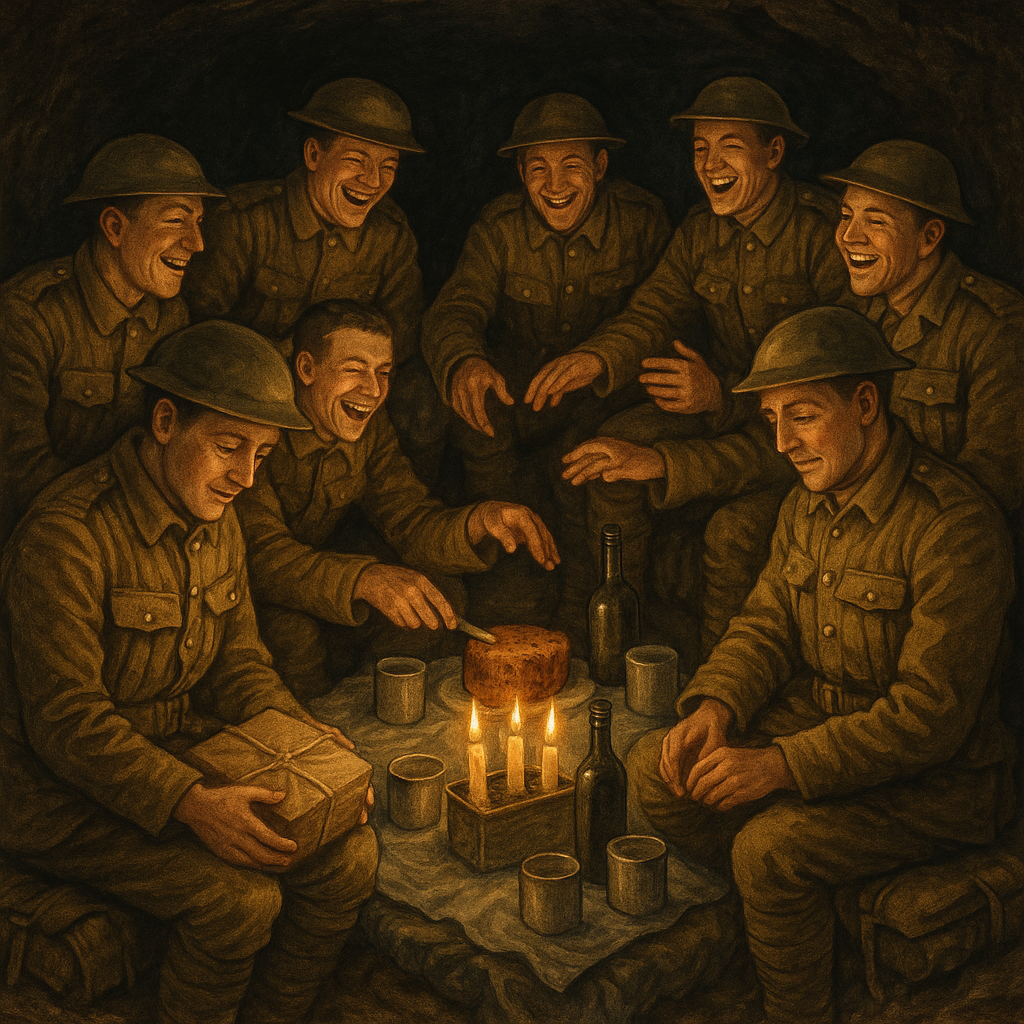
“Eight men from our machine-gun section had formed a circle around a wooden box, sitting on their packs. In an old ammunition tin, six candles were burning. I inwardly winced at the extravagance, then remembered it was Christmas Eve. Sailor Bill was making cocoa over a Tommy’s cooker, while Ikey was toasting bread in front of a fire bucket whose fumes nearly choked us.
“As soon as we appeared, the others stood up and — in the way you English always do — made room for us at the fire bucket to thaw out our stiffened joints. In twenty minutes or so the cold of the trench was forgotten and we joined in the warmth. Ikey put away the harmonica, which was greatly appreciated by the rest of us. Then Sailor Bill, bursting with importance, addressed us:
“‘Gentlemen, it is time for this ship’s company to report progress on the Christmas feed to be held tomorrow at eight bells. Yank — let’s hear yours.’
“I reported one dozen eggs, two bottles of white wine, one bottle of red wine, eight packets of Gold Flake cigarettes, and one quart bottle of champagne that had cost me five francs — my last note — at a French café behind the lines. This was received with a cheer. Ikey was next: he’d saved his rum ration for eleven days running and was able to contribute a water-bottle three-quarters full. We were fairly sure he’d stolen some of it, but said nothing, as it would help make brandy sauce for the plum pudding. Sailor Bill had a fruitcake, a bottle of pickled walnuts, and two tins of devilled ham, sent out to him from London. Every man had something to report. I made a careful list and handed it over to Bill, who was to serve as cook the following day.
“Just then Lance Corporal Hall came in and, warming his hands over the fire bucket, said: ‘If you lot want to hear something that’ll take you straight back to Blighty, come up to the fire trench for a minute.’
“None of us moved. The fire bucket was too comfortable. After much persuading, Sailor Bill, Ikey, and I followed Hall back up into the trench. A dead silence reigned, and we were about to turn back. Hall blocked our way and whispered: ‘Just a minute, boys — listen.’
“Presently, from the darkness ahead, we heard the strains of a cornet playing ‘It’s a Long, Long Trail We’re Winding.’ We stood there motionless until the last note died away. After four or five minutes’ silence it was repeated — and then nothing. I felt lonely and homesick.
“From the fire bay to our left a Welsh voice began to sing the song. The German cornet player must have heard it, because he picked up the melody and accompanied the singer across No Man’s Land. I had never heard anything so beautiful in my life. Then the music from the German trench suddenly ceased, and overhead came the sharp crack crack of machine-gun bullets as some other German gunner butted in on the concert. We ducked and went back to the dugout.
“The men were all worn out. Soon the sound of heavy breathing and snoring came from under blankets and overcoats.
“The next day was Christmas. We eagerly awaited the mail, which the ration party was to bring up at noon.
“Not a shot or shell had been fired all morning. The sun had come out and, although the trenches were slippery with mud, there was a warmth in the air, and we felt the Christmas spirit running through us. We all turned to and cleaned the dugout, hammering ammunition tins into reflectors and fitting a candle into each one. Sailor Bill bustled about preparing the spread. He laid a waterproof sheet on the floor, added three blankets, spread another waterproof on top as a tablecloth, and arranged the men’s packs around the edges for chairs.
“Presently the welcome voice of our Sergeant came from the entrance: ‘Come on lads, lend a hand with the post.’
“There was a mad rush for the steps. In a couple of minutes the boys came back staggering under a load of parcels. As each name was called out, the parcel was thrown to the waiting Tommy. My heart beat faster as the Sergeant picked up each one — and then sank again as someone else’s name was read.
“Each of the others received one to four parcels. There were none left. I could feel their eyes on me.
“Sailor Bill whispered something to the Sergeant I couldn’t catch. The Sergeant turned to me: ‘Why, blimey, Yank, I must be going soft in the head. I left your parcel up in the trench. Be right back.’
“He returned in a few minutes with a large parcel addressed to me. I looked for the postmark. London. Another pang of disappointment: I knew no one in London. My mail came from America.
“Then it all came clear in an instant. About two weeks earlier I’d noticed a collection being taken up in the section and thought it strange I hadn’t been asked to contribute. The boys had all chipped in to make sure I wouldn’t be forgotten at Christmas. They crowded round eagerly as I opened it. The parcel contained nearly everything under the sun, including American cigarettes.
“Tears came to my eyes, but somehow I managed not to show it. The Tommies were delighted at my exclamations as I took out each item — I could see them nudging each other out of the corner of my eye.
“A man named Smith had been detailed as runner to our Captain and wasn’t there for the mail. Three parcels and five letters were placed on his pack for his return.
“A few minutes later a man came from the trench carrying small oblong boxes — presents from the Queen of England. Every soldier in the British Army in the trenches received one that Christmas Day: a small plum pudding, cigarettes, a couple of cigars, matches, and chocolate.
“At last Sailor Bill announced that Christmas dinner was ready, and we lost no time getting to our places around the circle. Smith was the only empty seat. His parcels and letters, still unopened, sat on his pack. He was now a half hour overdue.
“Sailor Bill raised his hand: ‘Now boys, we’re all shipmates together. Don’t you think we ought to wait a few minutes more for Smith?’
“We agreed, though we cursed Smith in the friendly way of soldiers.
“Ten minutes passed. Fifteen. Twenty. All eyes turned to Sailor Bill. He answered with: ‘Go to it, boys — we can’t wait. His name’s in orders for leave, so perhaps he’s so pleased about seeing his wife and three little ones at home that he’s lost his bearings.’
“We began, and managed a few minutes of good cheer. Then there would be a pause, and all eyes would drift to the empty place. An unease settled over us.
“Suddenly the entrance to the dugout darkened and a figure came stumbling down the steps. With one voice we all called out: ‘Come on, Smith — you’re missing one of the best Christmas dinners of your life!’
“It was our Sergeant. One look at his face told us everything.
“With tears in his eyes and a catch in his voice, he asked: ‘Which is Smith’s pack?’
“We nodded silently toward the empty place. Without a word the Sergeant gathered up the letters, the parcels, and the pack, and turned to leave.
“Sailor Bill couldn’t hold it. Just as the Sergeant reached the steps he said: ‘Out with it, Sergeant. What’s happened?’
“The Sergeant turned, and in a choked voice said: ‘Boys — Smith’s gone. A German sniper got him through the head as he was passing that broken stretch of Yiddish Street.’
“Sailor Bill said quietly: ‘Poor old Smith.’ Then he caught himself and said: ‘God — his wife. His three little ones, waiting at home for him to come back for Christmas.’
“I believe that at that moment every man around that table made the same silent vow.
“The next day we buried Smith in a small cemetery behind the lines. While we stood at the grave our artillery opened up with an intense bombardment of the German positions, and as each shell screamed overhead we sent a thought with it.
“As the grave was filled in, I imagined a huge rainbow arching over those graves, with words written across it in fire — sarcastically, in German: Peace on Earth, Good Will Toward Men. But such is war.
“So, boys, that was my last Christmas. Where I’ll be next Christmas — God only knows.
“My mail from America came in the following day. It didn’t cheer me much. I was thinking of Smith’s wife and his little ones.
“So long, boys — I’ve got to go.”