On Christmas Day, 1840, Prince Chou-Faa of Bangkok invited every European in the city to spend the day at his palace and sit down to a grand Christmas dinner at four o’clock sharp. The invitation went to the officers and crews of all the military messes on the river, and to the American and French missionaries — though the latter, very wisely as it turned out, declined. Of all the celebrations I have ever witnessed, and I have seen some memorable ones at military messes in India, I never attended one to surpass that at Bangkok.
Guests began arriving at the palace around ten in the morning, and by eleven we were all assembled. There happened to be two English vessels in the river at the time, and three Bombay traders, and these, together with the Siamese men-of-war’s complement of Europeans, furnished a respectable number of Englishmen — some thirty in all, I think, when we sat down to dinner. Among the ships’ crews we had managed to muster two fiddlers, a hautboy, a flute, a fife, and a drummer; and with this magnificent ensemble we opened the day’s proceedings with the British National Anthem. Everyone joined in chorus, and though the music was frankly execrable and the singing alarmingly out of time, we got through it on the whole remarkably well. The princesses of the court had been given a screened enclosure from which, through small eyelet holes, they could watch these strange goings-on — and it was worth a good deal to see the palace cats bolting in all directions, tails straight up, as our first discordant burst fell on their astonished ears like a thunderclap. Jigs, reels, country-dances, and Highland flings were then attempted with varying degrees of success, and several who could not dance a reel in the morning were seen reeling about the courtyard somewhat later in the day.
Around one o’clock we sat down to a splendid cold luncheon laid out in the courtyard beneath the shade of a pandal — a temporary canopy of dried grass woven through split-bamboo trellis-work, its four corners lashed to posts driven into the ground. Champagne flowed without limit (ad libitum, as the classical among us noted) and though it was not properly chilled, it had been kept deliciously cool by the Indian method of standing the bottles in saltpetre, salt, and water. After luncheon we amused ourselves as best we could, and were eventually reduced to leap-frog — the occasional spectacular tumble of some less agile jumper proving a source of great delight to the Prince and his attendants, to whom the game was a complete novelty. Suppressed laughter from behind the screen made it plain that the princesses were enjoying themselves just as much as anyone.
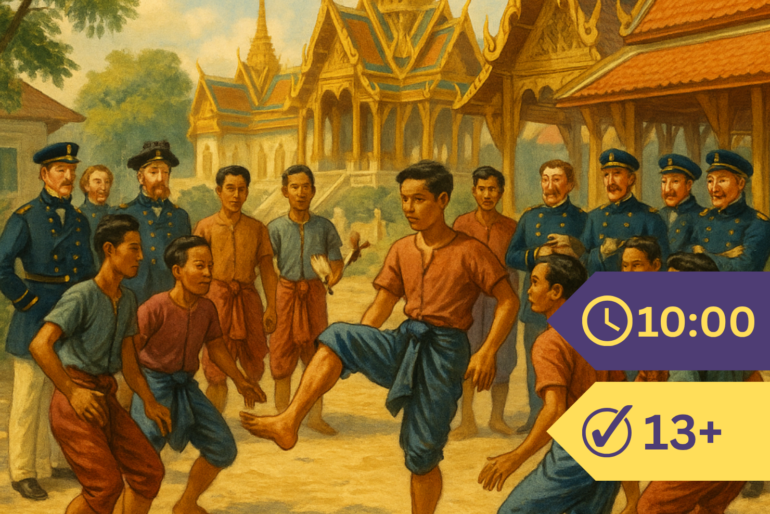
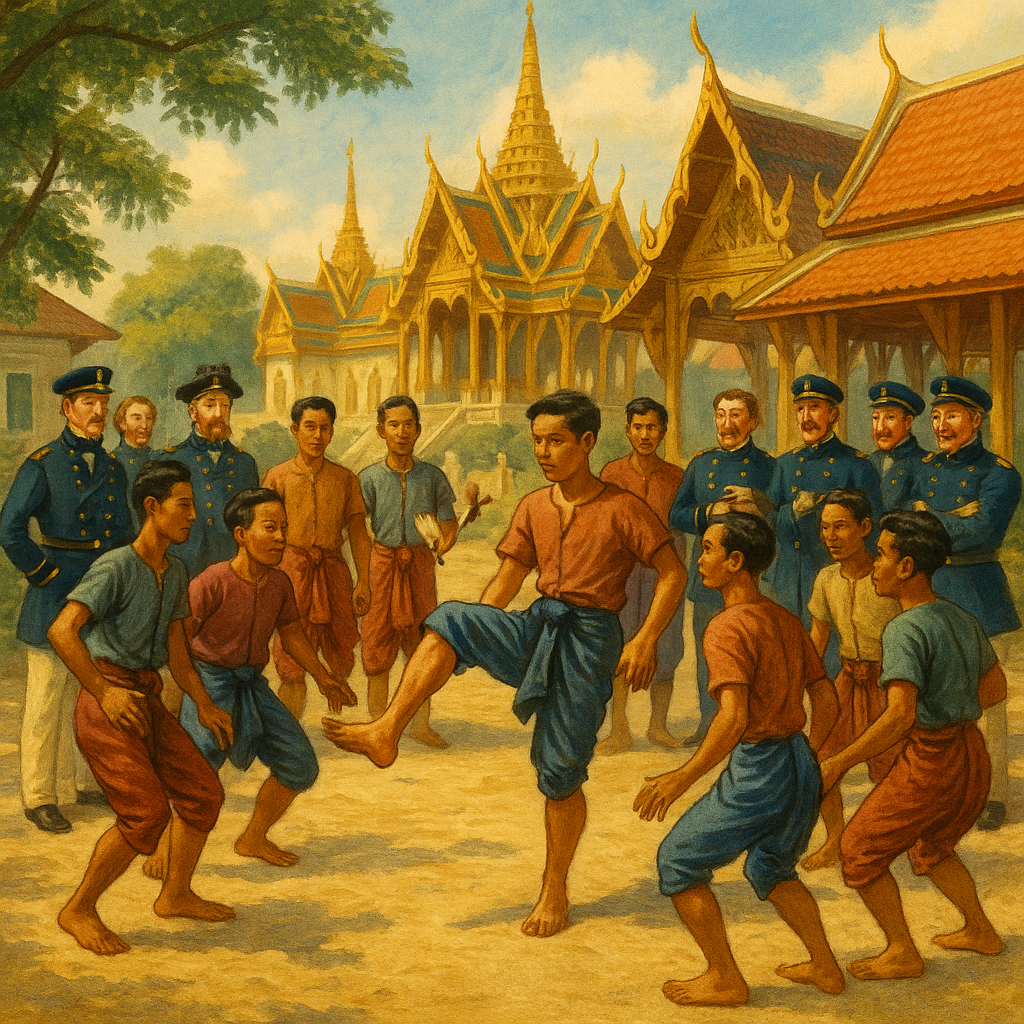
When our own amusements gave out, the Prince suggested his own people might provide some entertainment, and asked them to show us their ball games. What they produced was shuttlecock — but played in a fashion I had never imagined possible.
About thirty young men stood in a circle. The shuttlecock was exactly like those we use in England; the battledore was the sole of the foot. I have never witnessed such agility in my life. One player would launch the shuttlecock across the circle; the young man nearest where it threatened to land would wheel sharply, kick his right leg up with perfect precision, and catch it cleanly on the centre of his sole, sending it back with remarkable spring to the next player — who received it in exactly the same way. I watched them keep this going for nearly ten minutes without the shuttlecock once touching the ground. I attempted to join in myself and nearly put my ankle out of joint.
After the shuttlecock came wrestling and gymnastics, then a Siamese dance — vigorous, expressive, and quite unlike anything we Europeans had seen. This was followed by a sham boxing match between two English sailors, which began well enough until it emerged that the Prince had been rather too liberal in supplying the contestants with potcheen, whereupon they forgot entirely about the sham and set to in earnest. It required considerable combined effort to separate them.
The day’s entertainments concluded with a Chinese theatrical performance — a novelty to most of the Europeans present. A temporary theatre had been erected, its only scenery a drop-cloth at the rear and, at centre stage, a circular tent representing some fortress of an unspecified land, its gates facing the audience. In the distance beyond this fortress, twenty painted and heavily armed warriors were visible, approaching to lay siege. Inside the fortress, the besieged garrison remained for the moment invisible — though we were assured they were suffering all the horrors of a long investment.
The signal was given. The attacking army advanced with a din of shouting and gong-beating that was quite genuinely alarming; instinct moved several of us to cover our ears. Then out streamed the garrison: first a very old man with a long white beard, a bundle of “costly treasures” balanced on a stick over his shoulders; then an old woman with pots and pans; then a young man with a musket; a young girl with a basket; and finally a half-dozen children in rags. These constituted the entire heroic defence of the citadel. They fled in all directions. The besieging army carried the fortress — and then, to the visible surprise of every European in the audience, physically carried it off the stage on their shoulders, which would indeed have required an army of giants had the walls been real. The curtain fell to a tremendous storm of applause and shouting. It was the first Chinese play I had ever seen, and I confess it was enough — a further succession of such evenings, I felt, would render a man fit for nothing but the asylum.
Dinner was then announced, and we were shown into a room that none of us had expected and all of us will long remember. It was elegantly hung with tapestries, lit by three fine chandeliers. The sideboard was almost entirely of ivory, and upon it stood several massive gold and silver vases of Chinese workmanship, flanked by a remarkable clock whose face was a crystal fountain, kept perpetually playing by the mechanism within. Against the walls hung oil paintings — two, called Twilight and Dawn, were of a softness and mellowness I have rarely seen equalled. The long mahogany table, under its snow-white damask cloth, was bending under the weight of plate and glassware; and when the covers came off, the smell that rose from the dishes reminded us, very pointedly, that we had not yet actually dined.
We dined. There were excellent soups, then turkeys, geese, ducks, fowls, and roast suckling-pigs, and — best of all in that climate — prawn and rabbit curries. There were old crusty wines to wash it all down, and we told ourselves not to think about tomorrow’s headaches or the cholera. N’importe. We had good wine and good company, and I sang quietly to myself, like the famed Edgardo in the opera: Non curiamo l’incerto domani, se quest’oggi ci è dato godere — let us not worry about tomorrow’s uncertainty, if today is given us to enjoy. The Prince, I believe, felt precisely the same, for we made excellent havoc among those dishes, and as for the port, the sherry, and the burgundy — counting the empty bottles afterwards would have been an insult to the arithmetic.
When the cloth was removed and the fruits and sweets came out, toasting began. Mr. Hunter proposed the King of Siam, answered with three cheers. The Prince replied warmly and gave the Queen of Great Britain and Ireland; then rose again for the Queen of Portugal; and the Portuguese Consul gave the Prince himself, a toast received with an enthusiasm that must have moved him, knowing, as he did, how genuinely he was admired by the Europeans of Bangkok. There were further toasts, quantities of Maraschino, and then some of the bolder souls volunteered songs, the Prince joining in the refrains with evident pleasure.
Looking back now across the distance of years, I still recall those few hours with real delight. It seemed almost incredible then, and seems more so now, that in so remote a corner of the world one could find so enlightened and generous a host as the excellent Prince Chou-Faa.