
Dark and dull night, flie hence away,
And give the honor to this day
That sees December turn’d to May…
Why does the chilling winter’s morne
Smile like a field beset with corn?
— Herrick
When I woke the next morning it seemed as though the events of the night before had been a dream, and only the familiar walls of the old chamber convinced me they were real. As I lay musing on my pillow I heard the sound of small feet pattering outside the door, followed by a whispered consultation. Then a choir of little voices rose up and chanted an old Christmas carol, the refrain of which was:
Rejoice, our Saviour he was born
On Christmas Day in the morning.
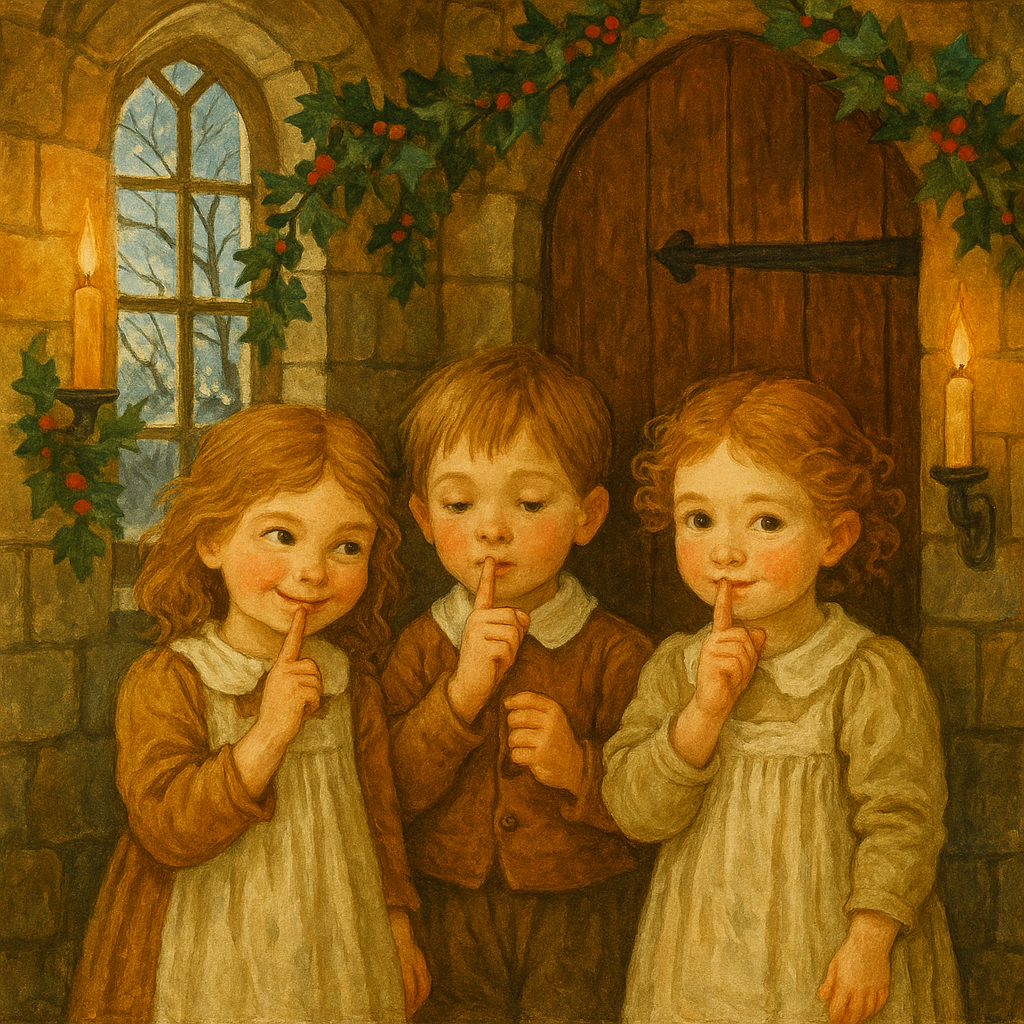
I rose quietly, slipped on my clothes, and threw open the door — and found myself face to face with one of the most beautiful little groups a painter could imagine. A boy and two girls, the eldest not yet six, and all as lovely as seraphs. They had been going from room to room singing at every door, but my sudden appearance struck them dumb with shyness. They stood for a moment with their fingers on their lips, stealing glances from under their eyebrows — until, as if at a signal, they scattered with a shriek of laughter and disappeared around the corner of the gallery.
Everything that morning conspired to produce warm and happy feelings. The window of my room looked out on what would, in summer, have been a beautiful landscape: a sloping lawn, a stream winding at its foot, a stretch of parkland beyond with noble trees and grazing deer, and in the distance a neat hamlet with cottage smoke curling above it and a church spire rising dark and clear against the cold sky. The house was ringed with evergreens in the English fashion, which might almost have suggested summer — but the morning was hard with frost. The mist of the previous evening had settled and crystallised on every branch and blade of grass, and the early sun struck dazzling light from all that glittering foliage. A robin perched on a mountain-ash just below my window, warming itself in the sunshine and piping a few complaining notes; on the terrace below, a peacock was displaying the full magnificence of his tail and strutting with the gravity of a Spanish grandee.
I had scarcely dressed when a servant came to invite me to family prayers. He led me to a small chapel in the old wing of the house, where most of the family had already gathered in a gallery furnished with cushions, hassocks, and large prayer-books; the servants sat on benches below. The old squire read prayers from a desk facing the gallery, while Master Simon served as clerk, making the responses with great gravity and decorum.
The service was followed by a Christmas carol that Mr. Bracebridge himself had assembled from lines of his beloved Herrick, set to an old church melody by Master Simon. There were several good voices in the household and the effect was very pleasing — though I was most moved by the moment when the worthy squire, eyes bright and voice wandering entirely free of time and tune, delivered this stanza:
‘Tis Thou that crown’st my glittering hearth
With guiltless mirth,
And givest me Wassaile bowles to drink
Spiced to the brink;
Lord, ’tis Thy plenty-dropping hand
That soiles my land:
And giv’st me for my bushell sowne,
Twice ten for one.
I later learned that morning prayers were observed every Sunday and saint’s day throughout the year, either by Mr. Bracebridge or some member of the family. This had once been common practice at the great houses of England, and it is much to be regretted that the custom has fallen into neglect — for even the least observant visitor must notice the quiet and harmony that settle over a household when the day begins with something larger than itself.
Breakfast was what the squire called true old English fare. He lamented at some length over the modern habit of tea and toast, which he blamed — not entirely without justice — for the decline of English heartiness and the weakening of English nerves. He allowed these refinements on the table in deference to his guests, but there was a fine display of cold meats, wine, and ale waiting on the sideboard for those with proper appetites.
After breakfast I walked the grounds with Frank Bracebridge and Master Simon — the latter called “Mr. Simon” by everyone except the squire. We were escorted by a loose retinue of gentlemanlike dogs, from a frisking spaniel to a steady old staghound whose breed had been in the family beyond memory; they all answered to a whistle that hung from Master Simon’s buttonhole, and occasionally glanced at the small switch he carried.
The old mansion looked even more venerable in the golden morning sun than it had by moonlight, and I felt the force of the squire’s belief that its formal terraces, stone balustrades, and clipped yew trees carried the air of an older and prouder England. There seemed to be an unusual number of peacocks about, and I made some remark about the flock of them basking against a sunny wall, whereupon Master Simon corrected me with mild pedantry: according to the most authoritative ancient treatises on hunting, one must say a muster of peacocks. “In the same way,” he added, warning to his subject, “we say a flight of doves or swallows, a bevy of quails, a herd of deer or wrens or cranes, a skulk of foxes, or a building of rooks.” He went on to report that according to Sir Anthony Fitzherbert, the peacock possessed “both understanding and glory; for, being praised, he will presently set up his tail, chiefly against the sun, to the intent you may the better behold the beauty thereof. But at the fall of the leaf, when his tail falleth, he will mourn and hide himself in corners till his tail come again as it was.”
I confess I smiled at this little exhibition of learning on so whimsical a subject — but I found that peacocks were indeed birds of consequence at the hall. Frank Bracebridge told me his father was very particular about maintaining the breed: they belonged to chivalry, he always said, and had graced the great banquets of former centuries; and nothing, in his view, conveyed such an air of dignity as a peacock perched upon an antique stone balustrade.
Master Simon now had to hurry off — he had an appointment at the parish church, where the village choir was to perform music of his arranging. There was something very agreeable about his cheerful high spirits, and I confessed to Frank that I had been surprised by his well-placed quotations from authors not usually found in everyday reading. Frank smiled and told me that Master Simon’s entire stock of erudition was drawn from half a dozen old books the squire had pressed upon him — Fitzherbert’s Book of Husbandry, Markham’s Country Contentments, the Tretyse of Hunting by Sir Thomas Cockayne, Izaak Walton’s Angler, and two or three others of that ancient fellowship. Like all men who know only a few books, he regarded these with something like idolatry and quoted them on all occasions. His songs came from old volumes in the squire’s library, set to tunes popular among the wits of the previous century. This practical deployment of literary scraps had earned him the reputation of a prodigy of learning among every groom, huntsman, and sportsman in the neighborhood.
As we talked we heard the distant toll of the church bell. I was told the squire was particularly insistent on having his household at church on Christmas morning, considering it a day appointed for thanksgiving — for, as old Tusser had observed:
At Christmas be merry, and thankful withal,
And feast thy poor neighbors, the great with the small.
“If you care to come to church,” said Frank, “you’ll have a sample of my cousin Simon’s musical work. The church has no organ, so he formed a band from village amateurs and set up a musical club for their improvement. He sorted the choir exactly as he would a pack of hounds — seeking out the deep, solemn mouths for the bass, and the loud-ringing mouths for the tenor, while for the sweet parts he has culled, with curious taste, the prettiest girls in the neighborhood; though these, he insists, are the most difficult to keep in tune, a pretty female singer being exceedingly wayward and very liable to distraction.”
The morning was frosty but clear and bright, and most of the family walked to the church — a very old gray-stone building near a village half a mile from the park gate. Beside it sat a low, snug parsonage that seemed as ancient as the church itself, its front entirely covered with a trained yew tree through whose dense foliage small gaps had been left to admit light to the latticed windows. As we passed, the parson issued forth and walked ahead of us.
I had expected the sort of sleek, comfortable clergyman one often finds near a wealthy patron’s table, but I was wrong. The parson was a small, lean, dark-complexioned man, with a grizzled wig too large for his head, so that it stood out from his ears as though his head had shrunk inside it like a dried nut in its shell. His coat was ancient, with great skirts and pockets large enough to hold both Bible and prayer-book; his small legs looked smaller still for being planted in enormous shoes with vast buckles.
Frank told me the parson had been a university friend of the squire’s and had received this living shortly after the squire came into his estate. He was a dedicated scholar of early printed books — barely able to bring himself to read anything not set in black-letter type. The editions of Caxton and Wynkyn de Worde were his delight; he was tireless in hunting down those old English writers who had been forgotten for their obscurity. In some deference to the squire’s enthusiasms he had made thorough investigations into the festive customs of earlier centuries, though with the dogged, unfeeling spirit of a man who pursues a line of study because it is called learning, regardless of whether it illuminates wisdom or mere ribaldry. He had stared into his old volumes so long that they seemed to have stamped themselves on his face, which — if faces truly reflect minds — might have been described as a title-page in black-letter type.
Arriving at the church porch, we found the parson scolding the white-haired sexton for having placed mistletoe among the Christmas greens that decorated the church. It was, he said, an unholy plant, profaned by its use in Druid ceremonies; though it might be harmlessly used to ornament halls and kitchens, the Fathers of the Church had declared it unfit for sacred purposes. He was so insistent on this point that the poor sexton was obliged to strip away a large portion of his humble decorations before the parson would consent to enter.
The interior of the church was venerable and simple. Along the walls hung several memorial monuments to the Bracebridge family, and beside the altar stood an ancient tomb bearing the effigy of a warrior in armour with his legs crossed — the sign of a Crusader. He was, I was told, an ancestor who had distinguished himself in the Holy Land, and the same man whose portrait hung over the hall fireplace.
During the service Master Simon stood in the family pew and delivered the responses with great audibility — the sort of ceremonious devotion natural to a gentleman of the old school. He turned the pages of an enormous folio prayer-book with something of a flourish, possibly to display the magnificent seal-ring on one of his fingers, which had all the look of a family heirloom. But he was plainly most anxious about the music, his eyes fixed on the choir throughout and his hand beating time with considerable emphasis.
The choir was assembled in a small gallery, presenting a remarkable assortment of heads stacked one above another. I particularly noticed the village tailor — a pale fellow with a retreating forehead and chin who played the clarinet, and seemed to have blown his entire face into a point. Beside him labored a short, round man hunched over a bass-viol, showing nothing but the top of a smooth bald head, like the egg of an ostrich. The female singers had two or three pretty faces, brightened by the cold morning air into a fine rosy colour. The male choristers had evidently been selected, like old Italian fiddles, more for tone than appearance; as several had to share a single book, they clustered into groupings of odd faces not unlike those little flights of cherubs one sees carved on country tombstones.
The main service went tolerably well, the vocal parts running a little behind the instruments throughout, with a loitering fiddler occasionally making up for lost time by racing through a passage at furious speed and clearing more bars than the keenest fox-hunter at the kill. But the real test was an anthem that Master Simon had prepared and arranged entirely himself, on which he had placed his greatest hopes. Unluckily there was a blunder at the very first note; the musicians became rattled; Master Simon worked himself into a fever; everything grew lame and irregular — until they reached a chorus beginning “Now let us sing with one accord,” at which point the whole enterprise fell apart. Everyone shifted for themselves and made for the end as best they could — or rather, as quickly as they could — except for one elderly chorister in a pair of horn spectacles who stood a little apart from the rest and, wrapped in his own private melody, continued quavering on regardless, wriggling his head, squinting at his book, and rounding off the whole affair with a nasal solo of at least three bars’ duration, entirely alone.
The parson preached a most learned sermon on the ceremonies of Christmas and the importance of observing it as a day not only of thanksgiving but of outright rejoicing, marshalling in support of his views the earliest practices of the Church and the authorities of Theophilus of Caesarea, St. Cyprian, St. Chrysostom, St. Augustine, and a considerable cloud of other saints and fathers, from all of whom he quoted at length. I was at first puzzled by the necessity of such a formidable array of forces to defend a point that no one present seemed inclined to dispute — until I realised that the good man had a whole legion of imaginary enemies to contend with. His researches into Christmas had led him deep into the sectarian battles of the English Revolution, when the Puritans launched their fierce assault on the Church’s observances and poor old Christmas was driven out of the land by Act of Parliament. The worthy parson lived among the past and knew almost nothing of the present. Shut up with his worm-eaten volumes in his antiquated study, the news of that distant age was as fresh to him as yesterday’s paper, while the Civil War was merely recent history. He had quite forgotten that nearly two centuries had passed since the persecution of mince-pie throughout the land — when plum porridge was condemned as “mere popery” and roast beef denounced as anti-Christian — and that Christmas had been brought back in triumph with the merry court of King Charles at the Restoration. He warmed to his invisible opponents, had it out in fine style with old Prynne and a handful of other long-forgotten Roundhead champions, and concluded by urging his congregation, with great solemnity and feeling, to stand by the traditions of their fathers and feast and make merry on this joyful day.
I have seldom seen a sermon produce such immediate results. On leaving the church the whole congregation seemed animated by precisely the spirit of gaiety their parson had so earnestly prescribed. The older folk gathered in the churchyard shaking hands; the children ran about calling out “Ule! Ule!” and chanting odd little rhymes that the parson told me had been handed down from ancient times. The villagers doffed their hats to the squire as he passed and offered him the good wishes of the season with every sign of genuine warmth; he invited them all up to the hall for something to keep out the cold; and I heard blessings from several of the poor that left no doubt that the worthy old squire, in the midst of his own enjoyment, had not forgotten the truest Christmas virtue of all.
On the walk home his heart seemed to overflow. As we crossed a rise in the ground from which the countryside spread out around us, the sounds of distant merrymaking drifted on the air, and he paused and looked about him with an expression of great happiness. The day itself was enough to inspire goodwill toward all creation. Though the morning had been sharp with frost, the sun climbing through a cloudless sky had warmed enough to melt the thin snow from every south-facing slope and reveal the living green that adorns an English landscape even in the depths of winter. Great stretches of smiling turf contrasted with the bright white of the shadowed hollows; every sheltered bank where the sunlight fell gave up a thin silver trickle of cold water glittering through the dripping grass, and sent up wisps of mist to join the faint haze hanging just above the earth. There was something truly heartening in this triumph of warmth over winter — it was, as the squire said, an emblem of Christmas hospitality breaking through the cold crust of selfishness and ceremony, and thawing every heart into a flow. He pointed out with pleasure the signs of good cheer rising from the chimneys of every farmhouse and cottage.
“I love to see this day well kept by rich and poor alike,” he said. “It is a great thing to have one day in the year when you are sure of being welcome wherever you go, and the world seems thrown open to you. I am almost inclined to join with Poor Robin in his curse on every churl who would spoil it:
Those who at Christmas do repine,
And would fain hence dispatch him,
May they with old Duke Humphry dine,
Or else may Squire Ketch catch’em.“
He went on to lament the decline of the games and amusements that had once filled the Christmas season — when the great halls of manor houses were thrown open at daybreak, the tables laid with brawn and beef and ale, the harp and the carol sounding all day long, and rich and poor alike welcome to enter and make merry. “Our old games and local customs,” he said, “made the country people fond of their homes, and the gentry’s support of them made the people fond of their lords. They made times merrier and kinder and better. I can truly say with one of our old poets:
I like them well: the curious preciseness
And all-pretended gravity of those
That seek to banish hence these harmless sports,
Have thrust away much ancient honesty.“
He went on to observe that the country had changed — that the old bond between the classes had loosened, that the working people had grown suspicious of those above them and were beginning to read newspapers, listen to political arguments in the ale-house, and talk of reform. His remedy, he thought, was for the gentry to spend more time on their estates, mix more freely among the country people, and revive the old English sports and games. He had in fact tried this himself a few years before, keeping open house throughout the Christmas season in the old fashion. The experiment had not gone well: the country people had not known how to behave in such an unusual situation, all manner of awkwardness had resulted, the estate had been overrun by every vagrant in the county, and more beggars had arrived in a single week than the parish authorities could deal with in a year. Since then he had limited himself to inviting the more settled country families to call at the hall on Christmas Day, and distributing beef, bread, and ale among the poor so that they might make merry in their own homes.
We had not been long back when the sound of music came up the avenue. A band of country lads appeared — their coats off, their shirtsleeves tied with ribbons, their hats decorated with greenery, each carrying a short club — followed by a great crowd of villagers. They halted before the hall door, the music struck up, and the lads performed a curious and intricate dance: advancing, retreating, striking their clubs together, keeping perfect time throughout; while one among them, fantastically crowned with a fox skin whose tail hung down his back, capered around the outside of the dance rattling a Christmas box and pulling all manner of comic faces.
The squire watched this with great delight and told me its full history, tracing it back to the Roman occupation and identifying it as a lineal descendant of the ancient sword dance. It was nearly extinct now, he said, but he had come across traces of it in the neighbourhood and encouraged its revival — though, he admitted, it was rather too apt to end in rough cudgel-play and broken heads as the evening wore on.
When the dance was finished the whole company was entertained with brawn and beef and good home-brewed ale. The squire himself moved among his guests, received with somewhat awkward shows of deference and goodwill. I noticed two or three of the younger men, as they lifted their tankards, making faces at each other the moment the squire’s back was turned — but they pulled perfectly straight faces the instant they caught my eye and looked extremely proper for the rest of the visit. With Master Simon, however, everyone seemed entirely at ease. He was a familiar figure at every farmhouse and cottage in the neighbourhood, at home with the farmers and their wives; and like that model of a roving bachelor, the bumblebee, he had gathered sweetness from every rosy corner of the countryside.
The guests’ shyness melted quickly before good food and easy friendliness. There is something genuine and touching in the merriment of ordinary people when it is drawn out by the warmth of those above them; gratitude enters into their laughter, and a kind word or an honest joke from a patron gladdens a working man’s heart more than any quantity of food and drink alone. When the squire stepped away the laughter grew louder, and there was a great deal of cheerful banter — particularly between Master Simon and a broad, red-faced, white-haired farmer who was clearly the local wit, all his companions holding their mouths open for his replies and bursting into appreciative laughter well before they could quite make out the joke.
The whole house was given over to festivity. As I passed through on my way to dress for dinner I heard music from a small courtyard below, and looking out I saw a band of wandering musicians with pipes and tambourine. A pretty, lively housemaid was dancing a jig with a young country lad while the other servants looked on, clapping. In the middle of it all the girl caught sight of my face at the window, turned scarlet, and ran off with an air of roguish and entirely unconvincing embarrassment.