The charity of the rich is much to be admired. But how beautiful is the charity of the poor.
Picture the coldest day you have ever known. The bitter wind, the driving snow. Sharp white particles stinging your face. Inside, the carpets lifting like waves along the floor, the wind howling in the chimneys, windows cracking, doors rattling, and now and then a heavy lump of snow thundering down from the roof.
Now hear my story.
On one of the broad, open plains of Lincolnshire there is a long, reedy sheet of water — a favourite haunt of wild ducks. At its northern end stand two mud cottages, old and out of repair.
One bitter night, when the snow lay three feet deep and a cutting east wind drove it in swirling clouds past the frozen reeds, swinging the bare willow branches until they swept the ice, an old woman sat spinning in one of these cottages before a cheerful fire. Her kettle sang on the coals. A homemade rushlight burned on her table. But the full moon shone in through the window and was the brighter light of the two.
The two cottages stood far from any road or other habitation, so the old woman was startled by a sudden, impatient knock at the door. It was nothing like the knock of her neighbours next door. The door was bolted. She rose, shuffled to the window, and looked out. A shivering figure — apparently a youth — stood in the snow.
“Trampers,” she said flatly. “Tramping folk aren’t wanted here.” And she went back to the fire without troubling to answer.
The youth tried the door and called out, begging to be let in. She heard him knock the snow from his boots against her doorstep, then knock again, louder, as if he were certain she must be deaf.
Surprised at his persistence, the old woman went to the casement, opened it, and demanded his business.
“Good woman,” the stranger began, “I only want a seat at your fire.”
“Nay,” she said. “Thou’ll get no shelter here. I’ve nothing for beggars — dirty, wet creature.” She slammed the window shut.
The stranger turned from her door and waded through the deep snow toward the other cottage. The bitter wind helped drive him along. It looked no less poor than the first. He tried the door — bolted fast — and his heart sank. His hand was so numb he could barely make a sound. He tried again.
A rushlight burned inside. A woman sat before the fire with an infant in her arms. She had dozed off, but his third knock woke her. She wrapped her apron round the child and opened the door a crack.
“What do you want?”
“Good woman,” said the youth, “I’ve had the misfortune to fall in the water tonight, and I am so numb I can scarcely walk.”
She gave him a sudden, searching look and sighed.
“Come in. You’re so near the size of my Jem — I thought at first it was him, come home from sea.”
He stepped across the threshold, trembling. His clothes were encased in frozen mud; water dripped from them with every step across her sanded floor.
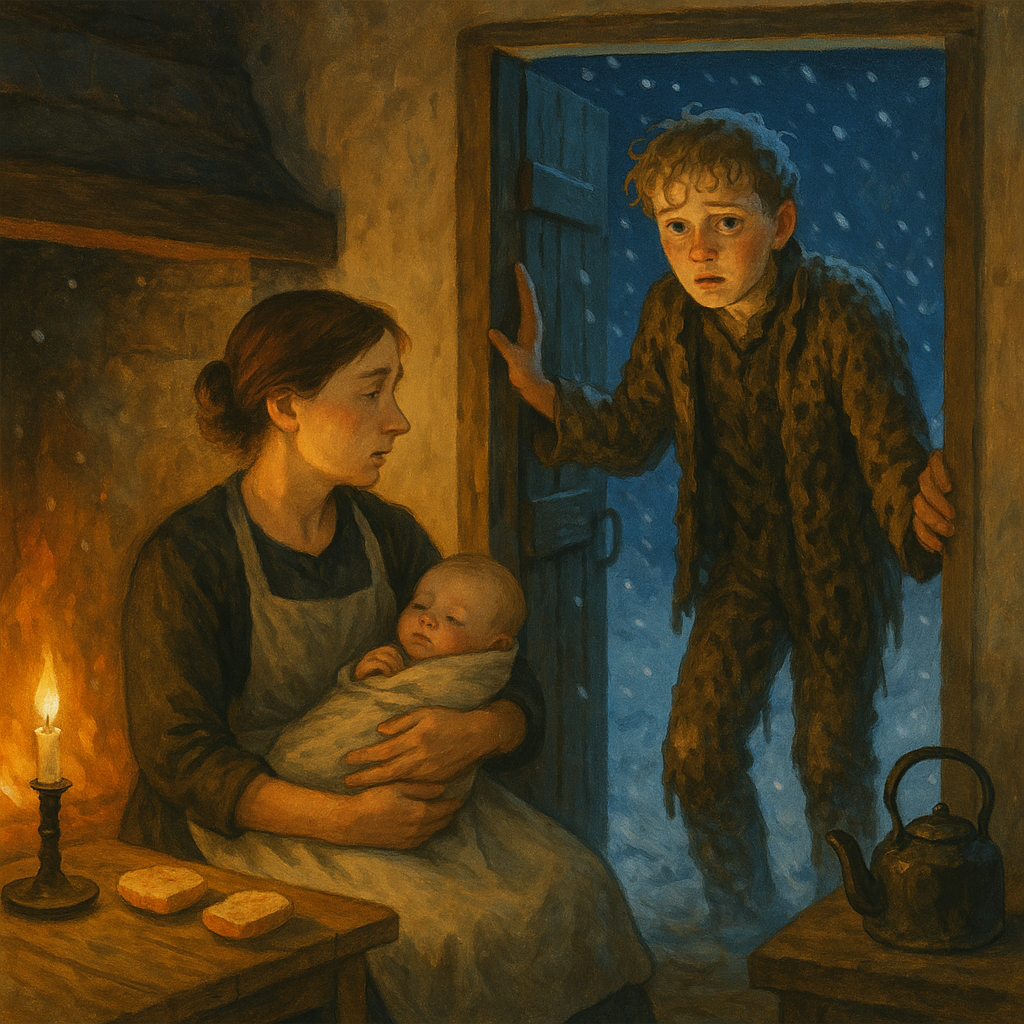
“You’re in a sorry state,” she said. “The nearest house is two miles off. Come kneel by the fire. Your teeth chatter so, I can scarcely bear to hear them.”
She looked more closely and saw he was barely sixteen. Her motherly heart went out to him at once.
“Are you hungry?” she asked. “What were you doing out there?”
“Shooting wild ducks,” said the boy.
“One of the gamekeeper’s lads, then?” She glanced toward the table, and he followed her eyes. Two portions of bread sat there, each with a small piece of bacon.
“My master is very late tonight,” she said — by “master” she meant her husband. “But you’re welcome to my share. It might put a little warmth in you.” And she set her own supper before him.
“Thank you,” the boy said. “But I’m so wet I’m making a pool on your floor.”
“Aye, you are that.” She went to an old box and rummaged through it, and came back to the fire carrying a clean shirt and a tolerably good suit of clothes.
“These are my master’s Sunday best,” she said with quiet pride. “If you’ll take care of them, you may wear them until yours are dry.”
She put the baby to bed, climbing a ladder to the room above, and left the boy to change by the fire.
When she came back down, he had dressed himself in the labourer’s clothes and was eating with hungry relish, his colour returning. His muddy things lay heaped on the floor.
“Lad,” she said, looking at him, “you came close to going under that ice. Your poor mother would have been frightened half to death.”
“Yes,” said the boy quietly.
In her imagination, the cottage woman saw his mother — a careworn, hardworking woman much like herself. The boy, in his own imagination, saw a beautiful, courtly lady. And yet both saw exactly the same thing: the same love, the same anxiety, the same terror at the sight of a boy struggling alone through breaking ice in the moonlight, catching at frozen reeds, then creeping, half-frozen and benumbed, to a cottage door.
But even as she stood there, she noticed something. The waistcoat she had stooped to pick up from the floor was finer than anything that had ever passed through her hands. A gold pencil-case fell from its pocket. And from beneath the heap of frozen mud, a shirt sleeve showed — white and fine as anything a squire might wear.
She glanced from the clothes to the boy. He had pushed back his cap. His fair curly hair and broad forehead told her plainly enough: this was no gamekeeper’s lad.
But before she could quite hesitate, he had placed a chair for her.
“What a lonely spot this is!” he said cheerfully. “If you hadn’t let me in, the cold would have finished me before I reached home. I won’t go duck-shooting alone again, I can tell you that.”
“Very cold sport, that,” she agreed.
He asked if he might stir the fire. She told him he was welcome. He said he was staying at Deen Hall, a house some five miles off. That morning he had broken a hole in the ice near the duck decoy, but it had frozen over so fast that in the dusk he had missed it and fallen through. He’d taken every precaution and made landmarks, but the sport had excited him, and in the moonlight he had walked clean past them.
Then he told her about his reception at the other cottage.
“Sir,” she said carefully, “if you had said you were a gentleman—”
The boy laughed. “I don’t think I knew it myself, my good woman. My senses were so far gone. I was nearly an hour crawling up to your door from the water’s edge. I remember it all rather dimly — but as soon as I’d felt the fire and had something to eat, I was a different creature.”
By and by the husband came in, and over his supper it was agreed he would walk to Deen Hall to let them know the young gentleman was safe. When he left, his wife heaped the last of the household’s coal on the fire and crept upstairs to bed, leaving her guest to rest before the warmth.
At grey dawn the labourer returned with a servant leading a horse and carrying a fresh suit of clothes.
The young man took his leave with many thanks, pressing three half-crowns into the woman’s hand — probably all the money he had on him. And I must mention that he kissed the baby; for whenever the mother tells this story, she never fails to note it with great pride, adding that her child, being “clean as wax, was quite fit to be kissed by anybody.”
“Misses,” said her husband, as they stood in the doorway watching him go, “who do you think that was?”
She didn’t know.
“That was young Lord W——. So you may be a proud woman — you sat and talked with lords, and asked them to supper!”
He shouldered his spade and went his way, leaving her standing with the three half-crowns clinking in her hand.
Her neighbour from the other cottage came in presently, and when she heard the tale and saw the money, her heart nearly broke with envy.
“To think that good luck should have come to her door, and she should have been such a fool as to turn it away! Seven shillings and sixpence for a bite of food and a night’s shelter — that’s nearly a week’s wages!”
And so, as both supposed, the matter ended.
The next week the frost was sharper than ever. Sheep froze in the fen fields and poultry on their perches. But the good woman had walked to the nearest town and bought a blanket — a welcome thing, and more comfort in their bed than they had known in many a long year.
Then one noon she looked out her window and saw three young gentlemen skating along the ice toward the cottage. They sprang to the bank, took off their skates, and knocked at her door. The young nobleman — for he was one of the three — explained that a severe cold had kept him away. “He spoke as free and pleasantly,” she always said in the telling, “as if I had been a lady, and no less.” He brought a parcel from his pocket: a keepsake, he said, from a visit to the town of B——. They chatted warmly for ten minutes or so, then went on their way across the ice.
She waited until her husband came home, and they opened the parcel together. Inside was a fine Bible, bound in gilded red morocco, with both their names written on the flyleaf — and tucked into the pages, a ten-pound note.
“When I thought he was a poor forlorn creature,” she always said, “he was kindly welcome. My master laid out part of the money on tools, and we rented a garden. He goes over to market on market days, and now, thank God, we want for nothing.”
That is how she generally ends the story. And she never fails to add that the young lord kissed her baby.
But I have not yet told you what I thought the finest part of it all. When this woman was asked what had made her take in a stranger off the frozen fen — and trust him with the best clothing her household possessed — she answered simply:
“Well, I saw him shivering and shaking, so I thought — thou shalt come in here, for the sake of Him that had not where to lay His head.“
The old woman in the other cottage may open her door every night of her future life to some poor wanderer. But it is all but certain she will never open it to a nobleman in disguise.
Let us do good not to receive good in return, but as evidence of gratitude for what has already been given. All for love, and nothing for reward.